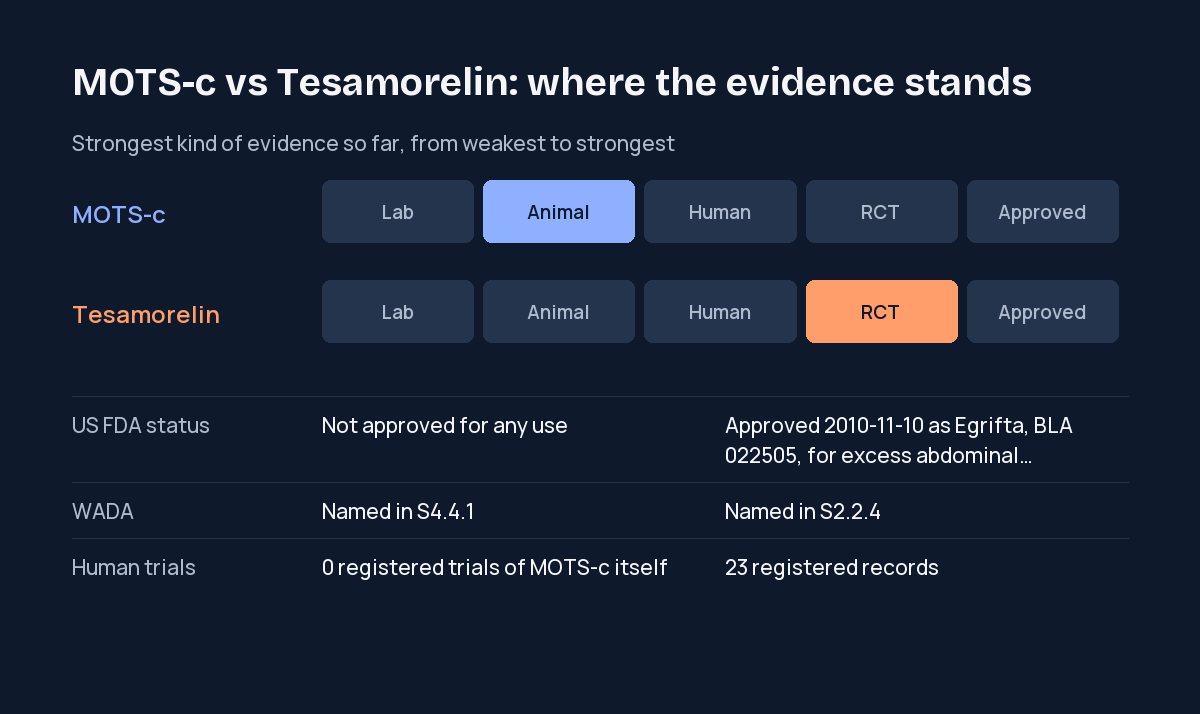
MOTS-c is an unapproved mitochondrial peptide that prevented diet-induced obesity in mice [Animal] (Lee 2015). Tesamorelin is an FDA-approved drug (Egrifta) that cut visceral (organ-surrounding) fat 15.2% in a phase 3 trial [Human RCT (n=412)] (Falutz 2007). No trial of MOTS-c itself is registered on ClinicalTrials.gov (searched 2026-11-25).
The gap is wide. In its 2026 review for an advisory committee, FDA found no clinical study and no human exposure data for MOTS-c by any route, and called its safety risks in people unknown (FDA briefing document). Tesamorelin’s approval is narrow: excess abdominal fat in adults with HIV and lipodystrophy, and its label says it is not a weight-loss drug (Egrifta WR label).
| Item | MOTS-c | Tesamorelin |
|---|---|---|
| US FDA status | Not approved for any use (USADA); not part of any FDA-approved drug (FDA) | Approved 2010-11-10 as Egrifta, BLA 022505, for excess abdominal fat in adults with HIV and lipodystrophy (Drugs@FDA) |
| Compounding (503A/503B) | Withdrawn from Category 2 by its nominator (FDA). FDA staff advised against 503A listing (FDA briefing); the advisory committee voted 7–5 (2 abstentions) for listing on 2026-07-23 (trade-press count; advisory, no FDA rule yet) (FDA meeting). Named in Appendix A of HHS’s interim enforcement-discretion policy, noticed 2026-10-30 (Federal Register; HHS policy). Next step: an FDA proposed rule; none published as of 2026-11-25 | Not eligible: its NDA was deemed a biologics license on 2020-03-23, and such biologics are outside the 503A/503B exemptions (FDA) |
| WADA | Named in S4.4.1 (AMPK activators), prohibited at all times, on the 2026 List (WADA 2026); unchanged on the 2027 List, in force 2027-01-01 (WADA 2027) | Named in S2.2.4 (GHRH analogues), prohibited at all times, on the 2026 List; unchanged on the 2027 List |
| Strongest evidence | Animal (mice); no human study giving MOTS-c | Human RCTs (phase 3, n=412 and n=404); approved label |
| Human trials | 0 registered trials of MOTS-c itself (ClinicalTrials.gov, searched 2026-11-25); 1 completed trial of the analog CB4211, no results posted (NCT03998514) | 23 registered records (ClinicalTrials.gov, searched 2026-11-25), e.g. NCT00123253, NCT02196831 |
| Last checked | 2026-11-25 | 2026-11-25 |
Key points:
- Tesamorelin’s visceral-fat effect held at about 18% over 52 weeks of treatment, and the fat came back after it stopped.
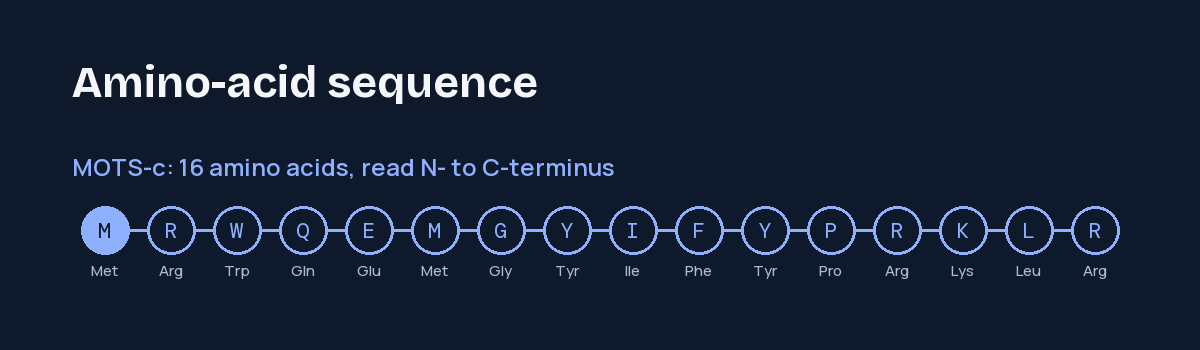
- MOTS-c is a 16-amino-acid peptide coded in mitochondrial DNA; the body makes it, and exercise raised its levels in human muscle and blood in one study.
- FDA found no in-vivo pharmacokinetic studies and no toxicity studies of MOTS-c, and its breakdown in human blood in the lab was rapid.
- Both are banned in sport at all times, under different WADA classes: S2 for tesamorelin, S4 for MOTS-c.
- No study of the two together, or of a blend containing both, was found on PubMed or ClinicalTrials.gov (searched 2026-11-25).
MOTS-c vs tesamorelin at a glance
| Feature | MOTS-c | Tesamorelin |
|---|---|---|
| What it is | 16-amino-acid peptide coded in mitochondrial DNA | Synthetic analog of growth hormone-releasing hormone |
| Class | Mitochondrial-derived peptide | GHRH analog (growth hormone-releasing factor) |
| Proposed action | Folate cycle block leading to AMPK activation, mainly in muscle (mice) | Raises the body’s own growth hormone and IGF-1 |
| Main research focus | Insulin resistance, obesity, ageing (animals) | Visceral fat, liver fat in HIV |
| Human evidence | None giving MOTS-c (FDA) | Phase 3 RCTs (2007, 2010) |
| Approval | None | FDA, HIV-associated abdominal fat |
| WADA | S4.4.1, prohibited at all times | S2.2.4, prohibited at all times |
| Routes studied | Intraperitoneal injection (mice) | Under the skin (human trials) |
| Timelines in studies | 8 weeks in diet-induced obesity (mice) | 12 weeks to 12 months (humans) |
| Main safety concerns | Unknown in humans; immunogenicity, impurities | Glucose intolerance, fluid retention, joint pain, raised IGF-1 |
What is MOTS-c?
MOTS-c (mitochondrial open reading frame of the 12S rRNA-c) is a 16-amino-acid peptide whose code sits in the DNA of mitochondria, the cell’s energy units. It was first described in 2015. In mice, treatment prevented age-related and high-fat-diet insulin resistance and diet-induced obesity, with skeletal muscle as the main target [Animal] (Lee 2015). Later mouse work found better physical performance at young, middle and old age [Animal] (Reynolds 2021). No MOTS-c product is approved, and FDA found no human use of it in published studies. For other mitochondrial peptides, see MOTS-c vs SS-31 vs NAD+.
What is tesamorelin?
Tesamorelin is a synthetic version of growth hormone-releasing hormone (GHRH), the brain signal that tells the pituitary gland to release growth hormone. Sold as Egrifta, it is approved to reduce excess abdominal fat in adults with HIV and lipodystrophy (Egrifta WR label). Two formulations exist, Egrifta WR and Egrifta SV, and the label says they are not substitutable. It is given under the skin. The label also states its limits: long-term cardiovascular safety is not established, and it is “weight neutral”. Our tesamorelin vs GLP-1 comparison covers how it differs from weight-loss drugs.
How they work differently
- MOTS-c: in mouse and cell work, it blocks the folate cycle and the purine production tied to it, which switches on AMPK, an energy-sensing enzyme [Animal] (Lee 2015). FDA notes that its molecular target “remains unknown” (FDA briefing document).
Tesamorelin: it acts on the pituitary to raise growth hormone, which raises IGF-1. In the first phase 3 trial, IGF-1 rose 81.0% versus a 5.0% fall on placebo [Human RCT (n=412)] (Falutz 2007). - MOTS-c: the body makes it. In a mouse and human study, exercise raised MOTS-c in human muscle and blood [Human (exercise study)] (Reynolds 2021). In a Swedish trial of 30 adults, blood MOTS-c only trended up after endurance exercise and was not linked to fitness [Human RCT of exercise (n=30)] (von Walden 2021).
Tesamorelin: its fat effect is selective. In the second phase 3 trial, visceral fat fell with no change in limb or abdominal subcutaneous fat [Human RCT (n=404)] (Falutz 2010). - MOTS-c: FDA reports that whether MOTS-c given from outside the body reaches active levels in people remains to be determined; human blood broke it into shorter fragments quickly in a lab test, and FDA found no pharmacokinetic study in animals or people.
Tesamorelin: its pharmacokinetics and drug interactions are described on the approved label (Egrifta WR label).
Evidence head-to-head
Each cell gives the best study found for that outcome and its evidence level. The two columns come from different studies in different species, so any comparison across them is cross-trial and indirect.
| Outcome | MOTS-c best evidence | Tesamorelin best evidence |
|---|---|---|
| Visceral (belly) fat | No human data. Mice on a high-fat diet weighed about 20% less after 8 weeks (body weight; no visceral-fat measure reported) [Animal] (FDA summary of Lee 2015) | −15.2% vs +5.0% on placebo at 26 weeks [Human RCT (n=412)] (Falutz 2007) |
| Visceral fat without HIV | No human data | Treatment effect −35 cm² vs placebo at 12 months in obese adults [Human RCT (n=60)] (Makimura 2012) |
| Liver fat | Less liver fat build-up in mice [Animal] (FDA); analog trial in fatty liver posted no results (NCT03998514) | 37% relative fall in liver fat at 12 months [Human RCT (n=61)] (Stanley 2019) |
| Insulin sensitivity / glucose | Prevented diet-induced insulin resistance [Animal] (Lee 2015) | No change in insulin response or glucose control at 12 weeks in type 2 diabetes [Human RCT (n=53)] (Clemmons 2017) |
| Muscle and physical capacity | Better physical performance in young, middle-aged and old mice [Animal] (Reynolds 2021) | Larger lean trunk-muscle area in treatment responders at 26 weeks [Human RCT, secondary analysis (n=341)] (Adrian 2019) |
| Cognition | No human data | Better executive function at 20 weeks [Human RCT (n=152)] (Baker 2012); no between-group benefit in HIV [Human RCT, open-label (n=73)] (Ellis 2025) |
| Human safety data | None; FAERS search found no reports (FDA) | 740 people treated in trials [Approved label] (label) |
Which fits which goal?
Visceral fat: tesamorelin has more evidence. Two phase 3 trials in people with HIV (Falutz 2007; Falutz 2010) and a 60-person trial in obese adults without HIV found visceral-fat reductions against placebo (Makimura 2012). The benefit is specific to fat around the organs: in that trial, fat under the skin did not change. MOTS-c’s fat findings come from mice only.
Fat loss and body weight: neither has human evidence for weight loss. Tesamorelin’s label calls it weight neutral and not indicated for weight loss (label). MOTS-c’s lower body weight was seen in mice on a high-fat diet [Animal]. For approved weight-loss drugs, see our weight-loss peptides ranked by evidence.
Insulin resistance and metabolic ageing: MOTS-c has the more targeted research, but it is animal research. Its discovery paper reported protection from insulin resistance in mice (Lee 2015). Over 12 weeks in people with type 2 diabetes, tesamorelin neither improved nor worsened glucose control (Clemmons 2017).
Liver fat: tesamorelin has a randomized trial in people with HIV and fatty liver (Stanley 2019); MOTS-c has mouse data and an analog trial with no posted results.
These are statements about the evidence, not a recommendation to use either. A clinician is the person to decide whether any treatment fits a given person.
Can they be combined?
People search for MOTS-c and tesamorelin together as a “stack”, sometimes in blends with AOD-9604 or ipamorelin. No controlled human study of the combination was found on PubMed or ClinicalTrials.gov (searched 2026-11-25). The only PubMed record naming both is a 2026 review of peptides marketed direct to patients, which says rigorous human safety data for the unapproved ones “are scarce” (Mendias 2026). The FDA label lists drug interactions for tesamorelin, including with cytochrome P450-metabolized drugs and glucocorticoids; it does not mention MOTS-c (label). The blend partners have their own pages: AOD-9604 vs tesamorelin and hexarelin vs ipamorelin vs tesamorelin.
Safety and regulatory status
Tesamorelin side effects (approved label): the most common, in more than 5% of patients, were joint pain, injection-site redness and itching, pain in the limbs, peripheral swelling (edema) and muscle pain (Egrifta WR label). HbA1c reached the diabetes range in 5% on the drug versus 1% on placebo by week 26. The label warns of glucose intolerance, fluid retention, carpal tunnel syndrome, hypersensitivity reactions and a possible neoplasm risk, and says the effects of long-term raised IGF-1 are unknown. It is contraindicated in pregnancy, active cancer and disorders of the hypothalamic-pituitary axis. Anti-tesamorelin antibodies appeared in 50% of patients at 26 weeks. In the first phase 3 trial, more people on tesamorelin than on placebo withdrew because of an adverse event (Falutz 2007).
MOTS-c safety: unknown in people. FDA found no acute, repeat-dose, genetic, reproductive or cancer toxicity studies, and warned of immunogenicity risk from aggregates and peptide impurities in compounded products (FDA briefing document). FDA’s staff concluded that the criteria weigh against adding MOTS-c to the 503A bulks list. USADA reports that people who buy MOTS-c online describe a fast or pounding heartbeat, injection-site irritation, insomnia, immune reactions and fever, and that there are no data on long-term use (USADA).
United States, compounding: tesamorelin cannot be compounded, because its approval converted to a biologics license in 2020 (FDA). MOTS-c is not on FDA’s 503A bulks list as of 2026-11-25 (FDA 503A page). HHS’s interim policy says it does not intend to act against licensed pharmacies or physicians compounding the peptides in its Appendix A, and the notice states that compounded drugs are not FDA-approved and not reviewed for safety, effectiveness or quality (Federal Register).
Sport: both are prohibited at all times. WADA names tesamorelin in S2.2.4 and MOTS-c in S4.4.1 on the 2026 List, and the 2027 List keeps both entries (WADA 2027). The 2027 List’s S0 class now names “peptides”, but S0 covers only substances with no approval by any health authority and that no later section of the List addresses, so neither of these two is classed there. USADA says a therapeutic use exemption for MOTS-c is highly unlikely. For more on athletes, see peptides vs steroids vs SARMs.
Anyone who suspects a side effect from MOTS-c, tesamorelin or any other drug or product can report it to the FDA through MedWatch.
How long do effects take in studies?
Tesamorelin: trials measured visceral fat at 26 weeks, the primary end point of both phase 3 trials (Falutz 2010). In people who kept taking it, the reduction was about 18% at 52 weeks; in those switched to placebo, visceral fat reaccumulated (Falutz 2008). Liver fat was measured at 12 months (Stanley 2019). Our tesamorelin results timeline lists each trial’s time points.
MOTS-c: no human timeline exists. In mice on a high-fat diet, the body-weight difference was measured after 8 weeks of treatment [Animal] (FDA).
What users report
What follows are unverified self-reports from people who usually bought unregulated products, not evidence. People who post about MOTS-c on forums, Reddit and YouTube commonly describe more energy during workouts and better endurance, and some say their weight or waist changed over several weeks; many others say they noticed nothing. A recurring complaint is a racing heart, poor sleep or a sore, red injection site, and some describe flu-like feelings. People who post about tesamorelin often say it is the peptide they would trust most because it is an approved drug, and they discuss a flatter stomach over a few months. Their complaints are joint aches, water retention, tingling hands, raised blood sugar and the cost of the prescription product. A long-running argument is whether combining the two adds anything, or whether any change comes from diet and training. Another is whether products sold online contain what the label says; no one posting can check that.
Frequently asked questions
Is MOTS-c or tesamorelin better for fat loss?
Tesamorelin has human evidence for visceral fat, and MOTS-c has only animal evidence. In a 412-person phase 3 trial, tesamorelin cut visceral fat by 15.2% versus a 5.0% rise on placebo over 26 weeks [Human RCT (n=412)] (Falutz 2007). Its label still calls it weight neutral and not a weight-loss drug.
Can MOTS-c and tesamorelin be taken together?
No study of the two together was found on PubMed or ClinicalTrials.gov (searched 2026-11-25), so the combination’s effects and safety are unknown. FDA’s 2026 review found no clinical study or human exposure data for MOTS-c by any route (FDA briefing document). The question of combining belongs with a clinician, who can weigh tesamorelin’s known risks.
Are there any peptides that can help with visceral fat?
Tesamorelin is the peptide with approved-label evidence for visceral fat, but only for adults with HIV and lipodystrophy. In obese adults without HIV, a 12-month trial found a 35 cm² visceral-fat reduction versus placebo [Human RCT (n=60)] (Makimura 2012). MOTS-c has no human trial of visceral fat.
How does tesamorelin work?
Tesamorelin copies the hormone that tells the pituitary gland to release growth hormone, which then raises IGF-1. In its first phase 3 trial, IGF-1 rose 81.0% on tesamorelin and fell 5.0% on placebo [Human RCT (n=412)] (Falutz 2007). Its approval covers only HIV-associated abdominal fat.
What is the difference between ipamorelin and tesamorelin?
Tesamorelin is an FDA-approved GHRH analog; ipamorelin belongs to a different class, the growth hormone secretagogues. WADA lists them in separate groups of S2.2.4: GHRH analogues for tesamorelin and secretagogues for ipamorelin (WADA 2027 List). Both are prohibited at all times in sport.
Is MOTS-c legal in the US?
MOTS-c is not approved by the FDA for any use, so no approved MOTS-c medicine exists. USADA states that MOTS-c is not approved for use in humans or in compounded medications (USADA). An HHS interim policy from October 2026 addresses compounding of certain peptides while FDA develops a rule.
References
- Falutz J, Allas S, Blot K, et al. Metabolic effects of a growth hormone-releasing factor in patients with HIV. N Engl J Med. 2007. PubMed 18057338
- Falutz J, Potvin D, Mamputu JC, et al. Effects of tesamorelin in HIV-infected patients with abdominal fat accumulation: a randomized placebo-controlled trial with a safety extension. J Acquir Immune Defic Syndr. 2010. PubMed 20101189
- Falutz J, et al. Long-term safety and effects of tesamorelin in HIV patients with abdominal fat accumulation. AIDS. 2008. PubMed 18690162
- Stanley TL, Fourman LT, Feldpausch MN, et al. Effects of tesamorelin on non-alcoholic fatty liver disease in HIV: a randomised, double-blind, multicentre trial. Lancet HIV. 2019. PubMed 31611038
- Makimura H, Feldpausch MN, Rope AM, et al. Metabolic effects of a growth hormone-releasing factor in obese subjects with reduced growth hormone secretion. J Clin Endocrinol Metab. 2012. PubMed 23015655
- Clemmons DR, et al. Safety and metabolic effects of tesamorelin in patients with type 2 diabetes: a randomized, placebo-controlled trial. PLoS One. 2017. PubMed 28617838
- Baker LD, et al. Effects of growth hormone-releasing hormone on cognitive function in adults with mild cognitive impairment and healthy older adults. Arch Neurol. 2012. PubMed 22869065
- Ellis RJ, et al. Effects of tesamorelin on neurocognitive impairment in persons with HIV and abdominal obesity. J Infect Dis. 2025. PubMed 39813152
- Adrian S, et al. The growth hormone releasing hormone analogue, tesamorelin, decreases muscle fat and increases muscle area in adults with HIV. J Frailty Aging. 2019. PubMed 31237318
- Lee C, Zeng J, Drew BG, et al. The mitochondrial-derived peptide MOTS-c promotes metabolic homeostasis and reduces obesity and insulin resistance. Cell Metab. 2015. PubMed 25738459
- Reynolds JC, Lai RW, Woodhead JST, et al. MOTS-c is an exercise-induced mitochondrial-encoded regulator of age-dependent physical decline and muscle homeostasis. Nat Commun. 2021. PubMed 33473109
- von Walden F, et al. Acute endurance exercise stimulates circulating levels of mitochondrial-derived peptides in humans. J Appl Physiol. 2021. PubMed 34351816
- Mendias CL, Awan TM. Safety and efficacy of approved and unapproved peptide therapies for musculoskeletal injuries and athletic performance. Sports Med. 2026. PubMed 41966639
- US Food and Drug Administration. FDA Briefing Document: MOTS-c-related bulk drug substances. Pharmacy Compounding Advisory Committee, July 23–24, 2026. fda.gov
- US Food and Drug Administration. EGRIFTA WR (tesamorelin) prescribing information, revised 3/2025. accessdata.fda.gov
- US Food and Drug Administration. Drugs@FDA: BLA 022505 (Egrifta). accessdata.fda.gov
- US Food and Drug Administration. Notice to compounders: changes that affect compounding on March 23, 2020. fda.gov
- US Food and Drug Administration. Certain bulk drug substances for use in compounding that may present significant safety risks. fda.gov
- US Food and Drug Administration. July 23–24, 2026: Meeting of the Pharmacy Compounding Advisory Committee. fda.gov
- US Food and Drug Administration. Bulk drug substances used in compounding under section 503A of the FD&C Act. fda.gov
- US Department of Health and Human Services. Enforcement Discretion Policy Regarding 503A Compounding Using Certain Peptide Bulk Drug Substances; notice of availability. Federal Register, 2026-10-30. govinfo.gov
- US Department of Health and Human Services. Enforcement Discretion Policy Regarding 503A Compounding Using Certain Peptide Bulk Drug Substances. hhs.gov
- USADA. What is the MOTS-c peptide? usada.org
- World Anti-Doping Agency. 2026 Prohibited List. wada-ama.org
- World Anti-Doping Agency. 2027 Prohibited List. wada-ama.org
- ClinicalTrials.gov. Intervention search: MOTS-c. clinicaltrials.gov
- ClinicalTrials.gov. Intervention search: tesamorelin. clinicaltrials.gov
- ClinicalTrials.gov. NCT03998514: A phase 1a/1b study of CB4211 in healthy non-obese subjects and subjects with nonalcoholic fatty liver disease. clinicaltrials.gov
- ClinicalTrials.gov. NCT00123253 (tesamorelin phase 3). clinicaltrials.gov
- ClinicalTrials.gov. NCT02196831 (tesamorelin in HIV-associated NAFLD). clinicaltrials.gov
Change log
2026-11-25: first published after review by the editorial team.