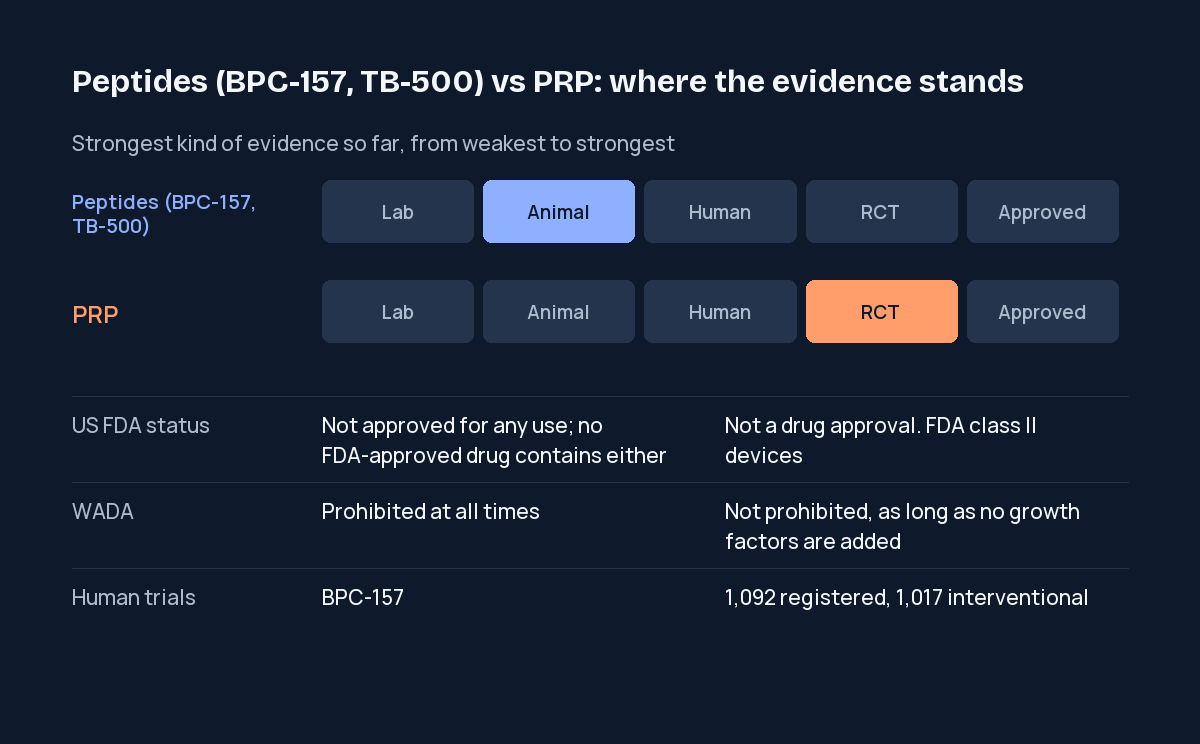
PRP (platelet-rich plasma), a concentrate of the patient’s own platelets, has far more human trials; in tennis elbow it beat corticosteroid at two years [Human RCT (n=100)] (Gosens 2011). Healing peptides such as BPC-157 sped tendon repair in rats [Animal] (Staresinic 2003). Neither is FDA approved.
The gap is large. PRP has more than 1,000 interventional studies registered (ClinicalTrials.gov), yet a 288-person placebo-controlled trial in knee arthritis found no benefit over saline [Human RCT (n=288)] (Bennell 2021). BPC-157’s human record is three uncontrolled studies with 30 people in total (Poolton 2026). FDA lists PRP preparation devices for mixing PRP with bone graft, not for injection into joints, tendons, skin or hair (FDA).
| Item | Peptides (BPC-157, TB-500) | PRP |
|---|---|---|
| US FDA status | Not approved for any use; no FDA-approved drug contains either (Drugs@FDA, searched 2026-11-26) | Not a drug approval. FDA class II devices (product code ORG, 510(k)) prepare PRP “for mixing with bone graft to improve handling characteristics” (FDA) |
| Compounding (503A/503B) | Both withdrawn from Category 2 by their nominators (FDA). Advisory committee voted 8–6 (1 abstention) for each on 2026-07-23 to recommend 503A listing (trade-press counts; advisory) (FDA meeting). Both named in HHS’s draft enforcement-discretion policy of 2026-10-30, one peptide per product; not an approval (Federal Register; HHS). Next step: an FDA proposed rule; none published as of 2026-11-26 | Not a compounded drug: prepared from the patient’s own blood in the clinic (USADA) |
| WADA | Prohibited at all times: BPC-157 under S0, TB-500 under S2.3 (2026 List). Unchanged on the 2027 List, in force 2027-01-01 (2027 List) | Not prohibited, as long as no growth factors are added (USADA); not named in the 2026 or 2027 List (text search, 2026-11-26) |
| Strongest evidence | BPC-157: animal studies; 3 uncontrolled human studies (n=30). Full-length thymosin beta-4: phase 2 RCT (n=73) | Many human RCTs and a Cochrane review, with mixed results |
| Human trials | BPC-157: 3 registered, none with results (ClinicalTrials.gov). TB-500 fragment: 0; full-length thymosin beta-4: 17, for eyes, wounds and the heart (ClinicalTrials.gov; both searched 2026-11-26, sponsor example records excluded) | 1,092 registered, 1,017 interventional (ClinicalTrials.gov, searched 2026-11-26) |
| Last checked | 2026-11-26 | 2026-11-26 |
Key points:
- PRP is made by spinning a small sample of the patient’s blood to concentrate platelets, which carry growth factors.
- In two large blinded trials, in knee arthritis (n=288) and Achilles tendinopathy (n=240), PRP did no better than saline or a sham.
- A 2021 Cochrane review found PRP probably gives little or no benefit over placebo for tennis elbow; a 2026 meta-analysis found it beat steroid after six months.
- A topical palmitoyl pentapeptide reduced fine lines versus placebo in a 93-woman trial by Procter & Gamble scientists.
- No controlled human study has combined PRP with BPC-157 or TB-500 (PubMed and ClinicalTrials.gov, searched 2026-11-26).
Peptides vs PRP at a glance
| Feature | Peptides | PRP |
|---|---|---|
| What it is | Short synthetic amino-acid chains | The patient’s own plasma, rich in platelets |
| Class | Unapproved research drugs (BPC-157, TB-500); cosmetic ingredients (topical peptides) | Autologous blood product |
| Proposed mechanism | More fibroblasts and collagen in healing rat tendon (BPC-157) | Growth factors carried by platelets |
| Main research focus | Gut and soft-tissue injury, mainly in animals; wounds; skin ageing | Tendons, knee arthritis, hair loss, acne scars |
| Human evidence | BPC-157: 3 small uncontrolled studies (review) | Dozens of RCTs (Cochrane) |
| Approval status | None as drugs | Preparation devices cleared; no injection indication in FDA’s device listing (2026-11-26) |
| WADA | BPC-157 S0; TB-500 S2.3 | Not prohibited if unaltered |
| Routes studied | Injection (including the bladder wall), IV, topical | Injection into tendon, joint or scalp; with microneedling |
| Timelines in studies | Rat tendon: days 1–14 | Tendon and knee trials: 6–24 months of follow-up |
| Main safety concerns | Unknown safe dose; immunogenicity and impurities (FDA) | Injection pain, swelling, small infection risk |
What are peptides?
Peptides are short chains of amino acids. BPC-157 is a synthetic peptide matching part of a protein first isolated from human gastric juice (USADA). TB-500 is a fragment of thymosin beta-4 with the sequence LKKTETQ (FDA). Their main benefit signal is from animals: in rats with a cut Achilles tendon, the 15-amino-acid BPC-157 restored tendon strength, function and collagen formation within two weeks [Animal] (Staresinic 2003). For skin, “peptides” can also mean topical cosmetic ingredients, a separate group with its own small trials. Our BPC-157 vs TB-500 comparison covers the two healing peptides in depth.
What is PRP?
PRP is made from a small sample of the patient’s own blood, spun in a centrifuge to concentrate the platelets, then injected at the injury (USADA). Platelets carry growth factors involved in healing. Products differ: a 2009 classification sorts platelet concentrates into four groups by their white-cell and fibrin content, including platelet-rich fibrin (PRF) (Dohan Ehrenfest 2009). Its most encouraging results come from tennis elbow, where a 2026 meta-analysis of six trials found lower pain with PRP than with a steroid shot after six months (Elhadi 2026).
How they work differently
- Peptides: one synthetic molecule, made in a lab. In rats, BPC-157 increased fibroblast and collagen formation in healing tendon [Animal] (Staresinic 2003). PRP: a mix of the body’s own platelets and growth factors. In human skin cells, activated PRP raised type I collagen expression [Lab] (Kim 2011).
- Peptides: BPC-157 is sold online or by compounding pharmacies, all of it synthetic (USADA), and FDA lists immunogenicity (an immune reaction to the drug) and peptide impurities as risks for it and TB-500 (FDA). PRP: prepared from the patient’s own blood with a device; FDA’s device listing names bone-graft handling as the intended use (FDA).
- Peptides: a single defined molecule, though FDA flags possible peptide-related impurities in compounded versions. PRP: content varies by kit and by person; in the 2009 classification each preparation method “leads to a different product with different biology” (Dohan Ehrenfest 2009).
Evidence head-to-head
PRP’s evidence is large and mixed; the peptides’ is small and mostly animal. The numbers below come from different trials and are cross-trial, not a direct comparison.
| Outcome | Peptides: best evidence | PRP: best evidence |
|---|---|---|
| Tennis elbow | No study found (PubMed, 2026-11-26) | Human RCT (n=230): pain 71.5% vs 56.1% better at 24 weeks vs needling alone (Mishra 2014) |
| Achilles tendon | Animal: rat tendon healed faster (Staresinic 2003) | Human RCT (n=240): no difference vs sham at 6 months (Kearney 2021) |
| Knee pain | Human, retrospective (n=16): 14 reported relief; no control group (Lee 2021) | Human RCT (n=288): no difference vs saline at 12 months (Bennell 2021) |
| Wounds | Human RCT (n=73), full-length thymosin beta-4: may speed healing of venous ulcers (Guarnera 2010) | Not covered in this comparison |
| Skin wrinkles | Human RCT (n=93): palmitoyl pentapeptide reduced fine lines vs placebo (Robinson 2005) | Lab: collagen up in skin cells (Kim 2011) |
| Acne scars | No controlled study found (PubMed, 2026-11-26) | Meta-analysis (472 patients): microneedling plus PRP beat microneedling alone (Kang 2021) |
| Hair loss | No controlled study reviewed here | Human RCT (n=35): no difference vs saline in hair density (Shapiro 2020) |
PRP: where the trials point
The strongest benefit is in tennis elbow. In a Dutch trial, PRP was more often successful than a corticosteroid injection at two years, and the steroid group’s function scores fell back to baseline [Human RCT (n=100)] (Gosens 2011). A 2026 meta-analysis of six trials found the steroid worked better in the first four weeks, while PRP gave lower pain after six months, by slightly less than a clinically important amount [Meta-analysis, 6 RCTs, n=338] (Elhadi 2026). Against placebo the picture is weaker: a Cochrane review of 32 studies concluded that PRP and blood injections “probably provide little or no clinically important benefit” for tennis elbow [Systematic review] (Karjalainen 2021).
For knees, the RESTORE trial found pain fell by 2.1 points with PRP and 1.8 with saline, a difference that was not significant (P=.17) [Human RCT (n=288)] (Bennell 2021). Compared with hyaluronic acid instead of saline, a 2026 meta-analysis found small gains for PRP on pain at 12 months [Meta-analysis, 21 RCTs, n=1,790] (Zhong 2026). For Achilles tendinopathy, two blinded trials found no advantage over saline or sham (de Vos 2010; Kearney 2021).
Peptides: where the evidence stands
A 2026 systematic review found three human BPC-157 studies, all reporting symptom improvement in most people without treatment-related side effects, but rated the certainty of evidence “very low” [Systematic review, n=30] (Poolton 2026). One was a bladder study in which 10 of 12 women with interstitial cystitis reported their symptoms resolved after one treatment [Human case series (n=12)] (Lee 2024). For TB-500’s parent molecule, topical thymosin beta-4 was as well tolerated as placebo in a venous-ulcer trial, with about 25% of patients fully healed within three months [Human RCT (n=73)] (Guarnera 2010). That trial used full-length thymosin beta-4, not the TB-500 fragment.
For skin, a palmitoyl pentapeptide cream reduced fine lines and wrinkles versus placebo in a 12-week split-face trial by Procter & Gamble scientists [Human RCT (n=93)] (Robinson 2005). A GHK-Cu skin-care trial after laser resurfacing found no objective improvement in wrinkles, though patients using it were more satisfied [Human RCT (n=13)] (Miller 2006).
Which fits which goal?
- Tendon and elbow pain: PRP has more evidence, from many human RCTs, with its clearest result against steroid shots in tennis elbow. The peptides have animal data only for tendons; our ranking of peptides for injury and tendon healing grades each one.
- Knee arthritis: PRP has more evidence, but a 288-person placebo-controlled trial was negative. BPC-157 has one uncontrolled phone survey of 16 patients.
- Skin texture and acne scars: PRP has more evidence when paired with microneedling; for fine lines, topical peptides have a placebo-controlled trial. For skin-focused options, see best peptides for acne and skin.
- Hair loss: in a split-scalp trial PRP did no better than saline, and our GHK-Cu vs minoxidil for hair comparison sets a hair peptide, GHK-Cu, against an approved drug, minoxidil.
These are evidence statements, not recommendations. A clinician is the person to decide whether either fits a specific injury.
Can they be combined?
No published trial has tested PRP and a healing peptide as a pair. No controlled human study of the combination was found on PubMed or ClinicalTrials.gov (searched 2026-11-26). The HHS draft policy also covers only products with a single listed peptide, so a peptide blend falls outside it (HHS).
Safety and regulatory status
Peptides
USADA says that because BPC-157 “has not been extensively studied in humans, it is unknown if there is a safe dose” (USADA). FDA names immunogenicity and peptide-related impurities as risks for both BPC-157 and TB-500 (FDA). HHS’s draft policy says compounded drugs “are not FDA-approved” and that HHS may revisit the policy if a safety signal arises (Federal Register). For athletes, BPC-157 is prohibited under S0 and TB-500 under S2.3, at all times (WADA 2026 List). The 2027 List adds “peptides” to the S0 examples, which still cover only substances with no approval anywhere, so neither outcome changes (WADA 2027 List). More on the wider picture is in are peptides safe?
PRP
In the Achilles trial, injection-site discomfort was reported by 97 of 121 PRP patients versus 73 of 119 sham patients, with similar rates of swelling and bruising [Human RCT (n=240)] (Kearney 2021). The Cochrane review notes that injection therapies “cause pain and carry a small risk of infection” (Karjalainen 2021). FDA’s listing for PRP preparation devices names bone-graft handling, and no FDA device record read for this page names a tendon, joint, skin or hair indication (searched 2026-11-26) (FDA). USADA says PRP is not prohibited, but that it becomes prohibited if it was altered to enhance performance (USADA).
Anyone who suspects a side effect from peptides, PRP or any other drug or product can report it to the FDA through MedWatch.
How long do effects take in studies?
In the rat Achilles study, BPC-157’s effects were measured from day 1 to day 14 [Animal] (Staresinic 2003). PRP trials follow people far longer. In tennis elbow, a steroid shot gave more relief in the first four weeks, and PRP’s advantage appeared after six months [Meta-analysis] (Elhadi 2026). In the hair trial, three monthly sessions were assessed three months after the last one [Human RCT (n=35)] (Shapiro 2020).
What users report
What follows are unverified self-reports, often from people who bought unregulated peptide products; they are not evidence. People who post about PRP commonly describe a sore, swollen joint or tendon for a few days after the injection, followed by gradual improvement over weeks, and a recurring complaint is the out-of-pocket cost when insurance does not cover it. Many say it did nothing for them. Posts about BPC-157 and TB-500 often describe faster recovery from tendon and joint injuries within a few weeks, though just as many report no change. Complaints include redness at the injection site, nausea, fatigue, and doubts about what a vial really contains. A frequent argument is whether peptides can replace PRP or should be added to it, with little agreement and no shared measure of results. Athletes on forums often ask whether PRP is allowed, and others warn that peptides are not.
Frequently asked questions
Are peptides or PRP better for healing?
PRP has far more human evidence, though its results are mixed. Healing peptides such as BPC-157 have encouraging animal data but only three uncontrolled human studies with 30 people in total, rated very low certainty (Poolton 2026). No head-to-head trial was found on PubMed (searched 2026-11-26).
What is the difference between ACP and PRP?
ACP, autologous conditioned plasma, is a type of PRP, prepared to contain few white blood cells. In a small FDA-regulated trial, ACP improved knee arthritis scores by 78% at one year versus 7% with saline, with no adverse events reported [Human RCT (n=30)] (Smith 2016).
Is PRP better than PRF?
No trial reviewed here settles that; they are different products. PRF, platelet-rich fibrin, is richer in fibrin, and a 2009 classification separates platelet concentrates into four groups by their white-cell and fibrin content, each with “different biology and potential uses” (Dohan Ehrenfest 2009).
Does PRP increase collagen production?
In lab studies it does; human skin trials measure scars, wrinkles or hair rather than collagen itself. In human skin fibroblasts, activated PRP increased type I collagen expression and cell growth [Lab] (Kim 2011). This is a cell-culture result, not a measured change in patients.
Can athletes use PRP or peptides?
PRP is generally allowed, while BPC-157 and TB-500 are prohibited at all times. USADA says PRP is not prohibited as long as no additional growth factors are added to the blood sample (USADA). WADA’s 2026 List names BPC-157 under S0 and TB-500 under S2.3 (WADA).
References
- US Food and Drug Administration. Product classification: platelet and plasma separator for bone graft handling (product code ORG). accessdata.fda.gov
- US Food and Drug Administration. Drugs@FDA database. accessdata.fda.gov
- US Food and Drug Administration. Certain bulk drug substances for use in compounding that may present significant safety risks (Category 2). Current as of 2026-04-22. fda.gov
- US Food and Drug Administration. July 23–24, 2026 meeting of the Pharmacy Compounding Advisory Committee. fda.gov
- US Department of Health and Human Services. Enforcement Discretion Policy Regarding 503A Compounding Using Certain Peptide Bulk Drug Substances; notice of availability. Federal Register 2026-10-30, FR Doc 2026-22192. govinfo.gov
- US Department of Health and Human Services. Draft enforcement discretion policy, 503A peptide compounding (2026). hhs.gov
- World Anti-Doping Agency. 2026 Prohibited List. wada-ama.org
- World Anti-Doping Agency. 2027 Prohibited List (in force 2027-01-01). wada-ama.org
- US Anti-Doping Agency. Orthobiologics: what do athletes need to know about PRP? usada.org
- US Anti-Doping Agency. #AskUSADA: Can I receive PRP injections as a drug tested athlete? usada.org
- US Anti-Doping Agency. BPC-157: what athletes should know about the prohibited experimental peptide. usada.org
- ClinicalTrials.gov. Search: BPC-157 (searched 2026-11-26). clinicaltrials.gov
- ClinicalTrials.gov. Search: thymosin beta 4 (searched 2026-11-26). clinicaltrials.gov
- ClinicalTrials.gov. Search: platelet-rich plasma (searched 2026-11-26). clinicaltrials.gov
- Gosens T, et al. (2011). Ongoing positive effect of platelet-rich plasma versus corticosteroid injection in lateral epicondylitis: a double-blind randomized controlled trial with 2-year follow-up. Am J Sports Med. PubMed 21422467
- Mishra AK, et al. (2014). Efficacy of platelet-rich plasma for chronic tennis elbow: a double-blind, prospective, multicenter, randomized controlled trial of 230 patients. Am J Sports Med. PubMed 23825183
- Karjalainen TV, et al. (2021). Autologous blood and platelet-rich plasma injection therapy for lateral elbow pain. Cochrane Database Syst Rev. PubMed 34590307
- Elhadi A, et al. (2026). Evidence for a time-dependent pain response to platelet-rich plasma versus corticosteroid injection in lateral epicondylitis: a systematic review and meta-analysis of randomized controlled trials. Clin Rheumatol. PubMed 42859367
- Bennell KL, et al. (2021). Effect of intra-articular platelet-rich plasma vs placebo injection on pain and medial tibial cartilage volume in patients with knee osteoarthritis: the RESTORE randomized clinical trial. JAMA. PubMed 34812863
- Zhong C, et al. (2026). Platelet-rich plasma provides small but superior short-term pain relief and functional improvement compared with hyaluronic acid for the treatment of knee osteoarthritis: a systematic review and meta-analysis. Arthroscopy. PubMed 42744748
- de Vos RJ, et al. (2010). Platelet-rich plasma injection for chronic Achilles tendinopathy: a randomized controlled trial. JAMA. PubMed 20068208
- Kearney RS, et al. (2021). Effect of platelet-rich plasma injection vs sham injection on tendon dysfunction in patients with chronic midportion Achilles tendinopathy: a randomized clinical trial. JAMA. PubMed 34255009
- Shapiro J, et al. (2020). Evaluation of platelet-rich plasma as a treatment for androgenetic alopecia: a randomized controlled trial. J Am Acad Dermatol. PubMed 32653577
- Kang C, Lu D. (2021). Combined effect of microneedling and platelet-rich plasma for the treatment of acne scars: a meta-analysis. Front Med (Lausanne). PubMed 35237616
- Kim DH, et al. (2011). Can platelet-rich plasma be used for skin rejuvenation? Evaluation of effects of platelet-rich plasma on human dermal fibroblast. Ann Dermatol. PubMed 22148008
- Dohan Ehrenfest DM, et al. (2009). Classification of platelet concentrates: from pure platelet-rich plasma (P-PRP) to leucocyte- and platelet-rich fibrin (L-PRF). Trends Biotechnol. PubMed 19187989
- Smith PA. (2016). Intra-articular autologous conditioned plasma injections provide safe and efficacious treatment for knee osteoarthritis: an FDA-sanctioned, randomized, double-blind, placebo-controlled clinical trial. Am J Sports Med. PubMed 26831629
- Poolton JT, et al. (2026). Human evidence for BPC-157 in orthopaedic and regenerative medicine: a systematic review of efficacy and safety. Acta Orthop Belg. PubMed 42885452
- Lee E, Padgett B. (2021). Intra-articular injection of BPC 157 for multiple types of knee pain. Altern Ther Health Med. PubMed 34324435
- Lee E, et al. (2024). Effect of BPC-157 on symptoms in patients with interstitial cystitis: a pilot study. Altern Ther Health Med. PubMed 39325560
- Staresinic M, et al. (2003). Gastric pentadecapeptide BPC 157 accelerates healing of transected rat Achilles tendon and in vitro stimulates tendocytes growth. J Orthop Res. PubMed 14554208
- Guarnera G, et al. (2010). The effect of thymosin treatment of venous ulcers. Ann N Y Acad Sci. PubMed 20536470
- Miller TR, et al. (2006). Effects of topical copper tripeptide complex on CO2 laser-resurfaced skin. Arch Facial Plast Surg. PubMed 16847171
- Robinson LR, et al. (2005). Topical palmitoyl pentapeptide provides improvement in photoaged human facial skin. Int J Cosmet Sci. PubMed 18492182
Change log
2026-11-26: first published after review by the editorial team.