Amino acids are single building blocks; peptides are short chains of them; collagen peptides are the protein collagen cut into such chains. Of the two supplements, collagen peptides have the larger trial record: a 2026 meta-analysis of 35 trials with 2,534 people found better skin hydration and elasticity [Human RCT meta-analysis] (Batool 2026). Collagen peptides and amino acid powders are sold as dietary supplements, which FDA does not approve before they reach shelves (FDA).
FDA draws its line at 40 amino acids: a longer chain with a defined sequence counts as a protein (21 CFR 600.3). The “research peptides” people compare collagen with, such as BPC-157, are a different thing: substances with no approval by any health authority, prohibited in sport under WADA’s S0 class (WADA 2027 List).
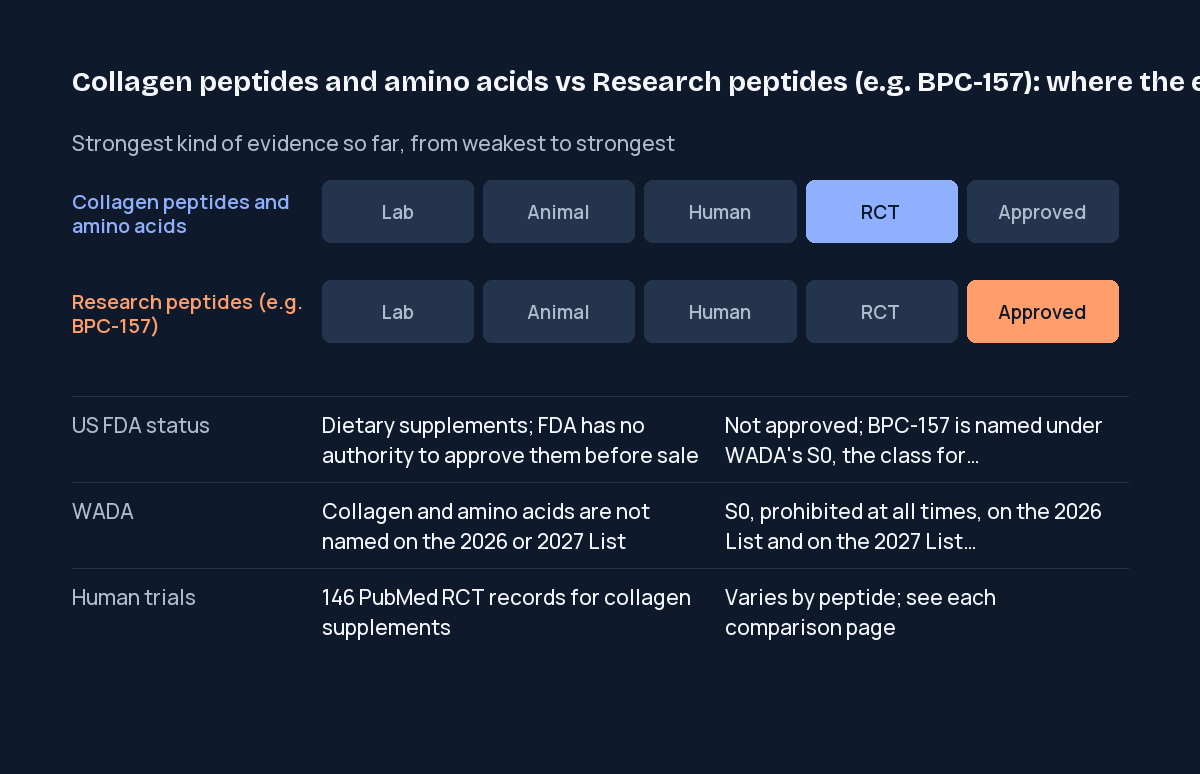
| Item | Collagen peptides and amino acids | Research peptides (e.g. BPC-157) |
|---|---|---|
| US FDA status | Dietary supplements; FDA has no authority to approve them before sale (FDA). A disease claim makes a product a drug (FDA Q&A) | Not approved; BPC-157 is named under WADA’s S0, the class for substances with no approval by any health authority (WADA). Some peptides are approved drugs, e.g. semaglutide (label) |
| Compounding (503A/503B) | Not applicable: sold as foods and supplements, not compounded drugs | GHRP-2, ipamorelin and kisspeptin-10 remain in FDA’s Category 2 (“may present significant safety risks”); BPC-157 is on its withdrawn-by-nominator list (FDA, page dated 2026-04-22) |
| WADA | Collagen and amino acids are not named on the 2026 or 2027 List (searched 2026-11-27) (WADA 2026). Contamination of supplements is a stated risk (USADA) | S0, prohibited at all times, on the 2026 List and on the 2027 List in force 2027-01-01, which now names “peptides” in S0 but covers only those with no approval anywhere (WADA 2027) |
| Strongest evidence | Collagen: meta-analyses of RCTs (skin, osteoarthritis). Amino acids: meta-analysis of leucine RCTs | Approved peptide drugs: label-level (e.g. semaglutide). Research peptides such as BPC-157: no approval anywhere (WADA S0) |
| Human trials | 146 PubMed RCT records for collagen supplements (searched 2026-11-27); 237 records on ClinicalTrials.gov | Varies by peptide; see each comparison page |
| Last checked | 2026-11-27 | 2026-11-27 |
Key points:
- Collagen is an incomplete protein: it lacks tryptophan, one of the nine essential amino acids.
- Two trials found whey, and pea, raised muscle protein synthesis in older adults while collagen did not.
- A 2025 meta-analysis found the skin benefit only in industry-funded trials, and none in high-quality trials.
- Bone broth delivered lower and less consistent collagen amino acids than a collagen supplement in lab tests.
- No randomized trial of collagen supplements in pregnancy was found on PubMed (searched 2026-11-27).
Peptides vs collagen vs amino acids at a glance
| Feature | Collagen peptides | Free amino acids |
|---|---|---|
| What it is | Collagen protein broken into short chains | Single building blocks (e.g. leucine, glycine) |
| Complete protein? | No: lacks tryptophan | Not a protein: single molecules that proteins are built from |
| Main research focus | Skin, joints, bone, body composition | Muscle protein synthesis |
| Best human evidence | Meta-analyses of RCTs, mixed quality | Meta-analysis of 9 leucine RCTs |
| US status | Dietary supplement / food | Dietary supplement / food |
| WADA | Not on the List | Not on the List |
| Main concerns | Trace metals in some marine products; much of the evidence industry-funded | Manufacturing quality (the 1989 tryptophan outbreak) |
Research peptides sit outside this table because they are not foods: they are unapproved substances, covered in our guide to whether peptides are safe.
What are amino acids?
Amino acids are the molecules that combine to form proteins, and digestion breaks proteins back down into them (MedlinePlus). Nine are essential, meaning the body cannot make them: histidine, isoleucine, leucine, lysine, methionine, phenylalanine, threonine, tryptophan and valine. Glycine and proline, two of the amino acids studied as collagen building blocks, are nonessential or conditionally essential. As supplements, amino acids are named “dietary ingredients” in US law (FDA Q&A).
What are peptides?
A peptide is a short chain of amino acids. Under FDA’s definition, a chain longer than 40 amino acids with a defined sequence is a protein (21 CFR 600.3). The word covers very different products. Some peptides are approved prescription drugs: semaglutide, the active ingredient of Ozempic, has a “peptide backbone” and is approved to improve blood sugar control in type 2 diabetes (FDA label). Others, such as BPC-157, have no approval by any health authority, which places them in WADA’s S0 class (WADA 2027 List). Our page on peptides vs Ozempic covers that split.
What are collagen peptides?
Collagen peptides (also sold as hydrolyzed collagen or collagen hydrolysate) are collagen or gelatin from animal sources, such as pig skin, chicken feet, cartilage or fish, cut into fragments. Some fragments survive digestion: after people drank gelatin hydrolysates, peptide-bound hydroxyproline in blood peaked within 1–2 hours, mainly as the two-amino-acid peptide Pro-Hyp [Human, small study] (Iwai 2005). So collagen peptides are both a protein food and a source of small peptides, but they are not drugs.
Is collagen a protein, and is it the same as protein powder?
Collagen counts as protein, but an incomplete one. It lacks tryptophan, so it scores as an incomplete source under the standard protein-quality method; a modelling study, two of whose authors are affiliated with collagen companies, calculated that collagen can supply up to 36% of daily protein while essential amino acid needs are still met (Paul 2019).
Against whey, collagen falls short for muscle. In 22 older women, whey raised muscle protein synthesis over six days, while collagen did not lift it significantly above baseline [Human RCT (n=22)] (Oikawa 2020). In 31 older men given protein beyond the recommended allowance, synthesis rose with whey and pea but “remained unchanged with collagen” [Human RCT (n=31)] (McKendry 2024). After a 20 g serving, collagen gave higher blood glycine (683 vs 260 μmol/L) and dairy higher leucine (267 vs 189 μmol/L) [Human, small study] (Alcock 2019).
Collagen peptides benefits: what the trials show
Collagen peptides are the better-studied of the two supplements, and several results are encouraging.
- Skin: in 69 women aged 35–55, eight weeks of collagen hydrolysate improved skin elasticity compared with placebo, with no side effects noted [Human RCT (n=69)] (Proksch 2014). Pooled across 35 trials, hydration (SMD 0.44) and elasticity (SMD 0.62) improved, with elasticity changes needing at least 12 weeks [Human RCT meta-analysis] (Batool 2026).
- Joints: in 97 evaluable athletes with activity-related joint pain, 24 weeks of collagen hydrolysate reduced physician-rated joint pain at rest more than placebo (−1.37 vs −0.90 points) [Human RCT (n=147 randomized)] (Clark 2008). In osteoarthritis, a meta-analysis found lower total WOMAC scores (−8.00) and pain on a visual scale (−16.57), though the WOMAC pain subscore alone did not change significantly [Human RCT meta-analysis] (García-Coronado 2019).
- Muscle with training: in 53 sarcopenic men doing 12 weeks of resistance training, collagen peptides added more fat-free mass than placebo (+4.2 vs +2.9 kg) [Human RCT (n=53)] (Zdzieblik 2015).
- Bone: in 131 postmenopausal women with reduced bone density, 12 months of collagen peptides raised spine and femoral-neck T-scores against placebo [Human RCT (n=131)] (König 2018).
The limits are real. When a 2025 meta-analysis of 23 trials split them by funding, trials without industry money showed no effect on hydration, elasticity or wrinkles, and high-quality trials showed none either; its authors concluded there is currently no clinical evidence to support collagen for skin aging (Myung 2025). The 2026 meta-analysis judged the wrinkle and dermal-density findings to be statistical artifacts. Several of the positive muscle and skin trials above have a co-author from a collagen research institute.
For other skin options, see the best-researched peptides for skin; for joints, the joint pain ranking.
Amino acid supplements: what the trials show
The best-studied single amino acid supplement for muscle is leucine. A meta-analysis of nine trials in older people found it raised the muscle protein synthesis rate (SMD 1.08), but lean body mass and leg lean mass did not differ from control [Human RCT meta-analysis] (Xu 2015). That pattern, a lab marker moving without a measured change in lean mass, is the main limit of this evidence. Glycine, which collagen supplied in larger amounts than dairy protein (Alcock 2019), is one the body can make (MedlinePlus).
Which has more evidence for which goal?
- Skin hydration and elasticity: collagen peptides have the most trials, with a pooled benefit that weakens when only independent or high-quality trials are counted.
- Muscle protein synthesis: complete proteins such as whey have more evidence than collagen; leucine raises synthesis rates without a shown gain in lean mass.
- Joint pain and osteoarthritis symptoms: collagen has RCTs and a meta-analysis behind it.
- Blood sugar: the approved peptide drug semaglutide has label-level evidence in type 2 diabetes; a supplement marketed to treat a disease would legally be a drug.
These are cross-trial comparisons of different products and people, not head-to-head results. A clinician is the person to decide what fits an individual diet or condition.
Side effects, safety and regulatory status
Collagen trials report few problems: a 2026 review of 25 trials found supplementation “generally well-tolerated, with a low incidence of adverse events”, while rating most trials at high risk of bias (Bassila 2026). Product quality is a separate question. Marine collagen products tested in Italy contained arsenic and lead that varied between brands, though none exceeded EU limits (Cammilleri 2025). Amino acids have a historic warning: the 1989 eosinophilia-myalgia outbreak was traced to a chemical constituent linked to one company’s tryptophan manufacturing (Belongia 1990).
In the US, supplement makers, not FDA, are responsible for making sure products are not adulterated or misbranded, and a product marketed to treat or prevent a disease is legally a drug (FDA Q&A). For athletes, USADA warns that some supplements “have been contaminated or spiked with performance-enhancing drugs” (USADA). Research peptides carry a different risk: under the 2027 List, in force 2027-01-01, unapproved peptides are prohibited at all times in S0 (USADA 2027 advisory). Pregnancy is a gap: no randomized trial of collagen supplements in pregnant people was found on PubMed (search, 2026-11-27).
Anyone who suspects a side effect from collagen peptides or any other drug or product can report it to the FDA through MedWatch.
What users report
These are unverified self-reports from people posting online, usually about products bought without independent testing; they are not evidence. People who post about collagen peptides commonly describe softer skin, stronger nails and less joint stiffness, usually noticed after several weeks rather than days, and before-and-after photos are a frequent format. A recurring complaint is that nothing changed at all, followed by debate over whether the effect is real or simply better hydration. Others mention bloating, a heavy feeling in the stomach or a taste they dislike in coffee. Many argue about marine versus bovine sources, about whether collagen “counts” toward a protein target, and about whether eating more ordinary protein would do the same job. Posts about free amino acid powders often focus on taste and on whether they make any difference for people who already eat enough protein. Comments comparing collagen with research peptides usually note that one is a grocery product and the other an unapproved drug.
Frequently asked questions
Are collagen peptides the same as peptides?
Collagen peptides are one kind of peptide, made by cutting dietary collagen into short fragments, but they are a food supplement rather than a drug. The word “peptide” also covers approved drugs such as semaglutide, whose label describes a “peptide backbone” produced by yeast fermentation (FDA label).
Does collagen count as protein intake?
Yes, collagen counts toward protein intake, but it is an incomplete protein because it lacks the essential amino acid tryptophan. A modelling study calculated that collagen peptides can make up as much as 36% of daily protein while essential amino acid needs are still met (Paul 2019).
Can you take collagen peptides while pregnant?
There is no trial evidence either way, so the question belongs with a clinician who knows the pregnancy. A PubMed search for randomized or clinical trials of collagen supplements in pregnancy returned no records on 2026-11-27 (PubMed), and FDA does not approve supplements before sale.
Are collagen peptides good for you?
Pooled human RCTs suggest modest skin benefits, but trials without industry funding do not confirm them. A 2025 meta-analysis of 23 trials found no effect on skin hydration, elasticity or wrinkles once only trials without industry funding were analyzed [Human RCT meta-analysis] (Myung 2025).
What foods are rich in collagen?
Bone broth is the food most often named, but lab tests suggest it is an unreliable source of collagen building blocks. In those analyses, bone broth made to a standard recipe held less hydroxyproline, glycine and proline than a 20 g collagen supplement serving, and recipes that were not standardized varied widely (Alcock 2019).
What is the downside of taking peptides?
For research peptides, the main downsides are safety concerns FDA has raised and a ban in sport. FDA keeps peptides such as GHRP-2, ipamorelin and kisspeptin-10 in Category 2, citing risks such as immunogenicity from aggregation or impurities (FDA); collagen peptides are not in that group.
References
- U.S. Code of Federal Regulations. 21 CFR 600.3, Definitions (“protein”). eCFR. ecfr.gov
- MedlinePlus (U.S. National Library of Medicine). Amino acids. medlineplus.gov
- U.S. Food and Drug Administration. Questions and Answers on Dietary Supplements. 2026. fda.gov
- U.S. Food and Drug Administration. Dietary Supplements. fda.gov
- U.S. Food and Drug Administration. Certain bulk drug substances for use in compounding that may present significant safety risks (Category 2). 2026. fda.gov
- World Anti-Doping Agency. The 2027 Prohibited List. 2026. wada-ama.org
- World Anti-Doping Agency. The 2026 Prohibited List. 2025. wada-ama.org
- U.S. Anti-Doping Agency. Athlete advisory: 2027 Prohibited List. usada.org
- U.S. Anti-Doping Agency. Supplement Connect. usada.org
- Novo Nordisk. RYBELSUS and OZEMPIC tablets (semaglutide) prescribing information. DailyMed, 2026. dailymed.nlm.nih.gov
- Paul C, Leser S, Oesser S. Significant amounts of functional collagen peptides can be incorporated in the diet while maintaining indispensable amino acid balance. Nutrients. 2019. PubMed
- Iwai K, et al. Identification of food-derived collagen peptides in human blood after oral ingestion of gelatin hydrolysates. J Agric Food Chem. 2005. PubMed
- Alcock RD, Shaw GC, Tee N, Burke LM. Plasma amino acid concentrations after the ingestion of dairy and collagen proteins, in healthy active males. Front Nutr. 2019. PubMed
- Alcock RD, Shaw GC, Burke LM. Bone broth unlikely to provide reliable concentrations of collagen precursors compared with supplemental sources of collagen used in collagen research. Int J Sport Nutr Exerc Metab. 2019. PubMed
- Proksch E, et al. Oral supplementation of specific collagen peptides has beneficial effects on human skin physiology: a double-blind, placebo-controlled study. Skin Pharmacol Physiol. 2014. PubMed
- Myung SK, Park Y. Effects of collagen supplements on skin aging: a systematic review and meta-analysis of randomized controlled trials. Am J Med. 2025. PubMed
- Batool A, et al. Oral collagen peptides and skin rejuvenation: a systematic review and an updated meta-analysis of randomized controlled trials. J Cosmet Dermatol. 2026. PubMed
- Bassila C, Bassila JC, Slim M. Efficacy and safety of hydrolyzed collagen supplementation on skin health outcomes: a systematic literature review of randomized controlled trials. Eur J Clin Nutr. 2026. PubMed
- Clark KL, et al. 24-week study on the use of collagen hydrolysate as a dietary supplement in athletes with activity-related joint pain. Curr Med Res Opin. 2008. PubMed
- García-Coronado JM, et al. Effect of collagen supplementation on osteoarthritis symptoms: a meta-analysis of randomized placebo-controlled trials. Int Orthop. 2019. PubMed
- Zdzieblik D, et al. Collagen peptide supplementation in combination with resistance training improves body composition and increases muscle strength in elderly sarcopenic men: a randomised controlled trial. Br J Nutr. 2015. PubMed
- König D, et al. Specific collagen peptides improve bone mineral density and bone markers in postmenopausal women: a randomized controlled study. Nutrients. 2018. PubMed
- Oikawa SY, et al. Whey protein but not collagen peptides stimulate acute and longer-term muscle protein synthesis with and without resistance exercise in healthy older women: a randomized controlled trial. Am J Clin Nutr. 2020. PubMed
- McKendry J, et al. The effects of whey, pea, and collagen protein supplementation beyond the recommended dietary allowance on integrated myofibrillar protein synthetic rates in older males: a randomized controlled trial. Am J Clin Nutr. 2024. PubMed
- Xu ZR, et al. The effectiveness of leucine on muscle protein synthesis, lean body mass and leg lean mass accretion in older people: a systematic review and meta-analysis. Br J Nutr. 2015. PubMed
- Belongia EA, et al. An investigation of the cause of the eosinophilia-myalgia syndrome associated with tryptophan use. N Engl J Med. 1990. PubMed
- Cammilleri G, et al. Toxic metals and metalloids in collagen supplements of fish and jellyfish origin: risk assessment for daily intake. Open Med (Wars). 2025. PubMed
- ClinicalTrials.gov. Search: intervention “collagen peptides” (searched 2026-11-27). clinicaltrials.gov
- PubMed. Search: collagen supplements AND randomized controlled trial (searched 2026-11-27). pubmed.ncbi.nlm.nih.gov
- PubMed. Search: collagen supplements AND pregnancy AND randomized or clinical trial (searched 2026-11-27). pubmed.ncbi.nlm.nih.gov
Change log
2026-11-27: first published after review by the editorial team.