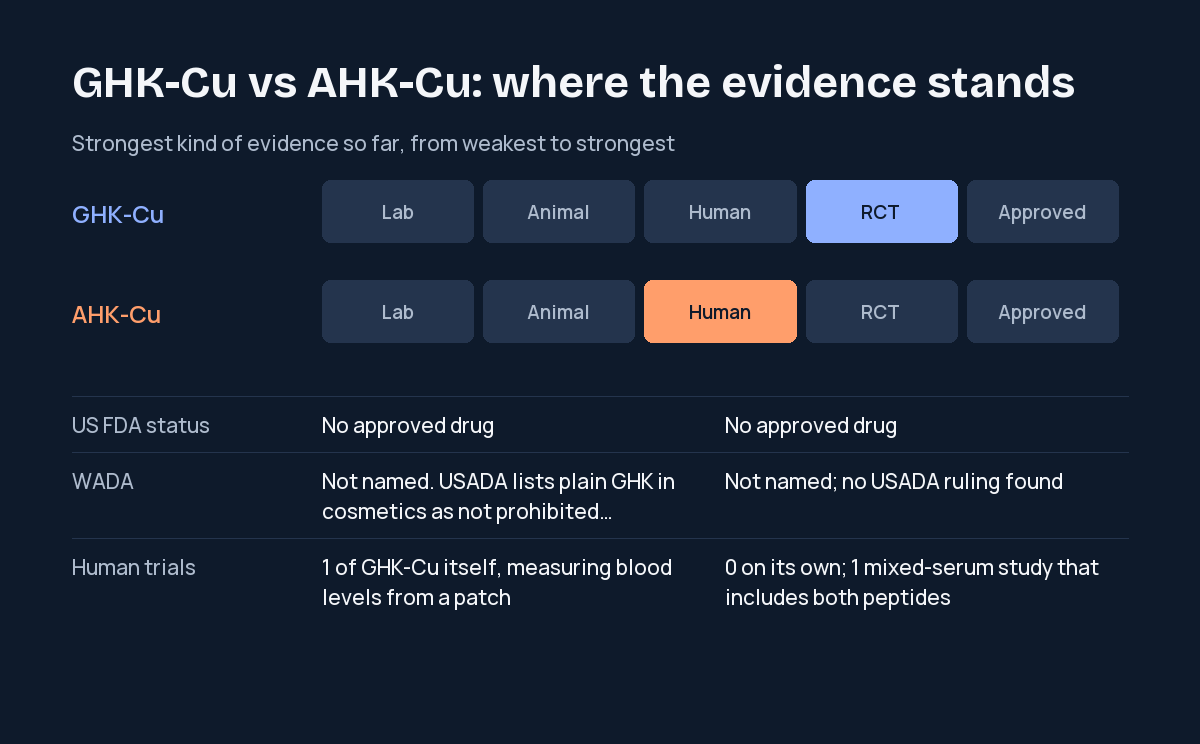
GHK-Cu has the larger evidence base: in a 2026 split-face trial, a GHK-Cu serum improved eyebrow hair count and diameter over 12 weeks [Human RCT (n=18)] (Mateescu 2026). AHK-Cu lengthened human hair follicles in a lab dish [Lab] (Pyo 2007). Neither is an FDA-approved drug.
The gap between them is wide. GHK-Cu has a handful of small human studies and one registered study of its own, not yet recruiting. AHK-Cu has one published laboratory study on PubMed and no human trial of its own (searched 2026-11-24). Cosmetic ingredients do not need FDA approval before they go on the market (FDA).
| Item | GHK-Cu | AHK-Cu |
|---|---|---|
| US FDA status | No approved drug (Drugs@FDA, searched 2026-11-24) | No approved drug (Drugs@FDA, searched 2026-11-24) |
| Compounding (503A/503B) | Injectable: withdrawn from Category 2 by its nominators (FDA). Non-injectable: back in Category 1, under evaluation, not on the 503A bulks list (FDA list, May 14, 2026). Next step: an advisory committee review before the end of February 2027, date not yet set (FDA) | Not on FDA’s 503A category list or Category 2 page (searched 2026-11-24) |
| WADA | Not named. USADA lists plain GHK in cosmetics as not prohibited and has no GHK-Cu ruling (USADA). The 2027 List, in force 2027-01-01, names “peptides” under S0, prohibited at all times, which covers only peptides with no approval anywhere (WADA; USADA) | Not named; no USADA ruling found (searched 2026-11-24). USADA warns that an unnamed peptide “may still be prohibited” |
| Strongest evidence | Human RCT, eyebrow hair (n=18) | Lab: human hair follicles and dermal papilla cells |
| Human trials | 1 of GHK-Cu itself, measuring blood levels from a patch: NCT07706361 (not yet recruiting); 2 more test multi-ingredient products (ClinicalTrials.gov, searched 2026-11-24) | 0 on its own; 1 mixed-serum study that includes both peptides (NCT07888595) |
| Last checked | 2026-11-24 | 2026-11-24 |
Key points:
- The two molecules differ by one amino acid: GHK-Cu starts with glycine, AHK-Cu with alanine. Both carry a copper ion.
- GHK occurs naturally in human plasma, saliva and urine and declines with age; AHK-Cu is a synthetic analog.
- An independent 2026 review says AHK-Cu “rests on a thin, poorly characterized evidence base”.
- The 45-man scalp trial a 2026 review cites as GHK-Cu hair evidence tested GHK combined with 5-aminolevulinic acid, not GHK-Cu alone.
- No controlled study has compared the two peptides head to head (PubMed and ClinicalTrials.gov, searched 2026-11-24).
GHK-Cu vs AHK-Cu at a glance
| Feature | GHK-Cu | AHK-Cu |
|---|---|---|
| What it is | Copper complex of glycyl-histidyl-lysine | Copper complex of alanyl-histidyl-lysine |
| Origin | Occurs naturally in the body | Synthetic |
| Class | Copper-binding tripeptide | Copper-binding tripeptide |
| Proposed mechanism | Collagen and matrix turnover, VEGF, wound repair | Dermal papilla cell growth, less apoptosis |
| Main research focus | Skin ageing, wounds, hair | Hair follicles |
| Human evidence | Small cosmetic studies (review) | None published (only study: lab) |
| Approval | None as a drug | None as a drug |
| WADA | Not named | Not named |
| Routes studied in people | On the skin | None |
| Timelines in studies | 12 weeks (eyebrow and laser studies) | No human timeline |
| Molecular weight | About 404 Da (NCT07888595) | About 418 Da |
| Main safety concerns | Copper sensitization; injectable impurities (FDA) | No human safety data |
What is GHK-Cu?
GHK-Cu is the copper-bound form of GHK (glycyl-L-histidyl-L-lysine), a three-amino-acid peptide found in human plasma, saliva and urine that declines with age (Pickart 2015). Its benefits in the lab are well documented: it raised collagen production by fibroblasts in culture, the cells that build skin’s support matrix [Lab] (Maquart 1988). An independent 2026 review called it “promising but unproven” and noted the clinical evidence “remains sparse” (Mateescu 2026). Our GHK-Cu results timeline lists what each study measured.
What is AHK-Cu?
AHK-Cu (L-alanyl-L-histidyl-L-lysine-copper) swaps GHK’s first amino acid, glycine, for alanine. Its promising result comes from Seoul National University: it stimulated the elongation of human hair follicles kept alive outside the body and the growth of dermal papilla cells, the specialized cells at the follicle base that steer hair growth [Lab] (Pyo 2007). That paper is the only PubMed record that names AHK-Cu in its title or abstract (searched 2026-11-24). A 2026 hair-peptide review calls it “a related analog” whose signaling “is less well characterized than GHK-Cu” (Fan 2026).
How they work differently
- GHK-Cu: raised MMP-2, an enzyme that remodels the skin matrix, in fibroblast cultures. Copper ions alone reproduced the effect; GHK without copper did not [Lab] (Siméon 2000).
AHK-Cu: no matrix-enzyme study found on PubMed (searched 2026-11-24). Its proposed action is on hair follicle cells [Lab] (Pyo 2007). - GHK-Cu: increased VEGF, a blood-vessel growth signal, in dermal fibroblasts, according to a 2026 review [Lab] (Fan 2026).
AHK-Cu: raised the Bcl-2/Bax ratio and lowered cleaved caspase-3 and PARP, markers of programmed cell death, in dermal papilla cells. Fewer cells died, but that drop was not statistically significant [Lab] (Pyo 2007). - Both: bind copper through histidine. A 2026 review warns that GHK-Cu, its derivatives and other copper peptides “cannot be treated as interchangeable” (Mateescu 2026).
GHK-Cu vs AHK-Cu evidence head-to-head
| Outcome | GHK-Cu best evidence | AHK-Cu best evidence |
|---|---|---|
| Hair growth | Human RCT (n=18): more eyebrow hairs, thicker hairs at 12 weeks (Mateescu 2026) | Lab: longer human follicles ex vivo (Pyo 2007) |
| Scalp hair loss | Human RCT (n=45) of a GHK–5-ALA complex, not GHK-Cu alone (Lee 2016) | No study found |
| Skin after laser | Human RCT (n=13): no objective benefit (Miller 2006) | No study found |
| Wound healing | Animal: wound area down 64.5% by day 13 vs 28.2% untreated, rats (Canapp 2003) | No study found |
| Collagen | Lab: more collagen from fibroblasts (Maquart 1988) | No study found |
“No study found” means no PubMed or Europe PMC record (searched 2026-11-24). The numbers come from different studies and are not a head-to-head comparison.
Which fits which goal?
For hair, GHK-Cu has more evidence, because it is the only one of the two tested in people. The eyebrow trial is small and single-center, yet a 2026 review rates it “the strongest recent controlled cosmetic signal” (Mateescu 2026). AHK-Cu’s encouraging follicle result has not moved beyond the lab dish [Lab] (Pyo 2007). One caution on GHK and scalp hair: the 45-man trial a 2026 review cites for it (Fan 2026) tested a complex of GHK with 5-aminolevulinic acid. Hair count rose by 71.5 in one active group versus 9.6 on placebo, with no difference in hair length or thickness at six months [Human RCT (n=45)] (Lee 2016). For a wider view, see our hair-loss evidence ranking and the GHK-Cu vs minoxidil comparison.
For skin and wounds, GHK-Cu again has more evidence, with lab, animal and small human studies; AHK-Cu has none on PubMed (searched 2026-11-24). The human skin record is mixed: after CO2 laser resurfacing, blinded evaluators found no difference in redness, wrinkles or skin quality, though patients using GHK-Cu rated their skin better [Human RCT (n=13)] (Miller 2006). The one registered study of GHK-Cu itself measures blood levels of GHK and GHK-Cu from a skin patch, not skin or hair outcomes, in 100 planned adults (NCT07706361).
A dermatologist or other clinician is the person to decide whether either belongs in someone’s care.
Can GHK-Cu and AHK-Cu be combined?
The only registered study that includes the two is an early phase 1 study, enrolling by invitation, that applies a serum of five peptides, among them GHK-Cu and AHK-Cu, to skin sites in 48 planned participants, with untreated sites as controls and an ageing-clock outcome at 4 weeks (NCT07888595). It cannot separate the effect of either peptide. No controlled human study of the combination was found on PubMed or ClinicalTrials.gov (searched 2026-11-24).
Safety and regulatory status
Side effects. The human studies of GHK-Cu report few problems: the eyebrow trial reported no serious adverse effects, and the 45-man trial of the GHK complex reported no adverse events (Mateescu 2026; Lee 2016). These trials were small and short. The same 2026 review notes that copper “is a recognized contact sensitizer in susceptible individuals”, and that a damaged skin barrier or penetration-enhancing vehicle raises exposure. AHK-Cu has no published human safety data (PubMed, searched 2026-11-24).
United States. Neither peptide is an approved drug (Drugs@FDA, searched 2026-11-24). FDA decides whether a product is a cosmetic or a drug by its intended use; a claim that a product will “restore hair growth” makes it a drug (FDA). For injectable GHK-Cu, FDA’s Category 2 entry, now listed as withdrawn by the nominators, warned of possible immunogenicity from “aggregation and peptide-related impurities” and “limited data in humans” (FDA Category 2 page). Non-injectable GHK-Cu is under evaluation for the 503A bulks list, with an advisory committee meeting planned before the end of February 2027 (FDA). AHK-Cu does not appear on FDA’s 503A category list (searched 2026-11-24). Our GHK-Cu serum vs injection comparison covers the routes in more detail.
Sport. USADA says topical use of a peptide “is just as prohibited as injectable or oral forms” and lists plain GHK in cosmetics as not prohibited, without a ruling on GHK-Cu or AHK-Cu (USADA). From 2027-01-01 the WADA List names “peptides” under S0, and USADA advises that a peptide not named on the List “may still be prohibited” (USADA 2027 advisory). Athletes can check Global DRO or ask USADA.
Anyone who suspects a side effect from GHK-Cu, AHK-Cu or any other drug or product can report it to the FDA through MedWatch.
How long do effects take in studies?
For GHK-Cu, the human studies ran about 12 weeks: the eyebrow trial assessed hair at 12 weeks, and the laser study judged skin 12 weeks after treatment (Mateescu 2026; Miller 2006). The GHK complex trial on scalp hair ran six months (Lee 2016). In rats, wound-area differences appeared within 13 days [Animal] (Canapp 2003). AHK-Cu has no human timeline.
What users report
What follows are unverified self-reports from people who usually bought unregulated products; they are not evidence. People who post about these copper peptides on forums and social media most often describe them as scalp or face serums and compare them for hair. A common claim is that AHK-Cu is “the hair one” and GHK-Cu “the skin one”, a split the published studies do not test. Users often say any change took months to notice, and many report no visible change at all. Recurring complaints include scalp itching, redness or a stinging feeling, blue or green tinting of serums and stained pillowcases, and a temporary shedding phase that people argue about. Others worry about copper building up or about whether products contain what the label says, since homemade or “research” products are common. Debates center on whether combining the two adds anything, whether results come from other ingredients such as minoxidil used at the same time, and whether cosmetic serums deliver enough peptide into the skin.
Frequently asked questions
Is AHK-Cu better than GHK-Cu for hair?
No study found on PubMed or ClinicalTrials.gov shows that AHK-Cu works better than GHK-Cu for hair (searched 2026-11-24), and none has compared them directly. AHK-Cu’s only hair data are lab work on human follicles, while GHK-Cu improved eyebrow hair count and diameter over 12 weeks in a small split-face trial [Human RCT (n=18)] (Mateescu 2026).
Can you use AHK-Cu and GHK-Cu together?
There is no evidence on using them together: no controlled human study of the pair was found on PubMed or ClinicalTrials.gov (searched 2026-11-24). The one registered study that includes both uses a five-peptide serum in a single group, so it cannot show what either peptide adds (NCT07888595).
What are the side effects of GHK-Cu?
Small human studies of GHK-Cu on the skin reported no serious adverse effects, but they were short and enrolled few people. A 2026 review notes that copper can cause contact allergy in susceptible people, especially through broken skin or penetration-enhancing products (Mateescu 2026).
Is GHK-Cu FDA approved?
No. GHK-Cu is not an FDA-approved drug for any use, and no approved drug contains it as an active ingredient in the Drugs@FDA database (searched 2026-11-24). FDA lists non-injectable GHK-Cu as under evaluation for compounding and plans an advisory committee review before the end of February 2027 (FDA).
What is the difference between GHK-Cu and AHK-Cu?
They differ by one amino acid: GHK-Cu begins with glycine and occurs naturally in the body, while AHK-Cu begins with alanine and is synthetic. A 2026 review says AHK-Cu shares GHK-Cu’s copper-binding motif but “rests on a thin, poorly characterized evidence base” (Mateescu 2026).
References
- Mateescu DM, Gavrilescu DM, Mincioaga RI, et al. (2026). GHK-Cu as a bioactive metallopeptide and drug-delivery cargo: coordination chemistry, formulation science, therapeutic evidence, and a translational roadmap. Pharmaceutics 18(9):1077. PubMed 42797253
- Pyo HK, Yoo HG, Won CH, et al. (2007). The effect of tripeptide-copper complex on human hair growth in vitro. Arch Pharm Res 30(7):834–839. PubMed 17703734
- Fan C, Chen Y, Huang Q, et al. (2026). Overview of short peptides for hair loss. Biomedicines 14(4):864. PubMed 42072405
- Lee WJ, Sim HB, Jang YH, et al. (2016). Efficacy of a complex of 5-aminolevulinic acid and glycyl-histidyl-lysine peptide on hair growth. Ann Dermatol 28(4):438–443. PubMed 27489425
- Miller TR, Wagner JD, Baack BR, Eisbach KJ. (2006). Effects of topical copper tripeptide complex on CO2 laser-resurfaced skin. Arch Facial Plast Surg 8(4):252–259. PubMed 16847171
- Pickart L, Vasquez-Soltero JM, Margolina A. (2015). GHK peptide as a natural modulator of multiple cellular pathways in skin regeneration. Biomed Res Int 2015:648108. PubMed 26236730
- Maquart FX, Pickart L, Laurent M, et al. (1988). Stimulation of collagen synthesis in fibroblast cultures by the tripeptide-copper complex glycyl-L-histidyl-L-lysine-Cu2+. FEBS Lett 238(2):343–346. PubMed 3169264
- Siméon A, Emonard H, Hornebeck W, Maquart FX. (2000). The tripeptide-copper complex glycyl-L-histidyl-L-lysine-Cu2+ stimulates matrix metalloproteinase-2 expression by fibroblast cultures. Life Sci 67(18):2257–2265. PubMed 11045606
- Canapp SO Jr, Farese JP, Schultz GS, et al. (2003). The effect of topical tripeptide-copper complex on healing of ischemic open wounds. Vet Surg 32(6):515–523. PubMed 14648529
- ClinicalTrials.gov. NCT07706361: Two-part study of the effects of the X39 patch on circulating GHK and GHK-Cu levels in healthy adults. Record
- ClinicalTrials.gov. NCT07888595: Systemic and topical geroprotective rejuvenation assessed by START/REST aging clocks. Record
- US Food and Drug Administration. Bulk drug substances nominated for use in compounding under section 503A (updated May 14, 2026). FDA
- US Food and Drug Administration. Certain bulk drug substances for use in compounding that may present significant safety risks. FDA
- US Food and Drug Administration. Pharmacy Compounding Advisory Committee: upcoming meeting. FDA
- US Food and Drug Administration. Drugs@FDA database. FDA
- US Food and Drug Administration. Is it a cosmetic, a drug, or both? (Or is it soap?). FDA
- USADA. Peptides and growth factors in cosmetics: are they banned? USADA
- USADA. Athlete advisory: 2027 Prohibited List. USADA
- World Anti-Doping Agency. 2027 Prohibited List. WADA
Change log
2026-11-24: first published after review by the editorial team.