Verdict: GHK-Cu serum is an unapproved cosmetic ingredient with small human skin studies; injected GHK-Cu is unapproved and has no published human trials; retinol is a cosmetic ingredient with a few small RCTs, and prescription tretinoin (Renova) is FDA-approved to help mitigate fine facial wrinkles. Retinoids hold by far the strongest evidence.
GHK-Cu is a copper-binding tripeptide found naturally in human plasma, and its level declines with age (Pickart 2015). A 2026 systematic review found 20 studies of GHK-Cu for aesthetic use, of which only 2 were randomized controlled trials [Human RCT] (Mokhtar 2026). Injected GHK-Cu has animal data only; FDA’s safety listing for compounded injectable GHK-Cu cites a risk of immune reactions and “limited data in humans” (FDA). Tretinoin cream (Renova) carries an FDA label for fine facial wrinkles [Approved label], with irritation in almost all trial patients (Renova label).
| Item | GHK-Cu serum | GHK-Cu injection | Retinol / tretinoin |
|---|---|---|---|
| US FDA status | Not an approved drug; sold as a cosmetic, which needs no FDA approval (FDA) | Not approved for any use | Retinol: cosmetic, not approved. Tretinoin: approved prescription drug (Renova) for fine facial wrinkles (label) |
| Compounding (503A/503B) | Cosmetic serums are not compounded drugs. Compounded GHK-Cu for non-injectable routes is back in 503A Category 1 (under evaluation; interim, not approval) per FDA’s May 14, 2026 update (FDA) | Category 2 listing (injectable routes) withdrawn by nominators; injectable routes are excluded from the Category 1 entry (FDA); PCAC review due before end of February 2027, advisory only (FDA) | Tretinoin is available as an approved product |
| WADA 2026 | GHK-Cu not named; WADA has not said whether S0 applies | Not named; S0 covers substances with no approval for human therapeutic use (WADA 2026) | Retinol and tretinoin not named |
| Strongest evidence | Human RCT, small (laser study n=13); larger studies not in PubMed-indexed journals | Animal only | Human RCTs (tretinoin n=296 and n=204; retinol n=36) and an approved label |
| Human trials | 1 registered, not yet recruiting: NCT07706361 | None registered | Five label trials for Renova (656 evaluable patients) |
| Last checked | 2026-10-18 | 2026-10-07 | 2026-10-07 |
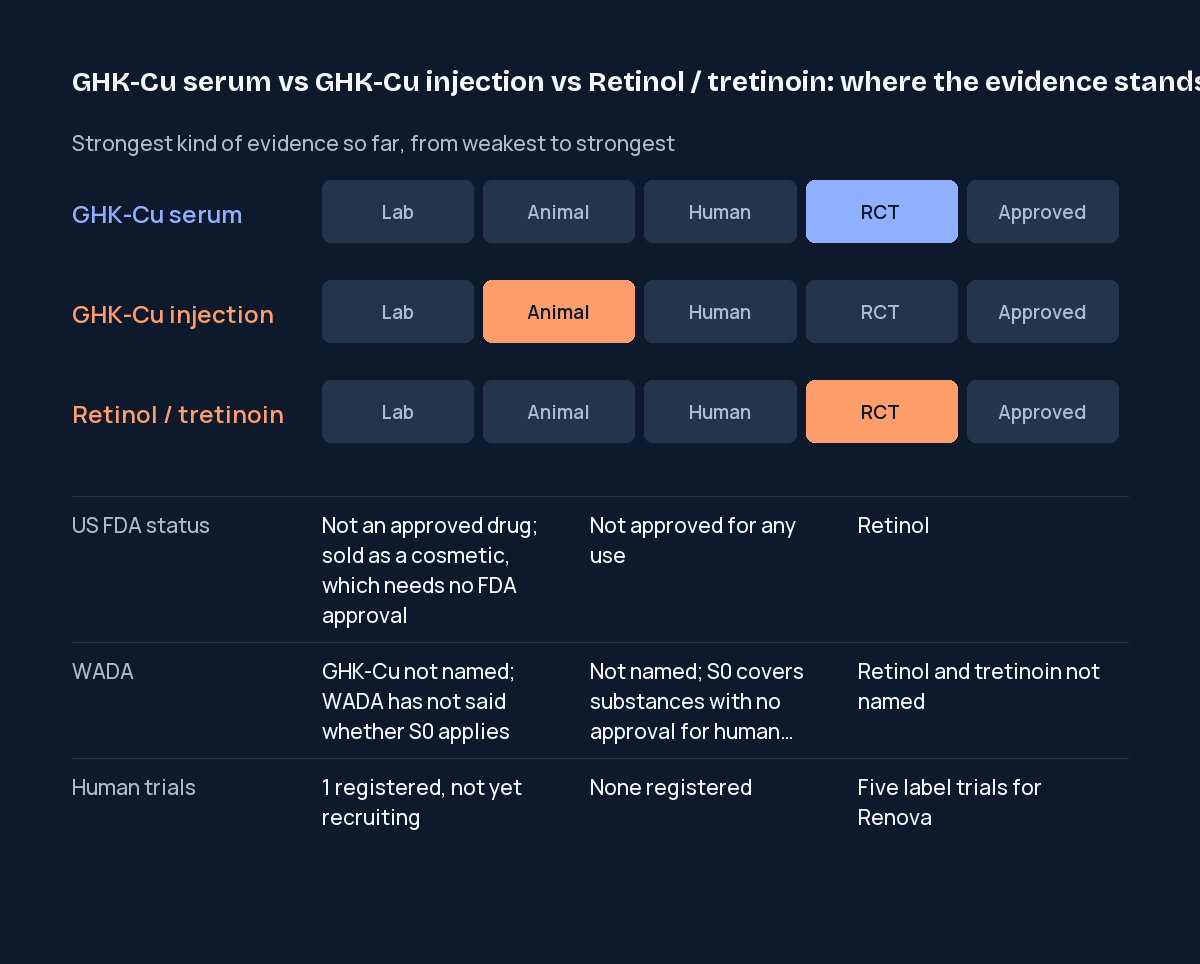
What changed (October 2026): a direct answer on GHK-Cu versus tretinoin is added to the questions below, and the athlete section now covers the 2027 WADA List.
Key points:
- FDA treats any product meant to “increase the skin’s production of collagen” as a drug or medical device, not a cosmetic (FDA).
- In a lab test on human skin, almost no GHK-Cu or copper passed through intact skin in 9 hours unless microneedles were used first [Lab] (Li 2015).
- A copper tripeptide cream did no better than placebo for venous leg ulcers in a randomized trial of 86 patients [Human RCT] (Bishop 1992).
- In a two-year trial of 204 adults, tretinoin cream caused no increase in abnormal skin cells compared with placebo [Human RCT] (Kang 2005).
- From 1 January 2027, WADA’s S0 class names “peptides” among its examples (WADA 2027).
GHK-Cu serum vs injection vs retinol at a glance
| Feature | GHK-Cu serum | GHK-Cu injection | Retinol / tretinoin |
|---|---|---|---|
| What it is | Copper peptide in a topical cosmetic | Same peptide given under the skin | Vitamin A (retinol) or its active acid (tretinoin) |
| Class | Copper-binding tripeptide | Copper-binding tripeptide | Retinoid |
| Main proposed action | Collagen and matrix signaling (lab data) | Same, body-wide | Retinoic acid pathway; retinol acts as a precursor (Kang 1995) |
| Main research focus | Wrinkles, laser recovery, wounds | Wound healing in animals | Photoaging and natural skin aging |
| Skin penetration | Contested: low through intact skin in one model | Bypasses the skin barrier | Effects measured in human skin biopsies |
| Human evidence | 2 RCTs in a 2026 review; cosmetic studies outside PubMed-indexed journals | None | Many RCTs; approved label |
| Approval status | Cosmetic ingredient | Unapproved | Tretinoin approved (Rx); retinol cosmetic |
| WADA | Not named | Not named; S0 may apply | Not named |
| Timelines in studies | 12 weeks (cosmetic studies) | No human data | 16 to 48 weeks; label trials 24 weeks |
| Main safety concerns | Few safety data; product quality varies | Immune reactions, impurities; “limited data in humans” (FDA) | Irritation, sun sensitivity; tretinoin not for use in pregnancy |
What is GHK-Cu serum?
GHK-Cu (glycyl-L-histidyl-L-lysine bound to copper) is a three-amino-acid peptide that holds a copper ion. In fibroblast cultures it stimulated collagen synthesis [Lab] (Maquart 1988), which is why it appears in “copper peptide” serums and creams. Those products are sold as cosmetics; US law does not require FDA approval for cosmetics, but a product intended to remove wrinkles or raise collagen production counts legally as a drug (FDA). A 2025 review noted “a surprising absence of clinical studies” despite the ingredient’s wide use (Mortazavi 2025).
What is injected GHK-Cu?
Injected GHK-Cu is the same peptide given as a shot under the skin. It is not approved for any use, and no injectable GHK-Cu trial is registered on ClinicalTrials.gov. FDA placed GHK-Cu “for injectable routes of administration” on its Category 2 safety list, citing possible immune reactions from aggregation and peptide impurities and “limited data in humans”; the nominators later withdrew it, which does not make it Category 1 (FDA). Body-wide healing effects have been reported in rats, mice and pigs [Animal] (Pickart 2015).
What are retinol and tretinoin?
Retinol is vitamin A, sold over the counter in cosmetics. Tretinoin is all-trans retinoic acid, the active form, sold by prescription. On human skin, retinol produced thickening similar to retinoic acid without measurable retinoic acid or significant redness, which suggests skin converts retinol into the active acid [Human, n=10] (Kang 1995). Renova (tretinoin cream) is approved as an add-on for fine facial wrinkles in people using sun avoidance and skin care; its label states it “does not eliminate wrinkles, repair sun-damaged skin, reverse photoaging” [Approved label] (Renova label).
How they work differently
- GHK-Cu serum: applied to the surface; it must cross the skin barrier first. Results conflict: copper from GHK-Cu permeated human skin samples over 48 hours in one lab study [Lab] (Hostynek 2010), while almost no peptide crossed intact skin in 9 hours in another [Lab] (Li 2015).
- GHK-Cu injection: skips the barrier and enters the body directly. That is the reason given for injecting it, but no published human study has measured what an injection does to skin.
- Retinol: works as a precursor that skin turns into retinoic acid, with collagen-gene effects that tended to be smaller than tretinoin’s in a 4-week biopsy comparison (Kong 2016).
- Tretinoin: is the active acid itself, so no conversion step is needed; in a 24-week trial it thickened the outer skin layer [Human RCT, n=296] (Olsen 1992).
Evidence head-to-head
The table grades the best published evidence for each outcome. Retinoids lead on every outcome where both have been studied.
| Outcome | GHK-Cu serum | GHK-Cu injection | Retinol / tretinoin |
|---|---|---|---|
| Fine wrinkles | Human RCT, small; review reports less wrinkle volume and depth than controls (Mokhtar 2026) | No data | Approved label (tretinoin); Human RCT for retinol, n=36 (Kafi 2007) |
| Overall photoaging | Cosmetic studies in 71 and 67 women, not in PubMed-indexed journals, reported in a Skin Biology-authored (review) | No data | Human RCT, n=30 (Weiss 1988) and n=99 (Griffiths 1995) |
| Collagen in biopsies | Pilot study: 70% of women vs 40% with retinoic acid, not in a PubMed-indexed journal, reported in a Skin Biology-authored (review) | No human data | Human RCT: procollagen marker up at 12 months (Kang 2005) |
| Laser recovery | Human RCT, n=13: no objective benefit (Miller 2006) | No data | Not assessed here |
| Chronic wounds | Human RCT: positive in diabetic foot ulcers (Mulder 1994); null in venous ulcers (Bishop 1992) | Animal only (review) | Not a studied use here |
| Long-term safety | No long-term trials | No human data | Human RCT, 2 years, n=204 (Kang 2005) |
The best-known GHK-Cu skin figures, such as collagen gains in 70% of women versus 50% with vitamin C and 40% with retinoic acid after a month, and 12-week facial studies in 71 and 67 women, come from a review by authors at the company Skin Biology; the studies behind them are a 1998 pilot in a journal not indexed in PubMed, a 2002 meeting abstract and a 2005 book chapter, none of them trials in PubMed-indexed journals (Pickart 2015). A 2026 evidence map concluded that GHK-Cu remains “a promising but unproven therapeutic cargo” (Mateescu 2026).
Which fits which goal?
- Fine wrinkles from sun damage: tretinoin has the most evidence, including an FDA label. In a 16-week trial, 14 of 15 people treated on the face improved versus none on vehicle [Human RCT, n=30] (Weiss 1988).
- Naturally aged skin: retinol has one RCT; fine wrinkling scores fell by 1.64 points versus 0.08 with vehicle over 24 weeks in adults with a mean age of 87 [Human RCT, n=36] (Kafi 2007).
- Healing after a procedure: GHK-Cu serum raised patient satisfaction after laser resurfacing, but blinded evaluators found no difference in redness or wrinkles [Human RCT, n=13] (Miller 2006).
- Diabetic foot ulcers: a GHK-Cu gel improved median closure to 98.5% versus 60.8% with vehicle [Human RCT] (Mulder 1994). This was a medical wound gel, not a cosmetic serum.
- Injected GHK-Cu: no human evidence for any skin goal.
These are evidence statements, not recommendations. A dermatologist or other clinician is the person to decide which, if any, suits a given patient. Our method for grading evidence is explained on How We Compare Peptides.
Can they be combined?
No controlled human study has tested GHK-Cu together with retinol or tretinoin; the only direct comparison is a 1998 pilot, in a journal not indexed in PubMed, that tested them separately, not together (Pickart 2015). Tretinoin’s label warns that other topical products that irritate or dry the skin “should be used with caution” alongside it (Renova label). For other GHK-Cu blends, see KLOW vs GLOW vs GHK-Cu.
Safety and regulatory status
GHK-Cu serum. As a cosmetic it is not FDA-approved and needs no pre-market approval, though cosmetics must be safe in customary use (FDA). A microneedle study on skin cells and pig skin saw no obvious signs of irritation [Lab and animal] (Li 2015), but no long-term safety trial exists. Separately, FDA put compounded GHK-Cu “except for injectable routes of administration” back in 503A Category 1 in May 2026 after one nominator kept its non-injectable nomination; Category 1 means the substance is under evaluation and FDA does not intend to act against compounders who meet its conditions, not that it is approved (FDA Category 1 list).
GHK-Cu injection. FDA lists immunogenicity, aggregation and peptide-related impurities as risks and says human data are limited (FDA Category 2 page). That Category 2 listing was later withdrawn by the nominators, and the injectable route was left out when GHK-Cu returned to Category 1. Under section 503A, pharmacies may compound only from bulk substances that have a USP or NF monograph, are components of an FDA-approved drug, or appear on the 503A bulks list (FDA 503A page); GHK-Cu is still only being considered for that list. FDA’s Pharmacy Compounding Advisory Committee will discuss GHK-Cu for the 503A bulks list at a meeting “before the end of February 2027”; the date is not yet set and the committee’s votes are non-binding (FDA PCAC). See Are peptides safe? for the wider picture.
Retinol and tretinoin. In the Renova trials, 32% of patients had severe irritation, stopped temporarily or needed a mild steroid cream, and about 4% stopped because of side effects; the label warns of sunburn susceptibility and says not to use it in pregnancy, as oral tretinoin causes birth defects in animals [Approved label] (Renova label). Higher-strength tretinoin irritated more without working better [Human RCT, n=99] (Griffiths 1995).
Athletes. The WADA 2026 List does not name GHK-Cu, retinol or tretinoin. Its S0 class prohibits any pharmacological substance not covered elsewhere and with no current approval by any regulator for human therapeutic use (WADA 2026). WADA has not stated whether S0 applies to GHK-Cu, injected or topical; athletes should ask their anti-doping organization. The 2027 List, in force from 2027-01-01, names “peptides” in general in S0, which brings a peptide such as GHK-Cu closer to that class; retinol and tretinoin are not peptides and remain unaffected (USADA athlete advisory).
How long do effects take in studies?
Tretinoin trials reported facial improvement at 16 weeks (Weiss 1988) and ran to 48 weeks (Griffiths 1995); Renova’s label trials lasted 24 weeks, and some benefit may fade within 12 weeks of stopping (Renova label). Retinol reduced facial wrinkles after 12 weeks in an industry-run study (Kong 2016) and fine wrinkling at 24 weeks in older adults (Kafi 2007). The GHK-Cu cosmetic studies ran 12 weeks (Pickart 2015). There is no human timeline for injected GHK-Cu.
What users report
These are unverified self-reports from people posting online, many of whom used unregulated products, and they are not evidence. People who post about GHK-Cu serums commonly describe softer, more even-looking skin over several weeks, and some say it feels gentler than retinol; others report no visible change. A recurring complaint about injected GHK-Cu is stinging or a lump where it went in, plus worry over what the vial actually contains. Some describe breakouts when starting. Retinol and tretinoin users most often describe peeling, dryness and redness in the first weeks, sometimes called a “purge”, before skin settles, and many say results took months. A long-running argument is whether copper peptides cancel out retinoids or vitamin C when layered, a question no controlled study has addressed. Cost, product quality and whether serums penetrate at all are frequent debates.
Frequently asked questions
Is GHK-Cu better than retinol?
Not on current evidence. Retinoids have more and larger randomized trials, and tretinoin is FDA-approved for fine facial wrinkles. A 2026 systematic review found only 2 randomized trials of GHK-Cu among 20 aesthetic studies, most of them preclinical (Mokhtar 2026). The only side-by-side comparison with retinoic acid is a 1998 pilot in a journal not indexed in PubMed, reported by Skin Biology authors.
Do GHK-Cu injections work better than serum for skin?
Nobody knows, because no human trial of injected GHK-Cu exists. The idea is that injection bypasses the skin barrier, but effects on skin have only been reported in animals. FDA flagged compounded injectable GHK-Cu for possible immune reactions and impurities and noted “limited data in humans” (FDA).
Is GHK-Cu FDA approved?
No. GHK-Cu is not an approved drug for any use. Topical copper peptide serums are sold as cosmetics, which do not need FDA approval, but FDA says a product intended to increase collagen production is legally a drug (FDA). FDA plans a compounding advisory committee review of GHK-Cu before the end of February 2027.
Is GHK-Cu better than tretinoin?
Not on current evidence. Tretinoin is FDA-approved for fine facial wrinkles, and in a 16-week trial 14 of 15 people treated on the face improved, against none on the inactive cream (Weiss 1988). GHK-Cu has only small cosmetic studies and, as of 2026-10-27, no indexed randomized trial against tretinoin. Tretinoin irritates more and is not for use in pregnancy.
Can copper peptides and retinol be used together?
No controlled human study has tested the combination, so there is no evidence either way on added benefit or harm. Tretinoin’s label advises caution with other topical products that dry or irritate the skin (Renova label). A clinician who knows the skin and products involved can advise on combining them.
Is GHK-Cu banned in sport?
GHK-Cu is not named on the WADA 2026 Prohibited List. WADA’s S0 class bans any pharmacological substance with no current approval for human therapeutic use, and the 2027 List adds “peptides” to its examples (WADA 2027). Athletes should check any GHK-Cu product, injected or topical, with their anti-doping organization.
References
- Pickart L, Vasquez-Soltero JM, Margolina A. 2015. GHK Peptide as a Natural Modulator of Multiple Cellular Pathways in Skin Regeneration. Biomed Res Int. PubMed 26236730
- Mokhtar J, et al. 2026. The Regenerative Potential of GHK-Cu in Aesthetic Medicine. Aesthet Surg J. PubMed 42619529
- Mateescu DM, et al. 2026. GHK-Cu as a Bioactive Metallopeptide and Drug-Delivery Cargo. Pharmaceutics. PubMed 42797253
- Mortazavi SM, Mohammadi Vadoud SA, Moghimi HR. 2025. Topically applied GHK as an anti-wrinkle peptide: Advantages, problems and prospective. Bioimpacts. PubMed 39963574
- Miller TR, et al. 2006. Effects of topical copper tripeptide complex on CO2 laser-resurfaced skin. Arch Facial Plast Surg. PubMed 16847171
- Mulder GD, et al. 1994. Enhanced healing of ulcers in patients with diabetes by topical treatment with glycyl-l-histidyl-l-lysine copper. Wound Repair Regen. PubMed 17147644
- Bishop JB, et al. 1992. A prospective randomized evaluator-blinded trial of two potential wound healing agents for the treatment of venous stasis ulcers. J Vasc Surg. PubMed 1495150
- Hostynek JJ, Dreher F, Maibach HI. 2010. Human skin retention and penetration of a copper tripeptide in vitro. Inflamm Res. PubMed 20703511
- Li H, et al. 2015. Microneedle-Mediated Delivery of Copper Peptide Through Skin. Pharm Res. PubMed 25690343
- Maquart FX, et al. 1988. Stimulation of collagen synthesis in fibroblast cultures by the tripeptide-copper complex glycyl-L-histidyl-L-lysine-Cu2+. FEBS Lett. PubMed 3169264
- Weiss JS, et al. 1988. Topical tretinoin improves photoaged skin. A double-blind vehicle-controlled study. JAMA. PubMed 3336176
- Griffiths CE, et al. 1995. Two concentrations of topical tretinoin cause similar improvement of photoaging but different degrees of irritation. Arch Dermatol. PubMed 7544967
- Olsen EA, et al. 1992. Tretinoin emollient cream: a new therapy for photodamaged skin. J Am Acad Dermatol. PubMed 1552056
- Kang S, et al. 2005. Long-term efficacy and safety of tretinoin emollient cream in the treatment of photodamaged facial skin: a two-year, randomized, placebo-controlled trial. Am J Clin Dermatol. PubMed 16060712
- Kafi R, et al. 2007. Improvement of naturally aged skin with vitamin A (retinol). Arch Dermatol. PubMed 17515510
- Kang S, et al. 1995. Application of retinol to human skin in vivo induces epidermal hyperplasia and cellular retinoid binding proteins characteristic of retinoic acid. J Invest Dermatol. PubMed 7561157
- Kong R, et al. 2016. A comparative study of the effects of retinol and retinoic acid on histological, molecular, and clinical properties of human skin. J Cosmet Dermatol. PubMed 26578346
- Bausch Health. Renova (tretinoin) cream prescribing information, revised 2026. DailyMed. DailyMed
- US FDA. Certain bulk drug substances for use in compounding that may present significant safety risks (content current 04/22/2026). FDA
- US FDA. Bulk Drug Substances Nominated for Use in Compounding Under Section 503A: categories 1–3 (updated May 14, 2026). FDA
- US FDA. Bulk drug substances used in compounding under section 503A (content current 05/14/2026). FDA
- US FDA. Meeting of the Pharmacy Compounding Advisory Committee (before the end of February 2027). FDA
- US FDA. Wrinkle Treatments and Other Anti-aging Products. FDA
- World Anti-Doping Agency. Prohibited List 2026. WADA
- World Anti-Doping Agency. Prohibited List 2027 (in effect 1 January 2027). WADA
- ClinicalTrials.gov. Search results for “GHK-Cu” (none of injected GHK-Cu, checked 2026-10-04). ClinicalTrials.gov search
- USADA. Athlete advisory: 2027 Prohibited List (2026-10-06). usada.org
Change log
2026-10-27: question on GHK-Cu versus tretinoin added; athlete section updated for the 2027 WADA List; reviewed by the editorial team.
2026-10-19: links to related entries added; no change to the facts.
2026-10-18: removed ClinicalTrials.gov record NCT07437586, whose sponsor posts example records; GHK-Cu registered trials now 1, not yet recruiting (NCT07706361); reviewed by the editorial team.
2026-10-13: links corrected (a link inside a citation or on a generic word removed); no change to the facts.
2026-10-12: links to related entries added; no change to the facts.
2026-10-07: first published after review by the editorial team.