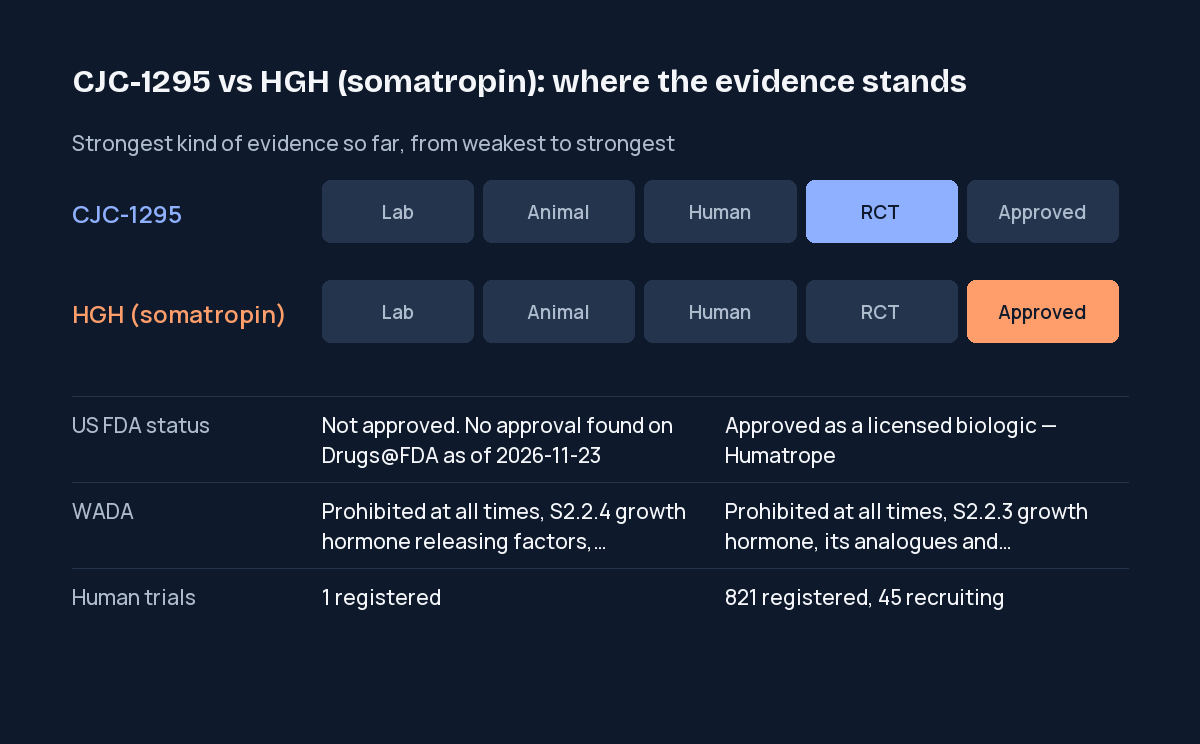
CJC-1295 is a long-acting GHRH analogue that raised mean plasma growth hormone levels 2- to 10-fold for six days or more in healthy adults [Human RCT] (Teichman 2006). HGH (somatropin) is the hormone itself, FDA approved for growth hormone deficiency and several growth disorders (FDA label). CJC-1295 has no approval anywhere and two published human trials.
The two sit at opposite ends of the evidence scale. Somatropin has 821 registered studies and a label with named indications; CJC-1295 has one registered trial, terminated in 2006 without results (NCT00267527). Both are prohibited in sport at all times.
| Item | CJC-1295 | HGH (somatropin) |
|---|---|---|
| US FDA status | Not approved. No approval found on Drugs@FDA as of 2026-11-23 (Drugs@FDA). Next regulatory step: none found as of 2026-11-23 | Approved as a licensed biologic — Humatrope (BLA019640) and other somatropin products — for GH deficiency and named growth disorders (FDA label; Drugs@FDA, searched 2026-11-23) |
| Compounding (503A/503B) | Previously in Category 2, withdrawn by the nominator; FDA cites “serious adverse events … including increased heart rate and systemic vasodilatory reaction” and limited clinical data. Not on the July 2026 advisory-committee agenda. Next step: no FDA listing decision as of 2026-11-23 (FDA) | Licensed under the Public Health Service Act, so it is outside the 503A and 503B compounding exemptions (FDA). Prescription-only |
| WADA | Prohibited at all times, S2.2.4 growth hormone releasing factors, named in the List (2026 List). The 2027 List, in force 2027-01-01, keeps the same S2.2.4 wording and names CJC-1295 again (2027 List) | Prohibited at all times, S2.2.3 growth hormone, its analogues and fragments; unchanged on the 2027 List |
| Strongest evidence | Two randomized, placebo-controlled, double-blind dose-ranging trials in healthy adults, hormone levels only [Human RCT] | Approved label plus randomized trials and systematic reviews with body-composition and performance outcomes [Approved label] |
| Human trials | 1 registered: NCT00267527, phase 2, terminated 2006, 120 planned, no results posted. 2 published trials | 821 registered, 45 recruiting (ClinicalTrials.gov, searched 2026-11-23) |
| Last checked | 2026-11-23 | 2026-11-23 |
Key points:
- CJC-1295 works one step upstream: it tells the pituitary to release its own growth hormone, and in the one trial that measured it, secretion kept its natural pulse pattern.
- Somatropin is the same 191-amino-acid protein the pituitary makes, produced in E. coli.
- CJC-1295 has no published human trial measuring strength; growth hormone’s trials did measure it and found no gain.
- Distributing growth hormone for uses the FDA has not authorized is a federal offense carrying up to five years in prison.
- No published study has given the two together, and none has compared them head to head.
CJC-1295 vs HGH at a glance
| Feature | CJC-1295 | HGH (somatropin) |
|---|---|---|
| What it is | Synthetic GHRH analogue bound to blood albumin | Recombinant human growth hormone, 191 amino acids |
| Class | Growth hormone releasing factor | Peptide hormone (licensed biologic) |
| Target | GHRH receptor on the pituitary | Growth hormone receptor in tissues |
| Main research focus | Prolonging GH and IGF-I release | GH deficiency and named growth disorders |
| Human evidence | 2 published trials (2006a, 2006b) | Decades of trials; reviews of 18 and 27 study populations (Liu 2007, Liu 2008) |
| Approval status | None anywhere | FDA approved, prescription-only |
| WADA | S2.2.4, prohibited at all times | S2.2.3, prohibited at all times |
| Routes studied in humans | Subcutaneous | Subcutaneous |
| Half-life | 5.8–8.1 days | Dosing frequency is set by each product’s label |
| Effect duration in studies | GH up for 6+ days, IGF-I for 9–11 days | Trials ran 20 days to 27 weeks on average |
| Body-composition data | None published in humans | Fat −2.1 kg, lean mass +2.1 kg in older adults |
| Main safety concerns | Raised heart rate, vasodilatory reaction, immunogenicity, unknown long-term risk | Edema, joint pain, carpal tunnel, glucose intolerance, neoplasm risk, mortality in critical illness |
| Product quality | Supplied as unregulated “research” material of uncertain composition | Pharmacy-dispensed, licensed manufacturing |
What is CJC-1295?
CJC-1295 is a synthetic analogue of growth hormone-releasing hormone, the pituitary signal that triggers GH release. Its distinctive feature is a chemical handle that binds it permanently to albumin in the blood, which stretches its half-life to about eight days (Ionescu 2006). That design turned a hormone lasting minutes into one acting for over a week. In mice bred without GHRH, daily CJC-1295 restored normal body weight and length [Animal] (Alba 2006). No further human trial has appeared: the only registered patient trial was terminated in 2006, and a ClinicalTrials.gov search on 2026-11-23 still returns that single record. The version sold online without the albumin-binding complex is covered on our CJC-1295 with DAC vs without DAC comparison.
What is HGH (somatropin)?
Somatropin is recombinant human growth hormone: “the protein is comprised of 191 amino acid residues”, with “the amino acid sequence … identical to that of human GH of pituitary origin”, made in E. coli (FDA label). It is approved for children with growth failure from inadequate GH, Turner syndrome, idiopathic short stature, SHOX deficiency and small-for-gestational-age short stature, and for adults as replacement in GH deficiency. In diagnosed adult deficiency, the Endocrine Society’s guideline says GH therapy “offers benefits in body composition, exercise capacity, skeletal integrity, and quality of life measures” (Molitch 2011). The label adds plainly that it “is not indicated for the treatment of non-GH deficient adults”. How the wider peptide field compares with the hormone is set out in our peptides vs HGH comparison.
How they work differently
- CJC-1295: acts on the pituitary, so the gland’s own release pattern is preserved — trough GH rose 7.5-fold while pulse frequency and size stayed unchanged, lifting mean GH 46% and IGF-I 45% [Human RCT] (Ionescu 2006).
HGH: bypasses the pituitary and delivers the hormone directly, which is why it still works when the gland cannot produce it — the basis of its approved replacement use (FDA label). - CJC-1295: needs a pituitary that can respond; its effect is capped by how much GH the gland will make.
HGH: the amount in the blood is set by the dose, not by the gland, and the body’s own feedback does not limit it. - CJC-1295: one injection kept GH raised for six days or more and IGF-I for 9–11 days [Human RCT] (Teichman 2006).
HGH: the trials above gave it for 20 days to 27 weeks on average, long enough to measure body-composition change rather than hormone levels alone.
Evidence head-to-head
| Outcome | CJC-1295 best evidence | HGH best evidence |
|---|---|---|
| Raising GH and IGF-I | GH 2–10× for 6+ days, IGF-I 1.5–3× for 9–11 days [Human RCT] (Teichman 2006) | Not applicable: it is the hormone, so levels follow the dose [Approved label] |
| Fat mass | No published human measurement | −2.1 kg (95% CI −2.8 to −1.35) in healthy older adults [Meta-analysis of RCTs] (Liu 2007) |
| Lean body mass | No published human measurement | +2.1 kg (CI 1.3 to 2.9) in both reviews, partly extracellular water [Meta-analysis of RCTs] (Liu 2008) |
| Strength | No published human measurement | No improvement in strength or exercise capacity [Meta-analysis of RCTs] (Liu 2008) |
| Sprint capacity | No published human measurement | +3.9% overall, +8.3% with testosterone in men, gone after 6 weeks off [Human RCT (n=96)] (Meinhardt 2010) |
| Growth in deficiency | Normal weight and length restored in GHRH-knockout mice [Animal] (Alba 2006) | Approved indication in children and adults with GH deficiency [Approved label] |
| Musculoskeletal repair | Claimed benefits “remain unsubstantiated by current human trials”; 67% of the literature is animal work [Scoping review] (Tewari 2026) | Not an approved indication; no comparable trial evidence found |
Which fits which goal?
CJC-1295 has more evidence for one narrow thing: raising a person’s own GH and IGF-I for days from a single injection, with the pituitary’s pulse pattern intact (Teichman 2006). What it has never shown in a published human study is any outcome a reader would actually want — fat, muscle, strength, healing or quality of life. HGH has more evidence for every one of those, because it was tested for them: measured fat loss and lean-mass gain, an approved indication in diagnosed deficiency, and honest negative findings on strength. A 2026 review of this peptide family sorts its members “from regulatory-grade randomized trial data to a complete absence of human studies” (Dominikowski 2026). Whether either belongs in a particular person’s care is a clinician’s decision, made with testing, not a choice to make from a comparison table.
Can they be combined?
Nothing published tests the pair. No controlled human study of the combination was found on PubMed or ClinicalTrials.gov (searched 2026-11-23); a PubMed search pairing CJC-1295 with somatropin or recombinant human growth hormone returns no records at all. No head-to-head trial of the two exists either, so every comparison here, including ours, is cross-trial: different participants, different years, different outcome measures. Cross-trial numbers show what each was tested for, not which performs better.
Safety and regulatory status
Somatropin’s risks are documented because they were collected in trials and postmarketing use: soft-tissue edema, joint pain, carpal tunnel syndrome and gynecomastia were all more common on GH than off it, with more cases of new diabetes and impaired fasting glucose [Meta-analysis of RCTs] (Liu 2007). The label carries warnings for neoplasm risk, glucose intolerance, intracranial hypertension usually within eight weeks of starting, hypothyroidism and pancreatitis, and it is contraindicated in active malignancy and acute critical illness, where two placebo-controlled studies in 522 intensive-care patients found mortality of 42% versus 19% (FDA label).
CJC-1295’s record is thinner in both directions. Its two trials reported no serious adverse reactions, but they enrolled healthy adults for weeks, not years. FDA’s compounding page lists “serious adverse events associated with CJC-1295 including increased heart rate and systemic vasodilatory reaction” and notes that “available clinical data are limited”, alongside immunogenicity and impurity concerns (FDA). A 2026 review of this peptide family lists prolactin and cortisol elevations, dysglycaemia, fluid retention, myalgia and injection-site reactions among reported effects, with “uncertainty surrounding product composition” in unregulated supply (Dominikowski 2026).
The legal positions differ sharply. Somatropin is a prescription biologic, and US law makes it an offense to knowingly distribute growth hormone “for any use in humans other than the treatment of a disease or other recognized medical condition” authorized by the FDA, punishable by up to five years in prison (21 U.S.C. 333(e)). CJC-1295 has no approved use to be prescribed for. For athletes, both are prohibited at all times — CJC-1295 under S2.2.4 and growth hormone under S2.2.3 — and the 2027 List keeps both there (WADA). Anyone who suspects a side effect from CJC-1295, somatropin or any other drug or product can report it to the FDA through MedWatch.
How long do effects take in studies?
For CJC-1295, the hormone response is measured in days: GH rose within hours of a single injection and stayed above baseline for six days or more, IGF-I for 9–11 days, and after repeated doses IGF-I remained raised for up to 28 days (Teichman 2006). No published study followed it long enough to measure a physical change. Growth hormone trials ran far longer: a mean of 20 days in the athletic-performance review, eight weeks in the randomized sprint study, and a mean of 27 weeks in the healthy-older-adult review, which is the timescale on which the body-composition changes were measured (Liu 2007).
What users report
These are unverified self-reports from people who usually bought unregulated products, and they are not evidence of anything. People who post about CJC-1295 on forums and social media most often describe deeper sleep in the first week or two, hunger, and a puffy, water-retained look, along with tingling or numbness in the hands that they compare to what growth hormone users describe. Reports of visible body-composition change are much rarer and usually tied to diet and training changes made at the same time. Those who say they have used pharmacy growth hormone generally describe stronger and more consistent effects on body shape, and also more joint ache, swelling and cost. A recurring argument is whether the peptide “does anything” compared with the hormone, with one camp insisting blood tests showed higher IGF-I and another reporting none. The complaints that come up most are product quality and mislabeled vials, pain or redness at the injection site, no effect at all, and the expense of continuing. Several also describe stopping because of fluid retention or rising fasting glucose on a routine blood panel.
Frequently asked questions
Can you take CJC-1295 and growth hormone together?
No published study has tested the two together in people, so nothing is known about the combination’s effects or safety. No controlled human study of it was found on PubMed or ClinicalTrials.gov when searched on 2026-11-23, and a PubMed search pairing CJC-1295 with somatropin or recombinant human growth hormone returns no records at all (ClinicalTrials.gov).
Is CJC-1295 the same thing as HGH?
No. CJC-1295 is a synthetic releasing factor that prompts the pituitary to secrete its own growth hormone, while HGH is the hormone itself. Somatropin is “comprised of 191 amino acid residues” with a sequence identical to pituitary growth hormone, per its FDA label (FDA). One is a signal; the other is the message.
What is an HGH peptide?
It is a loose marketing term for compounds that act on the growth hormone axis rather than being growth hormone. A 2026 review groups them as GHRH analogues such as CJC-1295, sermorelin and tesamorelin, growth hormone secretagogues such as ipamorelin, GH fragments and IGF-1 analogues (Dominikowski 2026). The review describes them as lacking regulatory approval for physique or performance indications.
Does CJC-1295 build muscle like growth hormone does?
Neither has published human evidence of a strength gain, and CJC-1295 has no published human measurement of muscle at all. In growth hormone’s own trials, lean body mass rose 2.1 kg but “strength and exercise capacity did not seem to improve” [Meta-analysis of RCTs] (Liu 2008), and part of that gain was extra body water.
Are CJC-1295 and HGH banned in sport?
Yes, both are prohibited at all times, in and out of competition. WADA’s 2026 List names CJC-1295 under S2.2.4, growth hormone releasing factors, and growth hormone itself under S2.2.3, and the 2027 List in force from 1 January 2027 keeps the same wording (WADA). Our peptides vs steroids vs SARMs guide explains how the classes differ.
References
- Teichman SL, Neale A, Lawrence B, et al. Prolonged stimulation of growth hormone (GH) and insulin-like growth factor I secretion by CJC-1295, a long-acting analog of GH-releasing hormone, in healthy adults. J Clin Endocrinol Metab. 2006. PubMed 16352683
- Ionescu M, Frohman LA. Pulsatile secretion of growth hormone (GH) persists during continuous stimulation by CJC-1295, a long-acting GH-releasing hormone analog. J Clin Endocrinol Metab. 2006. PubMed 17018654
- Alba M, Fintini D, Sagazio A, et al. Once-daily administration of CJC-1295, a long-acting GHRH analog, normalizes growth in the GHRH knockout mouse. Am J Physiol Endocrinol Metab. 2006. PubMed 16822960
- Liu H, Bravata DM, Olkin I, et al. Systematic review: the safety and efficacy of growth hormone in the healthy elderly. Ann Intern Med. 2007. PubMed 17227934
- Liu H, Bravata DM, Olkin I, et al. Systematic review: the effects of growth hormone on athletic performance. Ann Intern Med. 2008. PubMed 18347346
- Meinhardt U, Nelson AE, Hansen JL, et al. The effects of growth hormone on body composition and physical performance in recreational athletes: a randomized trial. Ann Intern Med. 2010. PubMed 20439575
- Molitch ME, Clemmons DR, Malozowski S, et al. Evaluation and treatment of adult growth hormone deficiency: an Endocrine Society clinical practice guideline. J Clin Endocrinol Metab. 2011. PubMed 21602453
- Dominikowski A, Rękoś Z, Olejarz M, et al. The emerging landscape of performance-enhancing peptides modulating GH-IGF1 axis. Front Endocrinol. 2026. PubMed 42395176
- Tewari K, Liu TP, Im C, et al. Peptide supplements and their therapeutic applications in sports medicine. Am J Sports Med. 2026. PubMed 42578445
- US Food and Drug Administration. HUMATROPE (somatropin) for injection, prescribing information, 2026. DailyMed label
- US Food and Drug Administration. Drugs@FDA database (searched 2026-11-23). Drugs@FDA
- US Food and Drug Administration. Certain bulk drug substances for use in compounding that may present significant safety risks (content current 2026-04-22). FDA
- US Food and Drug Administration. Notice to compounders: changes that affect compounding, March 23, 2020. FDA
- ClinicalTrials.gov. A study to evaluate CJC 1295 in HIV patients with visceral obesity, NCT00267527. ClinicalTrials.gov
- ClinicalTrials.gov. Registered studies of somatropin (searched 2026-11-23). ClinicalTrials.gov
- World Anti-Doping Agency. The 2026 Prohibited List, in force 1 January 2026. WADA (PDF)
- World Anti-Doping Agency. The 2027 Prohibited List, in force 1 January 2027. WADA (PDF)
- 21 U.S.C. 333(e), prohibited distribution of human growth hormone. govinfo
Change log
2026-11-23: first published after review by the editorial team.