The best-researched peptides for acne and skin are a short list, and none is an approved acne drug. For acne, the most encouraging human signal comes from afamelanotide: in a three-patient pilot, inflammatory lesions fell in every patient by day 56 (Böhm 2014, Human case series, n=3). It is FDA-approved only for a light-sensitivity disorder, erythropoietic protoporphyria. For skin aging, cosmetic peptides and oral collagen peptides have small randomized trials with modest results. Most other popular skin peptides have lab or animal data only.
| Item | Status |
|---|---|
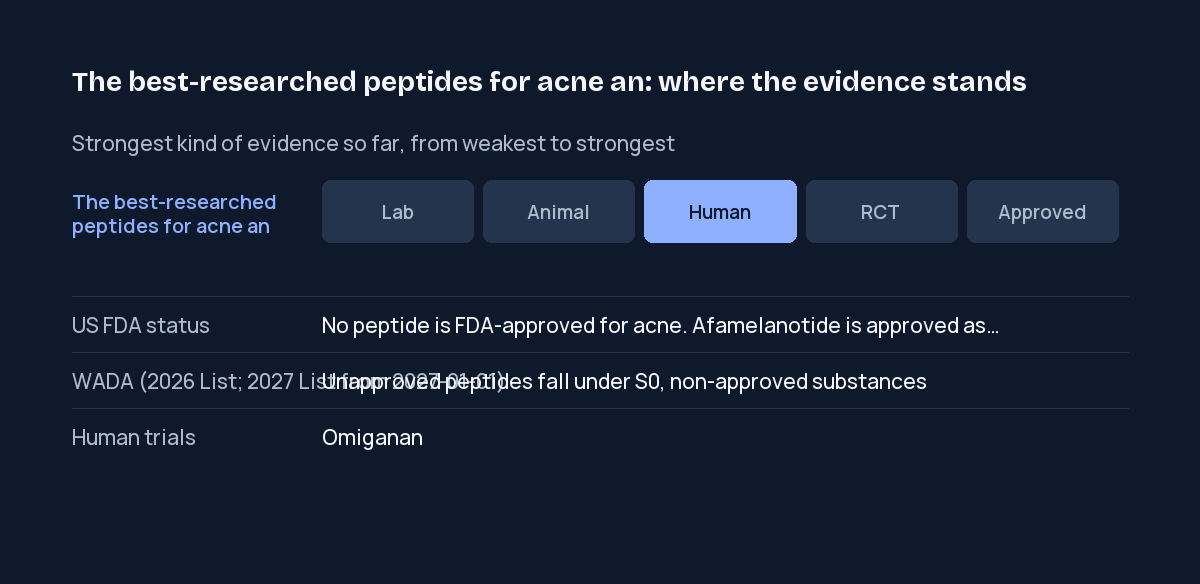
| US FDA status | No peptide is FDA-approved for acne. Afamelanotide is approved as Scenesse for erythropoietic protoporphyria (EPP) only (label). Omiganan has no FDA approval as of 2026-11-21. Peptide creams are generally sold as cosmetics and collagen peptides as supplements, which FDA does not approve (FDA) |
| Compounding (503A/503B) | GHK-Cu (injectable), LL-37, KPV and melanotan II: withdrawn from Category 2 by nominators (FDA, 2026-04-22). KPV: advisory committee voted 8–6 (1 abstention, as reported by trade press) on 2026-07-23 to recommend 503A listing; advisory, no FDA rule yet (meeting page) |
| WADA (2026 List; 2027 List from 2027-01-01) | Unapproved peptides fall under S0, non-approved substances (USADA). The 2027 List names “peptides” in general under S0, prohibited at all times (USADA 2027). Afamelanotide is approved, so not S0 (our reading) |
| Strongest evidence | Acne: Human case series (n=3, afamelanotide). Rosacea: two phase 3 RCTs of omiganan, one positive and one negative. Skin aging: meta-analysis of 19 RCTs (n=1,341) |
| Human trials | Omiganan: NCT02571998 (acne, no results posted), NCT02547441, NCT02576860 (rosacea). Afamelanotide: NCT04943159 (acne, n=3) |
| Last checked | 2026-11-21 |
Key points:
- The treatments the American Academy of Dermatology strongly recommends for acne are benzoyl peroxide, topical retinoids, topical antibiotics, oral doxycycline and, for severe acne, isotretinoin; none is a peptide.
- Omiganan, an antimicrobial peptide gel, beat vehicle in one phase 3 rosacea trial (n=463) and failed in the other (n=263).
- A phase 2 omiganan trial in 320 women with acne finished in 2016, but no results were posted on ClinicalTrials.gov as of 2026-11-21.
- Oral collagen looks positive in pooled trials, but a 2025 meta-analysis found no effect in trials without industry funding.
- LL-37, the skin’s own antimicrobial peptide, is found at abnormally high levels in rosacea skin, and those peptides drove inflammation in mice.
Best peptides for acne and skin, ranked by evidence
This roundup orders each peptide by the strongest evidence it has for acne or skin: an approved peptide drug first, then peptides with human trials, then peptides with lab or animal data only. Numbers from different trials are cross-trial comparisons: the people, products and measures differ, so they cannot be ranked against each other directly.
| Peptide | Best evidence | Key finding |
|---|---|---|
| Afamelanotide (Scenesse) | Human case series (n=3, acne) | Inflammatory lesions fell from a pooled 46 to 23.7 by day 56 (NCT04943159) |
| Omiganan gel | Human RCT, phase 3 (rosacea) | Lesions −18.1 vs −13.5 in one trial (NCT02547441); no difference in the other |
| Cleanser with ALA and peptides | Human RCT (n=60, acne) | Inflammatory lesions 5.9 to 4.1 over 8 weeks (Lee 2020) |
| Palmitoyl pentapeptide-4 | Human RCT (n=93, wrinkles) | Fewer fine lines vs placebo over 12 weeks (Robinson 2005) |
| Argireline | Human RCT (n=60, wrinkles) | 48.9% vs 0% efficacy at 4 weeks (Wang 2013) |
| Oral collagen peptides | Meta-analyses of RCTs (aging) | Positive overall; no effect in non-industry trials (Myung 2025) |
| GHK-Cu | Human RCT (n=13, after laser) | No objective difference; higher satisfaction (Miller 2006) |
| LL-37 | Lab and animal | High in rosacea skin; inflamed mouse skin (Yamasaki 2007) |
| KPV | Lab (in vitro) | Inhibited S. aureus growth (Cutuli 2000) |
Tier 1: approved peptide drugs
Afamelanotide (Scenesse)
Afamelanotide is a synthetic analogue of alpha-melanocyte-stimulating hormone (α-MSH), a hormone that increases skin pigmentation during tanning (Böhm 2014). Its FDA label approves it, since 2019, to increase pain-free light exposure in adults with phototoxic reactions from erythropoietic protoporphyria (Scenesse label). It is given as an implant by a trained healthcare professional, not as a cream.
Its acne result is small but encouraging. In an open-label pilot, total and inflammatory acne lesions declined in all three patients by day 56, and quality-of-life scores improved in all three (Böhm 2014, Human case series, n=3). The trial record reports a pooled count of 46 inflammatory lesions at baseline and 23.7 at day 56 (NCT04943159). The drawbacks were plain: every patient’s skin darkened, especially on the face, and the authors called for larger trials. Acne is not an approved use.
Tier 2: peptides with human trials
Omiganan, an antimicrobial peptide gel
Omiganan is a synthetic antimicrobial peptide (a short protein that kills microbes) developed as a skin gel. A 2017 review of early-stage acne drugs listed it among the compounds in phase 1 and 2 trials (Zouboulis 2017). Its acne trial enrolled 320 women with moderate to severe acne and finished in 2016, but no results were posted (NCT02571998, checked 2026-11-21).
Rosacea, a related facial condition with bumps and redness, has the fuller record. In the larger phase 3 trial, inflammatory lesions fell by 18.1 on omiganan vs 13.5 on vehicle at week 12 (p=0.043), and 26.3% vs 16.9% improved by two severity grades (NCT02547441, Human RCT, n=463). The second phase 3 trial found no difference: −19.8 vs −20.9 (p=0.799) (NCT02576860, Human RCT, n=263). Omiganan has no FDA approval as of 2026-11-21.
Peptide cleansers for acne-prone skin
One randomized trial tested a cleanser combining 5-aminolevulinic acid (ALA) with peptides in 60 people with mild to moderate acne. Over 8 weeks, inflammatory lesions in the treatment group fell from 5.9 to 4.1 and non-inflammatory lesions from 11.4 to 7.4, with adverse events similar to the plain cleanser (Lee 2020, Human RCT, n=60). The abstract does not name the peptides, and the cleanser also contained ALA, so the result cannot be credited to the peptides alone.
Cosmetic signal peptides for aging skin
Cosmetic peptides have been tested in randomized trials mainly for wrinkles. Palmitoyl pentapeptide-4 (Pal-KTTKS) reduced wrinkles and fine lines vs placebo in a 12-week split-face trial in 93 women aged 35–55 and was well tolerated (Robinson 2005, Human RCT, n=93). Argireline (acetyl hexapeptide-3), modeled on the nerve protein SNAP-25, reached 48.9% anti-wrinkle efficacy vs 0% for placebo after 4 weeks around the eyes (Wang 2013, Human RCT, n=60). A 2026 meta-analysis of 19 RCTs with 1,341 participants found peptides improved hydration and brightness, with a modest pooled effect on wrinkles driven mainly by oral peptides; effects on elasticity were inconsistent (Nukaly 2026, meta-analysis). None of these trials tested acne.
GHK-Cu (copper peptide)
GHK-Cu is a copper tripeptide used in skin care products. Its controlled human data for skin are thin: in a randomized trial of 13 patients after CO2 laser resurfacing, blinded evaluators found no difference in redness, wrinkles or skin quality, though patient satisfaction was higher with GHK-Cu products (P=.04) (Miller 2006, Human RCT, n=13). No controlled trial of GHK-Cu in acne was found on PubMed or ClinicalTrials.gov (searched 2026-11-21). The GHK-Cu results timeline covers its wound and hair studies, and GHK-Cu serum vs injection vs retinol compares it with retinol.
Oral collagen peptides
Collagen peptides are taken by mouth as a supplement. A 2021 meta-analysis of 19 trials with 1,125 participants (95% women) found better hydration, elasticity and wrinkles than placebo (de Miranda 2021, meta-analysis). A 2025 meta-analysis of 23 RCTs with 1,474 participants split the trials by funding: industry-funded trials showed benefits, while trials without industry funding and the high-quality trials showed no effect (Myung 2025, meta-analysis). No acne trial of collagen peptides turned up in these reviews.
Tier 3: lab and animal data only
LL-37 (cathelicidin)
LL-37 is the skin’s own antimicrobial peptide, and the acne research on it points both ways. In human acne lesions and mice, fat-precursor cells around hair follicles made cathelicidin when exposed to the acne bacterium C. acnes, and retinoids raised it further (O’Neill 2022, Animal and human tissue). In rosacea, people had abnormally high cathelicidin levels in facial skin, and injecting those cathelicidin peptides increased inflammation in mouse skin (Yamasaki 2007, Animal and human tissue). FDA notes nonclinical findings that LL-37 can be protumorigenic in some settings (FDA).
KPV
KPV is a three-amino-acid fragment of α-MSH. In lab tests, α-MSH peptides including KPV inhibited Staphylococcus aureus colony formation and Candida yeast (Cutuli 2000, Lab). FDA’s advisory committee reviewed KPV for wound healing and inflammatory conditions in July 2026 (FDA meeting page). No human acne study of KPV was found on PubMed or ClinicalTrials.gov (searched 2026-11-21).
Melanotan II
Melanotan II is an unapproved tanning peptide, not a skin treatment. A review of unregulated melanotan use describes changes in existing moles, new atypical moles and four case reports of melanoma, while noting that conclusive evidence of a link is lacking (Habbema 2017, Review of case reports). The Melanotan 1 vs Melanotan 2 comparison covers it in detail.
Peptide skincare for acne-prone skin: cosmetic or drug?
Peptide serums, creams and moisturizers sold for acne-prone skin are usually cosmetics. FDA decides whether a product is a cosmetic or a drug by its intended use: a product meant to treat a disease or change the body’s structure or function is a drug, and the law recognizes no “cosmeceutical” category (FDA). A cosmetic peptide product has not been through drug approval for acne. The acne guideline’s strong recommendations go to benzoyl peroxide, topical retinoids, topical antibiotics and oral doxycycline, with conditional ones for salicylic acid, azelaic acid and clascoterone (Reynolds 2024, Guideline).
Safety and regulatory status
Afamelanotide’s label lists skin hyperpigmentation, melanocytic nevus (moles), implant-site reactions, nausea and fatigue among its most common side effects, and recommends a full skin exam twice a year to watch moles (Scenesse label). In the omiganan rosacea trial, serious adverse events were equal: 4 of 235 on omiganan and 4 of 228 on vehicle (NCT02547441). The 2026 meta-analysis reported topical and oral peptides were well tolerated, with few adverse events (Nukaly 2026).
The injectable “skin peptides” carry more risk. FDA says compounded injectable GHK-Cu may pose an immunogenicity risk and that human safety data are limited, that it has found no human exposure data for KPV, and that case reports link melanotan II to melanoma, posterior reversible encephalopathy syndrome, and priapism (FDA). Collagen supplements are not approved by FDA before sale (FDA). For athletes, unapproved peptides fall under WADA’s S0 class, and the 2027 List names peptides in general, prohibited at all times from 2027-01-01 (USADA).
Anyone who suspects a side effect from a skin peptide or any other drug or product can report it to the FDA through MedWatch.
What users report
The following are unverified self-reports from people who usually bought unregulated products, and they are not evidence. People who post about peptide skincare commonly describe smoother or plumper-looking skin from copper peptide and “signal peptide” serums after several weeks, and many say they saw no change at all. A recurring complaint is that copper peptide serums sting, cause redness or break people out, which leads to long arguments about whether a product “purges” acne or simply irritates skin. Others report that peptide moisturizers feel gentle enough for oily, acne-prone skin but did little for active breakouts. People who post about injectable GHK-Cu or melanotan describe darker skin, new freckles or moles, nausea and flushing, and many argue about product purity and labeling. Collagen powder users often report better-looking skin or nails, while others say nothing changed, and debates about brand quality are common.
Frequently asked questions
What peptides are good for acne?
No peptide is approved for acne, and the human acne data are small. The most encouraging result is from afamelanotide, where inflammatory lesions fell in all three patients of an open-label pilot by day 56 (Böhm 2014, Human case series, n=3). Omiganan’s 320-woman acne trial has no posted results.
Are copper peptides good for acne-prone skin?
There is no controlled human acne trial of copper peptides, as searched on PubMed and ClinicalTrials.gov on 2026-11-21. The one randomized skin trial found no objective benefit after laser resurfacing, only higher patient satisfaction (Miller 2006, Human RCT, n=13).
Do collagen peptides help skin?
Pooled trials of oral collagen show improved hydration, elasticity and wrinkles, but the evidence is disputed. A 2025 meta-analysis of 23 RCTs found the benefit only in industry-funded trials, with no effect in independent or high-quality trials (Myung 2025, meta-analysis). No collagen trial measured acne.
What do peptides do for skin?
In trials, oral and topical peptides mainly produced modest gains in hydration, brightness and fine lines (Human RCTs). A 2026 meta-analysis of 19 RCTs with 1,341 participants found improved hydration and brightness and a small wrinkle effect, mostly from oral peptides, with inconsistent elasticity results (Nukaly 2026). Effects on acne were not tested.
Are peptide skincare products FDA approved?
Peptide serums and creams are generally sold as cosmetics, which do not go through FDA drug approval. FDA classifies a product by its intended use, and a claim to treat a disease such as acne makes it a drug under the law (FDA). The only approved peptide covered here, afamelanotide, is approved for a light-sensitivity disorder.
References
- Böhm M, Ehrchen J, Luger TA. Beneficial effects of the melanocortin analogue Nle4-D-Phe7-α-MSH in acne vulgaris. J Eur Acad Dermatol Venereol. 2014. PubMed 22845050
- Clinuvel Pharmaceuticals. Afamelanotide in patients suffering with acne vulgaris. ClinicalTrials.gov. NCT04943159
- Clinuvel Inc. SCENESSE (afamelanotide) implant, prescribing information. DailyMed, revised 2024. DailyMed
- Maruho Co. CLS001 (omiganan) topical gel vs vehicle in papulopustular rosacea, phase 3. ClinicalTrials.gov. NCT02547441
- Maruho Co. CLS001 (omiganan) topical gel vs vehicle in papulopustular rosacea, phase 3. ClinicalTrials.gov. NCT02576860
- Maruho Co. Omiganan (CLS001) topical gel vs vehicle in female subjects with acne vulgaris, phase 2. ClinicalTrials.gov. NCT02571998
- Zouboulis CC, Dessinioti C, Tsatsou F, Gollnick HPM. Anti-acne drugs in phase 1 and 2 clinical trials. Expert Opin Investig Drugs. 2017. PubMed 28627277
- Reynolds RV, Yeung H, Cheng CE, et al. Guidelines of care for the management of acne vulgaris. J Am Acad Dermatol. 2024. PubMed 38300170
- Lee HJ, Kim JY, Park KD, Lee WJ. Randomized controlled double-blind study of a cleanser composed of 5-aminolevulinic acid and peptides on mild and moderate acne vulgaris. J Cosmet Dermatol. 2020. PubMed 31778021
- Robinson LR, Fitzgerald NC, Doughty DG, et al. Topical palmitoyl pentapeptide provides improvement in photoaged human facial skin. Int J Cosmet Sci. 2005. PubMed 18492182
- Wang Y, Wang M, Xiao S, et al. The anti-wrinkle efficacy of argireline, a synthetic hexapeptide, in Chinese subjects: a randomized, placebo-controlled study. Am J Clin Dermatol. 2013. PubMed 23417317
- Nukaly HY, Halawani IR, Irtaza HM, et al. Oral and topical peptides for skin aging: systematic review and meta-analysis of randomized controlled trials. Front Med. 2026. PubMed 41924746
- Miller TR, Wagner JD, Baack BR, Eisbach KJ. Effects of topical copper tripeptide complex on CO2 laser-resurfaced skin. Arch Facial Plast Surg. 2006. PubMed 16847171
- de Miranda RB, Weimer P, Rossi RC. Effects of hydrolyzed collagen supplementation on skin aging: a systematic review and meta-analysis. Int J Dermatol. 2021. PubMed 33742704
- Myung SK, Park Y. Effects of collagen supplements on skin aging: a systematic review and meta-analysis of randomized controlled trials. Am J Med. 2025. PubMed 40324552
- O’Neill AM, Liggins MC, Seidman JS, et al. Antimicrobial production by perifollicular dermal preadipocytes is essential to the pathophysiology of acne. Sci Transl Med. 2022. PubMed 35171653
- Yamasaki K, Di Nardo A, Bardan A, et al. Increased serine protease activity and cathelicidin promotes skin inflammation in rosacea. Nat Med. 2007. PubMed 17676051
- Cutuli M, Cristiani S, Lipton JM, Catania A. Antimicrobial effects of alpha-MSH peptides. J Leukoc Biol. 2000. PubMed 10670585
- Habbema L, Halk AB, Neumann M, Bergman W. Risks of unregulated use of alpha-melanocyte-stimulating hormone analogues: a review. Int J Dermatol. 2017. PubMed 28266027
- US FDA. Certain bulk drug substances for use in compounding that may present significant safety risks. Content current as of 2026-04-22. FDA
- US FDA. July 23–24, 2026: Meeting of the Pharmacy Compounding Advisory Committee. FDA
- US FDA. Is it a cosmetic, a drug, or both? (Or is it soap?). FDA
- US FDA. Questions and answers on dietary supplements. Content current as of 2026-08-27. FDA
- USADA. Athlete advisory: 2027 Prohibited List. USADA
- USADA. #AskUSADA: What is a non-approved substance and why are they prohibited? USADA
Change log
2026-11-21: first published after review by the editorial team.