Tesamorelin, FDA-approved as Egrifta, cut deep belly fat by 15.2% in a 412-person phase 3 trial in people with HIV. AOD-9604, a growth-hormone fragment, was well tolerated in trials of about 900 volunteers, but it is not FDA-approved and failed a 24-week weight-loss trial.
The evidence gap is wide. Tesamorelin rests on two phase 3 randomized trials and an FDA label, but its approval covers one use only: excess abdominal fat in adults with HIV-associated lipodystrophy, a condition where fat collects around the organs. AOD-9604’s six human trials were run and funded by its developer, and no peer-reviewed report of the weight results from its two larger trials was found on PubMed (searched 2026-10-17). Both are prohibited in sport at all times.
| Item | AOD-9604 | Tesamorelin |
|---|---|---|
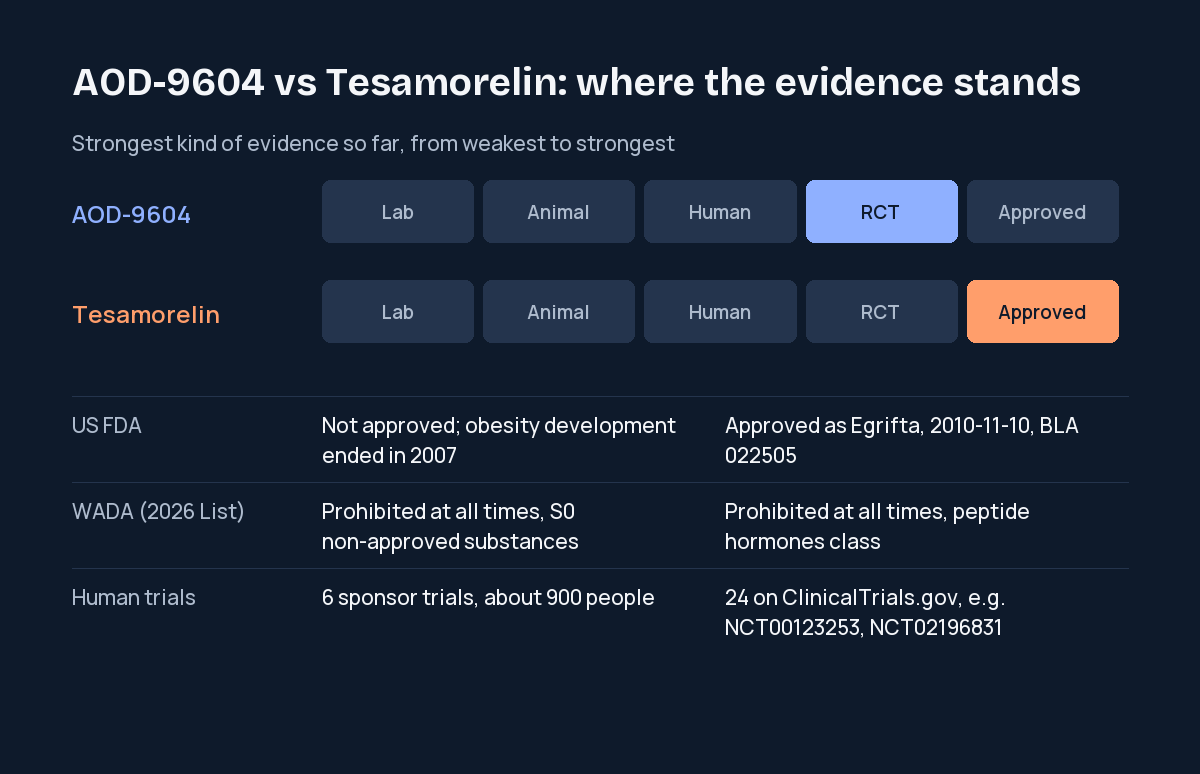
| US FDA | Not approved; obesity development ended in 2007 (Misra 2013) | Approved as Egrifta, 2010-11-10, BLA 022505 (Drugs@FDA); latest label 2025-03-25 |
| Compounding | Nomination withdrawn; listed as “withdrawn” on FDA’s Category 2 page (current 2026-04-22), with no new category given; next step: none announced | A biologic since 2020-03-23, so not eligible for 503A/503B exemptions (FDA) |
| WADA (2026 List) | Prohibited at all times, S0 non-approved substances (USADA on S0) | Prohibited at all times, peptide hormones class (USADA) |
| WADA 2027 List | Not yet checked against WADA’s published 2027 List (WADA) | |
| Strongest evidence | Human RCTs run by the sponsor; weight results not peer-reviewed; the 24-week trial failed | Approved label backed by two phase 3 RCTs |
| Human trials | 6 sponsor trials, about 900 people (Stier 2013); 0 on ClinicalTrials.gov | 24 on ClinicalTrials.gov, e.g. NCT00123253, NCT02196831 |
| Last checked | 2026-10-17 | |
Key points:
- AOD-9604’s most encouraging human result: in a 12-week trial, the 1 mg arm lost 2.6 kg against 0.8 kg on placebo (Misra 2013, Human RCT).
- In the sponsor’s trials, AOD-9604 did not raise IGF-1 or worsen glucose tolerance (Stier 2013).
- Tesamorelin also cut liver fat: 35% of treated patients, against 4% on placebo, ended with liver fat below 5% (Stanley 2019, Human RCT, n=61).
- Tesamorelin’s label says it is not indicated for weight loss, and belly fat came back in patients switched to placebo (Egrifta WR label).
- Tesamorelin is not approved in the EU: the applicant withdrew in 2012 after reviewers judged its benefits did not outweigh its risks (EMA).
AOD-9604 vs tesamorelin at a glance
| Feature | AOD-9604 | Tesamorelin |
|---|---|---|
| What it is | Modified fragment of human growth hormone (Tyr-hGH 177–191) | Modified copy of human GHRH (44 amino acids) |
| Class | Growth-hormone fragment | GHRH analogue |
| Mechanism | Fat breakdown in fat tissue (animal); no IGF-1 rise in human trials | Binds GHRH receptors; raises the body’s own GH |
| Main research focus | Obesity (stopped 2007); cartilage in animals | HIV-associated belly fat; liver fat |
| Human evidence | 6 sponsor trials, about 900 people | 24 registered trials; 2 phase 3 RCTs |
| Approval | None (FDA) | FDA-approved (Egrifta); EU application withdrawn |
| WADA | S0, prohibited at all times | Peptide hormones class, prohibited at all times |
| Routes studied | IV and oral (human); into the joint (rabbit) | Injection under the skin |
| Timelines in studies | 12 and 24 weeks | 26 to 52 weeks; 12 months for liver fat |
| Main safety concerns | Long-term effects unknown; FDA flags immunogenicity and impurity risks in compounded forms | IGF-1 rise, glucose intolerance, fluid retention, injection-site reactions |
What is AOD-9604?
AOD-9604 is a 16-amino-acid peptide based on the tail end of human growth hormone (amino acids 177–191, plus a tyrosine). Its developer, Metabolic Pharmaceuticals, designed it to keep growth hormone’s fat-reducing action without its unwanted effects (Stier 2013). In obese rats, oral AOD-9604 cut body-weight gain by more than half, 15.8 g against 35.6 g [Animal] (Ng 2000). The company then tested it in about 900 people. Development for obesity ended in 2007 after a 24-week trial failed to show significant weight loss (Misra 2013). It has no FDA approval.
What is tesamorelin?
Tesamorelin is the full 44-amino-acid sequence of human growth-hormone-releasing hormone (GHRH) with a short fatty chain attached. It is sold as Egrifta, and its label indication is the “reduction of excess abdominal fat in HIV-infected adult patients with lipodystrophy” (Egrifta WR label). It was approved on 2010-11-10, and the latest label supplement, for the Egrifta WR form, is dated 2025-03-25 (Drugs@FDA). Our comparison of tesamorelin with ipamorelin and sermorelin covers how it differs from other growth-hormone releasers.
How they work differently
- AOD-9604: works on fat tissue itself. In obese mice it raised fat burning (fat oxidation) and reduced weight gain [Animal] (Heffernan, Int J Obes 2001).
Tesamorelin: works upstream, on the pituitary gland. It binds GHRH receptors “with similar potency as the endogenous GRF” and triggers pulses of the body’s own growth hormone (label). - AOD-9604: did not raise IGF-1 (insulin-like growth factor 1, the hormone behind most of growth hormone’s growth effects) in human trials (Stier 2013).
Tesamorelin: raises IGF-1 by design. After 26 weeks, 47% of treated patients had IGF-1 above 2 standard deviation scores (label). - AOD-9604: in mice lacking the beta-3 adrenergic receptor, a fat-cell receptor that triggers fat breakdown, its long-term effects disappeared, though single doses still raised energy use [Animal] (Heffernan, Endocrinology 2001).
Tesamorelin: depends on a working growth-hormone axis, and the label rules it out for people whose hypothalamic-pituitary axis is disrupted.
Evidence head-to-head
Each cell gives the best evidence found for that option. Figures from different trials are cross-trial: different people, designs and endpoints, so the numbers cannot be compared directly.
| Outcome | AOD-9604 best evidence | Tesamorelin best evidence |
|---|---|---|
| Visceral (belly) fat | No human data found. Animal: less fat in obese mice (Heffernan 2001) | Human RCT (n=412): −15.2% vs +5.0% on placebo at 26 weeks (Falutz 2007) |
| Body weight | Human RCT: 2.6 kg vs 0.8 kg at 12 weeks; 24-week RCT (n=536): no significant loss (Misra 2013) | Approved label: not indicated for weight loss; trunk fat −1.0 to −0.8 kg, lean mass +1.3 to +1.2 kg (label) |
| Liver fat | No study found | Human RCT (n=61): liver fat −4.1 points vs placebo, p=0.018 (Stanley 2019) |
| Blood sugar | Human RCT: no glucose-tolerance difference at 24 weeks, P=0.63 (Stier 2013) | Label: HbA1c ≥6.5% in 5% vs 1% on placebo |
| Joint cartilage | Animal: better cartilage scores in rabbit knee arthritis (Kwon 2015) | No study found |
| Long-term safety | No data beyond 24 weeks found | Label: long-term heart safety not established |
Tesamorelin’s main benefit has been replicated. In the second phase 3 trial, visceral fat fell 14% against a 2% fall on placebo (Egrifta label). In a separate six-month trial, visceral fat changed by −34 cm² on tesamorelin against +8 cm² on placebo, and liver fat by a median −2.0 points against +0.9 (p=0.003) [Human RCT] (Stanley 2014). AOD-9604’s strongest result, the 12-week weight loss, is reported in a journal review of company results (Misra 2013), not in a peer-reviewed trial report. Its developer funded all six trials, and one author of the safety paper held a stake in the developer’s parent company (Stier 2013). The two sources also disagree on the size of the 24-week trial: 502 adults (Stier) or 536 (Misra).
Which fits which goal?
Tesamorelin has more evidence for reducing visceral belly fat and liver fat, but only in adults with HIV. Two phase 3 trials and later liver studies back it, and the FDA approved it for that use. Its label excludes weight-loss use (label). Our page on tesamorelin evidence and safety in women covers who was studied.
AOD-9604 has more evidence for leaving IGF-1 and blood sugar unchanged, because its trials measured those things directly (Stier 2013). For weight loss, its longest trial failed. For joints, the evidence is a single rabbit study.
Searches that add retatrutide to this pair are reaching for a different class, the incretin drugs, compared in retatrutide vs CagriSema: trials, FDA timeline and safety. A clinician is the person to decide whether any of these fits an individual.
Can AOD-9604 and tesamorelin be taken together?
Searches often pair the two, sometimes with MOTS-c or ipamorelin in a blend. ClinicalTrials.gov lists no registered trial of AOD-9604 at all (searched 2026-10-17), so none of these blends has a registered trial there. No controlled human study of the combination was found on PubMed or ClinicalTrials.gov (searched 2026-10-17). Whether the two add to each other’s effects, or whether combining them changes the safety picture, is unknown. MOTS-c is compared with another metabolic compound in MOTS-c vs 5-Amino-1MQ: evidence and safety, and tesamorelin is set against an ipamorelin pairing in tesamorelin vs CJC-1295 + ipamorelin for fat loss.
Safety and regulatory status
United States. Tesamorelin is a prescription biologic. Its label lists IGF-1 rises, glucose intolerance (HbA1c ≥6.5% in 5% vs 1% on placebo), hypersensitivity in 4%, fluid retention (swelling, joint pain, carpal tunnel syndrome) and injection-site reactions in 25% vs 14% on placebo (Egrifta WR label). Joint pain affected 13% vs 11%, and swelling of the limbs 6% vs 2%. It must not be used in pregnancy, with active cancer, or with a disrupted hypothalamic-pituitary axis. As a biologic it is not eligible for the compounding exemptions (FDA).
AOD-9604 has no FDA approval. In the sponsor’s 24-week trial, 78.7% of participants had at least one adverse event and 3.6% a serious one; the authors judged its profile “indistinguishable from placebo” across the six trials (Stier 2013). FDA writes that compounded AOD-9604 “may pose significant risk for immunogenicity” (an immune reaction against the drug) and that it lacks enough information to know whether it causes harm in people (FDA Category 2 page). Being moved to that page’s withdrawn-nominations table is not an approval.
European Union. Tesamorelin’s EU application was withdrawn on 2012-06-21. Reviewers at the time cited IGF-1-related cancer and diabetic eye-disease concerns, fat loss “not shown to be clinically meaningful in terms of actual health benefits”, and no long-term safety data (EMA).
Sport. Tesamorelin is prohibited at all times (USADA). AOD-9604 falls under S0, which covers substances “not approved by any government regulatory authority” (USADA).
Anyone who suspects a side effect from AOD-9604, tesamorelin or any other drug or product can report it to the FDA through MedWatch.
How long do effects take in studies?
- Tesamorelin: visceral fat fell over 26 weeks in both phase 3 trials. Between weeks 26 and 52, patients who stayed on the drug kept their loss, while those switched to placebo regained 24–25 cm² (label). The liver-fat result was measured at 12 months (Stanley 2019).
- AOD-9604: the weight difference was reported at 12 weeks; at 24 weeks it was not significant (Misra 2013).
What users report
What follows are unverified self-reports from people who usually bought unregulated products; they are not evidence. People who post about AOD-9604 commonly describe it as mild: some report a slightly flatter stomach or easier fat loss alongside diet changes, and many say they noticed nothing after weeks of use. A recurring argument is whether AOD-9604 does anything at all, with posters pointing to the failed obesity trial. Posts about tesamorelin more often describe a visible change in belly fat over a few months, along with water retention, joint aches, tingling hands and redness where it was injected. Cost is a frequent complaint, and posters say insurers tend to cover branded tesamorelin only for the HIV indication. Many threads discuss blends that pair the two, often with MOTS-c or ipamorelin, and posters disagree about whether any change comes from the blend, from diet or from expectation. Product quality is a constant worry: people question whether unregulated products contain what the label says, and some blame lumps or reactions on contamination.
Frequently asked questions
How much weight can people lose on AOD-9604?
Little, on current evidence. In its best human result, the 1 mg arm of a 12-week trial lost 2.6 kg against 0.8 kg on placebo. A later 24-week trial in 536 adults found no significant weight loss, and development stopped in 2007 (Misra 2013). No peer-reviewed report of either trial’s weight results was found on PubMed (searched 2026-10-17).
Can tesamorelin and AOD-9604 be used together?
Nobody knows how the pair behaves, because no controlled human study of it was found on PubMed or ClinicalTrials.gov (searched 2026-10-17). Effects and safety of the combination are unknown, and both are prohibited in sport at all times.
Which has more evidence for fat loss, AOD-9604 or tesamorelin?
Tesamorelin. In a phase 3 trial of 412 adults with HIV, visceral fat fell 15.2% against a 5.0% rise on placebo over 26 weeks (Falutz 2007). AOD-9604’s longest trial failed. These are cross-trial figures from different populations, and tesamorelin is approved only for HIV-associated abdominal fat.
Does tesamorelin cause weight loss?
Not much on the scale. Its label states that it is not indicated for weight loss: over 26 weeks, trunk fat fell by about 1 kg while lean mass rose by 1.2–1.3 kg (Egrifta WR label). The benefit is less deep belly fat, and in the trials that fat returned in patients switched to placebo.
Is AOD-9604 safer than tesamorelin?
That is not known. AOD-9604 showed no IGF-1 or blood-sugar effects in sponsor trials of up to 24 weeks (Stier 2013), but no longer-term data were found, and FDA flags immunogenicity risks in compounded forms. Tesamorelin’s risks are better documented, through phase 3 trials, an FDA label and 24 registered studies.
References
- Falutz J, Allas S, Blot K, et al. 2007. Metabolic effects of a growth hormone-releasing factor in patients with HIV. New England Journal of Medicine. PubMed 18057338
- Stanley TL, Feldpausch MN, Oh J, et al. 2014. Effect of tesamorelin on visceral fat and liver fat in HIV-infected patients with abdominal fat accumulation: a randomized clinical trial. JAMA 312(4):380-389. PubMed 25038357
- Stanley TL, Fourman LT, Feldpausch MN, et al. 2019. Effects of tesamorelin on non-alcoholic fatty liver disease in HIV: a randomised, double-blind, multicentre trial. Lancet HIV 6(12):e821-e830. PubMed 31611038
- US FDA. Egrifta WR (tesamorelin) prescribing information, revised March 2025. accessdata.fda.gov
- US FDA. Drugs@FDA: Egrifta, BLA 022505. accessdata.fda.gov
- US FDA. Notice to compounders: changes that affect compounding on March 23, 2020. fda.gov
- US FDA. Certain bulk drug substances for use in compounding that may present significant safety risks (content current as of 2026-04-22). fda.gov
- European Medicines Agency. Egrifta: withdrawn application (2012). ema.europa.eu
- Stier H, Vos E, Kenley D. 2013. Safety and tolerability of the hexadecapeptide AOD9604 in humans. Journal of Endocrinology and Metabolism 3(1-2):7-15. doi:10.4021/jem157w
- Misra M. 2013. Obesity pharmacotherapy: current perspectives and future directions. Current Cardiology Reviews 9:33-54. PMC3584306
- Ng FM, Sun J, Sharma L, et al. 2000. Metabolic studies of a synthetic lipolytic domain (AOD9604) of human growth hormone. Hormone Research. PubMed 11146367
- Heffernan MA, Thorburn AW, Fam B, et al. 2001. Increase of fat oxidation and weight loss in obese mice caused by chronic treatment with human growth hormone or a modified C-terminal fragment. International Journal of Obesity. PubMed 11673763
- Heffernan M, Summers RJ, Thorburn A, et al. 2001. The effects of human GH and its lipolytic fragment (AOD9604) on lipid metabolism following chronic treatment in obese mice and beta(3)-AR knock-out mice. Endocrinology 142(12):5182-5189. PubMed 11713213
- Kwon DR, Park GY. 2015. Effect of intra-articular injection of AOD9604 with or without hyaluronic acid in rabbit osteoarthritis model. Annals of Clinical and Laboratory Science. PubMed 26275694
- ClinicalTrials.gov. Searches for intervention AOD9604 (0 studies) and tesamorelin (24 studies), 2026-10-17. AOD9604; tesamorelin
- ClinicalTrials.gov. NCT00123253: TH9507 in patients with HIV-associated lipodystrophy. clinicaltrials.gov
- ClinicalTrials.gov. NCT02196831: Tesamorelin effects on liver fat and histology in HIV. clinicaltrials.gov
- USADA. Anthony McCauley accepts doping sanction (2025-09-17). usada.org
- USADA. #AskUSADA: What is a non-approved substance and why are they prohibited? usada.org
- World Anti-Doping Agency. Prohibited List. wada-ama.org
Change log
2026-10-26: links to related entries added; no change to the facts.
2026-10-19: links to related entries added; no change to the facts.
2026-10-17: first published after review by the editorial team.