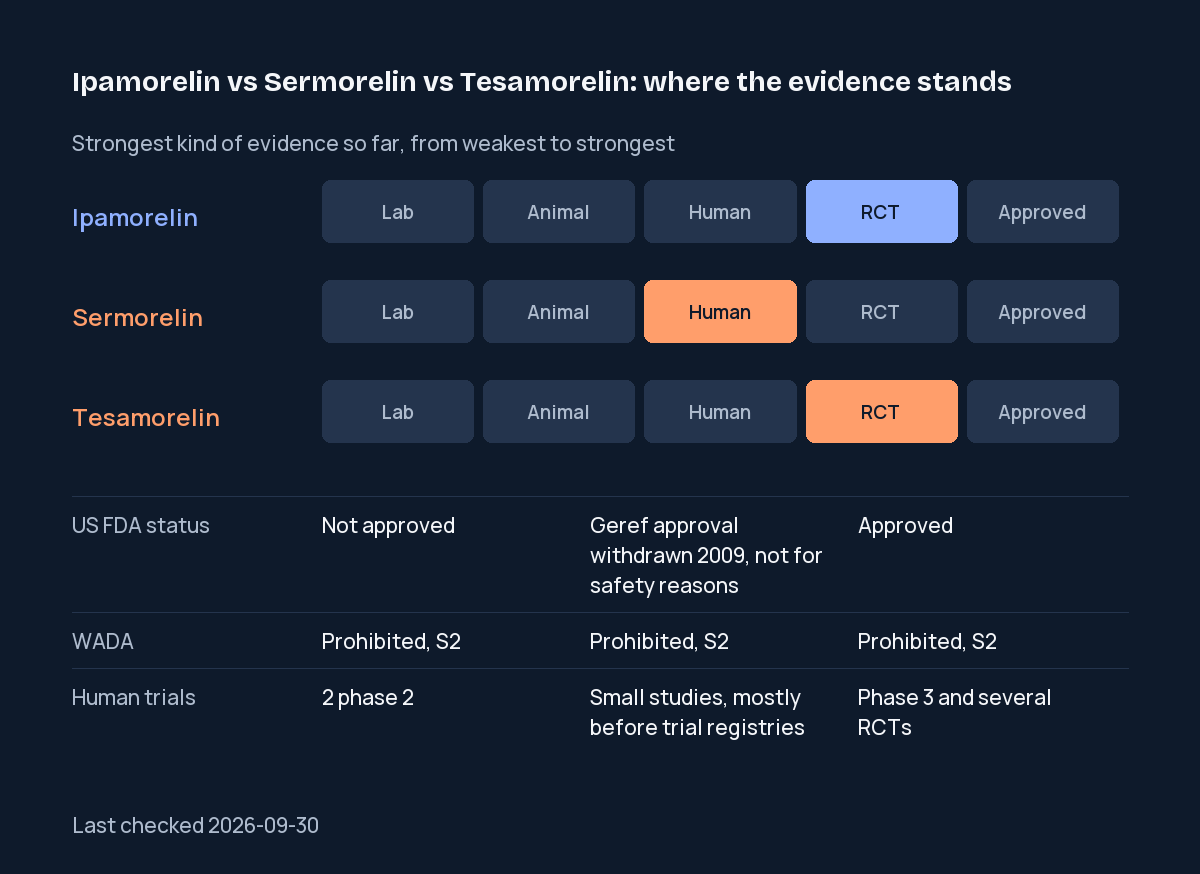
Verdict: Tesamorelin is an FDA-approved drug (Egrifta WR) for excess abdominal fat in adults with HIV lipodystrophy, backed by phase 3 randomized trials. Sermorelin was approved as Geref, but its approvals were withdrawn in 2009. Ipamorelin was never approved, and its one published trial missed its goal.
All three raise the body’s own growth hormone (GH), and all three are prohibited in sport under WADA class S2. The evidence gap between them is large. Tesamorelin has placebo-controlled trials in hundreds of people. Sermorelin’s human data are mostly small or open-label studies from the 1990s. Ipamorelin has a pharmacology study in healthy men and a surgical trial that showed no benefit. Tesamorelin also carries labeled risks: glucose intolerance, fluid retention and raised IGF-1, a growth factor whose long-term effects the label calls unknown.
| Item | Ipamorelin | Sermorelin | Tesamorelin |
|---|---|---|---|
| US FDA status | Not approved | Geref approval withdrawn 2009, not for safety reasons (FR 2013) | Approved: Egrifta WR, HIV-associated abdominal fat (label) |
| Compounding (503A/503B) | Category 2 under 503B, since 2023-09-29 (FDA) | Not on FDA’s Category 2 list | Not on FDA’s Category 2 list; licensed as a biologic (BLA022505) |
| WADA 2026 | Prohibited, S2 (GH secretagogue) | Prohibited, S2 (GHRH analogue) | Prohibited, S2 (GHRH analogue) |
| Strongest evidence | Human RCT (n=114), negative | Human open-label (n=110 children) | Human RCTs (phase 3) and approved label |
| Human trials | 2 phase 2 (NCT00672074, NCT01280344) | Small studies, mostly before trial registries | Phase 3 and several RCTs (e.g. NCT00123253) |
| Last checked | 2026-09-30 | 2026-09-30 | 2026-09-30 |
Key points:
- When patients switched from tesamorelin to placebo at week 26, visceral fat rose again by week 52 in both phase 3 studies (Approved label).
- In the EU, tesamorelin’s marketing application was withdrawn in 2012 because regulators could not conclude a positive benefit-risk balance (EMA).
- FDA cites a risk of immune reactions to compounded ipamorelin from aggregation or peptide impurities (FDA).
- A second, larger ipamorelin trial (n=320) finished in 2014, and no results have been posted (NCT01280344).
- In August 2026 FDA warned a “research use only” seller that its tesamorelin was an unapproved new drug (FDA warning letter).
Ipamorelin vs sermorelin vs tesamorelin at a glance
| Feature | Ipamorelin | Sermorelin | Tesamorelin |
|---|---|---|---|
| What it is | Synthetic five-amino-acid peptide | First 29 amino acids of human GHRH | Stabilized analog of human GHRH |
| Class | GH secretagogue (ghrelin mimetic) | GHRH analogue | GHRH analogue |
| Receptor | Ghrelin receptor | GHRH receptor | GHRH receptor |
| Main research focus | Gut recovery after surgery | GH deficiency in children; aging | HIV abdominal fat; liver fat; cognition |
| Human evidence | 1 published RCT (Beck 2014); 1 PK study (Gobburu 1999) | Open-label and small studies (Thorner 1996) | Phase 3 RCTs (pooled n=806) plus later RCTs |
| US approval | None | Withdrawn 2009 | Approved since 2010 |
| WADA | S2, banned at all times | S2, banned at all times | S2, banned at all times |
| Routes studied | Intravenous | Subcutaneous | Subcutaneous |
| Timelines in studies | GH peak about 40 min after infusion | Faster growth by 6 months | Visceral fat change at 26 weeks |
| Main safety concerns | Little long-term data; compounding purity (FDA) | Little adult data; unregulated products | Glucose intolerance, fluid retention, raised IGF-1 |
What is ipamorelin?
Ipamorelin is a synthetic pentapeptide (a chain of five amino acids) described in 1998 as the first selective GH secretagogue. In rat pituitary cells it released GH about as strongly as the older peptide GHRP-6. In animals it did not raise ACTH or cortisol, even at doses 200 times higher (Raun 1998) [Lab and Animal]. Its later human development targeted postoperative ileus, a temporary stall of the gut after bowel surgery. That program produced one published phase 2 trial, which found no significant benefit (Beck 2014) [Human RCT, n=114]. Ipamorelin is not approved in the US. It is still on FDA’s Category 2 list for 503B outsourcing facilities (FDA).
What is sermorelin?
Sermorelin is GHRH(1-29), the first 29 amino acids of growth hormone-releasing hormone, the brain’s natural signal for GH release. It works by mimicking that hormone (USADA). FDA approved it as Geref in 1990 as a diagnostic test of the pituitary’s ability to release GH. In 1997 it was approved to treat idiopathic GH deficiency in children with growth failure. The maker discontinued both products in 2008, and FDA withdrew the approvals effective June 18, 2009. In 2013 FDA determined that the withdrawal was not for safety or effectiveness reasons (Federal Register). Today sermorelin is sold through compounding pharmacies and black-market websites, according to USADA.
What is tesamorelin?
Tesamorelin is a stabilized analog of human GHRH (Baker 2012). It is approved in the US as Egrifta WR (earlier Egrifta and Egrifta SV) to reduce excess abdominal fat in adults with HIV and lipodystrophy, an abnormal redistribution of body fat. The label says it is not indicated for weight loss and that its long-term cardiovascular safety has not been established (Approved label). Its first US approval was in 2010, and it is now licensed as a biologic. It is the only one of the three with a current FDA approval.
How do they work differently?
- Ipamorelin: activates the ghrelin receptor (the receptor for the “hunger hormone”) in the pituitary. In animals it released GH without the ACTH and cortisol rise seen with older GH-releasing peptides (Raun 1998) [Animal].
- Sermorelin: activates the GHRH receptor, the same receptor the body’s own GHRH uses (USADA). In older men it raised 24-hour GH and IGF-1 over 14 days, but only at the higher of two doses. After that, their levels no longer differed significantly from young men’s (Corpas 1992) [Human, n=10 older men].
- Tesamorelin: activates the GHRH receptor as a stabilized analog. In a 20-week trial in older adults, IGF-1 rose 117% and body fat fell 7.4% (Baker 2012) [Human RCT, n=152].
- Human pharmacology: after one intravenous infusion, ipamorelin produced a single GH pulse that peaked at about 0.67 hours. Its terminal half-life was 2 hours (Gobburu 1999) [Human PK study, 8 healthy men per dose level].
Evidence head-to-head
Each cell gives the best evidence found for that outcome, with its level. “None found” means a search of PubMed and ClinicalTrials.gov turned up no human study of that outcome.
| Outcome | Ipamorelin | Sermorelin | Tesamorelin |
|---|---|---|---|
| Raises GH | Human PK (Gobburu 1999) | Human, n=10 (Corpas 1992) | Human RCT: IGF-1 +81% (Falutz 2007) |
| Visceral (belly) fat | None found | Human, n=11: no body-composition change (Vittone 1997) | Human RCT, n=412: −15.2% vs +5.0% (Falutz 2007) |
| Liver fat | None found | None found | Human RCT, n=61 (Stanley 2019) |
| Muscle strength | None found | Human, n=11: gains on 2 lifts (Vittone 1997) | None found |
| Cognition | None found | None found | Human RCT, n=152 (Baker 2012) |
| Child growth | None found | Human open-label, n=110 (Thorner 1996) | None found |
| Gut recovery after surgery | Human RCT, n=114: no benefit (Beck 2014) | None found | None found |
| Blood sugar safety | None found | Human: no fasting glucose change (Thorner 1996) | Human RCT, n=53 type 2 diabetes (Clemmons 2017) |
Some details behind the table:
- Ipamorelin after surgery: the median time to tolerating solid food was 25.3 hours with ipamorelin and 32.6 hours with placebo. The difference was not statistically significant (p=0.15) (Beck 2014) [Human RCT, n=114].
- Tesamorelin and liver fat: after 12 months, 35% of people on tesamorelin and 4% on placebo had liver fat below 5% (Stanley 2019) [Human RCT, n=61].
- Tesamorelin pooled phase 3 data: visceral fat changed by −24 cm² with tesamorelin and +2 cm² with placebo, and triglycerides fell (Falutz 2010) [Human RCT, n=806].
- Sermorelin in older men: it raised nighttime GH but did not change IGF-1 (Vittone 1997) [Human, n=11].
Which fits which goal?
- Belly fat and liver fat: tesamorelin has more evidence, from phase 3 and later RCTs, but only in people with HIV (Stanley 2014) [Human RCT, n=50]. Neither of the other two has a controlled human fat-loss trial.
- Weight loss in general: none of the three is approved for weight loss, and the tesamorelin label describes a weight-neutral effect (Approved label). Drugs with weight-loss trial data are compared in retatrutide vs tirzepatide vs semaglutide.
- GH deficiency in children: sermorelin has more evidence, as a former approved treatment (Federal Register).
- Aging, muscle and “anti-aging” use: the evidence is thin for all three. It consists of small sermorelin studies in older men and one tesamorelin cognition trial in older adults (Baker 2012).
- Ipamorelin: no controlled human trial has shown a positive result for any outcome.
These are statements about evidence, not recommendations. A clinician is the person to decide whether any treatment that acts on growth hormone fits a given person.
Can they be combined?
Ipamorelin is most often discussed alongside CJC-1295, another GHRH analogue. The evidence on that pairing is covered in our review of the peptides Joe Rogan has discussed. FDA’s compounding page records safety concerns for both. Ipamorelin remains in Category 2 for 503B. CJC-1295’s nomination was withdrawn, but the page still cites reported serious adverse events for it, including increased heart rate (FDA). No controlled human study has tested any pairing of the three peptides in this comparison.
Safety and regulatory status
United States
- Ipamorelin: not approved. FDA placed ipamorelin acetate in Category 2 for 503B outsourcing facilities on September 29, 2023, and it is still there. FDA’s stated concern is a “risk for immunogenicity” (immune reactions) from aggregation or peptide-related impurities (FDA Category 2 page). The FDA page also lists its nomination as withdrawn, the same route other peptides took (see our BPC-157 vs TB-500 comparison). In the surgery trial, adverse events were similar with ipamorelin (87.5%) and placebo (94.8%) (Beck 2014) [Human RCT, n=114]. The published human data cover only single infusions and courses of up to 7 days.
- Sermorelin: Geref’s approvals were withdrawn in 2009. FDA found that this was not for safety or effectiveness reasons (Federal Register). In the pediatric study it was well tolerated, with no adverse changes in biochemical or hormone tests (Thorner 1996) [Human open-label, n=110]. No long-term controlled safety data in adults were found.
- Tesamorelin: approved (Egrifta WR). The label lists these risks:
- glucose intolerance, with a diabetes hazard ratio of 3.3
- fluid retention, which can cause swelling, joint pain or carpal tunnel syndrome
- raised IGF-1, with unknown long-term effects
- hypersensitivity reactions
It is contraindicated in pregnancy and in people with active malignancy. The most common reactions were redness at the site where the drug was given (17%) and joint pain (13%) (Approved label). In people with type 2 diabetes, 12 weeks of tesamorelin did not worsen glucose control (Clemmons 2017) [Human RCT, n=53]. FDA treats tesamorelin sold as a “research” product as an unapproved new drug (FDA warning letter).
Outside the tesamorelin label, no established human dose exists for any of the three.
European Union
Tesamorelin’s EU application was withdrawn in 2012, after the EMA’s human-medicines committee (CHMP) found the data did not allow it to conclude a positive benefit-risk balance (EMA).
Sport
The 2026 WADA Prohibited List bans all three at all times under S2 “growth hormone releasing factors”. It names sermorelin and tesamorelin as GHRH analogues and ipamorelin as a GH secretagogue (WADA 2026 list). According to USADA, a therapeutic use exemption for sermorelin is highly unlikely, because it is not a first-line treatment for GH deficiency (USADA).
How long do effects take in studies?
- Ipamorelin: GH peaked about 40 minutes (0.67 hours) after a single infusion in healthy men (Gobburu 1999) [Human PK].
- Sermorelin: in children with GH deficiency, height velocity (growth speed) rose from 4.1 cm/year at baseline to 8.0 cm/year at 6 months and 7.2 cm/year at 12 months (Thorner 1996) [Human open-label, n=110]. In older men, GH and IGF-1 rose within 14 days (Corpas 1992) [Human, n=10].
- Tesamorelin: visceral fat was measured at 26 weeks. After a switch to placebo, it rose again by week 52 (Approved label). Liver fat fell by 6 months (Stanley 2014) [Human RCT, n=50]. Cognitive effects were measured at 20 weeks (Baker 2012) [Human RCT, n=152].
What users report
The reports below are unverified accounts from people who usually bought unregulated products, and they are not evidence. On Reddit, YouTube and bodybuilding forums, people who post about these peptides most often describe:
- deeper or more vivid sleep
- better recovery
- slow changes in body fat, which most say took weeks to months
Many say they noticed nothing at all. Common complaints about ipamorelin are:
- more hunger
- water retention
- tingling or numb hands
- headaches
- flushing
Tesamorelin posts often mention the high price of the prescription product. Some posters say they switched to “research” versions, and others then question whether those products contain what they claim to. Sermorelin posts often come from clinic or telehealth patients, and they describe subtle effects or none.
Posters argue about a few recurring questions:
- whether sermorelin is “too weak” next to tesamorelin or ipamorelin blends
- whether raising GH through the pituitary is safer than taking growth hormone itself
- whether blood sugar is a concern
- whether changes in IGF-1 lab results match how people feel
None of these questions has been tested in a controlled comparison.
Frequently asked questions
Is tesamorelin stronger than sermorelin?
No human trial has compared them directly, so the evidence cannot say which is stronger. Both act on the GHRH receptor, but tesamorelin is a stabilized analog with far more trial data. In its phase 3 trial, IGF-1 rose 81% and visceral fat fell 15.2% over 26 weeks (Falutz 2007) [Human RCT, n=412].
Is sermorelin FDA approved?
Not currently. Sermorelin was approved as Geref in 1990 and 1997. The maker discontinued it in 2008, and FDA withdrew the approvals in 2009. A 2013 FDA notice states that the withdrawal was not for safety or effectiveness reasons (Federal Register). Products sold today are compounded or unregulated.
Has ipamorelin been tested in humans?
Yes, but only in short studies. A pharmacology study in healthy men measured GH after single infusions. A phase 2 trial in 114 bowel-surgery patients found no significant speed-up in gut recovery (Beck 2014). A second phase 2 trial (n=320) finished in 2014 without posted results. No trial has tested it for muscle, fat loss or aging.
Are ipamorelin, sermorelin and tesamorelin banned in sports?
Yes. All three are prohibited at all times under WADA class S2. The 2026 list names sermorelin and tesamorelin as GHRH analogues and ipamorelin as a growth hormone secretagogue (WADA). A prescription alone does not permit their use by tested athletes.
Does tesamorelin’s effect last after stopping?
Not in the approved trials. In both phase 3 studies, people switched from tesamorelin to placebo at week 26 regained visceral fat by week 52. Those who stayed on the drug kept their reduction (Egrifta WR label). The label also states that long-term cardiovascular safety has not been established.
Is ipamorelin better than sermorelin?
No trial has compared them head to head, so neither can be called better. They act on different receptors: ipamorelin on the ghrelin receptor, sermorelin on the GHRH receptor. Sermorelin was once an approved treatment for children with GH deficiency, while ipamorelin’s only published efficacy trial found no significant benefit for gut recovery after bowel surgery (Beck 2014) [Human RCT, n=114].
References
- US Food and Drug Administration. Certain bulk drug substances for use in compounding that may present significant safety risks (page updated 2026-04-22). fda.gov
- World Anti-Doping Agency. 2026 Prohibited List, International Standard. wada-ama.org
- US Anti-Doping Agency. What should athletes know about sermorelin? usada.org
- US Food and Drug Administration. Determination that GEREF (sermorelin acetate) injection was not withdrawn from sale for reasons of safety or effectiveness. Federal Register 2013-04827, 2013-03-04. federalregister.gov
- Theratechnologies. EGRIFTA WR (tesamorelin) prescribing information, BLA022505. DailyMed. dailymed.nlm.nih.gov
- European Medicines Agency. Ferrer Internacional withdraws its marketing authorisation application for Egrifta (tesamorelin), 2012-06-26. ema.europa.eu
- US Food and Drug Administration. Warning letter to Peak Performance Peptides, 2026-08-24. fda.gov
- Raun K, Hansen BS, Johansen NL, et al. Ipamorelin, the first selective growth hormone secretagogue. Eur J Endocrinol. 1998. PubMed 9849822
- Gobburu JV, Agersø H, Jusko WJ, Ynddal L. Pharmacokinetic-pharmacodynamic modeling of ipamorelin, a growth hormone releasing peptide, in human volunteers. Pharm Res. 1999. PubMed 10496658
- Beck DE, Sweeney WB, McCarter MD; Ipamorelin 201 Study Group. Prospective, randomized, controlled, proof-of-concept study of the ghrelin mimetic ipamorelin for the management of postoperative ileus in bowel resection patients. Int J Colorectal Dis. 2014. PubMed 25331030
- Helsinn Therapeutics. Safety and efficacy of ipamorelin for management of post-operative ileus. ClinicalTrials.gov. NCT00672074
- Helsinn Therapeutics. Safety and efficacy of ipamorelin compared to placebo for the recovery of gastrointestinal function. ClinicalTrials.gov. NCT01280344
- Thorner M, Rochiccioli P, Colle M, et al. Once daily subcutaneous growth hormone-releasing hormone therapy accelerates growth in growth hormone-deficient children during the first year of therapy. J Clin Endocrinol Metab. 1996. PubMed 8772599
- Corpas E, Harman SM, Piñeyro MA, Roberson R, Blackman MR. Growth hormone-releasing hormone-(1-29) twice daily reverses the decreased GH and IGF-I levels in old men. J Clin Endocrinol Metab. 1992. PubMed 1379256
- Vittone J, Blackman MR, Busby-Whitehead J, et al. Effects of single nightly injections of growth hormone-releasing hormone (GHRH 1-29) in healthy elderly men. Metabolism. 1997. PubMed 9005976
- Falutz J, Allas S, Blot K, et al. Metabolic effects of a growth hormone-releasing factor in patients with HIV. N Engl J Med. 2007. PubMed 18057338
- Falutz J, Mamputu JC, Potvin D, et al. Effects of tesamorelin (TH9507) in HIV-infected patients with excess abdominal fat: a pooled analysis of two phase 3 trials. J Clin Endocrinol Metab. 2010. PubMed 20554713
- Stanley TL, Feldpausch MN, Oh J, et al. Effect of tesamorelin on visceral fat and liver fat in HIV-infected patients with abdominal fat accumulation: a randomized clinical trial. JAMA. 2014. PubMed 25038357
- Stanley TL, Fourman LT, Feldpausch MN, et al. Effects of tesamorelin on non-alcoholic fatty liver disease in HIV: a randomised, double-blind, multicentre trial. Lancet HIV. 2019. PubMed 31611038
- Baker LD, Barsness SM, Borson S, et al. Effects of growth hormone-releasing hormone on cognitive function in adults with mild cognitive impairment and healthy older adults: results of a controlled trial. Arch Neurol. 2012. PubMed 22869065
- Clemmons DR, Miller S, Mamputu JC. Safety and metabolic effects of tesamorelin, a growth hormone-releasing factor analogue, in patients with type 2 diabetes: a randomized, placebo-controlled trial. PLoS One. 2017. PubMed 28617838
- Theratechnologies. TH9507 in patients with HIV-associated lipodystrophy. ClinicalTrials.gov. NCT00123253
Change log
2026-10-19: links to related entries added; no change to the facts.
2026-10-13: links corrected (a link inside a citation or on a generic word removed); no change to the facts.
2026-10-12: links to related entries added; no change to the facts.
2026-10-06: links to related entries were added on 2026-10-05; no change to the facts.
2026-10-04: FAQ expanded with one question readers search for (ipamorelin vs sermorelin); reviewed by the editorial team.
2026-10-04: source link restored (the reference now links to the official text); reviewed by the editorial team.
2026-09-30: first published after review by the editorial team.