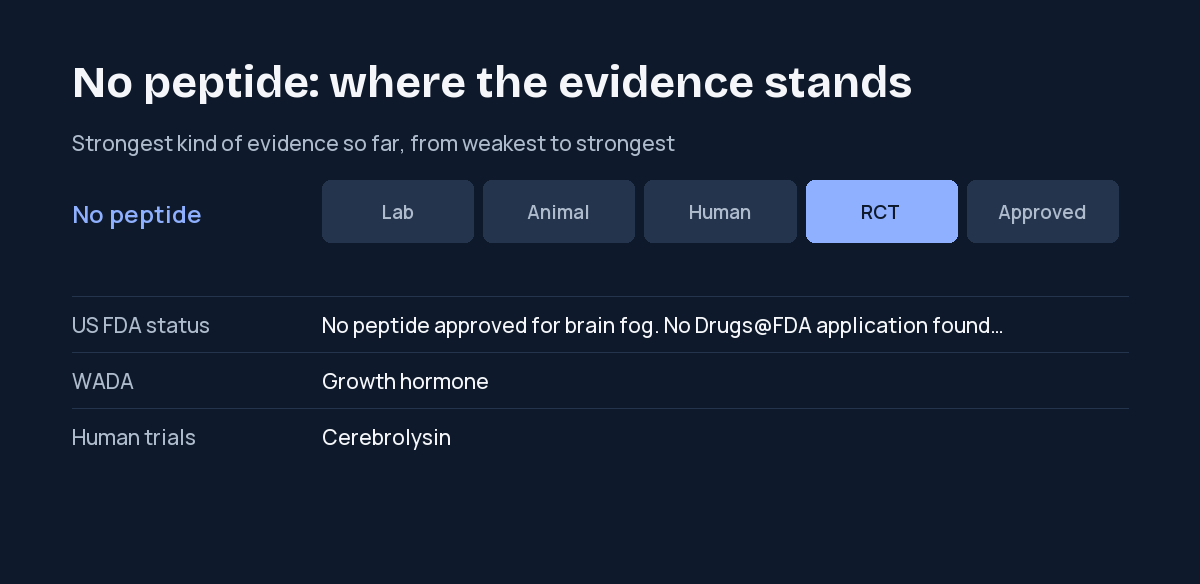
No peptide is FDA-approved for brain fog, and no controlled trial has tested one for brain fog by that name. The strongest cognitive signal is for Cerebrolysin, a pig-brain peptide mixture: a 2019 Cochrane review of six trials (597 people) found better cognition in vascular dementia (Human RCTs, very low-quality evidence). Cerebrolysin is not approved in the US. Semax has only small human studies. Approved peptide drugs tested on memory, including oral semaglutide in 3,808 people, showed no cognitive benefit.
| Item | Status |
|---|---|
| US FDA status | No peptide approved for brain fog. No Drugs@FDA application found for Cerebrolysin, Semax or dihexa (openFDA query, 2026-11-10) |
| Compounding (503A/503B) | Semax, selank and dihexa were withdrawn from Category 2 (page updated 2026-04-22). PCAC voted 8–5 on 2026-07-24 to recommend Semax for the 503A list, for cerebral ischemia, migraine and trigeminal neuralgia (FDA meeting page); advisory, no FDA rule yet |
| WADA | Growth hormone: prohibited at all times. Unapproved peptides fall under S0 (USADA). The 2027 List (in force 2027-01-01) names “peptides” in general under S0; it does not name Semax, Selank or Cerebrolysin |
| Strongest evidence | Human RCTs, very low quality (Cerebrolysin in vascular dementia) |
| Human trials | Cerebrolysin: e.g. NCT00947531, NCT00911807. Semax: 0 on ClinicalTrials.gov (searched 2026-11-10). No brain fog peptide trial found |
| Last checked | 2026-11-10 |
Key points:
- “Brain fog” is a lay term, not a diagnosis. People use it for forgetfulness, poor concentration, slowness and fatigue (McWhirter 2023).
- A 2025 review of long COVID brain fog treatments found no peptide studies at all (Whitaker-Hardin 2025).
- Growth hormone improved fatigue and mood scores, but not cognition, in a 13-person open-label long COVID study (Wright 2024).
- A 2023 Cochrane stroke review linked Cerebrolysin with more non-fatal serious adverse events (RR 2.39) (Ziganshina 2023).
- FDA says it has found no human exposure data for dihexa, which has been studied mainly in mice (FDA).
Peptides for brain fog, ranked by evidence
This roundup sorts the peptides most often linked to brain fog, memory and focus into three tiers. First come approved drugs, then peptides with human trials but no US approval, then peptides with animal or lab data only. Each entry gives one cited key finding and its evidence level. Brain fog has many causes, including long COVID, psychiatric and autoimmune conditions, and drug use or withdrawal (McWhirter 2023), so a result in dementia or stroke does not carry over to people with brain fog.
| Peptide | US status | Best evidence on cognition or fatigue |
|---|---|---|
| Oral semaglutide | Approved for type 2 diabetes (Rybelsus) | Human RCTs (n=3,808): no slowing of Alzheimer’s progression |
| Growth hormone | Approved for GH deficiency (e.g. Genotropin) | Human open-label (n=13): fatigue better, cognition unchanged |
| Nasal insulin | Investigational for cognition | Human RCT (n=289): no cognitive benefit |
| Cerebrolysin | Not FDA-approved | Human RCTs (6 trials, 597): small gain in vascular dementia, very low quality |
| Semax | Not FDA-approved | Human small studies: imaging and stroke recovery, no brain fog trial |
| Dihexa | Not FDA-approved | Animal (mice): restored maze learning |
Tier 1: approved peptide drugs tested on memory and fatigue
None of these drugs is approved for brain fog. They sit in Tier 1 because they are approved for other conditions and have been tested on cognition or fatigue in human studies.
Oral semaglutide
Semaglutide is a GLP-1 receptor agonist approved as Rybelsus tablets to improve blood sugar control in adults with type 2 diabetes (FDA label). The encouraging part: in the evoke and evoke+ trials, semaglutide improved Alzheimer’s-related biomarkers. But in those 3,808 adults with early Alzheimer’s disease it “did not confirm superiority” over placebo in slowing disease progression, and Novo Nordisk stopped the one-year extension (Novo Nordisk SEC filing, 2025-11-24) [Human RCTs, n=3,808]. These trials enrolled people with mild cognitive impairment or mild dementia, not brain fog. For how semaglutide relates to other peptides, see peptides vs Ozempic.
Growth hormone (somatropin)
Growth hormone is a peptide hormone approved as Genotropin and other brands for growth hormone deficiency in children and adults (FDA label). In a University of Texas Medical Branch study, 13 adults with neurologic long COVID symptoms and low stimulated GH levels had daily GH injections for 9 months. Their fatigue, mood, depression and quality-of-life scores improved (Wright 2024) [Human, open-label, n=13]. That is the most direct fatigue finding on this page. Cognition did not change, and the study had no placebo group (NCT03554265).
Nasal insulin
Insulin is a peptide hormone, and a nasal form has been tested for memory. In the SNIFF trial, 289 people with mild cognitive impairment or Alzheimer’s dementia were randomized to nasal insulin or placebo. The change in the primary memory-and-thinking score (ADAS-cog-12) over 12 months did not differ between the groups, and no clinically important adverse events were linked to treatment (Craft 2020) [Human RCT, n=289].
Tier 2: peptides with human trials but no US approval
Cerebrolysin
Cerebrolysin is a mixture of small peptides and amino acids made from pig brain (Ziganshina 2023), given as intravenous courses in the dementia trials. It has the most promising cognitive data of any peptide here. A Cochrane review of six randomized trials (597 people) found better combined MMSE and ADAS-cog scores in vascular dementia (SMD 0.36, 95% CI 0.13 to 0.58). Global function was also better (RR 2.69), with no difference in adverse effects (Cui 2019) [Human RCTs, very low-quality evidence]. A meta-analysis of six placebo-controlled Alzheimer’s trials found better cognition at 4 weeks and better global change at 6 months (OR 4.98) (Gauthier 2015) [Human RCTs].
The limits are real. The Cochrane authors judged the trials at high risk of bias and wrote that any benefit “may be too small to be clinically meaningful”. In acute stroke, a separate Cochrane review of seven trials (1,773 people) found little to no difference in deaths. It did find more people with non-fatal serious adverse events on Cerebrolysin (RR 2.39, 95% CI 1.10 to 5.23; 3 trials, 1,335 people) [Human RCTs]. No Cerebrolysin trial in people with brain fog was found on ClinicalTrials.gov (searched 2026-11-10). A side-by-side with Semax is in Semax vs Cerebrolysin.
Semax
Semax is a seven-amino-acid analog of a fragment of ACTH (a pituitary hormone), developed and studied mainly in Russia and given by nose. Its developers’ 1997 review reports that it stimulated working memory and attention in animals and people for 20–24 hours after nasal use (Ashmarin 1997) [Human, design and n not given in the abstract]. In 24 healthy volunteers, nasal Semax changed resting brain-network activity on fMRI compared with placebo (Lebedeva 2018) [Human, placebo-controlled, n=24; imaging, not memory scores].
In 110 stroke patients, those given Semax had higher blood BDNF (a nerve growth factor) and faster motor recovery (Gusev 2018) [Human, non-randomized comparison, n=110]. ClinicalTrials.gov lists no Semax trial (searched 2026-11-10). When FDA’s advisory committee reviewed Semax in July 2026, the uses on the table were cerebral ischemia, migraine and trigeminal neuralgia, not cognition (FDA meeting page). How it compares with its sister peptide is covered in Selank vs Semax.
Tier 3: animal and lab data only
Dihexa
Dihexa is an angiotensin IV analog. In Alzheimer’s model mice, it restored spatial learning in the Morris water maze and lowered the inflammatory markers IL-1β and TNF-α (Sun 2021) [Animal]. That is a mouse finding, not a human benefit. FDA states it “has not identified any human exposure data” for dihexa by any route (FDA Category 2 page).
Selank, for brain fog with anxiety
Selank is the anxiety-focused relative of Semax. FDA lists it as a possible immunogenicity risk and says it “lacks important information” on its safety in humans (FDA Category 2 page). No trial of Selank for brain fog was found on ClinicalTrials.gov (searched 2026-11-10). Its anxiety evidence is graded in best peptides for anxiety.
What about long COVID brain fog?
Long COVID was the most common cause people gave for their brain fog in a 2023 analysis of first-hand descriptions (McWhirter 2023). A 2025 review of long COVID cognition treatments covered cognitive training, magnetic stimulation, exercise and four drug or supplement studies. None tested a peptide, and the authors found “very few tightly controlled experimental designs” (Whitaker-Hardin 2025). The only peptide-hormone result found is the 13-person growth hormone study above: fatigue improved, cognition did not (Wright 2024) [Human, open-label].
Which peptide has the most evidence for memory, focus, fatigue or anxiety?
- Memory: Cerebrolysin has the most evidence, from randomized trials in vascular dementia and Alzheimer’s disease (Cui 2019). That evidence is very low quality and comes from dementia, not brain fog.
- Focus and attention: Semax has claims from its developers and one small imaging study (Lebedeva 2018). No randomized trial found in this review measured attention as an outcome.
- Fatigue and energy: growth hormone has the only peptide result, in 13 people with low GH and no placebo group (Wright 2024).
- Anxiety: see the Selank evidence on the anxiety page linked above. Sleep-related fog is covered in peptides for sleep.
These are statements about evidence, not suggestions to use any product. Brain fog has many possible causes, and a clinician is the person to work out the cause and decide on treatment.
Safety and regulatory status
United States. Semaglutide (Rybelsus) and growth hormone (Genotropin and others) are approved only for their labeled conditions, not brain fog. No Drugs@FDA application was found for Cerebrolysin, Semax or dihexa (openFDA query, 2026-11-10). FDA’s compounding page says compounded Semax “may pose risk for immunogenicity” from aggregation and peptide-related impurities, and that FDA “has no, or limited, safety-related information” for the proposed routes (FDA Category 2 page). The July 2026 advisory vote on Semax does not change its status until FDA completes rulemaking; that process is explained in our compounding vote explainer.
Side effects in trials. Cerebrolysin showed more non-fatal serious adverse events in stroke trials (RR 2.39) (Ziganshina 2023). There was no difference in adverse effects in the vascular dementia trials (RR 0.91, very low quality) (Cui 2019). Semaglutide’s safety in evoke matched earlier semaglutide trials (Novo Nordisk). For Semax, Selank and dihexa, none of the sources above reports controlled safety data.
Athletes. Growth hormone is prohibited at all times, and a Therapeutic Use Exemption is required even with a prescription (USADA). S0 prohibits, at all times, substances not approved for human therapeutic use by any government health agency. From 2027-01-01, the List names “peptides” in general as S0 substances (USADA 2027 advisory). Athletes can check a specific peptide with USADA. A wider overview is in are peptides safe?
Anyone who suspects a side effect from Cerebrolysin, Semax or any other drug or product can report it to the FDA through MedWatch.
What users report
What follows are unverified self-reports from people who usually bought unregulated products, not evidence. People who post about Semax on forums and social media commonly describe sharper focus, easier word-finding and more mental energy within hours. Some say the effect fades after a few days. Recurring complaints include headache, irritability, a stinging or runny nose, poorer sleep, and no noticeable effect at all. Posts about Cerebrolysin more often come from people recovering from head injury or stroke, and they argue about whether any benefit is worth the cost and the infusions. Product quality is a constant theme: many posters doubt that a grey-market product contains what its label says. Some argue that long clinical use in Russia counts as proof, while critics point to the lack of large Western randomized trials. Dihexa posts tend to be more cautious, with people raising the absence of any human safety data. Many posters also say their fog lifted once they dealt with sleep, a medicine side effect or a medical condition, which makes any peptide’s own role hard to judge.
Frequently asked questions
Are there peptides for brain fog?
No peptide is FDA-approved for brain fog, and no controlled trial has tested one under that name. The closest human evidence is Cerebrolysin in vascular dementia: six randomized trials showed a small cognitive gain, but the Cochrane reviewers rated the evidence very low quality (Cui 2019). Cerebrolysin is not FDA-approved.
Does Semax help with brain fog?
That is not known. No Semax trial is registered on ClinicalTrials.gov (searched 2026-11-10). The human data are small Russian studies, such as a 24-person fMRI study in healthy volunteers that measured brain-network activity rather than memory (Lebedeva 2018). The developers report memory and attention effects, but the abstract gives no trial design or numbers.
Does Cerebrolysin cause brain fog?
Brain fog is not reported as an adverse effect in the review abstracts examined here. The safety signal is different. A 2023 Cochrane review of stroke trials found more people with non-fatal serious adverse events on Cerebrolysin (RR 2.39; 3 trials, 1,335 people) (Ziganshina 2023). The vascular dementia trials showed no difference from placebo.
What is the downside of taking peptides for brain fog?
The main downsides are unknown safety and uncertain quality. For Semax and Selank, FDA lists possible immunogenicity from aggregation and impurities and says it lacks human safety information. For dihexa, it has found no human exposure data at all (FDA). Athletes also face S0 anti-doping rules.
Which peptide has the most research for brain fog and memory?
Cerebrolysin has the most randomized trial data on memory and thinking, all of it in dementia rather than brain fog. In Alzheimer’s disease, a meta-analysis of six placebo-controlled trials found better cognition at 4 weeks (Gauthier 2015). Semaglutide and investigational nasal insulin showed no cognitive benefit in their trials.
References
- McWhirter L, Smyth H, Hoeritzauer I, Couturier A, Stone J, Carson AJ. What is brain fog? J Neurol Neurosurg Psychiatry. 2023. PubMed 36600580
- Whitaker-Hardin B, McGregor KM, Uswatte G, Lokken K. A narrative review of the efficacy of long COVID interventions on brain fog, processing speed, and other related cognitive outcomes. Biomedicines. 2025. PubMed 40002834
- Cui S, Chen N, Yang M, Guo J, Zhou M, Zhu C, He L. Cerebrolysin for vascular dementia. Cochrane Database Syst Rev. 2019. PubMed 31710397
- Gauthier S, Proaño JV, Jia J, Froelich L, Vester JC, Doppler E. Cerebrolysin in mild-to-moderate Alzheimer’s disease: a meta-analysis of randomized controlled clinical trials. Dement Geriatr Cogn Disord. 2015. PubMed 25832905
- Ziganshina LE, Abakumova T, Nurkhametova D, Ivanchenko K. Cerebrolysin for acute ischaemic stroke. Cochrane Database Syst Rev. 2023. PubMed 37818733
- Ashmarin IP, Nezavibat’ko VN, Miasoedov NF, et al. A nootropic adrenocorticotropin analog 4-10-Semax (15 years experience in its design and study). Zh Vyssh Nerv Deiat Im I P Pavlova. 1997. PubMed 9173745
- Lebedeva IS, Panikratova YR, Sokolov OY, et al. Effects of Semax on the default mode network of the brain. Bull Exp Biol Med. 2018. PubMed 30225715
- Gusev EI, Martynov MY, Kostenko EV, Petrova LV, Bobyreva SN. The efficacy of semax in the treatment of patients at different stages of ischemic stroke. Zh Nevrol Psikhiatr Im S S Korsakova. 2018. PubMed 29798983
- Craft S, Raman R, Chow TW, et al. Safety, efficacy, and feasibility of intranasal insulin for the treatment of mild cognitive impairment and Alzheimer disease dementia: a randomized clinical trial. JAMA Neurol. 2020. PubMed 32568367
- Wright TJ, Sheffield-Moore M, Pyles RB, et al. Growth hormone treatment for neurologic symptoms of post-acute sequelae of COVID-19. Clin Transl Sci. 2024. PubMed 38894576
- Sun X, Deng Y, Fu X, Wang S, Duan R, Zhang Y. AngIV-analog dihexa rescues cognitive impairment and recovers memory in the APP/PS1 mouse via the PI3K/AKT signaling pathway. Brain Sci. 2021. PubMed 34827486
- Novo Nordisk A/S. Form 6-K: evoke phase 3 trials did not demonstrate a statistically significant reduction in Alzheimer’s disease progression. US SEC, 2025-11-24. sec.gov
- US FDA. RYBELSUS (semaglutide) tablets prescribing information. 2024. accessdata.fda.gov
- US FDA. GENOTROPIN (somatropin) prescribing information. 2025. accessdata.fda.gov
- US FDA. Certain bulk drug substances for use in compounding that may present significant safety risks (Category 2). Updated 2026-04-22. fda.gov
- US FDA. July 23–24, 2026 meeting of the Pharmacy Compounding Advisory Committee. fda.gov
- ClinicalTrials.gov. NCT03554265: Brain and gut plasticity in mild TBI or post-acute COVID syndrome following growth hormone therapy. clinicaltrials.gov
- ClinicalTrials.gov. NCT00947531: Cerebrolysin 20 ml in patients with vascular dementia. clinicaltrials.gov
- ClinicalTrials.gov. NCT00911807: Neurotrophic and cholinergic treatment of Alzheimer’s disease. clinicaltrials.gov
- USADA. #AskUSADA: What is a non-approved substance and why are they prohibited? usada.org
- USADA. Athlete advisory: what’s new on the 2027 WADA Prohibited List? usada.org
- USADA. Growth hormone in sport: what athletes should know. usada.org
Change log
2026-11-10: first published after review by the editorial team.