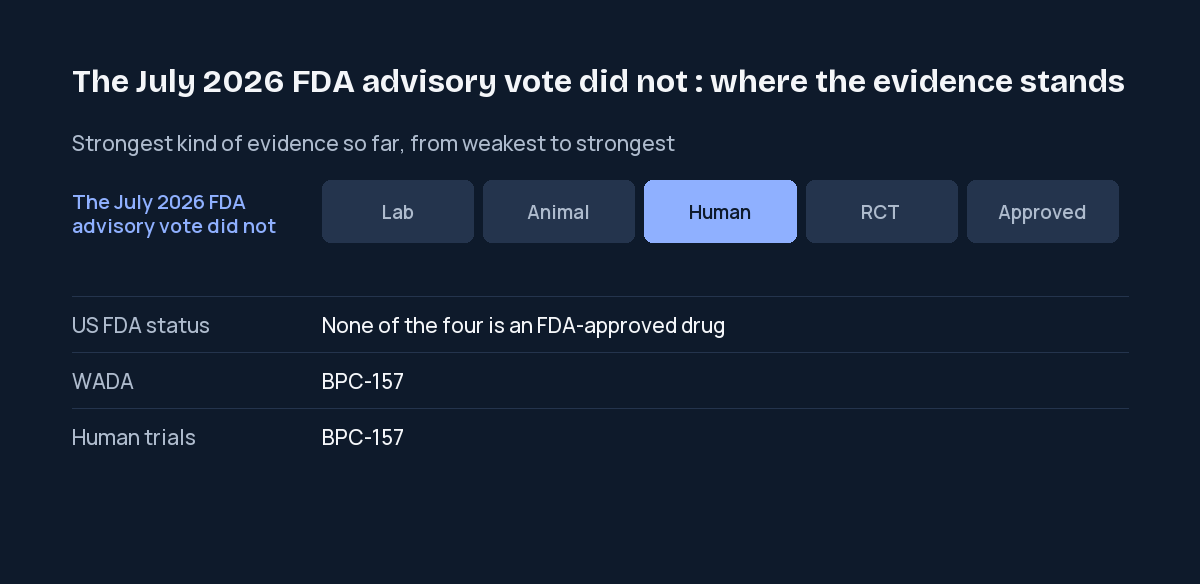
The July 2026 FDA advisory vote did not approve BPC-157, TB-500, KPV or MOTS-c, and it did not make them lawful to compound. FDA’s Pharmacy Compounding Advisory Committee (PCAC) recommended adding all four, plus Semax and Epitalon, to the list of bulk ingredients pharmacies may compound, but the committee’s job is to “provide advice and recommendations to FDA” (Federal Register, 2026). For patients nothing changes until FDA completes a rulemaking. The strongest human evidence for any of the four is one uncontrolled case series of 16 people (BPC-157); apart from two smaller BPC-157 pilots and a 2026 three-patient report combining BPC-157 and TB-500 with other drugs [Human (case series, n=12, 2 and 3)] (Poolton 2026, a systematic review; Froum 2026), the rest is animal research.
| Item | Status |
|---|---|
| US FDA status | None of the four is an FDA-approved drug (USADA, BPC-157; USADA, MOTS-c). Compounded drugs are never FDA-approved (FDA) |
| Compounding (503A/503B) | PCAC voted 8–6 (1 abstention) for BPC-157, KPV and TB-500 and 7–5 (2 abstentions) for MOTS-c on 2026-07-23 to recommend 503A listing, as reported by legal and trade press (FDA has posted no official tally); advisory, no FDA rule yet. Withdrawn from Category 2 (FDA, updated 2026-04-22); not on the 503A list (21 CFR 216.23) |
| WADA 2026 | BPC-157: prohibited, S0. TB-500: prohibited, S2.3 (USADA). MOTS-c: prohibited at all times, S4.4.1. KPV: not named; check Global DRO |
| Strongest evidence | BPC-157: Human, case series, n=16, no control group (Lee 2021). TB-500: Animal (rats). KPV: Animal (mice). MOTS-c: Animal (mice) |
| Human trials | BPC-157: 3 registered, none with posted results (NCT02637284, NCT07752381, NCT07803250). TB-500: none registered on the fragment. MOTS-c: none on MOTS-c itself; 1 on the analog CB4211, completed, no results posted (NCT03998514). KPV: none registered |
| Next regulatory step | An FDA proposed rule in the Federal Register, then public comment, then a final rule. None published as of 2026-10-02 |
| Last checked | 2026-10-18 |
What changed (October 2026): FDA’s own pre-meeting review of each of the seven peptides is now summarized from the briefing documents FDA posted, the vote table notes where trade reports differ, and the athlete and what-to-watch sections cover the 2027 WADA List and the next committee meeting.
Key points:
- FDA’s own staff reviews, posted as briefing documents before the meeting, came out against listing all seven peptides on the agenda; for TB-500, KPV and MOTS-c they found no human study at all (FDA meeting page). The committee split narrowly the other way.
- The current 503A bulks list holds just six substances, five of them “for topical use only” (21 CFR 216.23), so a listing can come with conditions.
- The last time FDA built that list, the proposed rule (December 2016) took until February 2019 to become final (Federal Register).
- Even after listing, a peptide could be compounded only for an identified patient with a valid prescription (21 U.S.C. 353a).
- The vote changes nothing for athletes: BPC-157 stays prohibited under WADA’s S0 class (USADA), and TB-500 and MOTS-c stay prohibited too.
What did the FDA advisory committee vote on?
On July 23–24, 2026, PCAC reviewed seven peptides nominated for the 503A bulks list, each for a specific proposed use (FDA meeting page). The 503A bulks list is the federal list of raw ingredients a state-licensed pharmacy may use to make a custom drug when the ingredient is neither part of an approved drug nor covered by a USP quality standard (FDA). FDA has posted the briefing documents but, as of 2026-10-27, no minutes or official vote tally; the counts below are as reported by legal and trade press.
| Peptide | Use nominated | Reported vote |
|---|---|---|
| BPC-157 | Ulcerative colitis | 8–6, 1 abstention: for |
| KPV | Wound healing, inflammatory conditions | 8–6, 1 abstention: for |
| TB-500 | Wound healing | 8–6, 1 abstention: for |
| MOTS-c | Obesity and osteoporosis | 7–5, 2 abstentions, or 8–6, 1 abstention (reports differ): for |
| Semax | Cerebral ischemia, migraine, trigeminal neuralgia | 8–5, 1 abstention: for |
| Epitalon | Insomnia | 7–4, 1 abstention: for |
| Emideltide (DSIP) | Opioid withdrawal, insomnia, narcolepsy | 6–7, 1 abstention: against |
Semax is covered in our Selank vs Semax evidence comparison. This guide focuses on the four peptides most often asked about after the vote.
What did FDA’s own reviewers conclude?
Before the meeting, FDA staff wrote a review of each nomination, dated May 2026 and posted with the meeting materials. Each one weighed the same criteria: the substance’s chemistry, its safety, whether it works for the proposed use, and whether it has been used historically in compounding. All seven came out against listing.
| Peptide | FDA staff conclusion | Human data FDA found |
|---|---|---|
| BPC-157 | Criteria “weigh against” listing (FDA, review dated 2026-05-11) | Small uncontrolled reports; an enema study in 24 volunteers; a 2005 colitis trial (n=53) known only from an abstract, not significant |
| KPV | “Propose not adding” (FDA, review dated 2026-05-12) | None by any route |
| TB-500 | “Propose not adding” (FDA, review dated 2026-05-15) | None: “no articles were found in which TB-500 was administered to humans” |
| MOTS-c | “Propose not adding” (FDA, review dated 2026-05-11) | No clinical study in people |
| Semax | Criteria “weigh against” listing (FDA, review dated 2026-05-11) | Small uncontrolled reports (migraine, n=12; trigeminal neuralgia, n=25, no reduction in pain) |
| Epitalon | Criteria “weigh against” listing (FDA, review dated 2026-05-12) | One spray study in 75 women measuring a melatonin marker; no sleep outcomes |
| Emideltide (DSIP) | Criteria “weigh against” listing (FDA, review dated 2026-05-11) | Small, mostly intravenous studies; the placebo-controlled one (n=16) found no significant difference |
The committee then voted for six of the seven anyway. Its recommendation and FDA’s own review now sit side by side, and FDA decides whether to propose a rule.
What changes for patients right now?
Legally, nothing. Federal law lets a pharmacy compound from a bulk ingredient only if it has a USP or National Formulary monograph, is a component of an FDA-approved drug, or appears “on a list developed by the Secretary through regulations” (21 U.S.C. 353a). None of the four meets any of these today: the codified list in 21 CFR 216.23 does not name them (eCFR). USADA states that “currently, there is no legal basis to include BPC-157 in any compounded medication” (USADA).
| Question | Before the vote | After the vote |
|---|---|---|
| FDA-approved? | No | No |
| On the 503A bulks list? | No | No; a rule is needed |
| FDA Category 2? | Withdrawn April 2026 | Unchanged |
| Interim Category 1? | No; FDA stopped categorizing nominations made on or after 2025-01-07 | Unchanged |
| WADA status | Prohibited (KPV not named) | Unchanged |
| Human evidence | Case series and animal studies | Unchanged |
The April 2026 withdrawal from Category 2, FDA’s list of substances with “significant safety risks”, is often misread as a promotion to Category 1. FDA’s page simply moved the peptides to a section of substances “previously in category 2” that were “withdrawn by the nominators” (FDA), and FDA says it “does not intend to place bulk drug substances nominated on or after January 7, 2025, into these categories” (FDA). None of the four holds Category 1 status.
What does “advisory” mean here?
The statute requires FDA to “convene and consult an advisory committee on compounding” before issuing rules for the bulks list (21 U.S.C. 353a(c)). Consulting is not the same as deciding. The committee gives “advice and recommendations to FDA on regulatory issues” (Federal Register); FDA then chooses whether to propose a rule, and in what form.
Two features of this vote matter for anyone reading the headlines. First, the margins were narrow: one or two votes, plus abstentions. Second, the agency’s own reviewers had argued against listing every one of the seven, in the briefing documents summarized above. FDA’s published notes on these substances flag possible immunogenicity (an immune reaction against the peptide itself) and impurity problems, and for KPV and MOTS-c the agency “has not identified any human exposure data” by any route (FDA).
How long could the rulemaking take?
A change needs notice-and-comment rulemaking: a proposed rule, a public comment period, and a final rule (FDA). The only precedent is slow. FDA proposed the first 503A bulks list on December 16, 2016 (Federal Register) and published the final rule on February 19, 2019, effective March 21, 2019 (Federal Register). The list that grew out of that rule still holds only six substances. Law-firm analyses of the July meeting expect a peptide rule in 2027 or later; FDA has announced no date.
If the peptides are listed, what would compounding look like?
Listing would open one narrow door, not a shelf. A 503A pharmacy may compound only “for an identified individual patient based on the receipt of a valid prescription order” (21 U.S.C. 353a). The product would still not be an approved drug: FDA states that “compounded drugs are not FDA-approved” and that it “does not verify the safety, effectiveness or quality of compounded drugs before they are marketed” (FDA). 503A pharmacies are also not held to the manufacturing standard (CGMP) that 503B outsourcing facilities must meet, according to the same FDA page.
A listing can also carry limits. Five of the six substances on today’s list are restricted to topical use (21 CFR 216.23). Whether FDA would attach a route or use condition to any peptide is unknown until a proposed rule appears.
What does the evidence say about each peptide?
The vote was about compounding eligibility, not about whether the peptides work. Here is where the evidence stands for each of the four.
BPC-157
BPC-157 has the most human data of the four, though all of it is small. In a retrospective chart review, 14 of 16 people who received knee injections of BPC-157, alone or with thymosin beta-4, reported pain relief [Human (case series, n=16, no control group)] (Lee 2021). An intravenous pilot in two healthy adults reported no adverse effects [Human (pilot, n=2)] (Lee 2025). No published human study covers ulcerative colitis, the use the committee reviewed. See how it compares in BPC-157 vs TB-500: differences, evidence and safety.
TB-500
TB-500 is a short fragment (LKKTETQ) of the natural protein thymosin beta-4 (FDA). In a randomized study of 32 rats, TB-500 improved the Achilles tendon’s maximum load to failure and its tissue organization versus controls, and combining it with BPC-157 added nothing over either alone [Animal (rats, n=32)] (Biçer 2026). Thymosin beta-4 itself has reached larger human trials, such as a 700-person phase 3 eye-drop study (NCT03937882), but those results do not transfer to the fragment. No genuine TB-500 trial is registered: the one ClinicalTrials.gov record naming it calls itself a “fictional study” (NCT07487363). For injury use specifically, see the peptides for injury and tendon healing, ranked by evidence.
KPV
KPV is a tripeptide (a chain of three amino acids) studied for gut inflammation. In cell studies it reduced inflammatory signaling at nanomolar concentrations, and oral KPV reduced chemically induced colitis in mice [Lab and Animal] (Dalmasso 2008). No KPV study is registered on ClinicalTrials.gov, and FDA’s notes, cited above, report no human exposure data by any route.
MOTS-c
MOTS-c is a mitochondrial-derived peptide. In mice, it prevented diet-induced obesity and insulin resistance [Animal] (Lee 2015), an encouraging lead for metabolic research. No trial of MOTS-c itself is registered on ClinicalTrials.gov; the one related record tested an analog, CB4211, and was completed with no results posted (NCT03998514). It also appears in our review of the peptides Joe Rogan has discussed.
Safety: what is still unknown
The vote did not answer any open safety question. On BPC-157, FDA wrote that it “lacks sufficient information to know whether the drug would cause harm when administered to humans”, and it lists immunogenicity risk for BPC-157, TB-500 and MOTS-c (FDA). A 2026 review in Sports Medicine concluded that “rigorous human safety data are scarce, and there is potential for serious harm to patients” (Mendias 2026). Another 2026 review lists “contamination, manufacturing impurities, inaccurate dosing, pathological angiogenesis” among the risks of unregulated injectable peptides (Moiz 2026).
The vote also does not cover gray-market “research use only” products. On 2026-08-24 FDA told one such seller that its “not for human consumption” claims did not hold when its marketing showed intended human use, and noted that injectables “bypass some of the body’s key defenses against toxins and microorganisms” (FDA warning letter). Our overview Are peptides safe? What the evidence and the FDA say covers these risks in more depth.
What about athletes?
Compounding status does not affect anti-doping rules. BPC-157 is prohibited under S0, non-approved substances (USADA). TB-500 is a named example under S2.3, growth factors (USADA). MOTS-c is prohibited at all times under S4.4.1, activators of AMP-activated protein kinase (USADA). KPV is not named; USADA directs athletes to Global DRO and its drug reference line for specific substances (USADA). On the 2027 List, in force from 2027-01-01, USADA’s examples keep BPC-157 under S0 and TB-500 under S2, and S0 now names “peptides” in general: it covers peptides with no approval for human therapeutic use, a description KPV fits (USADA athlete advisory). More on how these rules differ by drug class: peptides vs steroids vs SARMs.
What to watch next
- A proposed rule in the Federal Register. This is the first legally meaningful step, and it opens public comment (FDA). Check whether it names a route or a use.
- The meeting record. Minutes and the official tally would be posted with the other materials on the FDA meeting page (FDA).
- 21 CFR 216.23. A peptide becomes eligible for 503A compounding through this list only once it appears here (eCFR).
- The next committee meeting. FDA intends to consult the committee on GHK-Cu, for non-injectable routes, before the end of February 2027 (FDA 503A categories list, updated 2026-05-14).
- Trial results. A University of Arkansas study of BPC-157 after rotator cuff repair, with a no-treatment comparison group, is scheduled to start in January 2027 (NCT07803250).
What users report
What follows are unverified self-reports from people who usually bought unregulated products; they are not evidence. People who post about the vote on Reddit, X and biohacking forums commonly read it as a sign that their clinic or supplier will soon become “legit”, and a recurring argument is whether the vote already makes compounded BPC-157 lawful (it does not). Users of BPC-157 and TB-500 most often describe faster recovery from tendon and joint aches within a few weeks, while others say they noticed nothing. For MOTS-c, posts center on energy and weight, with frequent complaints about cost and no visible change. KPV discussion focuses on gut symptoms and skin. Common complaints across all four are irritation where the product was used, headaches, and uncertainty about what is actually in the product. Many posters say they plan to wait for a pharmacy route; others argue the rulemaking will take years and that quality concerns will remain either way.
Frequently asked questions
Did the FDA approve BPC-157 in 2026?
No. An FDA advisory committee recommended in July 2026 that BPC-157 be added to the 503A compounding list, which is different from drug approval. USADA states that BPC-157 “is not approved for human clinical use” by the FDA or any other global health authority (USADA). Even a compounded version would not be FDA-approved.
Can a pharmacy compound TB-500 or KPV now?
Not lawfully under section 503A. A bulk ingredient must have a USP monograph, be part of an approved drug, or appear on FDA’s list in 21 CFR 216.23. That list currently holds six substances and none is a peptide (eCFR). A final rule must come first.
When could these peptides become available from a compounding pharmacy?
No date exists. FDA must publish a proposed rule, take comments and issue a final rule. The last comparable rule took from December 2016 to February 2019 (Federal Register). As of 2026-10-26, no proposed rule for the peptides had been published in the Federal Register.
Does a positive vote mean the peptides are safe?
No. The committee voted on compounding eligibility, not on safety or effectiveness. For KPV and MOTS-c, FDA reported it had “not identified any human exposure data” by any route, and it flagged immunogenicity risk for several of the peptides (FDA). A clinician is the person to weigh these unknowns for an individual patient.
Is MOTS-c banned in sport?
Yes. MOTS-c is prohibited at all times under WADA’s S4.4.1 class, activators of AMP-activated protein kinase (USADA). The compounding vote has no effect on this, and BPC-157 (S0) and TB-500 (S2.3) remain prohibited as well.
Are compounding pharmacies regulated by the FDA?
Partly. Traditional 503A pharmacies are overseen mainly by state boards of pharmacy, while 503B outsourcing facilities register with FDA and must meet federal manufacturing standards; neither the pharmacies nor their products are FDA-approved. The stakes are real: contaminated steroid injections from one compounding pharmacy led to 749 reported fungal infections in 20 states, with 61 deaths (Smith 2013) [Human (observational, n=749)].
Written and fact-checked by the PeptidesView Editorial Team. This guide is general information, not medical or legal advice. Read how we research and compare peptides.
References
- US Food and Drug Administration. July 23–24, 2026: Meeting of the Pharmacy Compounding Advisory Committee. fda.gov
- US Food and Drug Administration. Pharmacy Compounding Advisory Committee; Notice of Meeting (docket FDA-2025-N-6895). Federal Register, 2026-04-16. federalregister.gov
- US Food and Drug Administration. Certain bulk drug substances for use in compounding that may present significant safety risks (updated 2026-04-22). fda.gov
- US Food and Drug Administration. Bulk drug substances used in compounding under section 503A of the FD&C Act (updated 2026-05-14). fda.gov
- 21 U.S.C. 353a, Pharmacy compounding. US Code (govinfo). govinfo.gov
- 21 CFR 216.23, Bulk drug substances that can be used to compound drug products. eCFR. ecfr.gov
- US Food and Drug Administration. List of Bulk Drug Substances That Can Be Used To Compound Drug Products (proposed rule). Federal Register, 2016-12-16. federalregister.gov
- US Food and Drug Administration. List of Bulk Drug Substances That Can Be Used To Compound Drug Products (final rule). Federal Register, 2019-02-19. federalregister.gov
- US Food and Drug Administration. Compounding and the FDA: Questions and Answers (updated 2025-09-16). fda.gov
- US Food and Drug Administration. Warning letter: Peak Performance Peptides, 2026-08-24. fda.gov
- USADA. BPC-157: prohibited peptide. usada.org
- USADA. What is the MOTS-c peptide? usada.org
- USADA. 2018 Prohibited List: summary of major changes. usada.org
- USADA. What’s new on the 2026 WADA Prohibited List? usada.org
- Lee E, Padgett B. 2021. Intra-articular injection of BPC 157 for multiple types of knee pain. Altern Ther Health Med. PubMed 34324435
- Lee E, Burgess K. 2025. Safety of intravenous infusion of BPC157 in humans: a pilot study. Altern Ther Health Med. PubMed 40131143
- Biçer O, Adanir O, Güleryüz Y, et al. 2026. Effects of BPC-157 and TB-500 on Achilles tendon healing in rats. Jt Dis Relat Surg. PubMed 42542926
- Dalmasso G, Charrier-Hisamuddin L, Nguyen HT, et al. 2008. PepT1-mediated tripeptide KPV uptake reduces intestinal inflammation. Gastroenterology. PubMed 18061177
- Lee C, Zeng J, Drew BG, et al. 2015. The mitochondrial-derived peptide MOTS-c promotes metabolic homeostasis and reduces obesity and insulin resistance. Cell Metab. PubMed 25738459
- Mendias CL, Awan TM. 2026. Safety and efficacy of approved and unapproved peptide therapies for musculoskeletal injuries and athletic performance. Sports Med. PubMed 41966639
- Moiz A, O’Keefe EL, O’Keefe JH. 2026. Dangers of injectable peptides and other unregulated “biohacking” drugs. Mo Med. PubMed 42757290
- ClinicalTrials.gov. NCT02637284: PCO-02 safety and pharmacokinetics trial (oral BPC-157). clinicaltrials.gov
- ClinicalTrials.gov. NCT07752381: Peptide gummies and markers of inflammation, physical performance and recovery (single-arm). clinicaltrials.gov
- ClinicalTrials.gov. NCT07803250: Impact of BPC-157 on recovery following rotator cuff repair surgery. clinicaltrials.gov
- ClinicalTrials.gov. NCT07487363: a record naming TB-500 that describes itself as fictional; not counted as a trial. clinicaltrials.gov
- ClinicalTrials.gov. NCT03937882: RGN-259 ophthalmic solutions for dry eye syndrome (ARISE-3). clinicaltrials.gov
- ClinicalTrials.gov. NCT03998514: study of CB4211, an analog of MOTS-c (completed, no results posted). clinicaltrials.gov
- US FDA. FDA briefing document: BPC-157, Pharmacy Compounding Advisory Committee, July 23–24, 2026 (review memo 2026-05-11). fda.gov
- US FDA. FDA briefing document: KPV, Pharmacy Compounding Advisory Committee, July 23–24, 2026 (review memo 2026-05-12). fda.gov
- US FDA. FDA briefing document: TB-500, Pharmacy Compounding Advisory Committee, July 23–24, 2026 (review memo 2026-05-15). fda.gov
- US FDA. FDA briefing document: MOTS-c, Pharmacy Compounding Advisory Committee, July 23–24, 2026 (review memo 2026-05-11). fda.gov
- US FDA. FDA briefing document: Semax, Pharmacy Compounding Advisory Committee, July 23–24, 2026 (review memo 2026-05-11). fda.gov
- US FDA. FDA briefing document: Epitalon, Pharmacy Compounding Advisory Committee, July 23–24, 2026 (review memo 2026-05-12). fda.gov
- US FDA. FDA briefing document: Emideltide (DSIP), Pharmacy Compounding Advisory Committee, July 23–24, 2026 (review memo 2026-05-11). fda.gov
- US FDA. Bulk drug substances nominated for use in compounding under section 503A: categories (updated 2026-05-14). fda.gov
- USADA. Athlete advisory: 2027 Prohibited List (2026-10-06). usada.org
Change log
2026-10-27: FDA’s own pre-meeting reviews of all seven peptides summarized from FDA’s briefing documents (replacing press accounts); MOTS-c vote counts marked as differing between reports; 2027 WADA List and the February 2027 GHK-Cu meeting added; reviewed by the editorial team.
2026-10-26: links to related entries added; no change to the facts.
2026-10-24: Poolton 2026 marked as a systematic review; the case-series label describes the studies it covers; reviewed by the editorial team.
2026-10-19: links to related entries added; no change to the facts.
2026-10-18: removed ClinicalTrials.gov records NCT07437547 (BPC-157) and NCT07505745 (MOTS-c), whose sponsor posts example records; status box no longer lists NCT07487363, which describes itself as fictional, as a TB-500 trial; BPC-157 registered trials now 3, none with posted results; MOTS-c: no registered trial of MOTS-c itself, one of the analog CB4211 (NCT03998514); reviewed by the editorial team.
2026-10-18: the only registry record naming TB-500 (NCT07487363) describes itself as fictional and is no longer called a trial; 2026 BPC-157 review and three-patient case report added to the human evidence summary; reviewed by the editorial team.
2026-10-13: links corrected (a link inside a citation or on a generic word removed); no change to the facts.
2026-10-12: links to related entries added; no change to the facts.
2026-10-06: links to related entries were added on 2026-10-05; no change to the facts.
2026-10-04: FAQ expanded with one question readers search for (compounding pharmacy oversight); reviewed by the editorial team.
2026-10-04: source links restored (2 references now link to the official text); reviewed by the editorial team.
2026-10-02: first published after review by the editorial team.