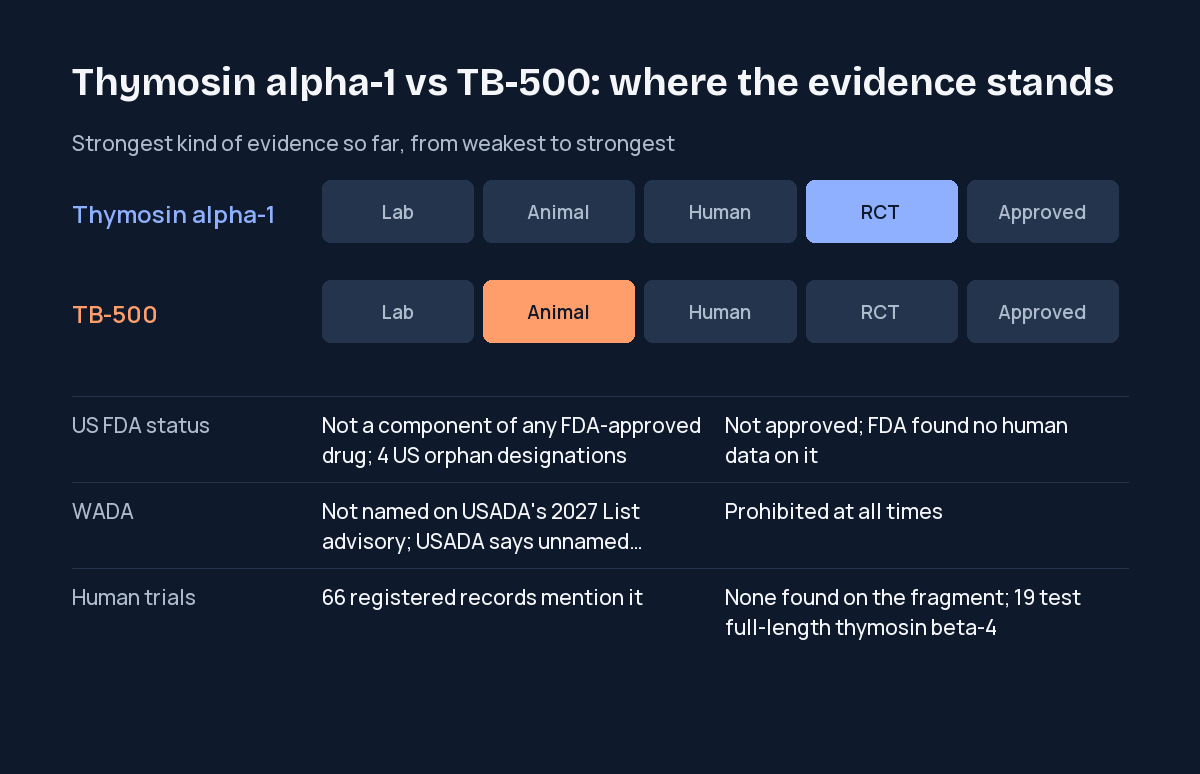
Thymosin alpha-1 is an immune-signaling peptide with human trials behind it: in a 488-person melanoma trial, median survival was 9.4 months with it against 6.6 months without (Human RCT, P=.08). TB-500 is a seven-amino-acid fragment of thymosin beta-4 studied for tissue repair, with healing results in rats and mice but no human trial of the fragment found on ClinicalTrials.gov as of 2026-10-22. Neither is FDA approved; thymosin alpha-1 is authorised in some other countries, and TB-500 is banned in sport.
| Item | Thymosin alpha-1 | TB-500 |
|---|---|---|
| US FDA status | Not a component of any FDA-approved drug; 4 US orphan designations (FDA briefing 2024) | Not approved; FDA found no human data on it (FDA briefing 2026) |
| Compounding | Category 2 nomination withdrawn (FDA); FDA advisers voted 4–17 against 503A listing on 2024-12-04 (FDA minutes); advisory vote | Category 2 nomination withdrawn (FDA); advisers voted 8–6 (1 abstention) for 503A listing on 2026-07-23, as reported by trade press (FDA meeting page); advisory, no FDA rule yet |
| WADA | Not named on USADA’s 2027 List advisory; USADA says unnamed peptides may still be prohibited (USADA) | Prohibited at all times (S2); the 2027 List, in force 2027-01-01, keeps it there by name (USADA) |
| Strongest evidence | Human RCTs (largest n=1,106) | Animal and lab only for the fragment |
| Human trials | 66 registered records mention it (ClinicalTrials.gov), e.g. NCT02867267 | None found on the fragment; 19 test full-length thymosin beta-4 (ClinicalTrials.gov) |
| Last checked | 2026-10-22 | 2026-10-22 |
Key points:
- The two share the word “thymosin” but are unrelated molecules; FDA states that thymosin beta-4 and TB-500 are not the same substance either.
- The largest thymosin alpha-1 trial, 1,106 adults with sepsis, found no drop in 28-day deaths.
- Full-length thymosin beta-4 has eye and skin trials; none tested the TB-500 fragment.
- FDA lists immunogenicity and impurity concerns for compounded versions of both.
- No controlled human study of the two together was found (searched 2026-10-22).
| Feature | Thymosin alpha-1 | TB-500 |
|---|---|---|
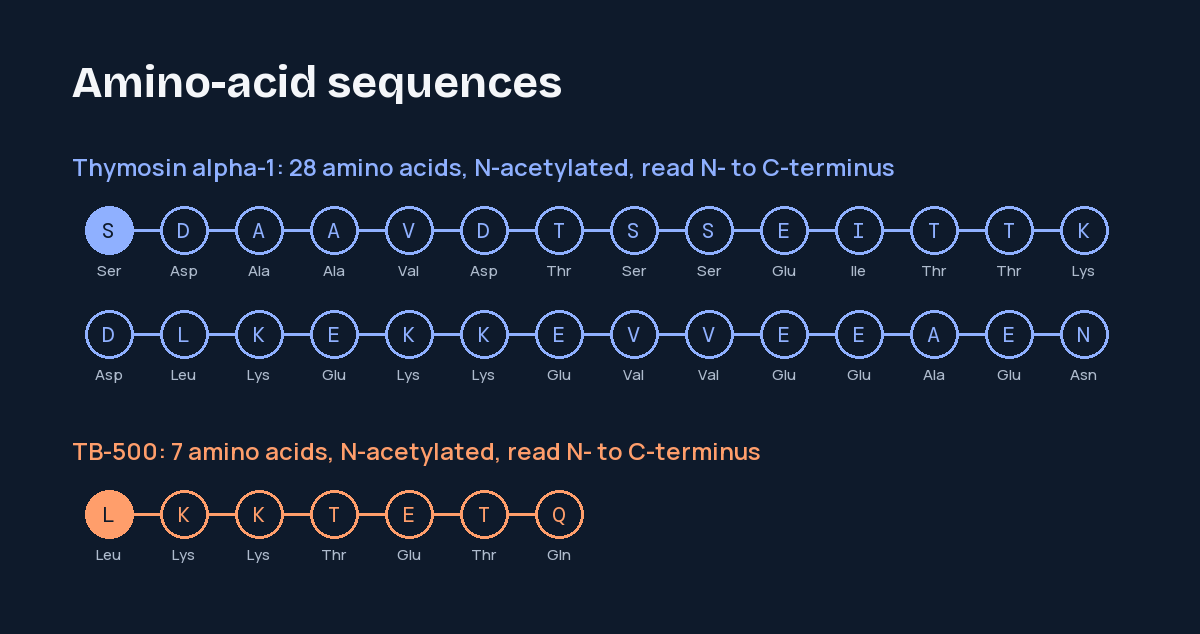
| What it is | 28-amino-acid thymus peptide; synthetic form is thymalfasin | Acetylated 7-amino-acid fragment (Ac-LKKTETQ) of thymosin beta-4 |
| Molecular weight | 3,108.3 (PubChem) | 889.0 (PubChem) |
| Class | Immune modulator | Actin-binding repair fragment |
| Mechanism | Toll-like receptor signaling in dendritic cells | Region of thymosin beta-4 linked to cell migration |
| Main research focus | Hepatitis B and C, sepsis, cancer, vaccine response | Wound and tendon repair (animals); heart data are for full thymosin beta-4 |
| Human evidence | Several RCTs and meta-analyses | None on the fragment |
| Approval | Reported in Italy, India and Hong Kong; not in the US | No approved product in the US, UK, EU, Canada or Australia |
| WADA | Not named | Prohibited (S2) |
| Routes studied | Under the skin (humans) | Under the skin and into the abdomen (animal PK) |
| Main safety concerns | Injection-site reactions; label cautions abroad | No human safety data; immunogenicity; tumor questions raised for the parent protein |
What is thymosin alpha-1?
Thymosin alpha-1 is a 28-amino-acid peptide found in the thymus that helps T cells mature (Mao 2023, review). Its synthetic version, thymalfasin, is sold outside the US as Zadaxin. FDA’s 2024 review cites approvals in Italy as a flu-vaccine adjuvant for immunocompromised people, in India for chronic hepatitis B, and in Hong Kong, while noting it could not verify every country claim (FDA briefing 2024). It is not part of any FDA-approved drug. Its human trials cover hepatitis B and C, sepsis, cancer, COVID-19 and vaccine response.
What is TB-500?
TB-500 is a synthetic, N-acetylated piece of thymosin beta-4: amino acids 17 to 23 (LKKTETQ) of the 43-amino-acid protein (FDA briefing 2026). Doping-control chemists identified that sequence in products sold as TB-500 (Esposito 2012, Lab). Online sources often call it synthetic thymosin beta-4, but FDA states the two “are not the same substance”. Most of the healing research in this family was done with full-length thymosin beta-4, a different and larger molecule. FDA found no study in which TB-500 itself was given to people.
How they work differently
A 2004 review describes the thymosins, first isolated from the thymus gland, as “biochemically and functionally distinct polypeptides” (Goldstein 2004, review).
- Thymosin alpha-1: it activated dendritic cells through Toll-like receptor pathways and boosted antifungal immunity in mice (Romani 2004, Lab and Animal).
- TB-500: thymosin beta-4 binds single actin units inside cells (Safer 1991, Lab), and its LKKTETQ region is linked to cell migration, new blood vessels and wound repair (Sosne 2010, review).
- Thymosin alpha-1: FDA describes its effects as immune modulation through Toll-like receptors on dendritic and lymphoid progenitor cells (FDA briefing 2024).
- TB-500: FDA cites a lab study in which TB-500 did not heal scratch wounds in fibroblast cultures, and animal studies showing it breaks down into smaller pieces in the body (FDA briefing 2026, Lab and Animal).
Evidence head-to-head
Thymosin alpha-1’s human signals are in cancer and liver disease, though the melanoma survival gain missed statistical significance. TB-500’s best data are in animals, where the LKKTETQ peptide helped wounds heal in aged mice about as well as the full protein (Philp 2003, Animal). Results below come from separate studies, so they cannot be compared directly.
| Outcome | Thymosin alpha-1 best evidence | TB-500 best evidence |
|---|---|---|
| Sepsis survival | Human RCT, n=1,106: 23.4% vs 24.1% died (Wu 2025) | None found |
| Cancer | Human RCT, n=488: survival 9.4 vs 6.6 months, P=.08 (Maio 2010) | None found |
| Hepatitis B | Meta-analysis, 4 RCTs, n=199 (Yang 2008) | None found |
| Vaccine response | Pilot study, n=99 dialysis patients (Carraro 2012) | None found |
| Skin wounds | None found | Animal: LKKTETQ aided repair in aged mice (Philp 2003) |
| Tendon | None found | Animal, 32 rats: stronger repair (Biçer 2026) |
| Heart repair | None found | Animal, full thymosin beta-4 in mice (Bock-Marquette 2004) |
| Eye healing | None found | Human RCT of full thymosin beta-4, n=18 (Sosne 2022), not TB-500 |
Thymosin alpha-1 in people
In metastatic melanoma, adding thymosin alpha-1 to chemotherapy gave a median overall survival of 9.4 months against 6.6 months, a result that did not reach statistical significance (P=.08), with no extra toxicity (Maio 2010, Human RCT, n=488). In chronic hepatitis B, a pooled analysis found it did better than interferon six months after treatment ended, with an odds ratio of 3.71 for virological response (Yang 2008, meta-analysis). Sepsis is where the evidence turned. An earlier trial of 361 patients reported 26.0% against 35.0% deaths (Wu 2013, Human RCT), but the larger TESTS trial found 23.4% against 24.1% (hazard ratio 0.99, P=0.93) and concluded there was “no clear evidence” of benefit (Wu 2025, Human RCT, n=1,106). For COVID-19, two 2023 meta-analyses disagree: one found lower mortality (RR 0.59) (Soeroto 2023), the other found no effect (RR 1.03) (Shang 2023).
Thymosin beta-4, not TB-500, in people
Every human trial of the thymosin beta-4 line found on ClinicalTrials.gov (searched 2026-10-22) used the full-length protein. In neurotrophic keratopathy, eye drops fully healed the cornea in 6 of 10 patients against 1 of 8 on placebo (p=0.0656) (Sosne 2022, Human RCT). In two large dry-eye trials of 601 and 700 people, the posted results show similar changes on drops and placebo for the main measures (ARISE-2, ARISE-3). A topical gel for venous leg ulcers had safety comparable to placebo, and the authors suggest one strength may speed healing, with about 25% of patients fully healed within three months (Guarnera 2010, Human RCT, n=73). In animals, a product the authors call TB-500 improved tendon strength and tissue scores in rats, though the abstract does not give its sequence (Biçer 2026, Animal).
Which fits which goal?
Thymosin alpha-1 has more evidence for immune-related uses: hepatitis B, vaccine response in people with weak immune systems, and cancer as an add-on, all from human trials of varying size and quality. TB-500 has more evidence for tissue repair, but only in animals and lab models; for people, the repair data belong to full-length thymosin beta-4 in eye and skin trials. Neither has evidence for general wellness, recovery or performance. Our ranking of peptides for injury and tendon healing places TB-500 against other repair peptides, and BPC-157 vs TB-500 compares the two most-discussed ones. A clinician is the person to decide whether either fits a specific situation.
Can they be combined?
Combining the two is discussed online as part of “stacks”; our guide to peptide stacks covers the common blends. No controlled human study of the combination was found on PubMed or ClinicalTrials.gov (searched 2026-10-22). The only combination data for TB-500 come from rats, where adding BPC-157 to TB-500 gave no extra benefit for tendon repair (Biçer 2026, Animal).
Safety and regulatory status
Thymosin alpha-1 has the longer safety record. FDA’s review found it generally well tolerated in clinical studies for up to 12 months, with injection-site irritation, redness or discomfort as the most common reactions (FDA briefing 2024). Labels outside the US carry warnings for children, pregnancy and breastfeeding, autoimmune disease and immunosuppressed people, and one label mentions short-lived liver-enzyme rises. FDA still concluded that compounding it may raise safety concerns, and its advisers voted 4–17 against adding it to the 503A list (FDA minutes).
TB-500 has no human safety data. FDA is “particularly concerned about the absence of human data” and warns that injected peptides can trigger immune reactions, made worse by clumping and impurities (FDA briefing 2026). A theoretical cancer question also applies to the parent protein: when mouse melanoma cells were engineered to overproduce thymosin beta-4, mice averaged 46.7 metastatic lung nodules against 10.9 with control cells (Cha 2003, Animal). That study raised the protein inside tumor cells rather than injecting the peptide, so its relevance to TB-500 is unknown. More on unregulated products is in are peptides safe?
| Jurisdiction | Thymosin alpha-1 | TB-500 |
|---|---|---|
| US FDA | Not approved | Not approved |
| US compounding | Advisers voted against listing, 2024 | Advisers voted for listing, 2026 (advisory) |
| WADA / USADA | Not named; status unconfirmed | Prohibited at all times (USADA sanction) |
| EU and other countries | Authorised in Italy (EMA) | No approved product in the UK, EU, Canada or Australia (FDA 2026) |
For athletes, USADA’s 2027 advisory names TB-500 and thymosin beta-4 under S2 and adds peptides in general to the S0 class of unapproved substances (USADA). How the List treats each class is compared in peptides vs steroids vs SARMs.
Anyone who suspects a side effect from thymosin alpha-1, TB-500 or any other drug or product can report it to the FDA through MedWatch.
How long do effects take in studies?
Timelines exist only from the trials. In sepsis, the main measure was death at 28 days (Wu 2025). In hepatitis B, the advantage over interferon appeared at follow-up six months after a six-month course, not at the end of treatment (Yang 2008). For thymosin beta-4, corneal healing was measured after 4 weeks (Sosne 2022), and leg ulcers within 3 months (Guarnera 2010). No human timeline exists for TB-500.
What users report
These are unverified self-reports from people who usually bought unregulated products, and they are not evidence. People who post about thymosin alpha-1 commonly describe taking it to get through colds, long COVID or chronic fatigue, and many say they noticed little change. People who post about TB-500 most often describe it for sore joints, tendons and old injuries, with some saying pain eased within weeks and others reporting nothing. Many threads ask whether the two are the same thing, a confusion the shared name invites. Recurring complaints include tiredness, headaches, redness at the injection spot and doubts about what was really in the product. Cost comes up often. Athletes in these discussions argue about testing and bans, and others debate whether stacking the two with BPC-157 adds anything.
Frequently asked questions
Is thymosin alpha-1 the same as TB-500?
No. Thymosin alpha-1 is a 28-amino-acid immune peptide, while TB-500 is a seven-amino-acid fragment of a different protein, thymosin beta-4 (FDA briefing 2026). The shared name comes from both being first isolated from the thymus. Their structures, targets and research areas do not overlap, and FDA reviewed them separately for compounding.
Is thymosin alpha-1 FDA approved?
No. FDA states that thymosin alpha-1 is not a component of any FDA-approved drug, although it holds four US orphan designations, which are not approvals (FDA briefing 2024). It is authorised in some other countries, including Italy, for uses such as hepatitis B and as a vaccine adjuvant.
What is thymosin alpha-1 used for?
Where it is authorised, mainly for chronic hepatitis B and to strengthen vaccine responses in people with weak immune systems, according to FDA’s review (FDA briefing 2024). It has also been tested in sepsis, melanoma and COVID-19. The largest sepsis trial, with 1,106 adults, found no reduction in deaths.
Who should not take thymosin alpha-1?
Labels outside the US warn about use in children, pregnant and breastfeeding women, people with autoimmune disease and immunosuppressed people, according to FDA’s 2024 review (FDA briefing 2024). FDA also flagged immunogenicity and impurity risks for compounded versions. No US label exists, so a clinician is the person to weigh these cautions.
Is TB-500 banned in sport?
Yes. TB-500 is prohibited at all times, in and out of competition, as a peptide hormone and growth-factor related substance, and USADA has sanctioned athletes for it (USADA). The 2027 List, in force from 2027-01-01, names TB-500 and thymosin beta-4 under S2.
References
- US FDA. Briefing document: thymosin alpha-1, Pharmacy Compounding Advisory Committee, December 4, 2024. FDA
- US FDA. Minutes, Pharmacy Compounding Advisory Committee, December 4, 2024. FDA
- US FDA. Briefing document: TB-500, Pharmacy Compounding Advisory Committee, July 2026. FDA
- US FDA. July 23–24, 2026 meeting of the Pharmacy Compounding Advisory Committee. FDA
- US FDA. Certain bulk drug substances for use in compounding that may present significant safety risks. FDA
- Wu J, et al. Thymosin α1 in adults with sepsis (TESTS). BMJ. 2025. PubMed 39814420
- Wu J, et al. Thymosin alpha 1 in severe sepsis (ETASS). Crit Care. 2013. PubMed 23327199
- Maio M, et al. Thymosin alpha 1 with dacarbazine and interferon in metastatic melanoma. J Clin Oncol. 2010. PubMed 20194853
- Yang YF, et al. Thymosin alpha 1 vs interferon alpha in chronic hepatitis B: meta-analysis. Antiviral Res. 2008. PubMed 18078676
- Carraro G, et al. Thymosin alpha 1 and pandemic influenza vaccine in hemodialysis patients. Vaccine. 2012. PubMed 22178096
- Soeroto AY, et al. Thymosin alpha-1 in COVID-19: meta-analysis. Inflammopharmacology. 2023. PubMed 37845598
- Shang W, et al. Thymosin alpha 1 in hospitalized COVID-19: meta-analysis. Int Immunopharmacol. 2023. PubMed 36527881
- Mao W. Thymosin alpha 1: broader applications in the immuno-oncology era (review). Int Immunopharmacol. 2023. PubMed 36871535
- Goldstein AL, Badamchian M. Thymosins: chemistry and biological properties. Expert Opin Biol Ther. 2004. PubMed 15102605
- Romani L, et al. Thymosin alpha 1 activates dendritic cells via Toll-like receptors. Blood. 2004. PubMed 14982877
- Safer D, et al. Thymosin beta 4 and Fx, an actin-sequestering peptide. J Biol Chem. 1991. PubMed 1999398
- Sosne G, et al. Biological activities of thymosin beta4 defined by active sites. FASEB J. 2010. PubMed 20179146
- Esposito S, et al. Identification of TB-500 (Ac-LKKTETQ) in doping control. Drug Test Anal. 2012. PubMed 22962027
- Philp D, et al. Thymosin beta 4 and LKKTETQ in dermal wound repair. Wound Repair Regen. 2003. PubMed 12581423
- Biçer O, et al. TB-500 and BPC-157 in rat Achilles tendon healing. Jt Dis Relat Surg. 2026. PubMed 42542926
- Bock-Marquette I, et al. Thymosin beta4 and cardiac repair. Nature. 2004. PubMed 15565145
- Sosne G, et al. RGN-259 in neurotrophic keratopathy (SEER-1). Int J Mol Sci. 2022. PubMed 36613994
- Guarnera G, et al. Thymosin beta 4 for venous stasis ulcers. Ann N Y Acad Sci. 2010. PubMed 20536470
- Cha HJ, et al. Thymosin beta4 in tumor metastasis and angiogenesis. J Natl Cancer Inst. 2003. PubMed 14625258
- ClinicalTrials.gov. ARISE-2, NCT02974907 (posted results). ClinicalTrials.gov
- ClinicalTrials.gov. ARISE-3, NCT03937882 (posted results). ClinicalTrials.gov
- ClinicalTrials.gov. TESTS, NCT02867267. ClinicalTrials.gov
- ClinicalTrials.gov. Searches for thymalfasin and thymosin beta 4, 2026-10-22. Thymalfasin; thymosin beta 4
- PubChem. Thymalfasin, CID 16130571; TB500, CID 62707662. CID 16130571; CID 62707662
- European Medicines Agency. Orphan designation EU/3/02/110, thymalfasin. EMA
- USADA. Athlete advisory: the 2027 WADA Prohibited List. USADA
- USADA. Anthony McCauley accepts doping sanction. 2025. USADA
Change log
2026-10-26: links to related entries added; no change to the facts.
2026-10-24: first published after review by the editorial team.