BPC-157 has the broader gut-healing record: in rats it healed chemically induced colitis, surgical bowel joins (Klicek 2013) and bowel fistulas (Klicek 2008). KPV, a three-amino-acid fragment of an anti-inflammatory hormone, has the clearer anti-inflammatory record: in mice it eased both chemical and immune-driven colitis (Kannengiesser 2008). Neither is FDA-approved, and neither has a published controlled human gut trial, so for both the strongest gut evidence is animal work.
| Item | BPC-157 | KPV |
|---|---|---|
| US FDA status | Not approved (Drugs@FDA, checked 2026-10-05) | Not approved (Drugs@FDA, checked 2026-10-05) |
| Compounding (503A) | Withdrawn from Category 2. Reviewed for ulcerative colitis by PCAC on 2026-07-23 (FDA meeting); FDA has posted no vote record. Advisory only; no FDA rule yet | Withdrawn from Category 2. Reviewed for wound healing and inflammatory conditions by PCAC on 2026-07-23; FDA has posted no vote record. Advisory only; no FDA rule yet |
| WADA, 2026 List | Prohibited at all times, S0 non-approved substances (USADA) | Not named; S0 appears to apply as an unapproved substance (our reading of the 2026 List) |
| WADA, 2027 List (from 2027-01-01) | No change: still S0 (USADA) | Not named, but “peptides” in general are named in S0 from 2027-01-01 (USADA) |
| Strongest gut evidence | Animal (rats) | Animal (mice, rats) |
| Human trials | 4 on ClinicalTrials.gov, none on the gut, none with posted results: NCT02637284, NCT07752381, NCT07437547, NCT07803250 | None registered on ClinicalTrials.gov (searched 2026-10-19) |
| Last checked | 2026-10-19 | 2026-10-19 |
Key points:
- BPC-157 reached phase II testing for inflammatory bowel disease under the code PL 14736, its developers reported (Sikiric 2012), but a 2026 review counts “no completed Phase II clinical trial” (Mateescu 2026).
- FDA says it has “not identified any human exposure data” for KPV by any route (FDA).
- In lab and mouse studies, KPV acted through PepT1, a peptide transporter in the gut lining (Dalmasso 2008) [Lab and Animal]; in lab and rat studies, BPC-157 acted on blood-vessel growth signals (Hsieh 2017) [Lab and Animal].
- Both were given by mouth, in drinking water, in animal gut studies; the papers reviewed here contain no human oral data for either.
- No PubMed-indexed controlled clinical trial of either peptide was found (searched 2026-10-19); BPC-157’s human data are limited to small uncontrolled pilots (Mateescu 2026).
BPC-157 vs KPV at a glance
| Feature | BPC-157 | KPV |
|---|---|---|
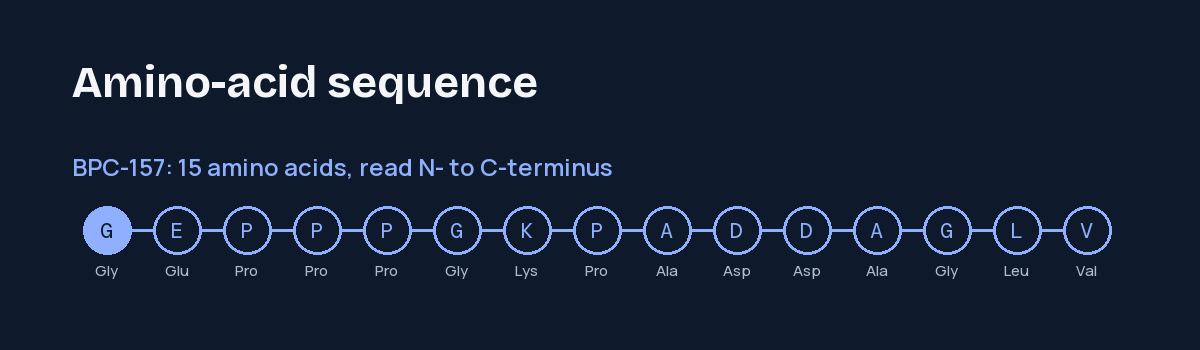
| What it is | 15-amino-acid peptide (pentadecapeptide) | Tripeptide Lys-Pro-Val, alpha-MSH(11–13) |
| Class | “Stable gastric pentadecapeptide” | Melanocortin fragment |
| Main mechanism studied | VEGFR2 and nitric-oxide signaling, blood-vessel growth | Enters cells via PepT1; blocks NF-κB inflammatory signaling |
| Main gut research focus | Repair: colitis, fistulas, short bowel, anastomosis | Inflammation: colitis, mucosal barrier |
| Gut models with results | Rat cysteamine colitis, fistula, short bowel | Mouse DSS, TNBS and T-cell transfer colitis |
| Human gut evidence | Phase II reported by developers; no peer-reviewed results | None found |
| Human data of any kind | Under 30 people in 3 uncontrolled pilots | None, per FDA |
| US approval | Not approved | Not approved |
| WADA | Prohibited, S0 | Not named; S0 appears to apply |
| Routes in gut studies | Drinking water, injection into the abdomen | Drinking water, oral nanoparticles, into the colon |
| Main safety concerns | Angiogenesis and cancer questions; immunogenicity, impurities | No human safety data at all |
What is BPC-157?
BPC-157 is a 15-amino-acid peptide that its developers describe as a “stable gastric pentadecapeptide” (Sikiric 2012). The Croatian drugmaker Pliva ran early clinical work for inflammatory bowel disease under the codes PL-10, PLD-116 and PL14736 (Mateescu 2026). In rats, it healed cysteamine-induced colitis and surgical colon-to-colon joins (Klicek 2013) [Animal]. In animal studies, its plasma half-life was under 30 minutes (Mateescu 2026) [Animal]. Its tendon and muscle research is compared in our BPC-157 vs TB-500 comparison.
What is KPV?
KPV is a tripeptide: lysine, proline and valine. It is the last three amino acids (positions 11–13) of alpha-melanocyte-stimulating hormone (alpha-MSH), a melanocortin hormone whose anti-inflammatory effects have been described in mouse colitis (Kannengiesser 2008). Its gut research comes mainly from colitis models in mice. Much of the recent work tests delivery systems, such as nanoparticles and hydrogels, that carry KPV to the inflamed colon (Xiao 2017; Zhao 2022). FDA lists no human exposure data for it (FDA).
How they work differently
- BPC-157: raised VEGFR2, a receptor for blood-vessel growth signals, and switched on the VEGFR2-Akt-eNOS pathway, increasing vessel density (Hsieh 2017) [Lab and Animal]. In a rat bowel-fistula model, its healing effect held up when nitric-oxide production was blunted (Klicek 2008) [Animal].
KPV: enters gut-lining and immune cells through PepT1 and blocks NF-κB and MAP-kinase inflammatory signaling at nanomolar concentrations (Dalmasso 2008) [Lab]. In mice lacking PepT1, it no longer prevented colitis-linked tumors (Viennois 2016) [Animal]. - BPC-157: the gut work is about repair: closing fistulas, strengthening surgical joins, and improving gut-wall structure after bowel resection (Sever 2009) [Animal].
KPV: the gut work is about inflammation. It still worked in mice without a working melanocortin-1 receptor, so its effect seems “at least partially independent of MC1R signaling” (Kannengiesser 2008) [Animal].
BPC-157 vs KPV for gut health: evidence head-to-head
Each cell gives the best evidence level found and the study behind it. All results come from separate studies in different models, so they are cross-trial and cannot be compared as if measured side by side. Our evidence-grading method explains the levels.
| Outcome | BPC-157 best evidence | KPV best evidence |
|---|---|---|
| Chemical colitis | Animal (rat): healed cysteamine colitis (Klicek 2013) | Animal (mouse): less DSS and TNBS colitis (Dalmasso 2008) |
| Immune-driven colitis | No T-cell-transfer colitis study found on PubMed (searched 2026-10-19) | Animal (mouse): recovery in transfer colitis (Kannengiesser 2008) |
| Colitis survival | Not reported in the studies found | Animal (mouse): all treated MC1R-deficient mice survived DSS colitis (Kannengiesser 2008) |
| Bowel fistula | Animal (rat): faster colocutaneous fistula healing (Klicek 2008) | No study found on PubMed (searched 2026-10-19) |
| Short bowel after surgery | Animal (rat): weight gain above pre-surgery levels in a 4-week study (Sever 2009) | No study found on PubMed (searched 2026-10-19) |
| Gut tissue repair | Animal (rat): better gut structure and anastomosis strength (Sever 2009) | Animal (rat): colon barrier recovered in TNBS colitis (Zhao 2022) |
| Colitis-linked cancer | No study found on PubMed (searched 2026-10-19) | Animal (mouse): prevented AOM/DSS tumors (Viennois 2016) |
| Human gut trial | Phase II for IBD reported (Sikiric 2012); no peer-reviewed results | None registered (ClinicalTrials.gov, searched 2026-10-19) |
| Human safety | Human pilot (n=2): no biomarker changes after IV infusion (Lee 2025) | No human exposure data (FDA) |
The most encouraging single result for KPV is a delivery one. Packed into colon-targeted nanoparticles, KPV protected mice from DSS colitis at a concentration “12,000-fold lower” than free KPV, with similar effect (Laroui 2010) [Animal].
For BPC-157, the standout is its range. Across separate rat studies, the same peptide closed colon fistulas, healed colitis and reversed weight loss after bowel resection; in the resection study, untreated rats lost weight while treated rats gained weight above their pre-surgery levels (Sever 2009) [Animal].
Oral BPC-157 and KPV: what the gut studies used
Both peptides have been given by mouth in animal gut studies. In rats, BPC-157 sped colon-fistula healing both in drinking water and by injection (Klicek 2008) [Animal]. BPC-157 appeared stable in gastric juice in lab incubation tests, but human oral bioavailability data are absent (Mateescu 2026) [Lab]. KPV in drinking water reduced colitis in mice (Dalmasso 2008) [Animal], and oral hyaluronic-acid nanoparticles carrying KPV sped mucosal healing (Xiao 2017) [Animal]. Those nanoparticles were research formulations made in the lab. Route differences for BPC-157 are covered in BPC-157 oral vs injection.
Which fits which goal?
BPC-157 has more evidence for structural gut repair: fistulas, surgical joins and recovery after bowel resection, all in rats (Klicek 2008; Sever 2009) [Animal]. It is also the only one of the two that its developers report testing in people with bowel disease, though no full results are available (Sikiric 2012).
KPV has more evidence for gut inflammation: it worked in three different mouse colitis models, including an immune-cell-driven one, and its anti-inflammatory signaling has been mapped in human cell lines (Kannengiesser 2008; Dalmasso 2008) [Animal and Lab].
Neither has a human result showing it helps any gut condition. These are evidence statements, not a recommendation to use either peptide. A clinician is the person to decide what fits a given gut condition.
Can BPC-157 and KPV be combined?
BPC-157 and KPV are often discussed together online, and both appear in multi-peptide blends with TB-500 and GHK-Cu, such as the blend marketed as KLOW (see KLOW vs GLOW vs GHK-Cu). Some stacks add MOTS-c, a metabolic peptide with its own evidence profile, compared in MOTS-c vs 5-Amino-1MQ. How blends are put together is explained in peptide stacks explained, and BPC-157’s pairing with GHK-Cu in GHK-Cu vs BPC-157.
No controlled human study of the combination was found on PubMed or ClinicalTrials.gov (searched 2026-10-19). Any claim that the two work better together is untested.
Safety and regulatory status
Known risks. For BPC-157, FDA says compounded products “may pose risk for immunogenicity” (an immune reaction against the drug) for some routes, may have problems with peptide impurities, and that it “lacks sufficient information to know whether the drug would cause harm” (FDA). A 2025 review warns that BPC-157’s pro-angiogenic effect could support a tumor’s blood supply, so it “may not be the right choice” where undetected cancer is possible (Józwiak 2025). The concern comes from BPC-157’s mechanism (Hsieh 2017) [Lab and Animal]; none of the studies cited here measured cancer risk in people. For KPV, FDA lacks information on “whether it would cause harm if administered to humans” (FDA).
Human safety data. BPC-157 has fewer than 30 people across three uncontrolled pilots (Mateescu 2026). One, a safety pilot, enrolled 2 adults and found no change in heart, liver, kidney, thyroid or glucose markers (Lee 2025) [Human pilot, n=2]. A 42-person phase I trial started in 2015, but submission of its results was cancelled in 2016 (Józwiak 2025; NCT02637284). KPV has no human safety data.
United States. Neither is FDA-approved (Drugs@FDA, checked 2026-10-05). Both were withdrawn from FDA’s Category 2 list, which does not make them approved. On 2026-07-23 FDA’s Pharmacy Compounding Advisory Committee reviewed BPC-157 for ulcerative colitis and KPV for wound healing and inflammatory conditions (FDA). FDA has posted no minutes or vote record for either peptide. The vote is advisory, and FDA has issued no rule. What that means is covered in what the FDA compounding vote changes.
Elsewhere. USADA says BPC-157 is not approved by “any other global health authority” (USADA). No KPV approval by any regulator was found in the sources reviewed for this page (searched 2026-10-19).
Sport. BPC-157 is prohibited at all times under S0, and stays there on the 2027 List (USADA 2027). KPV is not named, but from 2027-01-01 “peptides” in general are named in S0, and USADA warns that an unnamed peptide “may still be prohibited” (USADA 2027).
Anyone who suspects a side effect from BPC-157, KPV or any other drug or product can report it to the FDA through MedWatch.
What users report
These are unverified self-reports from people who usually bought unregulated products, not evidence. People who post about BPC-157 and KPV for gut problems on Reddit, YouTube and biohacking boards commonly describe less bloating, fewer flare symptoms in colitis or Crohn’s disease, and calmer digestion, often after a few weeks. Many say they took the two together, which makes it impossible to tell which one, if either, did anything. A recurring complaint is no effect at all, or symptoms returning after stopping. Others mention nausea, headaches, fatigue or irritation where they injected. Cost and product quality come up constantly: posters argue about whether vials contain what the label says, and some describe a batch that seemed to do nothing. A frequent argument is whether oral forms survive the stomach. Another is whether BPC-157’s effect on blood-vessel growth is a cancer risk. Some posters with diagnosed bowel disease say they use these peptides alongside prescribed treatment, and others warn against replacing that treatment.
Frequently asked questions
Which peptide is the best-researched for gut repair?
Between these two, BPC-157 has the wider gut-repair record, but it is animal work. In rats, it sped healing of colon fistulas when given by mouth or by injection (Klicek 2008) [Animal]. KPV’s gut record is mostly about inflammation in mouse colitis. Neither has published human results for any gut condition, and neither is FDA-approved.
Does BPC-157 heal gut issues?
In animals, it did; in people, it is unproven. In rats, it improved recovery after bowel resection (Sever 2009) [Animal]. Phase II testing in bowel disease was reported, but no peer-reviewed results exist, and a 2026 review counts no completed phase II trial (Mateescu 2026).
Is KPV the safest peptide?
No one can say, because KPV has not been tested for safety in people. FDA states it “has not identified any human exposure data” on KPV by any route, and lacks information on whether it would cause harm (FDA). A lack of reported side effects reflects missing data, not proven safety.
What are the side effects of BPC-157 and KPV?
No controlled human trial has measured them. A BPC-157 safety pilot enrolled 2 adults and found no changes in heart, liver, kidney, thyroid or glucose markers (Lee 2025) [Human pilot, n=2]. FDA flags possible immune reactions and impurity problems for compounded BPC-157. KPV has no human safety data, so its side effects are unknown.
Which peptides does Joe Rogan talk about?
The peptides most often linked to him are BPC-157, TB-500, ipamorelin, CJC-1295 and MOTS-c, and our Joe Rogan peptides evidence review grades each one. For athletes, BPC-157 is prohibited at all times under WADA’s S0 class of non-approved substances (USADA).
References
- Dalmasso G, Charrier-Hisamuddin L, Nguyen HT, et al. 2008. PepT1-mediated tripeptide KPV uptake reduces intestinal inflammation. Gastroenterology. PMID 18061177
- Kannengiesser K, Maaser C, Heidemann J, et al. 2008. Melanocortin-derived tripeptide KPV has anti-inflammatory potential in murine models of inflammatory bowel disease. Inflamm Bowel Dis. PMID 18092346
- Laroui H, Dalmasso G, Nguyen HT, et al. 2010. Drug-loaded nanoparticles targeted to the colon with polysaccharide hydrogel reduce colitis in a mouse model. Gastroenterology. PMID 19909746
- Xiao B, Xu Z, Viennois E, et al. 2017. Orally targeted delivery of tripeptide KPV via hyaluronic acid-functionalized nanoparticles efficiently alleviates ulcerative colitis. Mol Ther. PMID 28143741
- Viennois E, Ingersoll SA, Ayyadurai S, et al. 2016. Critical role of PepT1 in promoting colitis-associated cancer and therapeutic benefits of the anti-inflammatory PepT1-mediated tripeptide KPV in a murine model. Cell Mol Gastroenterol Hepatol. PMID 27458604
- Zhao Y, Xue P, Lin G, et al. 2022. A KPV-binding double-network hydrogel restores gut mucosal barrier in an inflamed colon. Acta Biomater. PMID 35245681
- Klicek R, et al. 2013. Stable gastric pentadecapeptide BPC 157 heals cysteamine-colitis and colon-colon-anastomosis and counteracts cuprizone brain injuries and motor disability. J Physiol Pharmacol. PMID 24304574
- Klicek R, et al. 2008. Pentadecapeptide BPC 157, in clinical trials as a therapy for inflammatory bowel disease (PL14736), is effective in the healing of colocutaneous fistulas in rats: role of the nitric oxide-system. J Pharmacol Sci. PMID 18818478
- Sever M, et al. 2009. Gastric pentadecapeptide BPC 157 and short bowel syndrome in rats. Dig Dis Sci. PMID 19093208
- Sikiric P, Seiwerth S, Rucman R, et al. 2012. Focus on ulcerative colitis: stable gastric pentadecapeptide BPC 157. Curr Med Chem. PMID 22300085
- Mateescu DM, Gavrilescu DM, Constantinescu FE, et al. 2026. BPC-157 as an investigational peptide therapeutic: biopharmaceutical challenges, formulation strategies, and translational development barriers. Pharmaceutics. PMID 42198317
- Hsieh MJ, et al. 2017. Therapeutic potential of pro-angiogenic BPC157 is associated with VEGFR2 activation and up-regulation. J Mol Med (Berl). PMID 27847966
- Józwiak M, Bauer M, Kamysz W, Kleczkowska P. 2025. Multifunctionality and possible medical application of the BPC 157 peptide: literature and patent review. Pharmaceuticals (Basel). PMID 40005999
- Lee E, Burgess K. 2025. Safety of intravenous infusion of BPC157 in humans: a pilot study. Altern Ther Health Med. PMID 40131143
- US FDA. Certain bulk drug substances for use in compounding that may present significant safety risks (updated 2026-04-22). fda.gov
- US FDA. July 23–24, 2026: Meeting of the Pharmacy Compounding Advisory Committee. fda.gov
- US FDA. Drugs@FDA database. accessdata.fda.gov
- USADA. BPC-157: experimental peptide creates risk for athletes. usada.org
- USADA. Athlete advisory: what’s new on the 2027 WADA Prohibited List. usada.org
- WADA. 2026 Prohibited List. wada-ama.org
- ClinicalTrials.gov. BPC-157 records: NCT02637284, NCT07752381, NCT07437547, NCT07803250; KPV search: no records (searched 2026-10-19).
Change log
2026-10-26: links to related entries added; no change to the facts.
2026-10-19: first published after review by the editorial team.