Verdict: The Wolverine stack is BPC-157 plus TB-500; KLOW is the same pair plus GHK-Cu and KPV. Neither blend is FDA approved, both contain WADA-prohibited peptides, and no human trial has tested either mix. KLOW’s extra ingredients add topical human data (GHK-Cu) and mouse data (KPV), not evidence for the blend.
None of the four ingredients is an approved drug in the US, and all four appear on the FDA’s list of compounding nominations that were withdrawn from Category 2, which is not an approval. The WADA 2026 Prohibited List names BPC-157 (S0) and TB-500 (S2.3), so both blends are prohibited in sport at all times. The strongest evidence for the Wolverine pair is animal data plus one uncontrolled human chart review; the strongest evidence for anything in KLOW is small topical GHK-Cu trials that did not use the blend.
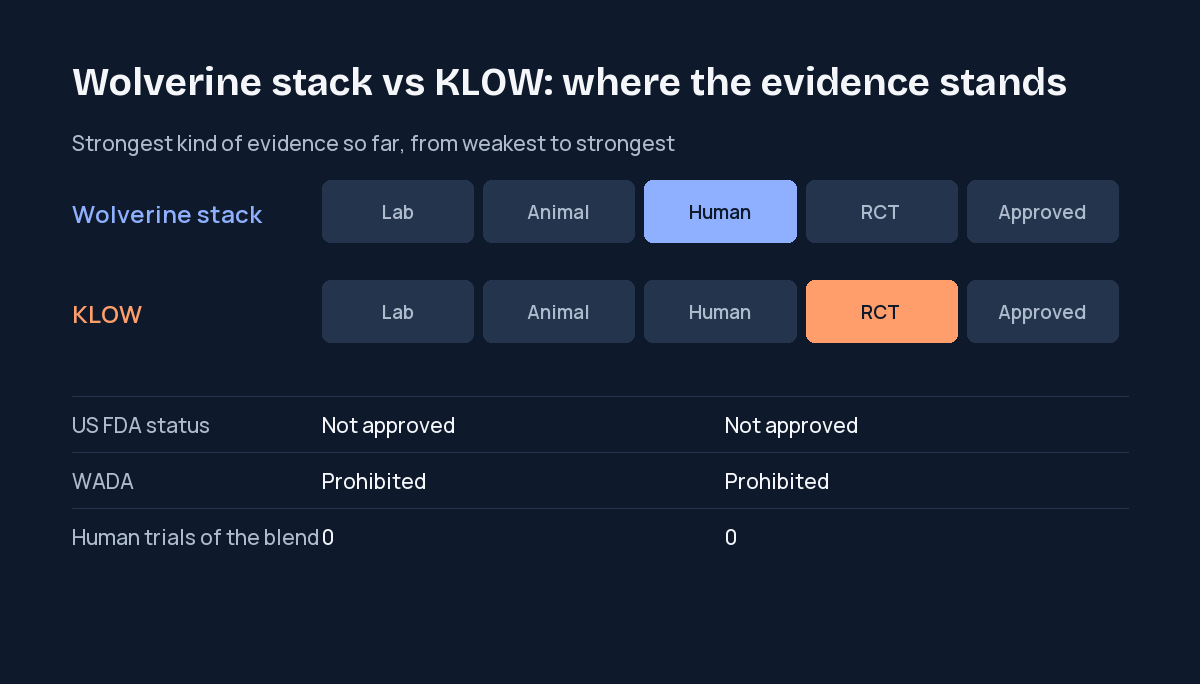
| Item | Wolverine stack | KLOW |
|---|---|---|
| US FDA status | Not approved (FDA) | Not approved (FDA) |
| Compounding (503A/503B) | Both parts withdrawn from Category 2; neither on the 503A bulks list. The Pharmacy Compounding Advisory Committee voted 8–6 on 2026-07-23 to recommend both BPC-157 and TB-500 for 503A listing; advisory only, no FDA rule yet (FDA PCAC meeting) | All four withdrawn from Category 2; none on the 503A bulks list. The same committee voted 8–6 that day to recommend BPC-157, TB-500 and KPV for 503A listing; advisory only, no FDA rule yet. GHK-Cu was not voted on; FDA plans to consult the committee on it before the end of February 2027 |
| WADA 2026 | Prohibited: BPC-157 S0, TB-500 S2.3 (WADA) | Prohibited (same two); GHK-Cu and KPV not named |
| Strongest evidence | Human, uncontrolled (n=16, BPC-157) | Human RCT, topical GHK-Cu only |
| Human trials of the blend | 0 (ingredient trials: BPC-157, 3 registered, none with posted results: NCT02637284, NCT07752381, NCT07803250; none of the TB-500 fragment) | 0 (adds GHK-Cu: NCT07706361, not yet recruiting) |
| Last checked | 2026-10-18 | 2026-09-30 |
Key points:
- A 2026 rat Achilles tendon study (n=32) that tested the Wolverine pair against each peptide alone found the combination added no benefit [Animal].
- The FDA states it has “not identified any human exposure data” for KPV by any route, so KLOW’s fourth ingredient has no documented human use in the agency’s review.
- The FDA flags possible immune reactions (immunogenicity) for compounded BPC-157 and TB-500, and aggregation-related immunogenicity for injectable GHK-Cu.
- The human trials often quoted for “TB-500” used full-length thymosin beta-4, a larger protein; TB-500 is a synthetic copy of one active region.
- An FDA advisory committee reviewed three of KLOW’s four ingredients in July 2026; GHK-Cu was not on the agenda, and the committee’s recommendations are non-binding.
Wolverine stack vs KLOW at a glance
| Feature | Wolverine stack | KLOW |
|---|---|---|
| What it is | Two-peptide combination | Four-peptide premixed blend |
| Ingredients | BPC-157, TB-500 | BPC-157, TB-500, GHK-Cu, KPV |
| Class | Unapproved synthetic peptides | Same, plus a copper peptide and an α-MSH fragment |
| Proposed mechanisms | Blood-vessel signaling via VEGFR2 (BPC-157, rat and lab); thymosin beta-4 active region (TB-500) | Adds collagen-related effects (GHK-Cu, lab) and NF-κB inhibition (KPV, lab) |
| Main research focus | Tendon, muscle and blood-flow models in rats | Adds skin wounds (GHK-Cu) and colitis models (KPV) |
| Human evidence, blend | None | None |
| Best human evidence, any part | Uncontrolled chart review, n=16 (Lee 2021) | Topical GHK-Cu RCT, diabetic ulcers (Mulder 1994) |
| Registered ingredient trials | BPC-157: 3 (NCT07803250, NCT02637284, NCT07752381); TB-500 fragment: 0 (the 19 registered thymosin beta-4 trials use the full-length protein) | Same, plus GHK-Cu: 1, not yet recruiting (NCT07706361); KPV: 0 |
| FDA approval | None | None |
| Compounding | Withdrawn from Category 2 | Withdrawn from Category 2 |
| WADA 2026 | Prohibited (S0, S2.3) | Prohibited (S0, S2.3) |
| Routes studied | Rats: several routes; humans: into the knee and IV (BPC-157, uncontrolled) | Adds topical skin (GHK-Cu, human) and oral in mice (KPV) |
| Timelines in studies | 4 weeks (rat tendon) | No study of the blend |
| Main safety concerns | Immunogenicity (FDA), tumor-vessel signal for thymosin beta-4 in mice, unregulated manufacturing | Same, plus injectable GHK-Cu aggregation and no human exposure data for KPV (FDA) |
What is the Wolverine stack?
“Wolverine stack” is a marketing name, not a product any regulator recognizes, for BPC-157 and TB-500 used together. BPC-157 is a synthetic 15-amino-acid peptide; a 2025 systematic review of its orthopedic research found 36 studies, of which 35 were preclinical and 1 was clinical. TB-500 is an acetylated seven-amino-acid fragment (LKKTETQ) of thymosin beta-4, identified in doping-control work as a synthetic version of that protein’s active region. Our BPC-157 vs TB-500 comparison sets the two ingredients against each other; this page covers what changes when two more are added.
What is KLOW?
KLOW is a premixed blend sold online that contains the two Wolverine peptides plus GHK-Cu and KPV. The ratio is set by each seller; no regulator or published study defines a standard formula. GHK-Cu is a copper-bound tripeptide (glycyl-histidyl-lysine) whose reported lab and animal actions include increased collagen and elastin. KPV (lysine-proline-valine) is the C-terminal tripeptide of alpha-melanocyte-stimulating hormone (α-MSH), studied for anti-inflammatory effects. For how KLOW differs from GLOW, the three-peptide version without KPV, see KLOW vs GLOW vs GHK-Cu.
How do they work differently?
The shared pair is proposed to work the same way in both blends. The difference is what KLOW’s extra two ingredients are proposed to add:
- Wolverine (BPC-157): in rats with blocked leg arteries and in human vessel cells, BPC-157 increased VEGFR2 expression and sped blood-flow recovery [Animal; Lab].
- Wolverine (TB-500): its parent protein, thymosin beta-4, increased blood-vessel formation in mouse tumors, with a mean 4.4-fold rise in vessels [Animal]. No study identified here measures how much of that activity the TB-500 fragment keeps.
- KLOW adds GHK-Cu: a 2018 review summarizes lab and animal findings on collagen, elastin, and blood-vessel and nerve outgrowth [Lab; Animal].
- KLOW adds KPV: nanomolar KPV inhibited NF-κB and MAP kinase inflammatory signaling in intestinal cells [Lab]. KPV lacks the sequence needed to bind known melanocortin receptors, so it is not expected to act like melanotan-type peptides [review of Lab and Animal data].
So the Wolverine pair targets repair and blood supply, while KLOW layers a skin-matrix peptide and a gut-inflammation peptide on top. Each of those rationales comes from separate lab or animal studies; none comes from a study of the blend.
Evidence head-to-head
Each cell gives the strongest evidence level found and the study behind it. Where KLOW’s cell says “same,” the only relevant data come from the two peptides it shares with the Wolverine stack.
| Outcome | Wolverine best evidence | KLOW best evidence |
|---|---|---|
| Tendon healing | Animal (rat, n=32): pair no better than either alone (Biçer 2026) | Same; no study adds GHK-Cu or KPV |
| Knee pain | Human, uncontrolled (n=16): 14 reported relief (Lee 2021) | Same; no data for added parts |
| Chronic skin ulcers | No TB-500 or BPC-157 human trial identified | Human RCT, topical GHK-Cu: 98.5% vs 60.8% median closure (Mulder 1994) |
| Skin after laser | None | Human RCT (n=13), topical GHK-Cu: higher satisfaction (Miller 2006) |
| Gut inflammation | No human trial | Animal (mice, oral KPV): less colitis (Dalmasso 2008) |
| Dry eye | Human RCT (n=72), full-length thymosin beta-4 eye drops, not TB-500 (Sosne 2015) | Same |
| Human safety | Pilot (n=2), IV BPC-157 (Lee 2025); RCT (n=40), IV full-length thymosin beta-4 (Ruff 2010) | Same; KPV has no human exposure data (FDA) |
| The blend itself | None | None |
Three points stand out. First, KLOW’s extra human evidence is all topical GHK-Cu on skin; nothing shows that GHK-Cu mixed with other peptides and given another way behaves the same. Second, the knee chart review had no control group, and some of its patients also received thymosin beta-4, so it cannot separate either peptide’s effect [Human, uncontrolled, n=16]. Third, the one direct test of “more peptides is better” identified here went against the idea: in the rat tendon study, TB-500 alone showed a significant biomechanical advantage at four weeks, while the pair added nothing over single treatment [Animal, n=32].
Which fits which goal?
These are statements about where the evidence sits, not advice to use either product:
- The Wolverine pair has more evidence for tendon and muscle repair models, almost all in rats. The 2025 systematic review found one clinical study among 36 [review; mostly Animal].
- KLOW’s added ingredients have more evidence for skin outcomes, but only as topical GHK-Cu in small human trials; in one, on post-laser skin (n=13), patient-rated skin quality improved but blinded measures of redness, wrinkles and skin quality did not [Human RCT].
- KLOW’s KPV has evidence for gut inflammation only in rodents, including mice given oral KPV and rats given a KPV hydrogel for chemically induced colitis [Animal].
- Neither has evidence as a blend for any outcome in people.
For an injury, a skin condition or a gut disease, a clinician is the person to decide what is appropriate.
Can they be combined?
KLOW already contains the whole Wolverine stack, so using both would double the shared pair; no study has examined that. On the underlying question, whether combining these peptides adds anything, the evidence is thin and not encouraging: the one controlled comparison identified of BPC-157 plus TB-500 against each alone, in rats (n=32), found no added benefit [Animal]. No published study identified here has tested BPC-157, TB-500, GHK-Cu and KPV together. No controlled human study has tested either combination, and ClinicalTrials.gov listed no registered trial of either blend on 2026-09-30. A 2026 review of unregulated peptide use names “stacking” among the practices spreading outside clinical oversight.
Safety and regulatory status
Every risk that applies to the Wolverine stack applies to KLOW, which then adds two ingredients with their own open questions. The sources for each row are in the paragraphs below.
| Issue | Wolverine stack | KLOW |
|---|---|---|
| FDA safety note | Possible immunogenicity for BPC-157 and TB-500 | Same, plus aggregation risk for injectable GHK-Cu; no human exposure data for KPV |
| FDA advisory review (non-binding) | BPC-157 (ulcerative colitis) and TB-500 (wound healing) reviewed July 2026 | KPV also reviewed; GHK-Cu not |
| WADA 2026 | BPC-157 S0; TB-500 S2.3; prohibited at all times | Same; GHK-Cu and KPV not named |
| Theoretical cancer concern | Thymosin beta-4 linked to metastasis in mice | Same |
| Product quality | Unregulated manufacturing | Same, with four ingredients instead of two |
United States. None of the four peptides is FDA approved. The FDA’s Category 2 page (updated 2026-04-22) lists all four as nominations that were withdrawn. It notes that compounded BPC-157 and TB-500 “may pose risk for immunogenicity,” that injectable GHK-Cu may pose that risk “due to the potential for aggregation,” and that the agency “has not identified any human exposure data” for KPV. Withdrawal from Category 2 does not place a substance on the 503A bulks list, and none of the four appears there. The Pharmacy Compounding Advisory Committee reviewed BPC-157 (for ulcerative colitis), KPV (for wound healing and inflammatory conditions) and TB-500 (for wound healing) on 2026-07-23; it makes non-binding recommendations to the FDA.
Sport. The WADA 2026 List names BPC-157 under S0 (non-approved substances) and “thymosin-β4 and its derivatives, e.g. TB-500” under S2.3 (growth factors). USADA confirms BPC-157 is prohibited under S0. Because both blends contain both peptides, both are prohibited at all times. GHK-Cu and KPV are not named on the List; S0 covers any pharmacological substance without government approval for human therapeutic use that no other section addresses, so their status on their own is a question for an anti-doping agency.
Known and theoretical risks. Melanoma cells engineered to overproduce thymosin beta-4 formed 46.7 versus 10.9 lung metastases in mice [Animal]; whether the TB-500 fragment carries this risk is untested. The 2025 orthopedic review warns that adverse effects are possible due to unregulated manufacturing, and a 2025 narrative review concludes BPC-157 “should be considered investigational.” A 2026 review of injectable “biohacking” drugs urges clinicians to counsel patients on long-term hazards. A four-ingredient blend also makes it harder to tell which component caused a reaction.
How long do effects take in studies?
No study reports a timeline for either blend. For the ingredients, the time points below are those the studies chose, not expected results in people:
- Rat Achilles tendon (BPC-157, TB-500, both): assessed after four weeks of postoperative treatment [Animal].
- Full-length thymosin beta-4 eye drops: discomfort in a controlled-environment test was 27% lower than placebo on day 28 [Human RCT, n=72].
What users report
Everything below comes from unverified self-reports posted by people online, most of whom say they bought unregulated peptide products rather than anything prescribed or medically supervised — none of this is evidence of safety or effectiveness. People who post about the Wolverine stack commonly report improvement in joint pain, tendon or ligament niggles, and general soft-tissue recovery, often saying they noticed a difference somewhere in the first several weeks, though timelines vary widely and plenty of posters say they felt nothing at all. A recurring complaint across Wolverine threads is injection-site soreness or redness, along with occasional reports of stomach upset, fatigue, or headache.
People discussing KLOW commonly report skin-related changes such as smoother texture or reduced redness in addition to the recovery effects also claimed for Wolverine, with posters often saying skin changes seemed to show up before anything else. Complaints specific to KLOW center on cost, since it’s a four-component blend, and on skepticism about whether a premixed product actually holds together as advertised over time. Across both, people frequently gripe about inconsistent or counterfeit product, vials that seem underdosed, and vendors they don’t trust.
The recurring argument in these communities is whether premixed multi-peptide blends like KLOW are even stable or worth the added cost compared to the simpler two-peptide Wolverine combination, with no consensus reached and posters on both sides mostly trading personal impressions rather than anything resembling clinical evidence.
Frequently asked questions
What is the difference between the Wolverine stack and KLOW?
The Wolverine stack is two peptides, BPC-157 and TB-500. KLOW contains those same two plus GHK-Cu, a copper peptide, and KPV, a tripeptide from α-MSH. KLOW therefore adds two ingredients rather than replacing any. The FDA lists all four as withdrawn Category 2 nominations, and none is an approved drug.
Is KLOW better than the Wolverine stack?
No evidence shows that. Neither blend has been tested in people, and adding ingredients has not been shown to add benefit. The one controlled test of combining the shared pair identified here, a rat tendon study with 32 animals, found BPC-157 plus TB-500 performed no better than either peptide alone.
Are the Wolverine stack and KLOW FDA approved?
No. None of BPC-157, TB-500, GHK-Cu or KPV is an FDA-approved drug, and none appears on the 503A bulks list that compounders may use. An FDA advisory committee reviewed three of the four in July 2026, but its recommendations are non-binding and no listing has followed.
Are Wolverine and KLOW banned in sports?
Yes. Both contain BPC-157, listed under S0, and TB-500, listed under S2.3 as a thymosin-β4 derivative, on the WADA 2026 Prohibited List. Both classes are prohibited in and out of competition. GHK-Cu and KPV are not named, which does not make a blend containing the other two permitted.
Has KPV been tested in humans?
No human trial of KPV was found, and the FDA states it has not identified any human exposure data for KPV by any route. Its evidence comes from cell studies and rodent colitis models, such as mice given KPV in drinking water, which developed less colitis. ClinicalTrials.gov listed no KPV trial on 2026-09-30.
References
- US Food and Drug Administration. Certain bulk drug substances for use in compounding that may present significant safety risks. Updated 2026-04-22. fda.gov
- US Food and Drug Administration. Bulk drug substances used in compounding under section 503A of the FD&C Act. Content current as of 2026-05-14. fda.gov
- US Food and Drug Administration. July 23–24, 2026: Meeting of the Pharmacy Compounding Advisory Committee. fda.gov
- World Anti-Doping Agency. International Standard: Prohibited List 2026. wada-ama.org
- US Anti-Doping Agency. BPC-157: peptide prohibited. usada.org
- Biçer O, Adanir O, Güleryüz Y, et al. 2026. Effects of BPC-157 and TB-500 on Achilles tendon healing in rats: a histopathological and biomechanical study. Joint Diseases and Related Surgery. PubMed 42542926
- Lee E, Padgett B. 2021. Intra-articular injection of BPC 157 for multiple types of knee pain. Alternative Therapies in Health and Medicine. PubMed 34324435
- Lee E, Burgess K. 2025. Safety of intravenous infusion of BPC157 in humans: a pilot study. Alternative Therapies in Health and Medicine. PubMed 40131143
- Vasireddi N, Hahamyan H, Salata MJ, et al. 2025. Emerging use of BPC-157 in orthopaedic sports medicine: a systematic review. HSS Journal. PubMed 40756949
- Hsieh MJ, et al. 2017. Therapeutic potential of pro-angiogenic BPC157 is associated with VEGFR2 activation and up-regulation. Journal of Molecular Medicine. PubMed 27847966
- McGuire FP, et al. 2025. Regeneration or risk? A narrative review of BPC-157 for musculoskeletal healing. Current Reviews in Musculoskeletal Medicine. PubMed 40789979
- Ho EN, et al. 2012. Doping control analysis of TB-500, a synthetic version of an active region of thymosin β4, in equine urine and plasma. Journal of Chromatography A. PubMed 23084823
- Sosne G, et al. 2015. Thymosin beta 4 ophthalmic solution for dry eye: a randomized, placebo-controlled, phase II clinical trial. Clinical Ophthalmology. PubMed 26056426
- Ruff D, et al. 2010. A randomized, placebo-controlled, single and multiple dose study of intravenous thymosin β4 in healthy volunteers. Annals of the New York Academy of Sciences. PubMed 20536472
- Cha HJ, et al. 2003. Role of thymosin β4 in tumor metastasis and angiogenesis. Journal of the National Cancer Institute. PubMed 14625258
- Mulder GD, et al. 1994. Enhanced healing of ulcers in patients with diabetes by topical treatment with glycyl-L-histidyl-L-lysine copper. Wound Repair and Regeneration. PubMed 17147644
- Miller TR, et al. 2006. Effects of topical copper tripeptide complex on CO2 laser-resurfaced skin. Archives of Facial Plastic Surgery. PubMed 16847171
- Pickart L, Margolina A. 2018. Regenerative and protective actions of the GHK-Cu peptide in the light of the new gene data. International Journal of Molecular Sciences. PubMed 29986520
- Dalmasso G, Charrier-Hisamuddin L, Nguyen HT, et al. 2008. PepT1-mediated tripeptide KPV uptake reduces intestinal inflammation. Gastroenterology. PubMed 18061177
- Sun J, et al. 2021. Self-cross-linked hydrogel of cysteamine-grafted γ-polyglutamic acid stabilized tripeptide KPV for alleviating TNBS-induced ulcerative colitis in rats. ACS Biomaterials Science & Engineering. PubMed 34547895
- Luger TA, Brzoska T. 2007. α-MSH related peptides: a new class of anti-inflammatory and immunomodulating drugs. Annals of the Rheumatic Diseases. PubMed 17934097
- Brzoska T, et al. 2010. Terminal signal: anti-inflammatory effects of α-MSH related peptides beyond the pharmacophore. Advances in Experimental Medicine and Biology. PubMed 21222263
- Hailu KT, et al. 2026. Unregulated peptide use in the age of biohacking. Cureus. PubMed 42437212
- Moiz A, et al. 2026. Dangers of injectable peptides and other unregulated “biohacking” drugs. Missouri Medicine. PubMed 42757290
- ClinicalTrials.gov. NCT07803250: Impact of BPC-157 on recovery following rotator cuff repair surgery (phase 1, not yet recruiting). clinicaltrials.gov
- ClinicalTrials.gov. NCT02637284: PCO-02 safety and pharmacokinetics trial (phase 1, status unknown). clinicaltrials.gov
Change log
2026-10-26: links to related entries added; no change to the facts.
2026-10-18: removed ClinicalTrials.gov records NCT07437547, NCT07437586 and NCT07487363, whose sponsor posts example records; registered trials now BPC-157 3, GHK-Cu 1, not yet recruiting, and none of the TB-500 fragment; reviewed by the editorial team.
2026-10-18: post-laser GHK-Cu trial result stated: patient-rated skin quality improved, blinded measures did not (Miller 2006); reviewed by the editorial team.
2026-10-13: Status box: the compounding vote removed from the row label; KLOW’s column now states the votes on its parts and GHK-Cu’s pending review; reviewed by the editorial team.
2026-10-13: links corrected (a link inside a citation or on a generic word removed); no change to the facts.
2026-10-12: links to related entries added; no change to the facts.
2026-10-06: links to related entries were added on 2026-10-05; no change to the facts.
2026-09-30: status box updated with the FDA advisory committee vote / next regulatory step (Study loop L-2).
2026-09-30: added “What users report” (summarised public anecdote, labelled as such).
2026-09-30: first published after review by the editorial team.