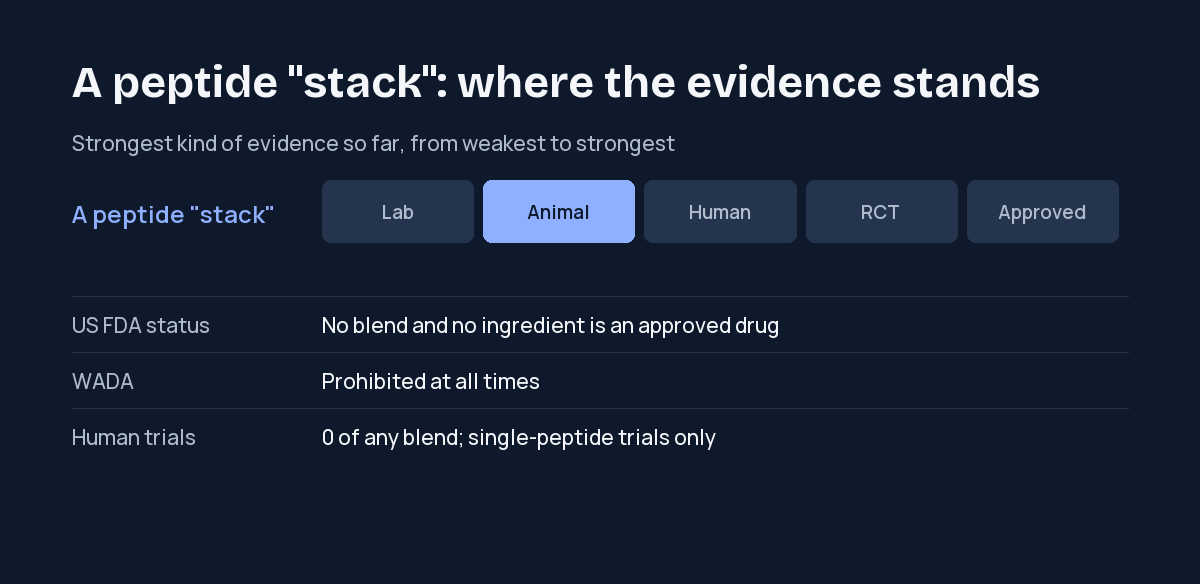
A peptide “stack” is two or more peptides sold or used together, often premixed in one vial. The four best known are Wolverine (BPC-157 plus TB-500), GLOW (GHK-Cu, BPC-157 and TB-500), KLOW (GLOW plus KPV) and CJC-1295 with ipamorelin. None is an FDA-approved drug, every blend contains at least one substance on the WADA Prohibited List, and no blend has ever been tested as a combination in a human trial. The strongest evidence sits with individual ingredients, and for most of them it is animal or lab data.
| Item | Status |
|---|---|
| US FDA status | No blend and no ingredient is an approved drug (Drugs@FDA); the related GHRH analogue tesamorelin is approved only as Egrifta (label) |
| Compounding (503A/503B) | BPC-157, TB-500, KPV, GHK-Cu (injectable routes) and CJC-1295 withdrawn from Category 2, not approved; ipamorelin still Category 2 for 503B (FDA). PCAC voted 8–6 (1 abstention) on 2026-07-23 to recommend BPC-157, TB-500 and KPV for 503A listing, per trade-press reports of the meeting (FDA PCAC); advisory, no FDA rule yet. GHK-Cu review due before end of February 2027 |
| WADA 2026 | Prohibited at all times: BPC-157 (S0), TB-500 (S2.3), CJC-1295 and ipamorelin (S2.2.4); GHK-Cu and KPV not named (WADA) |
| Strongest evidence | Combination: Animal (one rat study, no added benefit). Single ingredients: Human RCT for ipamorelin (no significant effect) and CJC-1295 (hormone levels only) |
| Human trials | 0 of any blend; single-peptide trials only (e.g. BPC-157: NCT02637284, NCT07752381, NCT07803250) |
| Last checked | 2026-10-18 |
What changed (October 2026): FDA’s own pre-meeting reviews of BPC-157, TB-500 and KPV are now summarized, the 2024 committee votes against CJC-1295 are added, and the sport section covers the 2027 WADA List.
Key points:
- The only study found that directly compared a stack with its parts, a 2026 rat Achilles tendon study (n=32), found that BPC-157 plus TB-500 “did not confer additional benefits compared to either agent alone” [Animal] (Biçer 2026).
- The closest thing to human combination data is four patients in an uncontrolled knee-pain chart review who received BPC-157 and thymosin beta-4; three of the four reported improvement [Human, uncontrolled, n=4] (Lee 2021).
- Lab analyses of products sold online found TB-500 products whose contents did not consistently match their description, and seized ipamorelin-type powders carrying an extra amino acid (Delcourt 2023; Gajda 2019).
- In August 2026 the FDA named premixed tesamorelin–ipamorelin blends as unapproved new drugs in warning letters to online sellers (FDA warning letter).
- The FDA says it has found no human exposure data for KPV by any route, or for drug products containing TB-500 (FDA). Its staff reviews for the July 2026 committee proposed not adding BPC-157, TB-500 or KPV to the compounding list; the committee’s reported vote went the other way, and as of 2026-10-27 FDA has made no decision (briefing documents: BPC-157, TB-500, KPV).
Peptide stacks explained: what is in each blend
The table gives each blend’s contents and the best evidence for the blend itself, as opposed to its ingredients one at a time. Ingredient evidence follows in the sections below.
| Blend | What is in it | Evidence for the combination |
|---|---|---|
| Wolverine | BPC-157, TB-500 | Animal: one rat study, no added benefit (Biçer 2026); 4 uncontrolled human cases (Lee 2021) |
| GLOW | GHK-Cu, BPC-157, TB-500 | None found |
| KLOW | GHK-Cu, KPV, BPC-157, TB-500 | None found |
| CJC-1295 + ipamorelin | A GHRH analogue plus a GH secretagogue | None found; described in forum material, not trials (Dominikowski 2026) |
What is a peptide “stack”?
“Stack” and “blend” are marketing words, not regulatory categories. Wolverine, GLOW and KLOW are names used by sellers; the WADA list, the FDA compounding pages and the trial registry list the ingredients, never these product names (WADA 2026 list). A stack may mean separate vials used side by side or a single vial with several peptides premixed. The idea behind every stack is the same: ingredients with different proposed mechanisms might add up to more than any one alone.
That idea is testable, but it has almost never been tested. A 2026 review of growth-hormone-axis peptides lists “stacking practices in unregulated supply chains” among the main uncertainties clinicians face, and treats forum descriptions of stacks as behavioral material, not evidence (Dominikowski 2026). A 2026 scoping review of six popular peptides found that 67% of publications used animal models and concluded that their claimed benefits “remain unsubstantiated by current human trials” (Tewari 2026).
Wolverine: BPC-157 plus TB-500
BPC-157 is a synthetic 15-amino-acid peptide (sequence GEPPPGKPADDAGLV), which doping-control chemists have identified in confiscated vials (Cox 2017). A 2025 systematic review of its orthopedic research included 36 studies, 35 preclinical and 1 clinical, and found no clinical safety data (Vasireddi 2025). TB-500 is a fragment of the repair protein thymosin beta-4 with the sequence LKKTETQ (FDA).
The encouraging part is that both ingredients have shown repair effects in animals. In the 2026 rat tendon study, TB-500 alone produced a statistically significant gain in load to failure (p < 0.05), and BPC-157 alone showed numerically better tissue scores that did not reach statistical significance on total scores [Animal, n=32] (Biçer 2026). The pair, given together, did no better than either one. The authors call it an exploratory study. Our BPC-157 vs TB-500 comparison covers the two ingredients in depth.
GLOW and KLOW: adding GHK-Cu and KPV
GLOW adds GHK-Cu, a copper-bound tripeptide (glycyl-histidyl-lysine). A review by researchers at a skin-care company reports that in lab and animal work GHK stimulated blood vessel and nerve outgrowth and increased collagen and elastin synthesis [Lab; Animal] (Pickart 2018). Its published human trials are topical; one GHK-Cu trial is registered and not yet recruiting (NCT07706361). For injected GHK-Cu, the FDA notes “limited data in humans” (FDA).
KLOW adds KPV, the tripeptide lysine-proline-valine. In intestinal cells, nanomolar KPV blocked NF-κB and MAP kinase inflammatory signaling [Lab], and in mice, KPV in drinking water reduced chemically induced colitis [Animal] (Dalmasso 2008). No KPV trial is registered on ClinicalTrials.gov. The head-to-head details are in KLOW vs GLOW vs GHK-Cu and Wolverine stack vs KLOW.
CJC-1295 and ipamorelin: the growth-hormone pair
This pair works on the growth-hormone axis rather than on tissue repair. CJC-1295 is a long-acting analogue of growth-hormone-releasing hormone (GHRH). In two randomized, placebo-controlled trials in healthy adults, one injection raised growth hormone 2- to 10-fold for 6 days or more and IGF-1 1.5- to 3-fold for 9–11 days, with no serious adverse reactions reported [Human RCT, hormone levels only] (Teichman 2006). The version sold as “CJC-1295 without DAC” (modified GRF 1–29) has no peer-reviewed human studies reporting its route or half-life (Dominikowski 2026).
Ipamorelin is a growth hormone secretagogue (a ghrelin-receptor agonist). Its phase 2 trial after bowel surgery (n=114) found a median time to first tolerated meal of 25.3 hours versus 32.6 hours with placebo, not a significant difference (p = 0.15) [Human RCT] (Beck 2014). No study identified here measured muscle, fat loss or recovery from training or injury with either peptide, alone or combined. Our CJC-1295 with vs without DAC page covers the two CJC-1295 forms.
Has any blend been tested as a combination?
Not in a controlled human trial. A ClinicalTrials.gov search run on 2026-10-05 for each ingredient found only single-peptide trials, such as BPC-157 after rotator cuff repair surgery (NCT07803250). The registered thymosin beta-4 trials all use the full-length protein, not the TB-500 fragment; NCT07487363, earlier cited here as a TB-500 trial in heart disease, describes itself as fictional. None tests Wolverine, GLOW, KLOW or CJC-1295 with ipamorelin.
The published combination data fit in two lines. In rats, the Wolverine pair added nothing over either peptide alone [Animal, n=32] (Biçer 2026). In a clinic’s retrospective chart review, 3 of 4 patients given BPC-157 plus thymosin beta-4 for knee pain reported improvement, against 11 of 12 given BPC-157 alone, with no control group and no validated measures [Human, uncontrolled] (Lee 2021).
This gap matters for three reasons. First, results for single ingredients do not tell whether the effects add up, cancel out or interact. Second, a combination can only be safety-tested as a combination. Third, when several peptides go in at once, any effect or side effect cannot be traced to one of them.
What is actually in a multi-peptide vial?
Like their single-peptide versions, blends are frequently marketed online as “for research purposes only”, with uncertain purity, dose consistency and sterility (Dominikowski 2026). Lab analyses of that market give concrete reasons for caution. French horse-racing lab chemists who analyzed products sold online as TB500 and TB1000 found the contents “not systematically consistent” with their descriptions (Delcourt 2023). Danish forensic chemists found seized powders that were not ipamorelin or modified GRF 1–29 themselves but versions carrying an extra glycine (Gajda 2019), and the Cologne anti-doping lab identified a “Gly-Ipamorelin” analogue in black-market products (Krug 2018).
In a premixed vial, each ingredient carries these uncertainties, and a buyer has no way to tell which one is off. The FDA lists possible immunogenicity (unwanted immune reactions) and peptide-related impurities as concerns for BPC-157, TB-500, injectable GHK-Cu, CJC-1295 and ipamorelin (FDA). A 2026 review names “product contamination, manufacturing impurities, inaccurate dosing” among the risks of unapproved injectable peptides (Moiz 2026).
Safety and regulatory status of each ingredient
| Ingredient | FDA / compounding | WADA 2026 |
|---|---|---|
| BPC-157 | Not approved; withdrawn from Category 2; FDA staff review against listing; PCAC 8–6 for 503A (ulcerative colitis), advisory | S0, prohibited |
| TB-500 | Not approved; withdrawn from Category 2; FDA staff review against listing; PCAC 8–6 for 503A (wound healing), advisory | S2.3, prohibited |
| GHK-Cu | Not an approved drug; injectable withdrawn from Category 2; PCAC review before end of Feb 2027 | Not named |
| KPV | Not approved; withdrawn from Category 2; FDA staff review against listing; PCAC 8–6 for 503A, advisory | Not named |
| CJC-1295 | Not approved; withdrawn from Category 2; PCAC voted against 503A listing in December 2024 | S2.2.4, prohibited |
| Ipamorelin | Not approved; Category 2 for 503B since 2023-09-29 | S2.2.4, prohibited |
“Withdrawn from Category 2” means the nominators withdrew those substances from the FDA’s list of compounding substances with significant safety concerns; it is not an approval (FDA Category 2 page). The FDA no longer places substances nominated on or after January 7, 2025 into the interim categories at all (FDA 503A page). The July 2026 advisory committee reviewed BPC-157 for ulcerative colitis, TB-500 for wound healing and KPV for wound healing and inflammatory conditions (FDA PCAC); trade press reported 8–6 votes in favor, and FDA rulemaking would come next. FDA’s own staff reviews, written in May 2026 before the meeting, had proposed the opposite for all three. For TB-500, “no articles were found in which TB-500 was administered to humans” (TB-500 review). For KPV, the review found no clinical study or human exposure data by any route (KPV review). For BPC-157, it concluded that the evaluation criteria “weigh against” listing (BPC-157 review). Earlier, in December 2024, the same committee voted against adding CJC-1295 for growth hormone deficiency: 0–13 for four of its five forms and 1–12 for the acetate (FDA committee minutes, 2024-12-04). GHK-Cu is on the agenda of a meeting the FDA plans before the end of February 2027, and the agency notes that advisory committees make non-binding recommendations (FDA).
On side effects, the FDA reports serious adverse events with CJC-1295, “including increased heart rate and systemic vasodilatory reaction”, and serious adverse events including death in a published study of intravenous ipamorelin for gastric motility. A 2026 review of growth-hormone-axis peptides lists reported adverse effects including prolactin and cortisol elevations, appetite changes, blood-sugar disturbances, fluid retention, muscle and joint pain and injection-site reactions (Dominikowski 2026). In the ipamorelin phase 2 trial, adverse events were common in both arms: 87.5% with ipamorelin and 94.8% with placebo (Beck 2014). Tesamorelin, which appears with ipamorelin in blends the FDA has cited, is approved as Egrifta SV and Egrifta WR, both under one FDA application, for excess abdominal fat in adults with HIV and lipodystrophy (Drugs@FDA). The FDA called a “Tesamorelin Ipamorelin Blend” (FDA warning letter) and a second “dual peptide blend combining Tesamorelin … and Ipamorelin” (FDA warning letter) unapproved new drugs. For athletes, every blend here contains at least one substance WADA prohibits in and out of competition (WADA). The 2027 List, in force from 2027-01-01, keeps them prohibited: USADA’s examples name BPC-157 under S0 and TB-500 and ipamorelin under S2, and S0 now names “peptides” in general (USADA athlete advisory). GHK-Cu and KPV are still not named, but both are peptides with no approval for therapeutic use, the kind of substance S0 describes; an anti-doping agency can rule on a specific product. The wider picture is in Are peptides safe?
What users report
What follows are unverified self-reports from people who usually bought unregulated products; they are not evidence. People who post about Wolverine and KLOW on forums, Reddit and YouTube most often describe faster recovery from tendon, joint and muscle injuries, and less nagging pain, and many say they noticed changes within a few weeks. GLOW posts focus on skin texture and healing of scars. CJC-1295 and ipamorelin posts most often describe deeper sleep, more vivid dreams, better recovery from training and, less often, changes in body composition. Recurring complaints include water retention, tingling or numb hands, hunger, flushing and stinging or redness at the injection site with the growth-hormone pair, and fatigue or headaches with the repair blends. A large share of posts report no noticeable effect at all. The arguments that recur are whether a blend works better than single peptides, whether improvement came from rest and rehab rather than the peptides, and whether a given product contained what its label said, with frequent worries about purity, sterility and cost.
Frequently asked questions
What is the Wolverine peptide stack?
The Wolverine stack is a seller’s name for BPC-157 and TB-500 used together, mainly for injury recovery. Neither peptide is FDA approved, and both are prohibited by WADA. The one study that compared the pair with each peptide alone, a 2026 rat tendon study of 32 animals, found the combination added no benefit (Biçer 2026).
What is the difference between GLOW and KLOW?
GLOW contains GHK-Cu, BPC-157 and TB-500; KLOW is the same mix plus KPV, a tripeptide studied for anti-inflammatory effects. No human trial has tested either blend. KPV’s evidence is lab and mouse data, and the FDA says it has not identified any human exposure data for KPV by any route of administration (FDA).
Has CJC-1295 with ipamorelin been studied in humans?
Not as a combination. Each peptide has been studied alone: CJC-1295 raised growth hormone and IGF-1 in healthy adults (Teichman 2006), and ipamorelin had no significant effect on recovery after bowel surgery in a phase 2 trial of 114 patients (Beck 2014). Neither study measured muscle, fat loss or sleep, and no trial of the pair is registered.
Are peptide stacks banned in sport?
Yes, for athletes under the WADA Code. Every blend here contains at least one prohibited peptide: BPC-157 is banned under S0, and TB-500 and ipamorelin under S2. From 2027-01-01, S0 also names “peptides” in general, so ingredients not listed by name, such as GHK-Cu and KPV, may also be caught. An anti-doping agency can confirm a specific product (USADA athlete advisory).
Are peptide blends legal?
None of these blends is an FDA-approved drug, and the FDA treated premixed tesamorelin–ipamorelin blends as unapproved new drugs in its August 2026 warning letters to online sellers (FDA). An advisory vote in July 2026 favored compounding three ingredients, but that vote is not binding and no FDA rule has followed.
References
- US Food and Drug Administration. Certain bulk drug substances for use in compounding that may present significant safety risks (content current 2026-04-22). fda.gov
- US Food and Drug Administration. Bulk drug substances used in compounding under section 503A of the FD&C Act (content current 2026-05-14). fda.gov
- US Food and Drug Administration. July 23–24, 2026: Meeting of the Pharmacy Compounding Advisory Committee. fda.gov
- US Food and Drug Administration. Meeting of the Pharmacy Compounding Advisory Committee (before end of February 2027). fda.gov
- World Anti-Doping Agency. The 2026 Prohibited List. wada-ama.org
- US Food and Drug Administration. Warning letter 733652, 2026-08-24 (Tesamorelin Ipamorelin Blend). fda.gov
- US Food and Drug Administration. Warning letter 734884, 2026-08-24 (tesamorelin–ipamorelin blend). fda.gov
- US Food and Drug Administration. Drugs@FDA: Egrifta (tesamorelin), application 022505. accessdata.fda.gov
- Biçer O, Adanir O, Güleryüz Y, et al. 2026. Effects of BPC-157 and TB-500 on Achilles tendon healing in rats: a histopathological and biomechanical study. Jt Dis Relat Surg. PubMed 42542926
- Lee E, Padgett B. 2021. Intra-articular injection of BPC 157 for multiple types of knee pain. Altern Ther Health Med. PubMed 34324435
- Vasireddi N, Hahamyan H, Salata MJ, et al. 2025. Emerging use of BPC-157 in orthopaedic sports medicine: a systematic review. HSS J. PubMed 40756949
- Cox HD, Miller GD, Eichner D. 2017. Detection and in vitro metabolism of the confiscated peptides BPC 157 and MGF R23H. Drug Test Anal. PubMed 28035768
- Pickart L, Margolina A. 2018. Regenerative and protective actions of the GHK-Cu peptide in the light of the new gene data. Int J Mol Sci. PubMed 29986520
- Dalmasso G, Charrier-Hisamuddin L, Nguyen HT, et al. 2008. PepT1-mediated tripeptide KPV uptake reduces intestinal inflammation. Gastroenterology. PubMed 18061177
- Teichman SL, Neale A, Lawrence B, et al. 2006. Prolonged stimulation of growth hormone (GH) and insulin-like growth factor I secretion by CJC-1295, a long-acting analog of GH-releasing hormone, in healthy adults. J Clin Endocrinol Metab. PubMed 16352683
- Beck DE, Sweeney WB, McCarter MD. 2014. Prospective, randomized, controlled, proof-of-concept study of the ghrelin mimetic ipamorelin for the management of postoperative ileus in bowel resection patients. Int J Colorectal Dis. PubMed 25331030
- Dominikowski A, Rękoś Z, Olejarz M, et al. 2026. The emerging landscape of performance-enhancing peptides modulating GH-IGF1 axis. Front Endocrinol. PubMed 42395176
- Tewari K, Liu TP, Im C, et al. 2026. Peptide supplements and their therapeutic applications in sports medicine. Am J Sports Med. PubMed 42578445
- Delcourt V, Garcia P, Chabot B, et al. 2023. TB500/TB1000 and SGF1000: a scientific approach for a better understanding of misbranded and adulterated drugs. Drug Test Anal. PubMed 36482504
- Gajda PM, Holm NB, Hoej LJ, et al. 2019. Glycine-modified growth hormone secretagogues identified in seized doping material. Drug Test Anal. PubMed 30136411
- Krug O, Thomas A, Malerød-Fjeld H, et al. 2018. Analysis of new growth promoting black market products. Growth Horm IGF Res. PubMed 29864719
- Moiz A, O’Keefe EL, O’Keefe JH. 2026. Dangers of injectable peptides and other unregulated “biohacking” drugs. Mo Med. PubMed 42757290
- ClinicalTrials.gov. NCT07803250: Impact of BPC-157 on recovery following rotator cuff repair surgery. clinicaltrials.gov
- US FDA. FDA briefing document: BPC-157, Pharmacy Compounding Advisory Committee, July 23–24, 2026 (review memo 2026-05-11). fda.gov
- US FDA. FDA briefing document: TB-500, Pharmacy Compounding Advisory Committee, July 23–24, 2026 (review memo 2026-05-15). fda.gov
- US FDA. FDA briefing document: KPV, Pharmacy Compounding Advisory Committee, July 23–24, 2026 (review memo 2026-05-12). fda.gov
- US FDA. Pharmacy Compounding Advisory Committee, final summary minutes of the December 4, 2024 meeting. fda.gov
- USADA. Athlete advisory: 2027 Prohibited List (2026-10-06). usada.org
Change log
2026-10-27: FDA’s pre-meeting reviews of BPC-157, TB-500 and KPV summarized; 2024 committee votes against CJC-1295 added; 2027 WADA List and a sport FAQ added; reviewed by the editorial team.
2026-10-26: links to related entries added; no change to the facts.
2026-10-19: links to related entries added; no change to the facts.
2026-10-18: removed ClinicalTrials.gov records NCT07437547, NCT07437586 and NCT07487363, whose sponsor posts example records (NCT07487363 describes itself as fictional); registered trials now BPC-157 3, GHK-Cu 1, not yet recruiting, and none of the TB-500 fragment; reviewed by the editorial team.
2026-10-13: links corrected (a link inside a citation or on a generic word removed); no change to the facts.
2026-10-12: links to related entries added; no change to the facts.
2026-10-11: first published after review by the editorial team.