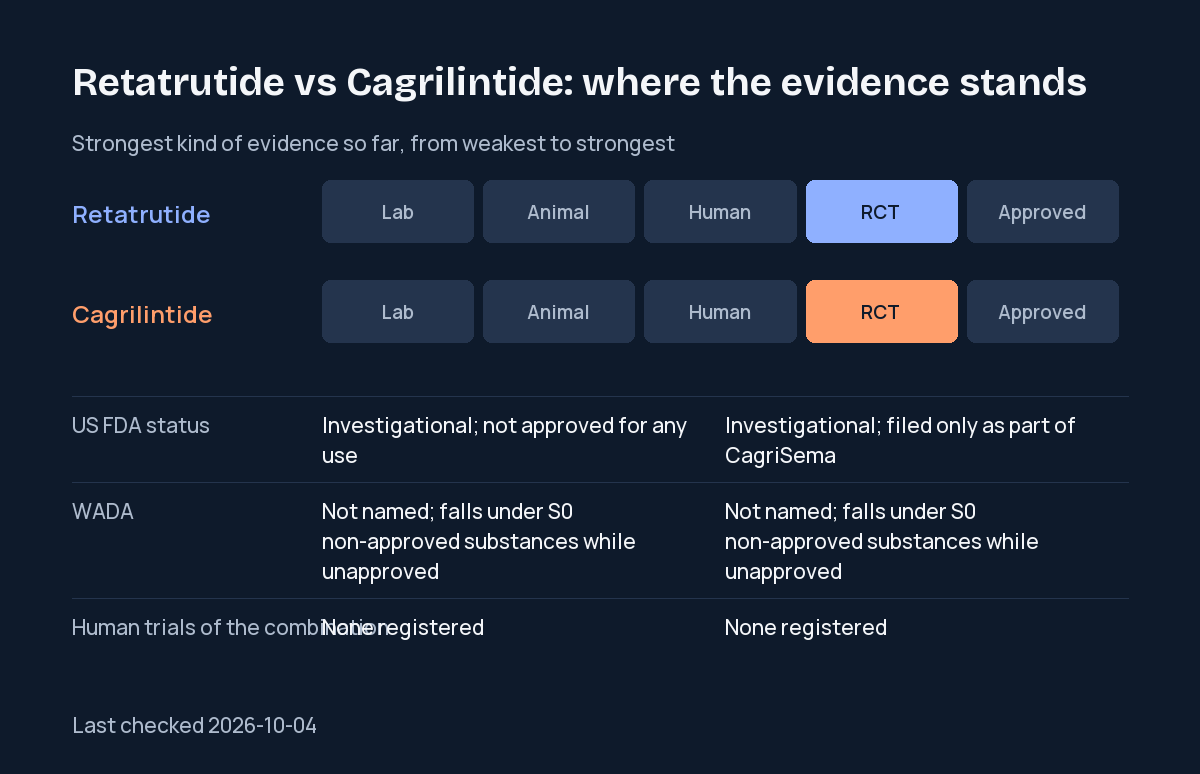
Retatrutide and cagrilintide are two investigational weight-loss drugs that have never been tested together in people. Retatrutide (Eli Lilly) acts on three gut-hormone receptors and has phase 3 trial results; cagrilintide (Novo Nordisk) is a long-acting amylin analogue with a published phase 2 trial of its own and phase 3 results reported mainly as part of CagriSema. Neither is FDA-approved, and neither can be obtained legally outside clinical trials (plus, for retatrutide only, a narrow physician-requested expanded access program). The only study of the pair is a 2026 experiment in obese male rats [Animal].
| Item | Retatrutide | Cagrilintide |
|---|---|---|
| US FDA status | Investigational; not approved for any use | Investigational; filed only as part of CagriSema (December 2025), not approved |
| Compounding (503A/503B) | Cannot be compounded under federal law (FDA) | Cannot be compounded under federal law (FDA) |
| WADA 2026 | Not named; falls under S0 non-approved substances while unapproved | Not named; falls under S0 non-approved substances while unapproved |
| Strongest evidence | Human RCT, phase 3 (n=2,339) | Human RCT, phase 2 alone (n=706 on drug); phase 3 results reported mainly with semaglutide |
| Human trials of the combination | None registered | None registered |
| Next regulatory step | Lilly says it plans to submit retatrutide to the FDA in Q1 2027 (company release, July 2026) | FDA review of CagriSema expected in 2026 (Novo Nordisk); no filing announced for cagrilintide alone |
| Last checked | 2026-10-04 | 2026-10-04 |
Key points:
- A search of ClinicalTrials.gov for retatrutide with cagrilintide, or with any amylin drug, returns no registered study.
- In the rat study, the pair cut weight and food intake more than either drug alone and more than matched pairings built on semaglutide or tirzepatide [Animal].
- Each drug causes mostly gastrointestinal side effects on its own; retatrutide trials also report raised heart rate, low blood pressure and skin-sensation changes.
- The FDA has warned sellers of retatrutide labeled “for research purposes”; such products carry no quality guarantee.
- Athletes: drugs in clinical development with no approval anywhere are prohibited at all times under WADA’s S0 class.
Retatrutide and cagrilintide at a glance
| Feature | Retatrutide | Cagrilintide |
|---|---|---|
| Developer | Eli Lilly | Novo Nordisk |
| Class | GIP, GLP-1 and glucagon receptor agonist (“triple agonist”) | Long-acting amylin analogue (amylin and calcitonin receptor agonist) |
| Main research focus | Obesity, type 2 diabetes, knee osteoarthritis pain, sleep apnea | Obesity and type 2 diabetes, mostly combined with semaglutide |
| Best weight result | −25.0% vs −3.9% placebo at 80 weeks [Human RCT] | −10.8% vs −3.0% placebo at 26 weeks [Human RCT] |
| Route studied | Once-weekly injection under the skin | Once-weekly injection under the skin |
| Main safety concerns | Nausea, diarrhea, heart-rate rise, low blood pressure, dysesthesia | Nausea, constipation, diarrhea, injection-site reactions |
| Approval | None | None (CagriSema under FDA review) |
| Combination data | One rat study (2026) [Animal]; no human data | |
What is retatrutide?
Retatrutide is a single molecule that activates three hormone receptors: those for the gut hormones GIP and GLP-1, plus the receptor for glucagon. In the phase 2 obesity trial (338 adults, 48 weeks), the 12 mg arm lost 24.2% of body weight versus 2.1% on placebo [Human RCT, n=338]. Phase 3 trials have since reported large losses in people without diabetes and in people with obesity and type 2 diabetes (TRIUMPH-2) [Human RCT, n=1,152]. For how retatrutide sits beside the approved drugs, see our retatrutide vs tirzepatide vs semaglutide comparison.
What is cagrilintide?
Cagrilintide is a long-acting analogue of amylin, a pancreatic hormone that induces satiety (fullness). In the phase 2 dose-finding trial (706 people on cagrilintide, 26 weeks), weight fell 6.0% to 10.8% across doses versus 3.0% on placebo, and the top dose beat liraglutide 3.0 mg (10.8% vs 9.0%) [Human RCT]. Novo Nordisk then paired it with semaglutide as CagriSema; the REDEFINE 1 trial reported −20.4% versus −3.0% with placebo at 68 weeks [Human RCT, n=3,417]. A cagrilintide-only phase 3 trial (NCT07220642) is under way.
How they work differently
- Retatrutide: acts on GIP, GLP-1 and glucagon receptors; the phase 2 paper describes it as an agonist of all three.
- Cagrilintide: acts on amylin and calcitonin receptors. In mice, its weight loss depended on the amylin receptor subtypes AMY1R and AMY3R and activated neurons in the dorsal vagal complex, a brainstem region (Carvas 2025) [Animal].
- Together: the two drugs hit five receptor types with no overlap. The authors of the 2026 rat study call this “five-receptor polypharmacology” and present it as a design idea for future single molecules [Animal].
What is known about retatrutide and cagrilintide together?
Only one study has tested the pair. Researchers at the University of Copenhagen’s Novo Nordisk Foundation Center for Basic Metabolic Research gave daily co-administration to diet-induced obese male rats (Petersen 2026, Nature Metabolism) [Animal]. Their findings:
- Weight and food intake fell in a dose-dependent way, by more than with either drug alone at the same molar dose.
- The pair also beat matched-dose comparator combinations that included semaglutide or tirzepatide.
- Cholesterol, triglycerides and insulin improved.
- Pair-feeding tests showed the extra weight loss was not explained by eating less alone.
These are rat results. They show the idea is worth testing; they do not show the combination works or is safe in humans. A ClinicalTrials.gov search found no registered trial of retatrutide with cagrilintide or any other amylin drug. No controlled human study has tested the combination.
The closest human evidence is indirect. CagriSema, which pairs cagrilintide with the GLP-1 drug semaglutide, has two published phase 3 trials, and Lilly has completed a phase 1 study of its own amylin drug eloralintide given with tirzepatide (NCT06916065, 188 participants). Neither tells us how retatrutide’s glucagon action and cagrilintide’s amylin action behave together in people, including on heart rate, blood pressure or how much nausea people can tolerate.
Evidence head-to-head
| Outcome | Retatrutide best evidence | Cagrilintide best evidence |
|---|---|---|
| Weight, no diabetes | Human RCT, phase 3 (n=2,339): TRIUMPH-1 | Human RCT, phase 2 (n=706 on drug): Lau 2021 |
| Weight, type 2 diabetes | Human RCT, phase 3 (n=1,152): TRIUMPH-2 | Only as CagriSema, Human RCT (n=1,206): REDEFINE 2 |
| Blood sugar (HbA1c) | Human RCT, phase 3 (n=537): TRANSCEND-T2D-1 | Only as CagriSema: REDEFINE 2 |
| Knee pain, sleep apnea | Human RCT subgroups: TRIUMPH-1 | No published trial |
| Heart and kidney outcomes | Trial running: NCT06383390 | No published trial |
| The two drugs combined | Animal only: Petersen 2026 | |
On published numbers, retatrutide has the deeper evidence base: three phase 3 trials published in 2026 with more than 4,000 participants between them. Cagrilintide on its own has one published phase 2 trial and a 302-person cagrilintide-only arm in REDEFINE 1; most of its human data come from the CagriSema program, where its separate contribution is harder to isolate. How we grade these levels is explained on our how we compare peptides page.
How long do effects take in studies?
- Retatrutide: in the phase 2 trial, the 12 mg arm had lost 17.5% at 24 weeks and 24.2% at 48 weeks, so weight was still falling at the six-month mark [Human RCT, n=338]. In TRIUMPH-1 the endpoint was 80 weeks.
- Cagrilintide: the phase 2 trial measured its result at 26 weeks [Human RCT]; CagriSema trials ran 68 weeks.
- Combination: no human timeline exists.
Safety and regulatory status
Side effects seen in trials
Retatrutide. In TRIUMPH-2 (adults with obesity and type 2 diabetes), diarrhea affected 34% on the two higher doses versus 13% on placebo, and nausea up to 28% versus 8% [Human RCT, n=1,152]. Low blood pressure (up to 6% vs under 1%) and dysesthesia, an abnormal skin sensation (up to 7% vs 1%), were also more common. Stopping treatment because of side effects or death reached 12% in the 9 mg arm versus 5% with placebo; investigators judged all deaths unrelated to the drug. The phase 2 trial found dose-dependent heart-rate increases that peaked at 24 weeks and then declined.
Cagrilintide. In the phase 2 trial, gastrointestinal side effects hit 41% to 63% of people on cagrilintide versus 32% on placebo, mainly nausea (20% to 47% vs 18%); injection-site reactions were also common [Human RCT]. With semaglutide in REDEFINE 1, gastrointestinal events affected 79.6% versus 39.9% on placebo [Human RCT, n=3,417].
Together. No human safety data exist. Each drug causes mainly gastrointestinal side effects on its own, so added gastrointestinal effects are a plausible concern, but that is an inference, not a trial finding.
Products sold outside trials
The FDA states that retatrutide and cagrilintide “are not components of FDA-approved drugs and have not been found safe and effective for any condition”, that neither can be used in compounding under federal law, and that it has warned companies selling retatrutide “falsely labeled ‘for research purposes’ or ‘not for human consumption.’” A 2026 case report describes a man with type 1 diabetes admitted with vomiting, high ketones and acute kidney injury after self-administering an online product sold as retatrutide; an infection was also present, so the authors could not establish cause [Human case report, n=1]. They note that the composition and purity of such products may be uncertain.
Status by jurisdiction
- United States: neither drug is approved (FDA, above). Novo Nordisk filed CagriSema with the FDA on December 18, 2025 and says it “is not approved in the US or EU”. Lilly runs a single-patient expanded access program for retatrutide, requested by a treating physician, for adults with a BMI of 35 or more despite the highest available dose of approved weight-management therapy, at least two serious obesity complications and no access to a trial.
- United Kingdom: the MHRA reported its largest-ever seizure of unlicensed weight-loss medicines in May 2026: about 12,000 doses recovered from a site believed to make and distribute unlicensed weight-loss medicines, including retatrutide.
- Sport: the WADA 2026 Prohibited List bans at all times any substance “with no current approval by any governmental regulatory health authority for human therapeutic use (e.g. drugs under pre-clinical or clinical development…)”. Neither drug is named on the list; as investigational drugs they fall into this S0 class until approved somewhere.
What users report
What follows are unverified self-reports from people who usually bought unregulated products; they are not evidence. People who post about retatrutide on forums and social media most often describe strong appetite loss and faster weight loss than they had on semaglutide or tirzepatide, usually noticed within the first few weeks. Cagrilintide posts are fewer; a common claim is that it adds fullness and quiets “food noise” when paired with a GLP-1 drug. Posts about using both together are largely speculative or single-person accounts. Recurring complaints are nausea, constipation, reflux, fatigue and a racing heart, plus injection-site irritation. Many threads question product quality: whether a vial contains what its label says, inconsistent results between batches, and costs. Arguments center on whether the rat data justify trying the pair at all, whether the extra weight loss is mostly muscle, and the legal risk of buying unapproved drugs online.
Frequently asked questions
Has anyone tested retatrutide and cagrilintide together in a clinical trial?
No. No controlled human study has tested the combination, and a ClinicalTrials.gov search found no registered trial pairing retatrutide with cagrilintide or any amylin drug. The only data come from a 2026 study in obese male rats, where the pair reduced weight more than either drug alone [Animal].
Is retatrutide or cagrilintide FDA approved?
No. Both are investigational. The FDA says neither is a component of an FDA-approved drug and neither can be used in compounding under federal law. Cagrilintide is under FDA review only as part of CagriSema, filed in December 2025; retatrutide has not been approved for any use.
Which drug causes more weight loss on its own?
In published trials, retatrutide. Its phase 3 TRIUMPH-1 trial reported a 25.0% average loss on the 12 mg arm at 80 weeks versus 3.9% on placebo [Human RCT, n=2,339]. Cagrilintide alone reached 10.8% at 26 weeks in its phase 2 trial [Human RCT]. The trials differed in length and population, so this is not a direct comparison.
Is cagrilintide the same as CagriSema?
No. Cagrilintide is the amylin analogue on its own; CagriSema is a fixed combination of cagrilintide and semaglutide. In REDEFINE 1, CagriSema produced a 20.4% average weight loss at 68 weeks versus 3.0% with placebo [Human RCT, n=3,417]. Most human data on cagrilintide come from this pairing.
Can athletes use retatrutide or cagrilintide?
No. Drugs in clinical development with no government approval anywhere fall under the S0 class of the WADA 2026 Prohibited List, which is banned in and out of competition. Neither drug is named on the list, but both fit that definition for as long as they remain unapproved everywhere.
Does retatrutide contain cagrilintide?
No. Retatrutide is a single Eli Lilly molecule that acts on GIP, GLP-1 and glucagon receptors; cagrilintide is a separate Novo Nordisk amylin analogue. Retatrutide’s trials tested it alone, for example a phase 2 obesity trial where weight loss of up to 24.2% at 48 weeks came with mostly gastrointestinal side effects (Jastreboff 2023) [Human RCT, n=338]. Any product mixing the two is untested in people.
This page is general information, not medical advice; a clinician is the person to decide on any weight-loss treatment. See our medical disclaimer.
References
- Petersen J, Merrild C, Holm SK, et al. (2026). Cagrilintide and retatrutide combination therapy enhances weight loss and metabolic outcomes in obese male rats. Nature Metabolism. PubMed 42744908
- Jastreboff AM, Kaplan LM, Frías JP, et al. (2023). Triple-hormone-receptor agonist retatrutide for obesity: a phase 2 trial. N Engl J Med 389:514-526. PubMed 37366315
- Jastreboff AM, Kaplan LM, Davies MJ, et al. (2026). Retatrutide, a triple hormone receptor agonist, for treatment of obesity (TRIUMPH-1). N Engl J Med. PubMed 42814954
- Bellido V, le Roux CW, Ekinci EI, et al. (2026). Retatrutide in adults with obesity and type 2 diabetes (TRIUMPH-2). Lancet. PubMed 42810372
- Bajaj HS, et al. (2026). Efficacy and safety of retatrutide in people with type 2 diabetes and inadequate glycaemic control with diet and exercise (TRANSCEND-T2D-1). Lancet 407:2402-2413. PubMed 42250575
- Lau DCW, et al. (2021). Once-weekly cagrilintide for weight management in people with overweight and obesity: a phase 2 trial. Lancet 398:2160-2172. PubMed 34798060
- Garvey WT, Blüher M, Osorto Contreras CK, et al. (2025). Coadministered cagrilintide and semaglutide in adults with overweight or obesity (REDEFINE 1). N Engl J Med 393:635-647. PubMed 40544433
- Davies MJ, Bajaj HS, Broholm C, et al. (2025). Cagrilintide-semaglutide in adults with overweight or obesity and type 2 diabetes (REDEFINE 2). N Engl J Med 393:648-659. PubMed 40544432
- Carvas AO, Leuthardt A, et al. (2025). Cagrilintide lowers bodyweight through brain amylin receptors 1 and 3. EBioMedicine 118:105836. PubMed 40609154
- Branine N. (2026). Online-sourced retatrutide complicating impending diabetic ketoacidosis in a patient with type 1 diabetes and concurrent Shigella gastroenteritis. Cureus 18:e115260. PubMed 42669023
- US Food and Drug Administration. FDA’s concerns with unapproved GLP-1 drugs used for weight loss (content current as of 2026-10-01). fda.gov
- Novo Nordisk. Novo Nordisk files for FDA approval of CagriSema (company announcement, 2025-12-18). novonordisk.com
- Eli Lilly and Company. Pre-approval expanded access of retatrutide (LY3437943). NCT07629401
- Eli Lilly and Company. Eloralintide and eloralintide with tirzepatide in participants with overweight or obesity (phase 1). NCT06916065
- Eli Lilly and Company. Retatrutide cardiovascular and kidney outcomes trial (TRIUMPH-Outcomes). NCT06383390
- Novo Nordisk. Weight loss with cagrilintide in people with overweight or obesity (phase 3). NCT07220642
- Medicines and Healthcare products Regulatory Agency (2026-05-29). Two arrested during the MHRA’s largest ever seizure of unlicensed weight loss medicines. gov.uk
- World Anti-Doping Agency. The 2026 Prohibited List (in force 1 January 2026). wada-ama.org
Change log
2026-10-19: links to related entries added; no change to the facts.
2026-10-12: links to related entries added; no change to the facts.
2026-10-06: links to related entries were added on 2026-10-05; no change to the facts.
2026-10-04: FAQ expanded with one question readers search for (whether retatrutide contains cagrilintide); reviewed by the editorial team.
2026-10-04: first published.