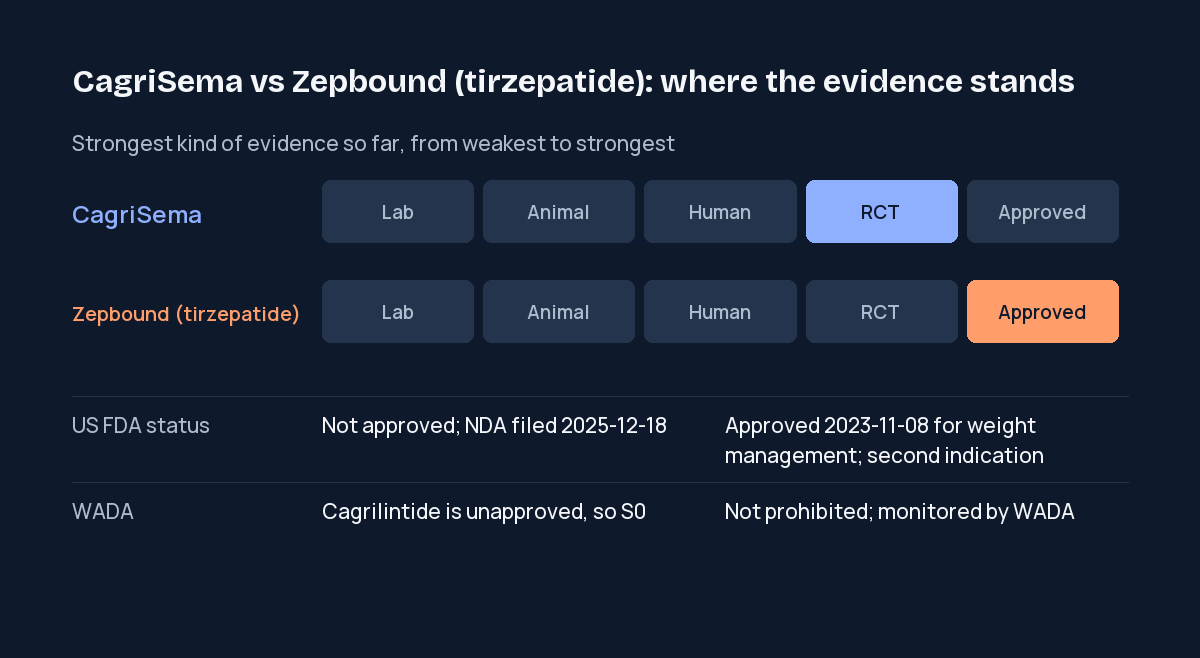
CagriSema is an investigational once-weekly injection that combines cagrilintide (an amylin analogue) with semaglutide. Novo Nordisk filed it with the FDA in December 2025 and expects a decision in Q4 2026. Zepbound (tirzepatide) is FDA approved for chronic weight management and obstructive sleep apnea. In the only obesity head-to-head trial, an open-label Human RCT with 809 participants, tirzepatide 15 mg produced more weight loss than CagriSema (25.5% vs 23.0% at 84 weeks, Novo Nordisk, 2026). None of the three head-to-head trials has been published in a peer-reviewed journal yet.
| Item | CagriSema | Zepbound (tirzepatide) |
|---|---|---|
| US FDA status | Not approved; NDA filed 2025-12-18 (Novo) | Approved 2023-11-08 for weight management; second indication (OSA) 2024-12-20 (Drugs@FDA) |
| Next regulatory step | FDA decision expected Q4 2026; no public action date (Q2 report) | Already approved; label last revised 8/2026 (label) |
| Compounding | Cagrilintide cannot be compounded under federal law (FDA) | Shortage over 2024-12-19; 503B exclusion proposed 2026-04-30, final decision pending (FDA) |
| WADA 2026 | Cagrilintide is unapproved, so S0 (non-approved substances) applies (USADA) | Not prohibited; monitored by WADA (USADA) |
| Strongest evidence | Human RCT, phase 3 (n=3,417, REDEFINE 1) | Approved label plus phase 3 RCTs (n=2,539, SURMOUNT-1) |
| Head-to-head trials | 3, all completed: NCT06131437, NCT06221969, NCT06534411 | |
| Last checked | 2026-10-04 | |
What changed (October 2026): the three CagriSema abstracts Novo presented in September 2026 (appetite and brain imaging, organ fat, bone) are summarized, Novo’s latest statement on FDA timing is added, and the sport section covers the 2027 WADA List.
Key points:
- At lower doses in type 2 diabetes, CagriSema 1.0/1.0 mg beat tirzepatide 5 mg on weight (12.4% vs 9.1% at 60 weeks) (Novo Nordisk, 2026).
- In type 2 diabetes at full doses, CagriSema matched tirzepatide 15 mg on weight (non-inferior) but missed non-inferiority on HbA1c (Novo Nordisk Q2 2026).
- All head-to-head figures so far are sponsor toplines; they have not been peer reviewed.
- A 2026 BMJ network meta-analysis put the two drugs level at one year: −14.9% for tirzepatide vs −14.8% for CagriSema, each compared with lifestyle change alone (Nong 2026).
- FDA has warned companies selling tirzepatide falsely labeled “for research purposes”; such products are not Zepbound (FDA).
CagriSema vs Zepbound at a glance
| Feature | CagriSema | Zepbound |
|---|---|---|
| What it is | Fixed-dose pair: cagrilintide + semaglutide | Single molecule: tirzepatide |
| Class | Amylin analogue + GLP-1 receptor agonist | GIP and GLP-1 receptor agonist |
| Sponsor | Novo Nordisk | Eli Lilly (also sold as Mounjaro for diabetes) |
| Main research focus | Obesity; type 2 diabetes | Obesity; sleep apnea; type 2 diabetes (as Mounjaro) |
| Pivotal obesity trial | REDEFINE 1: −20.4% at 68 weeks | SURMOUNT-1: −20.9% (15 mg) at 72 weeks |
| Head-to-head, obesity | 23.0% (REDEFINE 4) | 25.5%; tirzepatide led |
| Approval status | Investigational; under FDA review | FDA approved (2023) |
| WADA | S0 applies while unapproved | Not prohibited |
| Route studied | Once-weekly injection | Once-weekly injection |
| Trial lengths | 60–84 weeks | 52–88 weeks |
| Main safety concerns | GI events (79.6% vs 39.9% placebo); fatigue | Boxed warning (thyroid C-cell tumors in rats); GI events; pancreatitis; gallbladder disease |
What is CagriSema?
CagriSema is Novo Nordisk’s once-weekly injection of cagrilintide 2.4 mg, a long-acting amylin analogue, and semaglutide 2.4 mg, a GLP-1 receptor agonist (Novo Nordisk, 2025). An analogue is a lab-made version of a natural hormone, here amylin. The FDA application covers adults with obesity, or overweight with at least one weight-related condition. It rests on two trials: REDEFINE 1 (3,417 adults) and REDEFINE 2 (1,206 adults with type 2 diabetes). Novo says CagriSema would be the first once-weekly combination of GLP-1 and amylin analogues for weight management. It is not approved, and outside clinical trials it cannot be obtained legally.
What is Zepbound?
Zepbound is Eli Lilly’s brand of tirzepatide for weight management. The FDA approved it on 2023-11-08 and added a new indication on 2024-12-20 (Drugs@FDA). The label covers long-term weight reduction in adults with obesity, or overweight with a weight-related condition. It also covers moderate to severe obstructive sleep apnea in adults with obesity (Zepbound label, 2026). The same molecule has been sold as Mounjaro for type 2 diabetes since its approval on 2022-05-13 (Drugs@FDA, Mounjaro).
How they work differently
- CagriSema: two separate peptides given together. Semaglutide acts on the GLP-1 receptor, and cagrilintide acts as an amylin analogue (Novo Nordisk, 2025).
Zepbound: one peptide that activates two incretin receptors, GIP and GLP-1 (Zepbound label). Incretins are gut hormones released after eating. - CagriSema: in the REIMAGINE 5 record, the dose is raised every 4 weeks over an 8-week period.
Tirzepatide: in the same trial, the dose is raised over 4 weeks (NCT06534411). - Both: both act on the GLP-1 receptor, and GI adverse events were frequent with each in their pivotal trials (Garvey 2025; Jastreboff 2022).
Both drugs pair GLP-1 with a second target, and the targets differ: amylin for CagriSema, GIP for tirzepatide. The head-to-head trials are the first direct test of which pairing produces more weight loss.
Evidence head-to-head: what the trials show
Three phase 3 trials have randomized people to CagriSema or tirzepatide. All are open-label, meaning participants knew which drug they were taking. Results are reported two ways. The “efficacy” estimand estimates the result if everyone had stayed on treatment. The “treatment-regimen” estimand counts everyone, including people who stopped.
| Outcome | CagriSema | Tirzepatide |
|---|---|---|
| Weight, obesity, 84 wk (efficacy) | 23.0% — Human RCT, n=809 (REDEFINE 4) | 25.5% (15 mg) — same trial |
| Weight, obesity, 84 wk (regimen) | 20.2% — same trial | 23.6% — same trial |
| Weight, type 2 diabetes, 68 wk | 15.2% — Human RCT, n=1,024 (REIMAGINE 4; record) | 15.8% (15 mg); CagriSema non-inferior |
| HbA1c, type 2 diabetes, 68 wk | −1.9 points — same trial | −2.2 points; CagriSema missed non-inferiority |
| Weight, type 2 diabetes, lower doses, 60 wk | 12.4% (1.0/1.0 mg) — Human RCT, n=1,023 (REIMAGINE 5; record) | 9.1% (5 mg); CagriSema superior |
| HbA1c, lower doses, 60 wk | −1.71 points — same trial | −1.67 points; non-inferior |
| Sleep apnea | No trial reported | AHI −25.3 vs −5.3 events/h on placebo — Human RCT, n=469 (SURMOUNT-OSA; record) |
| Keeping weight off | No withdrawal trial reported | Stopping: 14.0% regain vs 5.5% further loss — Human RCT, n=670 (SURMOUNT-4) |
In REDEFINE 4, the obesity trial with 809 participants, CagriSema “did not meet the primary endpoint of showing non-inferiority on weight loss” against tirzepatide 15 mg (Novo Nordisk 6-K, 2026). Non-inferiority means “not meaningfully worse”. REIMAGINE 4 enrolled 1,024 adults with type 2 diabetes (NCT06221969). Weight results were close (15.2% vs 15.8%), but tirzepatide lowered HbA1c more (Novo Nordisk Q2 2026). REIMAGINE 5 compared lower doses of both drugs in 1,023 adults with type 2 diabetes (NCT06534411). CagriSema 1.0/1.0 mg was superior to tirzepatide 5 mg on weight, with similar HbA1c (Novo Nordisk, 2026). That is CagriSema’s first head-to-head win, though only at lower doses. On 2026-10-04, a PubMed search found no peer-reviewed publication of any of the three trials.
Cross-trial numbers (not a direct comparison): REDEFINE 1 reported −20.4% with CagriSema vs −3.0% with placebo at 68 weeks (Human RCT, n=3,417) (Garvey 2025). SURMOUNT-1 reported −20.9% with tirzepatide 15 mg vs −3.1% with placebo at 72 weeks (Human RCT, n=2,539) (Jastreboff 2022). The trials differ in length and population, so the 0.5-point gap between them means little. A network meta-analysis pooled 262 trials with 99,791 participants. It estimated one-year weight loss vs lifestyle change alone at −14.9% for tirzepatide and −14.8% for CagriSema, with moderate to high certainty (Nong 2026, BMJ).
New CagriSema data, September 2026 (abstracts, not peer reviewed): at the EASD meeting Novo presented three abstracts. In a 52-week brain-imaging study in adults with overweight or obesity, weight fell 22.4% more with CagriSema than with placebo, and participants reported less “food noise”, fewer cravings and less hunger. In an MRI sub-study of REIMAGINE 1, in early type 2 diabetes, CagriSema reduced fat in the abdomen, around the liver and in the pancreas compared with placebo at 40 weeks. A post hoc analysis of REIMAGINE 2 gave what its authors call “preliminary reassurance regarding bone changes” at 68 weeks. The release gives no sample sizes or safety data for these analyses, and none compares CagriSema with tirzepatide [Human RCT, sponsor abstracts] (Novo Nordisk, 2026-09-30).
Which fits which goal?
- Weight loss in obesity: tirzepatide has more evidence. It won the only direct obesity comparison and has an approved label (REDEFINE 4).
- Blood sugar in type 2 diabetes: tirzepatide has more evidence at full doses. It lowered HbA1c by 2.2 points vs 1.9 for CagriSema in REIMAGINE 4, where CagriSema missed non-inferiority (Q2 2026 report).
- Weight at lower doses in type 2 diabetes: CagriSema has the stronger result (12.4% vs 9.1% in REIMAGINE 5), so far as a sponsor topline only (REIMAGINE 5).
- Obstructive sleep apnea: only tirzepatide has trial data and a label for it (Malhotra 2024).
- Keeping weight off long term: tirzepatide has a randomized withdrawal trial. None has been reported for CagriSema (Aronne 2024).
These are statements about evidence, not a choice for any person. That decision belongs to a clinician who knows the person’s health history. How we compare peptides explains the evidence levels used here.
Can CagriSema and Zepbound be combined?
No controlled human study has tested CagriSema together with tirzepatide. Three ClinicalTrials.gov records include both drugs, and all compare them head to head rather than together (NCT06131437). Both products act on the GLP-1 receptor (Zepbound label). Combining them would therefore mean taking two drugs that hit the same target, and no trial has measured that. A separate page covers what is known about pairing cagrilintide with a different incretin drug: retatrutide and cagrilintide.
Safety and regulatory status
Side effects in trials. GI events were frequent with both drugs. In REDEFINE 1, they occurred in 79.6% of people on CagriSema vs 39.9% on placebo (Human RCT, n=3,417) (Garvey 2025). In REDEFINE 2, the figures were 72.5% vs 34.4% (Human RCT, n=1,206) (Davies 2025). In SURMOUNT-1, GI events were the most common adverse events with tirzepatide. Adverse events led 4.3%, 7.1% and 6.2% of people on 5, 10 and 15 mg to stop treatment, vs 2.6% on placebo (Human RCT, n=2,539) (Jastreboff 2022). The BMJ network meta-analysis of RCTs placed CagriSema among the drugs with the highest discontinuation due to adverse events. CagriSema also raised fatigue risk, by 92 more cases per 1,000 people. Tirzepatide reduced fat mass the most (25.7%) but also lean mass the most (8.3%) (Nong 2026). In REDEFINE 4, Novo reported that most GI events were mild to moderate and “diminished over time” (Novo Nordisk, 2026).
Label warnings (Zepbound). The label carries a boxed warning: tirzepatide causes thyroid C-cell tumors in rats, and whether it does so in humans is unknown. Zepbound must not be used by anyone with a personal or family history of medullary thyroid carcinoma or MEN 2. Listed warnings also include:
- severe GI reactions
- acute kidney injury
- gallbladder disease
- pancreatitis
- hypoglycemia
- diabetic retinopathy complications in patients with type 2 diabetes (section revised 8/2026)
- aspiration under general anesthesia
(Zepbound label). CagriSema has no FDA label yet, so its official warning list does not exist.
| Jurisdiction | CagriSema | Zepbound |
|---|---|---|
| FDA | Under review; decision expected Q4 2026 | Approved: weight management, sleep apnea |
| US compounding | Cagrilintide barred (FDA) | Shortage resolved 2024-12-19 (FDA); 503B exclusion proposed |
| Sport (WADA) | S0 while unapproved | Permitted; monitored |
FDA says companies have illegally sold unapproved drugs containing tirzepatide, retatrutide and other incretins “falsely labeled ‘for research purposes’”. It also states that cagrilintide cannot be used in compounding under federal law (FDA, 2026). The tirzepatide shortage ended on 2024-12-19, and the compounding grace periods ended in February and March 2025 (FDA). On 2026-04-30, FDA proposed excluding tirzepatide from the 503B bulks list. It has not made a final decision (FDA). For athletes, USADA says GLP-1 drugs are not prohibited and need no exemption, though WADA monitors them (USADA). The 2027 List, in force from 2027-01-01, names semaglutide and tirzepatide on WADA’s Monitoring Program: labs test for them, but they are not prohibited (USADA athlete advisory). Cagrilintide is not approved by any regulator, so it falls under S0, WADA’s prohibited class for non-approved substances (USADA).
How long do effects take in studies?
The head-to-head trials measured their main results at 60, 68 and 84 weeks, so they say little about the early weeks (NCT06534411). In REIMAGINE 2, Novo reported that “no weight loss plateau was observed at week 68” for CagriSema. In other words, weight was still falling when the trial ended (Novo Nordisk, 2026). For tirzepatide, SURMOUNT-4 shows what happens after stopping. After 36 weeks on the drug, people who switched to placebo regained 14.0% of body weight over the next 52 weeks. Those who stayed on it lost a further 5.5% (Human RCT, n=670) (Aronne 2024). No similar stopping trial has been reported for CagriSema. For where CagriSema sits among other late-stage drugs, see retatrutide vs CagriSema and retatrutide vs tirzepatide vs semaglutide.
What users report
These are unverified self-reports from public forums and social media, often from people who bought unregulated products, and they are not evidence. People who post about Zepbound most often describe a quieter appetite and fewer intrusive food thoughts in the first weeks, followed by steady loss over months. Common complaints:
- nausea, constipation and reflux
- tiredness in the days after each weekly injection
- cost and insurance refusals
Posts about CagriSema are fewer. Most come from trial participants or from people combining gray-market cagrilintide with semaglutide or tirzepatide. They often claim stronger fullness than with a GLP-1 drug alone and complain of nausea and fatigue. Recurring arguments:
- whether the REDEFINE 4 miss matters
- whether amylin gives “better quality” weight loss
- whether gray-market products contain what their labels claim
None of those gray-market products is CagriSema, and their contents are unknown.
Frequently asked questions
Is CagriSema better than Zepbound?
For weight loss in obesity, no, based on the only direct trial. In REDEFINE 4 (809 adults), tirzepatide 15 mg produced 25.5% weight loss vs 23.0% for CagriSema at 84 weeks. CagriSema missed its non-inferiority goal (Novo Nordisk, 2026). At lower doses in type 2 diabetes, CagriSema led on weight.
Is CagriSema FDA approved?
No. Novo Nordisk filed a New Drug Application in December 2025 and expects an FDA decision in the fourth quarter of 2026. No public action date has been given (Novo Nordisk Q2 2026). Until it is approved, CagriSema is available only in clinical trials, and cagrilintide cannot be compounded under federal law.
When will CagriSema be available?
No date has been set. In its Q2 2026 report, Novo Nordisk lists a “CagriSema US decision” among the milestones it expects in Q4 2026, and it repeated on 2026-09-30 that “a decision is expected in Q4 2026” (Novo Nordisk, 2026-09-30). A decision is not an approval, and an approval is not a launch. Products sold online as cagrilintide are unapproved, and none of them is CagriSema.
Why did CagriSema lose to tirzepatide?
The trial shows that CagriSema lost but not why. REDEFINE 4 was open-label, and Novo Nordisk has released only topline figures, so any explanation is untested. One example is the difference between amylin and GIP as the second target. The 84-week weight gap was 2.5 points if everyone had stayed on treatment and 3.4 points counting everyone.
Does CagriSema cause fewer side effects than Zepbound?
No trial shows that. GI events are common with both drugs. In REDEFINE 1, 79.6% of people on CagriSema reported GI events vs 39.9% on placebo (Garvey 2025). A 2026 BMJ meta-analysis placed CagriSema among the drugs with the highest discontinuation due to adverse events. The head-to-head safety tables have not been published yet.
References
- Novo Nordisk A/S. CagriSema REDEFINE 4 topline results. Form 6-K, US SEC, 2026-02-23. sec.gov
- Novo Nordisk A/S. Interim report for the first six months of 2026 (REIMAGINE 4; regulatory milestones). Form 6-K, US SEC, 2026-08-04. sec.gov
- Novo Nordisk A/S. Novo’s CagriSema delivers superior weight loss versus tirzepatide in REIMAGINE 5 trial. Press release, 2026-09-21. Press release
- Novo Nordisk A/S. Novo Nordisk files for FDA approval of CagriSema. Company announcement, 2025-12-18. novonordisk.com
- Novo Nordisk A/S. CagriSema REIMAGINE 2 results. Company announcement, 2026-02-02. novonordisk.com
- ClinicalTrials.gov. NCT06131437 (REDEFINE 4). clinicaltrials.gov
- ClinicalTrials.gov. NCT06221969 (REIMAGINE 4). clinicaltrials.gov
- ClinicalTrials.gov. NCT06534411 (REIMAGINE 5). clinicaltrials.gov
- ClinicalTrials.gov. NCT05412004 (SURMOUNT-OSA). clinicaltrials.gov
- Garvey WT, Blüher M, Osorto Contreras CK, et al. Coadministered cagrilintide and semaglutide in adults with overweight or obesity. N Engl J Med. 2025;393(7):635-647. PubMed 40544433
- Davies MJ, Bajaj HS, Broholm C, et al. Cagrilintide-semaglutide in adults with overweight or obesity and type 2 diabetes. N Engl J Med. 2025;393(7):648-659. PubMed 40544432
- Jastreboff AM, et al. Tirzepatide once weekly for the treatment of obesity. N Engl J Med. 2022;387(3):205-216. PubMed 35658024
- Aronne LJ, et al. Continued treatment with tirzepatide for maintenance of weight reduction in adults with obesity: the SURMOUNT-4 randomized clinical trial. JAMA. 2024;331(1):38-48. PubMed 38078870
- Malhotra A, Grunstein RR, Fietze I, et al. Tirzepatide for the treatment of obstructive sleep apnea and obesity. N Engl J Med. 2024. PubMed 38912654
- Nong K, Shi Q, Xie X, et al. Comparative effects of drugs for adults with overweight or obesity: systematic review and network meta-analysis. BMJ. 2026;394:e372161. PubMed 42419792
- US FDA. Drugs@FDA: Zepbound (tirzepatide), NDA 217806. accessdata.fda.gov
- US FDA. Zepbound prescribing information, revised 8/2026. accessdata.fda.gov
- US FDA. Drugs@FDA: Mounjaro (tirzepatide), NDA 215866. accessdata.fda.gov
- US FDA. FDA’s concerns with unapproved GLP-1 drugs used for weight loss (content current as of 2026-10-01). fda.gov
- US FDA. FDA clarifies policies for compounders as national GLP-1 supply begins to stabilize. fda.gov
- US FDA. FDA proposes to exclude semaglutide, tirzepatide and liraglutide from 503B bulks list. 2026-04-30. fda.gov
- USADA. Weight loss drugs: what athletes need to know about GLP-1s. usada.org
- USADA. #AskUSADA – What is a non-approved substance and why are they prohibited? usada.org
- Novo Nordisk A/S. CagriSema reduces food noise and shows benefits in organ and bone health (EASD 2026). Press release, 2026-09-30. globenewswire.com
- USADA. Athlete advisory: 2027 Prohibited List (2026-10-06). usada.org
Change log
2026-10-27: September 2026 CagriSema abstracts (food noise and brain imaging, organ fat, bone) and Novo’s 2026-09-30 FDA timing statement added; 2027 WADA Monitoring Program added; reviewed by the editorial team.
2026-10-19: links to related entries added; no change to the facts.
2026-10-13: links corrected (a link inside a citation or on a generic word removed); no change to the facts.
2026-10-12: links to related entries added; no change to the facts.
2026-10-05: source links restored; reviewed by the editorial team.
2026-10-04: first published after review by the editorial team.