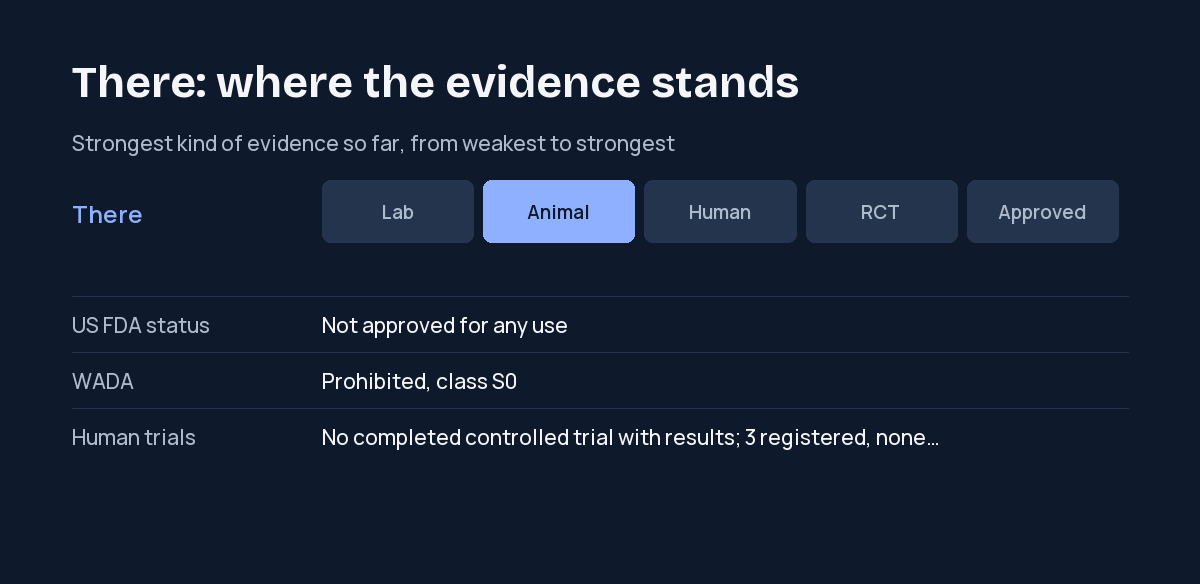
There is no human BPC-157 results timeline. Every day-by-day time course published for BPC-157 comes from rats or rabbits, where injured tendons, muscles and ligaments were examined at set checkpoints from day 1 to day 90 (Animal). In people, three small uncontrolled pilot reports exist, none of which measured how fast anything healed (McGuire et al., 2025). BPC-157 is not approved by the FDA or any other health authority, and WADA prohibits it (USADA).
| Item | Status |
|---|---|
| US FDA status | Not approved for any use (USADA) |
| Compounding (503A/503B) | Listed by FDA as “nominated but withdrawn” from Category 2; not on the 503A bulks list (FDA). The Pharmacy Compounding Advisory Committee reviewed it for ulcerative colitis and voted 8–6 (1 abstention) on 2026-07-23 to recommend 503A listing; advisory only, no FDA rule yet (FDA PCAC meeting; counts as reported by trade press) |
| WADA 2026 | Prohibited, class S0 (non-approved substances) |
| Strongest evidence | Animal (rat, rabbit); human data limited to uncontrolled pilots |
| Human trials | No completed controlled trial with results; 3 registered, none with posted results (NCT02637284, NCT07752381, NCT07803250, the last not yet recruiting) |
| Timeline in humans | Not established by any study |
| Last checked | 2026-10-24 |
What changed (October 2026): FDA’s own pre-meeting review of BPC-157 is now summarized, including the human studies it found and its exact half-life figures, a 2026 scoping review is added, and the sport section covers the 2027 WADA List.
Key points:
- Rat tendon, muscle and ligament studies report differences from untreated animals within the first 1–14 days, but almost all come from one research group in Zagreb (Animal).
- An independent 2026 rat study found no statistically significant tendon benefit from BPC-157 alone at four weeks (Animal, n=32).
- In rats and dogs, BPC-157 has an elimination half-life under 30 minutes, so blood levels say little about when tissue changes appear (Animal).
- No human trial has reported results; the only placebo-controlled one, after rotator cuff surgery, is not yet recruiting.
- No study has shown that a rat healing time predicts how long an injury takes to heal in a person.
How long does BPC-157 take to work? What each evidence level shows
The honest answer depends on what kind of study is asked. Animal studies report when a difference between treated and untreated animals was first measured. Human reports give only follow-up windows, collected after the fact and without a comparison group. A 2025 systematic review of the orthopedic literature found 36 eligible studies: 35 preclinical and one clinical (Vasireddi et al., 2025). The table sums up the time points each study type reported.
| Tissue or condition | Time points reported | Evidence level |
|---|---|---|
| Cut Achilles tendon | Day 1 to 14; differences at each checkpoint (2003) | Animal (rat) |
| Tendon detached from bone | Day 1 to 21 (2006) | Animal (rat) |
| Crushed calf muscle | 2 hours to 14 days (2008) | Animal (rat) |
| Cut quadriceps muscle | Up to 72 days (2006) | Animal (rat) |
| Knee ligament (MCL) | Up to 90 days (2010) | Animal (rat) |
| Muscle–tendon junction | Day 7 to 42 (2021) | Animal (rat) |
| Bone defect | 2-week intervals to 6 weeks (1999) | Animal (rabbit) |
| Tendon, independent lab | 4 weeks; no significant BPC-157 effect (2026) | Animal (rat, n=32) |
| Knee pain | Recalled relief, 6–12 months after one injection (2021) | Human (case series, n=16) |
BPC-157 results timeline in animal studies
These findings describe injured laboratory animals under controlled conditions. They are findings about rats and rabbits, not predictions for people.
Tendons: days 1 to 21
In the most cited tendon study, rats with a cut Achilles tendon were examined on days 1, 4, 7, 10 and 14. Treated rats had higher load to failure, better walking scores and smaller tendon defects than saline controls, and the authors reported full tendon integrity by the end of the study (Animal) (Staresinic et al., 2003). A follow-up in which the tendon was cut away from the heel bone tracked rats to day 21 and reported better function, strength and collagen organization, plus a reduction in the healing delay caused by a corticosteroid (Animal) (Krivic et al., 2006).
An independent group in Türkiye tested a repaired Achilles tendon in 32 rats over four weeks. BPC-157 alone produced numerically better tissue scores and load to failure, but neither reached statistical significance; TB-500 did reach significance, and the two together added nothing over either one (Animal) (Biçer et al., 2026).
Muscle: hours to 72 days
After a crush injury to the calf muscle, rats were assessed from 2 hours to 14 days; treated rats showed less bruising and swelling, lower muscle-damage enzymes and restored function “at all investigated intervals” (Animal) (Novinscak et al., 2008). A related study with checkpoints on days 1, 2, 4, 7 and 14 reported that BPC-157 reversed the slower healing seen with a systemic corticosteroid (Animal) (Pevec et al., 2010). With a fully cut quadriceps muscle, the benefit was reported across the whole 72-day observation period, including less muscle wasting (Animal) (Staresinic et al., 2006).
Ligaments and the muscle–tendon junction: weeks 1 to 13
Rats with a cut medial collateral ligament of the knee were followed for 90 days, with improvement reported in function, strength and tissue structure whether the peptide was given into the abdomen, in drinking water or as a cream (Animal) (Cerovecki et al., 2010). When the quadriceps tendon was cut away from its muscle, well-oriented repaired tissue without inflammation was described at days 28 and 42, while untreated rats did not heal (Animal) (Japjec et al., 2021).
Bone, nerve and spinal cord: weeks to months
In rabbits with a gap cut into the forearm bone, X-rays every two weeks for six weeks showed more healed defects with BPC-157 than with saline, comparable to bone graft in some measures (Animal) (Sebecić et al., 1999). For a cut sciatic nerve, walking scores were tracked weekly and nerve signals were tested at one and two months, with faster regrowth of nerve fibers reported (Animal) (Gjurasin et al., 2010). After a spinal cord compression, rats given one injection 10 minutes after injury had resolved tail spasticity by day 15 and tissue changes from day 7, in a study followed to day 360 (Animal) (Perovic et al., 2019).
Skin and gut: days to weeks
A lab in China applied BPC-157 to alkali burns on rat skin and found better new tissue, skin cover and collagen on day 18 than in untreated burns (Animal) (Huang et al., 2015). A review by the Zagreb group reports that in rats with short-bowel syndrome, weight gain started right away with treatment over a four-week model, and that fistulas closed even when treatment began a month late (Animal) (Sikiric et al., 2011).
What the human reports say about timing
Three human reports exist, all from the same private-clinic author, none with a control group (McGuire et al., 2025).
- Knee pain (2021). A retrospective chart review phoned 16 patients 6 months to 1 year after a knee injection; 11 of the 12 who received BPC-157 alone said their pain improved significantly. No imaging, function scores or comparison group were used (Human, case series, n=16) (Lee and Padgett, 2021). A systematic review reading the same paper counted 7 of 12 patients who reported relief lasting more than six months (Vasireddi et al., 2025).
- Interstitial cystitis (2024). Twelve women treated during one bladder procedure rated their symptom change on a questionnaire; 10 reported complete resolution. The abstract does not report when symptoms changed (Human, case series, n=12) (Lee et al., 2024).
- Intravenous safety (2025). Two adults received infusions over two days with blood tests and vital signs checked to day 3; no side effects or lab changes were reported. It measured safety markers only, not results (Human, n=2) (Lee and Burgess, 2025).
None of these reports can separate the peptide’s effect from natural recovery, other treatment or expectation, and none measured how many days or weeks a change took.
FDA’s own staff review for its July 2026 compounding committee, dated 2026-05-11, collected the human data it could find. Besides these reports, it lists a rectal-enema study in 24 healthy volunteers, in which BPC-157 could not be measured in the blood, and a 2005 ulcerative colitis trial in 53 patients known only from an abstract: disease activity scores fell by 3.2 points with BPC-157 and 1.6 with placebo, a difference that was not statistically significant. FDA judged the human data inadequate and reported no human information on when effects begin or how long they last (Human, small and incomplete) (FDA briefing document).
Why a rat timeline cannot be read as a human timeline
- Mostly one laboratory. A 2019 review noted that most studies were done in small rodent models, that only a handful of research groups have studied the peptide in depth, and that its efficacy is yet to be confirmed in humans (Gwyer et al., 2019).
- Replication is thin. The one recent independent tendon study did not find a statistically significant BPC-157 effect at four weeks (Animal) (Biçer et al., 2026).
- Short time in the body. In rats and beagle dogs the unchanged peptide had a half-life under 30 minutes and broke down into small fragments and amino acids (Animal) (He et al., 2022). FDA’s 2026 review gives the intravenous figures as 5.3 minutes in dogs and 15.2 minutes in rats, and found no human blood-level data for any route (Animal) (FDA briefing document). How a short-lived molecule would produce effects over weeks in people has not been tested.
- Surgical injuries, not everyday ones. The animal models cut or crushed healthy tissue under anesthesia and compared it with untreated controls that often did not heal at all (Japjec et al., 2021). Chronic tendon pain, arthritis and gym strains are different conditions.
- Reviews agree. A 2026 scoping review in the American Journal of Sports Medicine covered BPC-157, TB-500 and four other peptides: 67% of publications were animal studies, and the claimed musculoskeletal benefits are not supported by current human trials [Scoping review] (Tewari 2026).
- No human time data. A newer, PRISMA-compliant, PROSPERO-registered systematic review found three small human studies (n=30 total: knee-pain injections, interstitial-cystitis use, and an IV safety pilot); all reported symptom improvement with no treatment-related adverse events, but overall certainty of evidence was rated very low (Poolton et al., 2026).
Trials that could produce a real human timeline
A small placebo-controlled pilot after rotator cuff surgery, not yet recruiting, plans to measure shoulder strength at 12 weeks and 5 months (NCT07803250). An earlier phase 1 safety and blood-level study in healthy volunteers was registered in 2015; its status is listed as unknown and no results are posted (NCT02637284).
Until trials like these report, any page promising “week 1” or “week 4” results in people is going beyond the evidence.
Safety and regulatory status
USADA states that BPC-157 is not approved for human clinical use by the FDA or any other global health authority, that it is prohibited under WADA’s S0 non-approved substances class, and that because it has not been studied extensively in humans, “it is unknown if there is a safe dose” (USADA). Athletes subject to the WADA Prohibited List can face a violation for using it. The 2027 List, in force from 2027-01-01, keeps BPC-157 prohibited under S0 and names “peptides” in general in that class (USADA athlete advisory).
FDA’s compounding page lists BPC-157 among substances “nominated but withdrawn” from Category 2 and notes that compounded BPC-157 may carry a risk of immune reactions for some routes, plus uncertainty about peptide impurities (FDA). Withdrawal from Category 2 is not placement on the 503A bulks list, which is the list compounders may draw from (FDA 503A page). FDA’s Pharmacy Compounding Advisory Committee reviewed BPC-157 for ulcerative colitis on July 23–24, 2026; its votes are advisory (FDA). Before the meeting, FDA’s own staff concluded that the evaluation criteria “weigh against” adding BPC-157 to the 503A list, citing the thin human evidence, possible immune reactions and findings in 28-day animal studies, where blood clotting times changed (shorter in rats, longer in dogs) and some blood markers, including the liver enzyme ALT, rose (FDA briefing document, review memo dated 2026-05-11). The committee’s vote, as reported, went the other way; as of 2026-10-27, FDA has posted no minutes and made no decision.
On risks, the orthopedic systematic review warns of possible harm from unregulated manufacturing, contamination and unknown clinical safety (Vasireddi et al., 2025). A second review concludes that BPC-157 should be considered investigational until well-designed trials are done (McGuire et al., 2025). Blends that pair BPC-157 with other peptides are covered in Wolverine stack vs KLOW. A clinician is the person to assess any injury and its treatment.
What users report
What follows are unverified self-reports from people who usually bought unregulated products, not evidence. People who post about BPC-157 on forums, YouTube and social media most often describe less joint or tendon pain, and some describe calmer digestion. Timelines in these posts vary widely: some say they noticed something within days, others say it took several weeks, and a sizeable share say they noticed nothing at all. A recurring complaint is that it is impossible to tell whether the peptide helped or the injury was healing anyway, since most people were also resting, doing physical therapy or using other products at the same time. Other common complaints are redness or soreness where it was injected, nausea, lightheadedness, the monthly cost, and doubts about what the product really contained. Arguments center on whether oral forms do anything, whether results fade once people stop, and whether the rat studies say anything about humans at all.
Frequently asked questions
How long does BPC-157 take to work?
No study has measured this in people. In rats with cut Achilles tendons, differences from untreated animals were reported at checkpoints between day 1 and day 14 (Staresinic et al., 2003). Rat surgical injuries are not human injuries, and no human trial with a time-based outcome has reported results yet.
Are there BPC-157 before and after results in humans?
Only from small uncontrolled reports. In a phone survey of 16 knee-pain patients reached 6 to 12 months after an injection, 11 of the 12 given BPC-157 alone said their pain improved (Lee and Padgett, 2021). There was no placebo group, imaging or function testing, so the change cannot be credited to the peptide.
How long does BPC-157 stay in the body?
Briefly, in animal data. After an intravenous dose, the intact peptide had a half-life of about 15 minutes in rats and 5 minutes in beagle dogs, and was broken down into small fragments and amino acids (He et al., 2022). Human blood-level data have not been published, and a 2015 phase 1 study lists no results.
Is a human BPC-157 trial measuring recovery time underway?
Not yet. The only placebo-controlled BPC-157 trial registered in injury, a small pilot after rotator cuff surgery, is not yet recruiting; it plans to measure shoulder strength at 12 weeks and 5 months (NCT07803250). No BPC-157 trial has posted results.
Can athletes use BPC-157 during injury recovery?
No, not under anti-doping rules. BPC-157 is prohibited under WADA’s S0 class of non-approved substances, and USADA notes it is not approved for human clinical use by the FDA or any other health authority (USADA). National anti-doping agencies can confirm the status of any product.
References
- Staresinic M, et al. 2003. Gastric pentadecapeptide BPC 157 accelerates healing of transected rat Achilles tendon and in vitro stimulates tendocytes growth. J Orthop Res. PMID 14554208
- Krivic A, et al. 2006. Achilles detachment in rat and stable gastric pentadecapeptide BPC 157: promoted tendon-to-bone healing and opposed corticosteroid aggravation. J Orthop Res. PMID 16583442
- Staresinic M, et al. 2006. Effective therapy of transected quadriceps muscle in rat: gastric pentadecapeptide BPC 157. J Orthop Res. PMID 16609979
- Novinscak T, et al. 2008. Gastric pentadecapeptide BPC 157 as an effective therapy for muscle crush injury in the rat. Surg Today. PMID 18668315
- Pevec D, et al. 2010. Impact of pentadecapeptide BPC 157 on muscle healing impaired by systemic corticosteroid application. Med Sci Monit. PMID 20190676
- Cerovecki T, et al. 2010. Pentadecapeptide BPC 157 (PL 14736) improves ligament healing in the rat. J Orthop Res. PMID 20225319
- Japjec M, et al. 2021. Stable gastric pentadecapeptide BPC 157 as a therapy for the disable myotendinous junctions in rats. Biomedicines. PMID 34829776
- Sebecić B, et al. 1999. Osteogenic effect of a gastric pentadecapeptide, BPC-157, on the healing of segmental bone defect in rabbits. Bone. PMID 10071911
- Gjurasin M, et al. 2010. Peptide therapy with pentadecapeptide BPC 157 in traumatic nerve injury. Regul Pept. PMID 19903499
- Perovic D, et al. 2019. Stable gastric pentadecapeptide BPC 157 can improve the healing course of spinal cord injury and lead to functional recovery in rats. J Orthop Surg Res. PMID 31266512
- Huang T, et al. 2015. Body protective compound-157 enhances alkali-burn wound healing in vivo and promotes proliferation, migration, and angiogenesis in vitro. Drug Des Devel Ther. PMID 25995620
- Sikiric P, et al. 2011. Stable gastric pentadecapeptide BPC 157: novel therapy in gastrointestinal tract. Curr Pharm Des. PMID 21548867
- Biçer O, et al. 2026. Effects of BPC-157 and TB-500 on Achilles tendon healing in rats: a histopathological and biomechanical study. Jt Dis Relat Surg. PMID 42542926
- He L, et al. 2022. Pharmacokinetics, distribution, metabolism, and excretion of body-protective compound 157 in rats and dogs. Front Pharmacol. PMID 36588717
- Gwyer D, Wragg NM, Wilson SL. 2019. Gastric pentadecapeptide body protection compound BPC 157 and its role in accelerating musculoskeletal soft tissue healing. Cell Tissue Res. PMID 30915550
- Lee E, Padgett B. 2021. Intra-articular injection of BPC 157 for multiple types of knee pain. Altern Ther Health Med. PMID 34324435
- Lee E, Walker C, Ayadi B. 2024. Effect of BPC-157 on symptoms in patients with interstitial cystitis: a pilot study. Altern Ther Health Med. PMID 39325560
- Lee E, Burgess K. 2025. Safety of intravenous infusion of BPC157 in humans: a pilot study. Altern Ther Health Med. PMID 40131143
- Vasireddi N, et al. 2025. Emerging use of BPC-157 in orthopaedic sports medicine: a systematic review. HSS J. PMID 40756949
- McGuire FP, et al. 2025. Regeneration or risk? A narrative review of BPC-157 for musculoskeletal healing. Curr Rev Musculoskelet Med. PMID 40789979
- ClinicalTrials.gov. Peptide gummies and markers of inflammation, physical performance and recovery (single-arm). NCT07752381
- ClinicalTrials.gov. Impact of BPC-157 on recovery following rotator cuff repair surgery. NCT07803250
- ClinicalTrials.gov. PCO-02 safety and pharmacokinetics trial (phase 1). NCT02637284
- US Food and Drug Administration. Certain bulk drug substances for use in compounding that may present significant safety risks (content current as of 2026-04-22). fda.gov
- US Food and Drug Administration. Bulk drug substances used in compounding under section 503A of the FD&C Act (content current as of 2026-05-14). fda.gov
- US Food and Drug Administration. July 23–24, 2026 meeting of the Pharmacy Compounding Advisory Committee. fda.gov
- USADA. BPC-157: experimental peptide creates risk for athletes. usada.org
- World Anti-Doping Agency. The Prohibited List. wada-ama.org
- US FDA. FDA briefing document: BPC-157, Pharmacy Compounding Advisory Committee, July 23–24, 2026 (review memo 2026-05-11). fda.gov
- Tewari K, Liu TP, Im C, et al. (2026). Peptide supplements and their therapeutic applications in sports medicine. Am J Sports Med. doi:10.1177/03635465261464420
- USADA. Athlete advisory: 2027 Prohibited List (2026-10-06). usada.org
Change log
2026-10-27: FDA’s pre-meeting review of BPC-157 summarized (human studies, half-life, animal safety findings); 2026 scoping review added; 2027 WADA List added; reviewed by the editorial team.
2026-10-26: links to related entries added; no change to the facts.
2026-10-24: human-evidence note updated — a newer systematic review found three small human studies (not one), none with treatment-related adverse events, but very-low over; reviewed by the editorial team.
2026-10-18: removed ClinicalTrials.gov record NCT07437547, whose sponsor posts example records; BPC-157 registered trials now 3, none with posted results, and no placebo-controlled trial is recruiting yet; reviewed by the editorial team.
2026-10-13: Status box: the compounding committee’s 8–6 vote to recommend 503A listing is now stated in the Status column (it only said the drug was reviewed); reviewed by the editorial team.
2026-10-13: links corrected (a link inside a citation or on a generic word removed); no change to the facts.
2026-10-12: links to related entries added; no change to the facts.
2026-10-06: links to related entries were added on 2026-10-05; no change to the facts.
2026-09-30: status box updated with the FDA advisory committee vote / next regulatory step (Study loop L-2).
2026-09-30: first published after review by the editorial team.