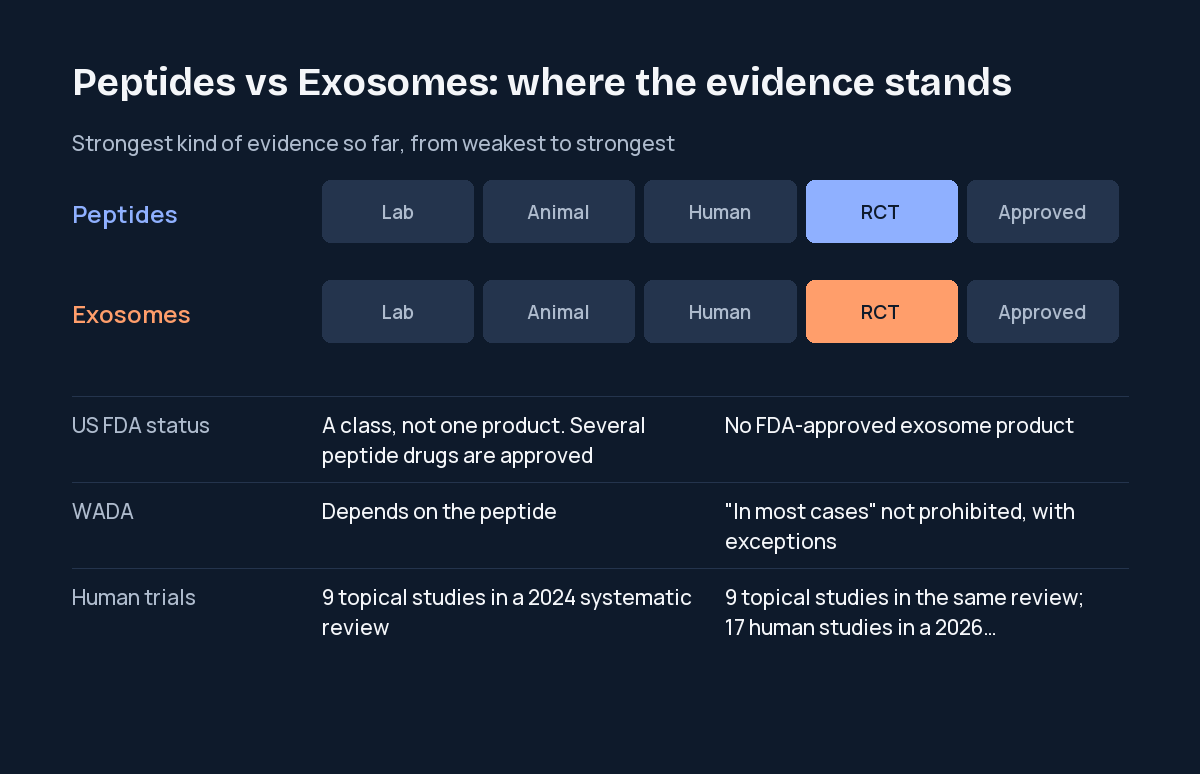
Peptides have the longer skin record: a palmitoyl pentapeptide cream reduced fine lines versus placebo in a 12-week trial [Human RCT (n=93)] (Robinson 2005). Exosomes improved acne scars after laser more than a control gel [Human RCT (n=25)] (Kwon 2020). FDA has approved no exosome product.
They are different things. Peptides are short chains of amino acids; exosomes are tiny lipid-wrapped particles that cells release, carrying proteins, lipids and genetic material (Contreras 2026). Cosmetic peptide creams need no FDA approval to be sold; exosome products used to treat a condition need FDA approval, and none has it (FDA). Most exosome skin studies are small and short, with single-arm designs and potential conflicts of interest (Wang 2026).
| Item | Peptides | Exosomes |
|---|---|---|
| US FDA status | A class, not one product. Several peptide drugs are approved (Renke 2026); peptide creams are cosmetics, which need no FDA approval before sale (FDA) | No FDA-approved exosome product (FDA); none on FDA’s approved cell and gene therapy list (FDA, searched 2026-11-22) |
| Compounding (503A/503B) | Depends on the peptide. Injectable GHK-Cu was withdrawn from Category 2 by its nominator; FDA cites immunogenicity risk and limited human data (FDA) | Not named on FDA’s Category 2 page (searched 2026-11-22); FDA regulates exosomes for treating conditions as drugs and biological products that need premarket approval (FDA 2019) |
| WADA | Depends on the peptide: non-approved peptides such as BPC-157 (S0) and TB-500 (S2) are prohibited. The 2027 List, in force 2027-01-01, names “peptides” in general under S0, prohibited at all times (USADA) | “In most cases” not prohibited, with exceptions (USADA). The 2026 List added cell components to M3 (USADA); the 2027 advisory does not mention exosomes (read 2026-11-22) |
| Strongest evidence | Human RCT, wrinkles (n=93) | Human RCT, acne scars with laser (n=25) |
| Human trials | 9 topical studies in a 2024 systematic review (Ash 2024) | 9 topical studies in the same review; 17 human studies in a 2026 scoping review (Wang 2026); e.g. NCT06239207 |
| Last checked | 2026-11-22 | 2026-11-22 |
Key points:
- A 2024 systematic review found 9 topical exosome studies and 9 topical peptide studies for skin, and said neither is FDA approved as a topical therapy.
- The controlled exosome scar and skin-aging trials applied the product right after laser or microneedling, not to intact skin.
- Injected exosome products have caused granulomas, skin necrosis and lasting scars in published case reports.
- UK cosmetics law bars “cells, tissues or products of human origin” from cosmetic products.
- No controlled human study of exosomes plus peptides against either alone was found (searched 2026-11-22).
Peptides vs exosomes at a glance
| Feature | Peptides | Exosomes |
|---|---|---|
| What it is | Short chains of amino acids | Lipid-wrapped vesicles released by cells |
| Class | Single molecules; cosmetic ingredients or drugs | Biological product; a mix of proteins, lipids and nucleic acids |
| Proposed mechanism | Signal collagen production (pal-KTTKS was designed for this) | Carry cargo between cells; matrix remodeling |
| Main research focus | Wrinkles, fine lines, texture | Scars, skin aging, hair, wounds |
| Human evidence | Several RCTs (2005, 2019) | Small split-face RCTs (2020, 2023) |
| Approval | Cosmetic use needs none; some peptide drugs approved | None |
| WADA | Non-approved peptides: S0 from 2027 | Usually not prohibited; exceptions apply |
| Routes studied | Creams, serums, microneedle patches | Gels after laser or microneedling; injection |
| Study length | 29 days to 24 weeks | 20 days to 120 days |
| Main safety concern | Few data above tested strengths | Injection reactions; unregulated products |
| Industry ties | P&G and L’Oréal authors on key trials | Maker-linked authors on phase 1 studies |
What are peptides?
Peptides are short chains of amino acids, the building blocks of proteins (Renke 2026). In skincare they are common ingredients in “cosmeceutical” products (Ash 2024). The best-known benefit result: palmitoyl pentapeptide (pal-KTTKS) at 3 ppm in a moisturizer reduced wrinkles and fine lines versus the same moisturizer without it over 12 weeks [Human RCT (n=93)] (Robinson 2005). Outside skincare, peptides include approved drugs and newer unapproved compounds (Renke 2026). Our ranking of peptides for acne and skin grades the skin peptides one by one.
What are exosomes?
Exosomes are small extracellular vesicles: particles wrapped in a lipid membrane that cells release to pass proteins, lipids and nucleic acids to other cells (Contreras 2026). The same review notes that aesthetic products and studies often call these preparations exosomes although their endosomal origin is not always demonstrated. In the human skin studies of a 2026 scoping review, the exosomes came mostly from mesenchymal stem cells (Wang 2026); others are made from plants (Hou 2024). They are not stem cells themselves. A 2023 trial team described adipose stem cell exosomes as a “cell-free” option, citing the “rarely possible tumorigenicity and low engraftment rates” of stem cells (Park 2023).
How they work differently
- Peptides: one defined molecule at a stated strength, such as 3 ppm pal-KTTKS, designed to stimulate collagen production [Human RCT (n=93)] (Robinson 2005).
Exosomes: a mixed cargo that varies by source cell, isolation method and product; the 2026 review lists this variability as a main limit of the evidence (Contreras 2026). - Peptides: applied to intact skin, or in a dissolving microneedle patch; the acetyl hexapeptide-8 patch beat the plain patch for wrinkles (p<0.05) [Human RCT (n=52)] (An 2019).
Exosomes: in the controlled skin trials, applied right after fractional laser (Kwon 2020) or microneedling (Park 2023). - Exosomes as carriers: in lab skin models, plant-derived exosomes moved acetyl hexapeptide-8 deeper into skin than free peptide [Lab] (Hou 2024).
Evidence head-to-head
| Outcome | Peptides: best evidence | Exosomes: best evidence |
|---|---|---|
| Wrinkles, fine lines | Human RCT (n=93), better than placebo (Robinson 2005) | Human RCT (n=28) with microneedling, better than saline (Park 2023) |
| Versus a standard treatment | Human RCT (n=196): peptide regimen comparable to tretinoin at 24 weeks (Fu 2010) | Human, non-randomized (n=15): similar to PRP, no statistics run (Estupiñan 2025) |
| Acne scars | No trial found (PubMed, searched 2026-11-22) | Human RCT (n=25): 32.5% vs 19.9% score reduction (Kwon 2020) |
| Hair | Human, open-label: copper tripeptide serum, dandruff study (Patel 2024) | Human, single-arm (n=30) with microneedling (Ablon 2025) |
| Wound healing | Not compared here | Phase 1b (n=7): no difference from standard care (Wan 2026) |
| Topical tolerability | Expert panel: acetyl hexapeptide-8 acceptable up to 0.005% (Johnson 2025) | Phase 1 (n=10): no related adverse events (Chandran 2025) |
All figures above come from separate trials with different products, devices and scales, so any comparison between the two columns is cross-trial. No study has tested a peptide product directly against an exosome product (PubMed and ClinicalTrials.gov, searched 2026-11-22).
Which fits which goal?
Peptides have more evidence for fine lines and wrinkles on intact skin. The strongest results come from controlled trials: the 93-woman pal-KTTKS trial against placebo (Robinson 2005) and a 196-woman trial in which a peptide-containing regimen improved wrinkle appearance more than 0.02% tretinoin at 8 weeks, comparably at 24 weeks, and was better tolerated through 8 weeks (Fu 2010). That regimen also held niacinamide and retinyl propionate, so the peptide’s share of the effect is unknown.
Exosomes have more evidence for acne scars and recovery after laser. In the split-face trial, the exosome side also had milder redness and shorter downtime [Human RCT (n=25)] (Kwon 2020). For hair loss, a 2026 systematic review found early clinical reports of 8–20% gains in hair density but small, often uncontrolled studies (Malih 2026). Our hair-loss peptide ranking covers the peptide side. A clinician is the person to decide what suits a given person.
Can they be combined?
Many products already combine them. The exosome complex in the single-arm hair study was described as delivering “growth factors, peptides, coenzymes, minerals, amino acids, and vitamins” (Ablon 2025). The exosome kit in a randomized hair trial against PRP included a peptide solution (NCT06239207); that trial finished in 2024 with no results posted (checked 2026-11-22). No controlled human study of exosomes plus peptides against either alone was found on PubMed or ClinicalTrials.gov (searched 2026-11-22).
Safety and regulatory status
Peptides, US: a cosmetic peptide cream needs no FDA approval, but a product meant “to affect the structure or function of the body” is a drug under the law (FDA). For injectable GHK-Cu, FDA lists a risk of immunogenicity from “aggregation and peptide-related impurities” and limited human data (FDA). For topical acetyl hexapeptide-8, an expert panel judged the data adequate at concentrations up to 0.005% and insufficient above that (Johnson 2025). More on the drug side is in our peptide safety overview.
Exosomes, US: in 2019 FDA reported “serious adverse events” in Nebraska patients treated with unapproved products marketed as containing exosomes, and said certain clinics “deceive patients with unsubstantiated claims” (FDA). Its consumer alert, current as of 2024-04-09, repeats that no exosome product is FDA approved (FDA).
Exosomes, injection harms: four women developed persistent nodules, granulomatous inflammation and scarring after exosome products were injected into the skin in a nonclinical setting, and none fully recovered [Human case series (n=4)] (Park 2025). A man developed skin necrosis and vasculitis after intradermal exosome injections for enlarged pores [Human case report (n=1)] (Tawanwongsri 2024). A 2026 scoping review found adverse events uncommon in 17 studies but listed granulomas, necrosis and allergic reactions after injection (Wang 2026).
UK and Korea: Annex II of the Cosmetic Products Regulation (EC) 1223/2009, as kept in UK law, lists “Cells, tissues or products of human origin” (entry 416) among substances prohibited in cosmetic products (legislation.gov.uk). A Korean case series notes that these exosome cosmetics are approved for topical use, while injecting them remains off-label and unregulated in many countries, including South Korea (Park 2025).
Athletes: USADA says exosomes are prohibited when the preparation contains red blood cells and is given intravenously, or when growth factors, hormones or other prohibited substances are added and reinjected (USADA). Peptides such as BPC-157 (S0) and TB-500 (S2) are prohibited (USADA 2027 advisory); our peptides vs steroids vs SARMs guide covers the anti-doping side.
Anyone who suspects a side effect from peptides, exosomes or any other drug or product can report it to the FDA through MedWatch.
How long do effects take in studies?
- Peptides: one multi-ingredient acetyl hexapeptide-8 serum improved static wrinkle scores within the first week, and dynamic wrinkle scores by 10–13% [Human clinical studies (n=50 and n=42), no control arm described] (Zhu 2026). The pal-KTTKS trial ran 12 weeks (Robinson 2005).
- Exosomes: skin trials ran 12 weeks, with three treatment sessions three weeks apart in one (Park 2023). The hair study measured results at day 120 after four sessions (Ablon 2025).
What users report
These are unverified self-reports from people who usually bought unregulated products or clinic treatments, not evidence. People who post about exosome facials most often describe a short “glow”, less redness and faster healing after microneedling or laser, and they tend to credit the exosomes rather than the device. A recurring complaint is the price of a session against results that fade or never show, and some describe bumps, lasting redness or nodules after injected products. People who post about peptide serums commonly report smoother texture and softer fine lines after several weeks, with many saying they noticed nothing at all. Copper peptide users often mention irritation or purging when they combine it with acids or retinoids. A frequent argument is whether either works on intact skin without a device, since skeptics say exosomes and larger peptides cannot get through the skin barrier. Many posters also question what a bottle labeled “exosomes” really holds.
Frequently asked questions
Are exosomes and peptides the same?
No. Peptides are single molecules made of a few amino acids, while exosomes are whole vesicles that cells release, packed with many different proteins, lipids and nucleic acids. A 2026 review defines them as lipid bilayer-delimited particles that pass that cargo between cells (Contreras 2026). An exosome product may contain peptides among its cargo.
Are exosomes FDA approved?
No exosome product is FDA approved as of 2026-11-22, for skin, hair or any other use. FDA says exosome products intended to treat diseases or conditions in humans require its approval, and that there are currently no FDA-approved exosome products (FDA). Cosmetic peptide creams need no approval before sale.
Are peptides or exosomes better for skin?
Neither has been tested against the other, so no trial says which is better. Leading trials include a peptide cream study of 93 women [Human RCT] (Robinson 2005) and an exosome-after-laser acne scar study of 25 patients [Human RCT] (Kwon 2020). Those results are cross-trial and measured different outcomes.
Are exosomes stem cells?
No. Exosomes are particles that cells, including stem cells, release, not cells themselves. The authors of a 2023 exosome trial called adipose stem cell exosomes a “cell-free” option and noted the stem-cell drawbacks of rare possible tumorigenicity and low engraftment (Park 2023). No head-to-head trial against stem cells was found.
What is the difference between PRP and exosomes?
PRP is a patient’s own blood, spun to concentrate platelets; exosome products are made ahead of time, so no blood draw is needed. In a small split-face study, exosomes and PRP after microneedling improved photoaged skin to a similar degree in 15 participants, without statistical testing [Human, non-randomized] (Estupiñan 2025).
References
- Robinson LR, et al. (2005). Topical palmitoyl pentapeptide provides improvement in photoaged human facial skin. Int J Cosmet Sci. PubMed 18492182
- Kwon HH, et al. (2020). Combination treatment with human adipose tissue stem cell-derived exosomes and fractional CO2 laser for acne scars. Acta Derm Venereol. PubMed 33073298
- Contreras C, Ariza-Donado A. (2026). Extracellular vesicles in regenerative and cosmetic medicine. Int J Mol Sci. PubMed 42353255
- US FDA (2019). Public Safety Notification on Exosome Products. fda.gov
- US FDA (2020, current 2024). Consumer Alert on Regenerative Medicine Products Including Stem Cells and Exosomes. fda.gov
- US FDA. Approved Cellular and Gene Therapy Products (current 2026-10-30). fda.gov
- US FDA. FDA Authority Over Cosmetics: How Cosmetics Are Not FDA-Approved, but Are FDA-Regulated. fda.gov
- US FDA. Certain bulk drug substances for use in compounding that may present significant safety risks (current 2026-04-22). fda.gov
- USADA. Athlete advisory: the 2027 Prohibited List. usada.org
- USADA. What athletes need to know about exosomes. usada.org
- USADA. What’s new on the 2026 WADA Prohibited List. usada.org
- Renke G, Chinellato L. (2026). Therapeutic peptides in aesthetic, metabolic and endocrine conditions. Int J Mol Sci. PubMed 42123471
- Ash M, et al. (2024). The innovative and evolving landscape of topical exosome and peptide therapies: a systematic review. Aesthet Surg J Open Forum. PubMed 38633728
- Wang OJE, et al. (2026). Exosome-based therapies in dermatology: a scoping review. J Drugs Dermatol. PubMed 41931695
- ClinicalTrials.gov. NCT06239207: Exosomes versus platelet-rich plasma in androgenetic alopecia. clinicaltrials.gov
- An JH, et al. (2019). Anti-wrinkle efficacy of cross-linked hyaluronic acid-based microneedle patch with acetyl hexapeptide-8 and EGF. Ann Dermatol. PubMed 33911590
- Park GH, et al. (2023). Human adipose tissue stem cell-derived exosome-containing solution and microneedling for facial skin aging. J Cosmet Dermatol. PubMed 37377400
- Hou J, et al. (2024). Developing plant exosomes as an advanced delivery system for cosmetic peptide. ACS Appl Bio Mater. PubMed 38598772
- Fu JJ, et al. (2010). A cosmetic niacinamide/peptide/retinyl propionate regimen vs 0.02% tretinoin. Br J Dermatol. PubMed 20374604
- Estupiñan B, et al. (2025). Adipose mesenchymal stem cell-derived exosomes versus platelet-rich plasma for photoaged facial skin. J Cosmet Dermatol. PubMed 40414798
- Patel MN, et al. (2024). A hydroxy acid scrub and copper tripeptide serum for seborrheic dermatitis. Cureus. PubMed 39449909
- Ablon G. (2025). An exosome regenerative complex plus microneedling promotes hair growth. J Drugs Dermatol. PubMed 41037530
- Wan R, et al. (2026). A purified exosome product for skin graft donor sites: a phase 1b trial. J Plast Reconstr Aesthet Surg. PubMed 42155421
- Johnson W Jr, et al. (2025). Safety assessment of acetyl hexapeptide-8 amide as used in cosmetics. Int J Toxicol. PubMed 40673537
- Chandran NS, et al. (2025). A phase 1 study of a topical MSC exosome ointment in healthy volunteers. Cytotherapy. PubMed 39918488
- Malih S, et al. (2026). Exosome-driven treatments for hair regrowth in androgenetic alopecia: a systematic review. Mol Biol Rep. PubMed 42377704
- Park KY. (2025). Adverse reactions following intradermal injection of exosome-based formulations: a case series. J Cosmet Dermatol. PubMed 41097876
- Tawanwongsri W, Vachiramon V. (2024). Skin necrosis after intradermal injection of lyophilized exosome. J Cosmet Dermatol. PubMed 38327119
- Cosmetic Products Regulation (EC) No 1223/2009, Annex II (UK retained version). legislation.gov.uk
- Zhu M, et al. (2026). A serum containing acetyl hexapeptide-8: ex vivo and clinical studies. Int J Cosmet Sci. PubMed 41668671
Change log
2026-11-22: first published after review by the editorial team.