Tesamorelin vs GLP-1 for visceral fat: tesamorelin (Egrifta) cut visceral fat 15.4% more than placebo in pooled 26-week HIV trials, without weight loss. The GLP-1 drug semaglutide cut it 30.6% in a 108-person HIV trial, with broader fat and weight loss. Both are FDA-approved, but for different uses.
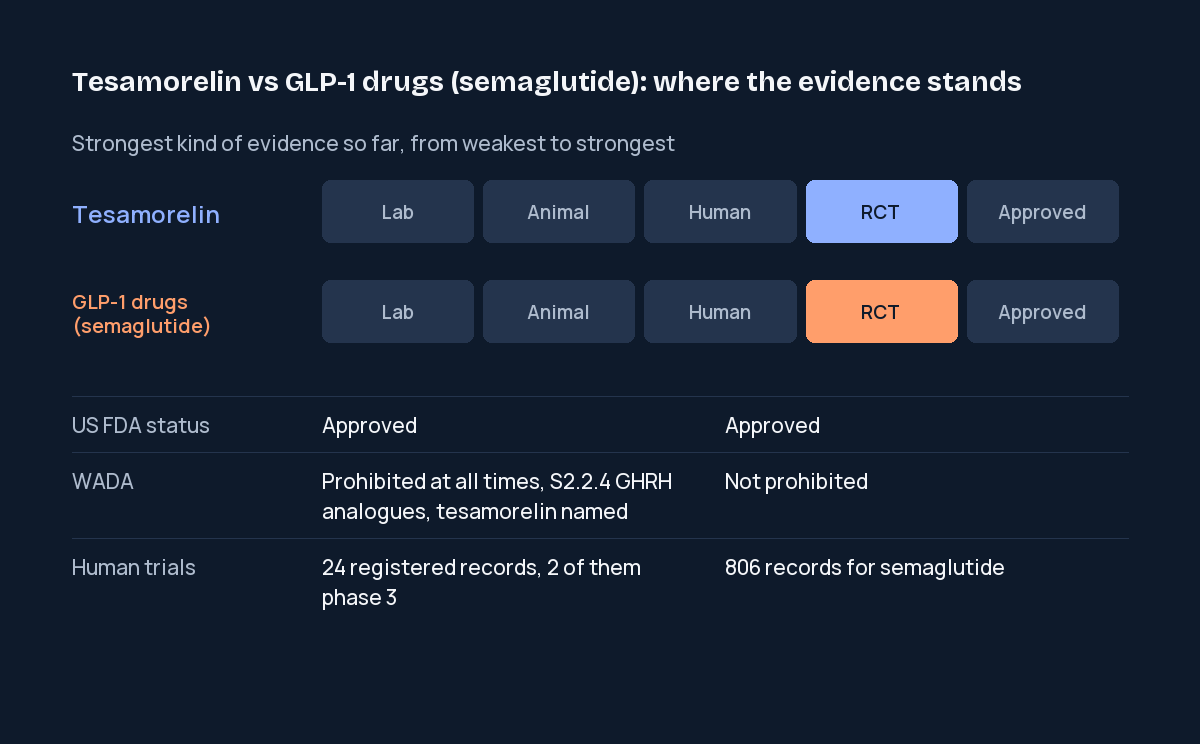
Tesamorelin is not a GLP-1 drug. It is a growth hormone-releasing hormone (GHRH) analog, and its label covers “the reduction of excess abdominal fat in HIV-infected adult patients with lipodystrophy” (Egrifta WR label). Its best evidence is two phase 3 trials pooled at 806 people, with a visceral fat treatment effect of -15.4% at 26 weeks [Human RCT (n=806)] (Falutz 2010, pooled). Semaglutide (Wegovy) is approved for weight reduction, heart risk reduction and a liver disease, not for visceral fat as such (Wegovy label). No trial comparing the two was found on ClinicalTrials.gov (searched 2026-11-16), so every comparison below is cross-trial.
| Item | Tesamorelin | GLP-1 drugs (semaglutide) |
|---|---|---|
| US FDA status | Approved: Egrifta, 2010-11-10 (BLA 022505), for excess abdominal fat in adults with HIV and lipodystrophy (Drugs@FDA) | Approved: Wegovy, 2021-06-04 (NDA 215256), for weight reduction, heart risk and MASH (Drugs@FDA); no visceral-fat indication |
| Compounding (503A/503B) | Deemed a BLA on 2020-03-23; transitioned biologics are not eligible for the 503A/503B exemptions (FDA) | Not on FDA’s drug shortage list or the 503B bulks list; 503A enforcement discretion for semaglutide has ended (FDA) |
| WADA | Prohibited at all times, S2.2.4 GHRH analogues, tesamorelin named (2026 List); USADA’s summary of the 2027 List (in force 2027-01-01) lists no change to S2 | Not prohibited (USADA); semaglutide and tirzepatide are in the 2027 monitoring program, which does not prohibit them (USADA) |
| Strongest evidence | Phase 3 RCTs on visceral fat (pooled n=806) | Phase 3 RCTs on weight; visceral fat measured in a phase 2b HIV trial (n=108) and a phase 3 substudy |
| Human trials | 24 registered records, 2 of them phase 3 (ClinicalTrials.gov, searched 2026-11-16) | 806 records for semaglutide (ClinicalTrials.gov, searched 2026-11-16) |
| Last checked | 2026-11-17 | 2026-11-17 |
Key points:
- Tesamorelin’s label calls it “weight neutral” and says it is “not indicated for weight loss management” (Egrifta WR label).
- In east Asian adults, semaglutide 2.4 mg reduced abdominal visceral fat area by 40.0% vs 6.9% on placebo over 68 weeks (STEP 6).
- Tesamorelin left belly fat under the skin largely unchanged (Falutz 2010, pooled); semaglutide reduced it too, by 11.2% in the HIV trial (Eckard 2024).
- With both drugs, visceral fat came back after stopping (Falutz 2010; Adekunle 2026).
- Their main risks differ: raised IGF-1 and glucose for tesamorelin, stomach and bowel effects for semaglutide (labels above).
Tesamorelin vs GLP-1 drugs at a glance
| Feature | Tesamorelin | GLP-1 drugs |
|---|---|---|
| What it is | Synthetic GHRH analog | Drugs that mimic the gut hormone GLP-1 |
| Class | Growth hormone-releasing factor | GLP-1 receptor agonist (tirzepatide also acts on GIP) |
| Target | Pituitary GHRH receptor; raises GH and IGF-1 | GLP-1 receptors; lowers appetite |
| Main research focus | Visceral and liver fat in HIV | Weight, diabetes, heart risk |
| Body weight | Weight neutral (label) | -14.9% at 68 weeks (STEP 1) |
| Visceral fat, best trial | -15.2% vs +5.0% at 26 weeks (n=412) | -40.0% vs -6.9% at 68 weeks (STEP 6) |
| Fat under the skin | No significant change | Also reduced |
| US approval | Egrifta (HIV lipodystrophy) | Wegovy (weight, heart risk, MASH) |
| WADA | Prohibited, S2 | Not prohibited; monitored |
| Routes studied | Daily injection | Weekly injection; tablets |
| Timelines in studies | 26–52 weeks | 32–68 weeks |
| Main safety concerns | IGF-1, glucose, fluid retention | GI effects, pancreatitis, gallbladder |
What is tesamorelin?
Tesamorelin is a lab-made version of growth hormone-releasing hormone, the brain signal that tells the pituitary gland to release growth hormone. It is sold as Egrifta, and the label describes it as a growth hormone-releasing factor analog for excess abdominal fat in adults with HIV and lipodystrophy (Egrifta WR label). A 2024 analysis calls it “the only FDA-approved therapy to treat abdominal fat accumulation in people with HIV” (Russo 2024). Its benefit is targeted: it trims fat around the organs while leaving weight steady. Our tesamorelin results timeline follows the trial readouts week by week.
What are GLP-1 drugs?
GLP-1 receptor agonists mimic GLP-1, a gut hormone that the Wegovy label calls “a physiological regulator of appetite and caloric intake” (Wegovy label). Semaglutide is the best-known; as Wegovy it is approved to reduce excess body weight and maintain the loss, to lower the risk of major heart events in people with heart disease, and for a form of fatty liver disease called MASH (Wegovy label). In STEP 1, semaglutide 2.4 mg cut body weight 14.9% vs 2.4% on placebo over 68 weeks [Human RCT (n=1,961)] (Wilding 2021). Visceral fat falls along with that weight: in STEP 6, visceral fat area dropped 40.0% on semaglutide 2.4 mg [Human RCT; visceral fat scanned in a subset of 180 (post hoc analysis)] (STEP 6). Our semaglutide, tirzepatide and retatrutide comparison covers the drugs in this class side by side. Semaglutide is itself a peptide, as our peptides vs Ozempic guide explains.
How they work differently
- Tesamorelin: raises the body’s own growth hormone; IGF-1, a marker of growth hormone activity, rose 81.0% vs a 5.0% fall on placebo (Falutz 2007).
- GLP-1 drugs: act on appetite and caloric intake (Wegovy label), and semaglutide lowered body weight overall in STEP 1 (Wilding 2021).
- Tesamorelin: selective; in the pooled phase 3 data, fat under the skin of the belly did not change significantly (treatment effect -0.6%) (Falutz 2010, pooled).
- GLP-1 drugs: broad; semaglutide reduced visceral fat, fat under the skin and total body fat in the same trial (Eckard 2024).
- Tesamorelin: a 2026 case report whose authors include employees of its maker describes it as working “selectively”, and GLP-1 drugs as causing weight loss “in a nonspecific way” [Human case report (n=2)] (Beach 2026).
Evidence head-to-head
The table gives each option’s best result for each outcome. The trials used different people (mostly people with HIV for tesamorelin, mostly people with obesity for GLP-1 drugs) and different scans, so the numbers are cross-trial and cannot be ranked against each other directly.
| Outcome | Tesamorelin best evidence | GLP-1 best evidence |
|---|---|---|
| Visceral fat, HIV | Human RCT (n=412): -15.2% vs +5.0%, 26 weeks (Falutz 2007) | Human RCT (n=108): -30.6%, 32 weeks, semaglutide (Eckard 2024) |
| Visceral fat, no HIV | Human RCT (n=60): -35 cm² vs placebo, 12 months (Makimura 2012) | Human RCT (n=401; visceral fat scanned in 180): -40.0% vs -6.9%, 68 weeks (STEP 6; post hoc) |
| Visceral fat, other RCTs | Human RCT (n=50): -42 cm² vs placebo, 6 months (Stanley 2014) | Human RCT (n=185): -12.49% vs -1.63%, liraglutide, 40 weeks (Neeland 2021) |
| Liver fat | Human RCT (n=61): -4.1% absolute, 12 months (Stanley 2019) | Human RCT (n=296): -8.09% vs -3.38% on insulin, tirzepatide (SURPASS-3 MRI) |
| Body weight | Approved label: weight neutral (Egrifta WR) | Human RCT (n=1,961): -14.9% vs -2.4% (STEP 1) |
| Lasting effect after stopping | Human RCT (n=404): gains “rapidly lost” on placebo (Falutz 2010) | Human RCT follow-up (n=80): visceral fat rose again by week 56 (Adekunle 2026) |
Which fits which goal?
Tesamorelin has more evidence for reducing visceral fat in people with HIV whose main problem is belly fat rather than overall weight. That is the population of its two phase 3 trials, where it beat placebo by 15.4% (Falutz 2010, pooled), and the use FDA approved. Its benefit is that it targets the deep fat without weight loss, and a 60-person trial found a visceral fat treatment effect of -35 cm² in abdominally obese adults without HIV who had low growth hormone [Human RCT (n=60)] (Makimura 2012).
GLP-1 drugs have more evidence for people who need to lose weight overall, and for heart risk, where Wegovy holds an approved indication (Wegovy label). Their visceral fat falls were larger in percentage terms in the trials above, but they came with loss of fat under the skin and of body weight. A 2026 Lancet HIV review notes “a growing body of evidence” for GLP-1 drugs in people with HIV alongside “a historical literature showing the efficacy of tesamorelin”, and lists the lack of large GLP-1 trials with body composition end points as an evidence gap (Manne-Goehler 2026). Which, if either, suits a given person is a decision for a clinician.
Can tesamorelin and GLP-1 drugs be combined?
The only published report found is a 2026 pair of case reports in which one woman with HIV on a GLP-1 drug had tesamorelin added for persistent abdominal fat [Human case report (n=2)] (Beach 2026). Its authors include employees of Theratechnologies, the company that makes tesamorelin. None of the 24 tesamorelin records on ClinicalTrials.gov lists a GLP-1 drug as an intervention. No controlled human study of the combination was found on PubMed or ClinicalTrials.gov (searched 2026-11-16).
Safety and regulatory status
Tesamorelin. Several of the label’s warnings relate to raised growth hormone and IGF-1. It is contraindicated in active cancer and in pregnancy. Among people on Egrifta for 26 weeks, 47% had IGF-1 levels above 2 standard deviation scores. Fluid retention can cause swelling, joint pain and carpal tunnel syndrome. Raised HbA1c (6.5% or higher) occurred in 5% vs 1% on placebo, and the label notes that long-term heart safety “has not been established” (Egrifta WR label). In a 12-week trial in type 2 diabetes, it did not change insulin response or blood sugar control [Human RCT (n=53)] (Clemmons 2017). Because tesamorelin became a licensed biologic in 2020, it cannot be made by compounding pharmacies under the 503A/503B exemptions (FDA). Athletes: it is named under WADA’s S2 class, prohibited at all times (WADA 2026 List).
GLP-1 drugs. Wegovy carries a boxed warning on thyroid C-cell tumors seen in rodents, plus warnings on pancreatitis, gallbladder disease and kidney injury from fluid loss; nausea, diarrhea and vomiting are the most common side effects (Wegovy label). In the HIV trial, one grade 4 lipase rise was judged related to semaglutide and two gallstone cases possibly related (Eckard 2024). FDA warns that unapproved versions “do not undergo FDA’s review for safety, effectiveness and quality” and that compounded drugs “are not FDA approved” (FDA). Athletes: GLP-1 drugs are not prohibited, and no therapeutic use exemption is needed (USADA).
Anyone who suspects a side effect from tesamorelin, a GLP-1 drug or any other drug or product can report it to the FDA through MedWatch.
How long do effects take in studies?
Tesamorelin’s visceral fat results were measured at 26 weeks, and the reduction reached about 18% in people who stayed on it for 12 months (Falutz 2010). Semaglutide’s HIV trial measured its 30.6% drop at 32 weeks (Eckard 2024), and STEP 6 measured its result at 68 weeks (STEP 6). For both, the fat returned when treatment stopped: on tesamorelin after a switch to placebo, and on semaglutide between weeks 32 and 56, though net weight loss remained (Adekunle 2026).
What users report
What follows are unverified self-reports from people who usually bought unregulated products, not evidence. People who post about tesamorelin commonly describe a flatter stomach or a smaller waist after a few months, with little change on the scale, and some say they noticed nothing at all. Recurring complaints are joint aches, swelling in the hands, tingling, redness at the injection site and the cost of daily injections. People who post about GLP-1 drugs more often describe fast weight loss and much smaller appetites, with nausea, constipation and fatigue as the usual complaints, and some worry about losing muscle or about a softer face. A frequent argument is whether tesamorelin “targets” belly fat in a way a GLP-1 drug cannot, and whether adding one to the other does anything beyond what either does alone. Many posters also question whether unregulated products contain what the label says.
Frequently asked questions
Is tesamorelin a GLP-1?
No. Tesamorelin is a growth hormone-releasing hormone analog that makes the pituitary release more growth hormone, while GLP-1 drugs act on gut-hormone receptors that curb appetite. In its first phase 3 trial, tesamorelin raised IGF-1, a growth hormone marker, by 81.0% over 26 weeks, against a 5.0% fall on placebo (Falutz 2007).
Does tesamorelin cause weight loss like semaglutide?
No. Its FDA label calls it weight neutral and says it is not indicated for weight loss management; it lowers visceral fat without lowering weight. Semaglutide 2.4 mg, by contrast, cut body weight 14.9% vs 2.4% on placebo over 68 weeks in STEP 1, a trial of 1,961 adults (Wilding 2021).
Which reduces more visceral fat, tesamorelin or semaglutide?
In separate trials, semaglutide’s percentage drops were larger: 30.6% against placebo in a 108-person HIV trial, against a pooled 15.4% placebo-adjusted drop for tesamorelin in its phase 3 trials. The trials used different people, doses, scans and durations, so this is a cross-trial comparison, and no head-to-head trial was found (searched 2026-11-16) (Eckard 2024).
Does visceral fat come back after stopping tesamorelin or a GLP-1?
In trials of both, yes. Tesamorelin’s visceral fat gains were “rapidly lost” in people switched to placebo after 6 months (Falutz 2010). After semaglutide stopped at week 32 in the HIV trial, visceral fat rose again by week 56, though some net weight loss remained compared with the start.
Are tesamorelin and GLP-1 drugs banned in sport?
Tesamorelin is banned at all times; WADA names it under S2 as a growth hormone-releasing hormone analog. GLP-1 drugs are not prohibited, and USADA says no therapeutic use exemption is needed. For 2027, semaglutide and tirzepatide join WADA’s monitoring program, which tracks use without banning it (USADA).
References
- Falutz J, et al. (2007). Metabolic effects of a growth hormone-releasing factor in patients with HIV. N Engl J Med. PubMed 18057338
- Falutz J, et al. (2010). Effects of tesamorelin in HIV-infected patients with abdominal fat accumulation: a randomized placebo-controlled trial with a safety extension. J Acquir Immune Defic Syndr. PubMed 20101189
- Falutz J, et al. (2010). Effects of tesamorelin (TH9507) in HIV-infected patients with excess abdominal fat: a pooled analysis of two phase 3 trials. J Clin Endocrinol Metab. PubMed 20554713
- Stanley TL, et al. (2014). Effect of tesamorelin on visceral fat and liver fat in HIV-infected patients with abdominal fat accumulation. JAMA. PubMed 25038357
- Stanley TL, et al. (2019). Effects of tesamorelin on non-alcoholic fatty liver disease in HIV. Lancet HIV. PubMed 31611038
- Makimura H, et al. (2012). Metabolic effects of a growth hormone-releasing factor in obese subjects with reduced growth hormone secretion. J Clin Endocrinol Metab. PubMed 23015655
- Clemmons DR, et al. (2017). Safety and metabolic effects of tesamorelin in patients with type 2 diabetes. PLoS One. PubMed 28617838
- Russo SC, et al. (2024). Efficacy and safety of tesamorelin in people with HIV on integrase inhibitors. AIDS. PubMed 38905488
- Eckard AR, et al. (2024). Once-weekly semaglutide in people with HIV-associated lipohypertrophy: a phase 2b trial. Lancet Diabetes Endocrinol. PubMed 38964353
- Adekunle RO, et al. (2026). Durability of semaglutide effects after treatment discontinuation in HIV-associated lipohypertrophy. Open Forum Infect Dis. PubMed 42921178
- Kadowaki T, et al. (2022). Semaglutide once a week in adults with overweight or obesity in an east Asian population (STEP 6). Lancet Diabetes Endocrinol. PubMed 35131037
- Kadowaki T, et al. (2025). Post hoc analysis of STEP 6. Effect of once-weekly subcutaneous semaglutide on abdominal visceral fat area in Japanese adults with overweight and obesity. Obes Res Clin Pract. PubMed 40189961
- Wilding JPH, et al. (2021). Once-weekly semaglutide in adults with overweight or obesity (STEP 1). N Engl J Med. PubMed 33567185
- Neeland IJ, et al. (2021). Effects of liraglutide on visceral and ectopic fat in adults with overweight and obesity at high cardiovascular risk. Lancet Diabetes Endocrinol. PubMed 34358471
- Gastaldelli A, et al. (2022). Effect of tirzepatide versus insulin degludec on liver fat content and abdominal adipose tissue (SURPASS-3 MRI). Lancet Diabetes Endocrinol. PubMed 35468325
- Manne-Goehler J, et al. (2026). Weight management in people with HIV. Lancet HIV. PubMed 43000036
- Beach R, et al. (2026). Differing presentations of excess visceral abdominal fat in people living with HIV: two clinical cases. Clin Infect Dis. PubMed 42139091
- US FDA. Egrifta WR (tesamorelin) prescribing information, revised 3/2025. accessdata.fda.gov
- US FDA. Drugs@FDA: BLA 022505 (Egrifta). accessdata.fda.gov
- US FDA. Wegovy (semaglutide) prescribing information, 2/2026. accessdata.fda.gov
- US FDA. Drugs@FDA: NDA 215256 (Wegovy). accessdata.fda.gov
- US FDA. Notice to compounders: changes that affect compounding as of March 23, 2020. fda.gov
- US FDA. FDA clarifies policies for compounders as national GLP-1 supply begins to stabilize (current 04/01/2026). fda.gov
- US FDA. FDA’s concerns with unapproved GLP-1 drugs used for weight loss (current 10/01/2026). fda.gov
- WADA. 2026 Prohibited List. wada-ama.org
- USADA. Athlete advisory: what’s new on the 2027 WADA Prohibited List. usada.org
- USADA. Weight loss drugs: what athletes need to know about GLP-1s. usada.org
- ClinicalTrials.gov searches for tesamorelin and semaglutide (2026-11-16). tesamorelin, semaglutide
Change log
2026-11-17: first published after review by the editorial team.