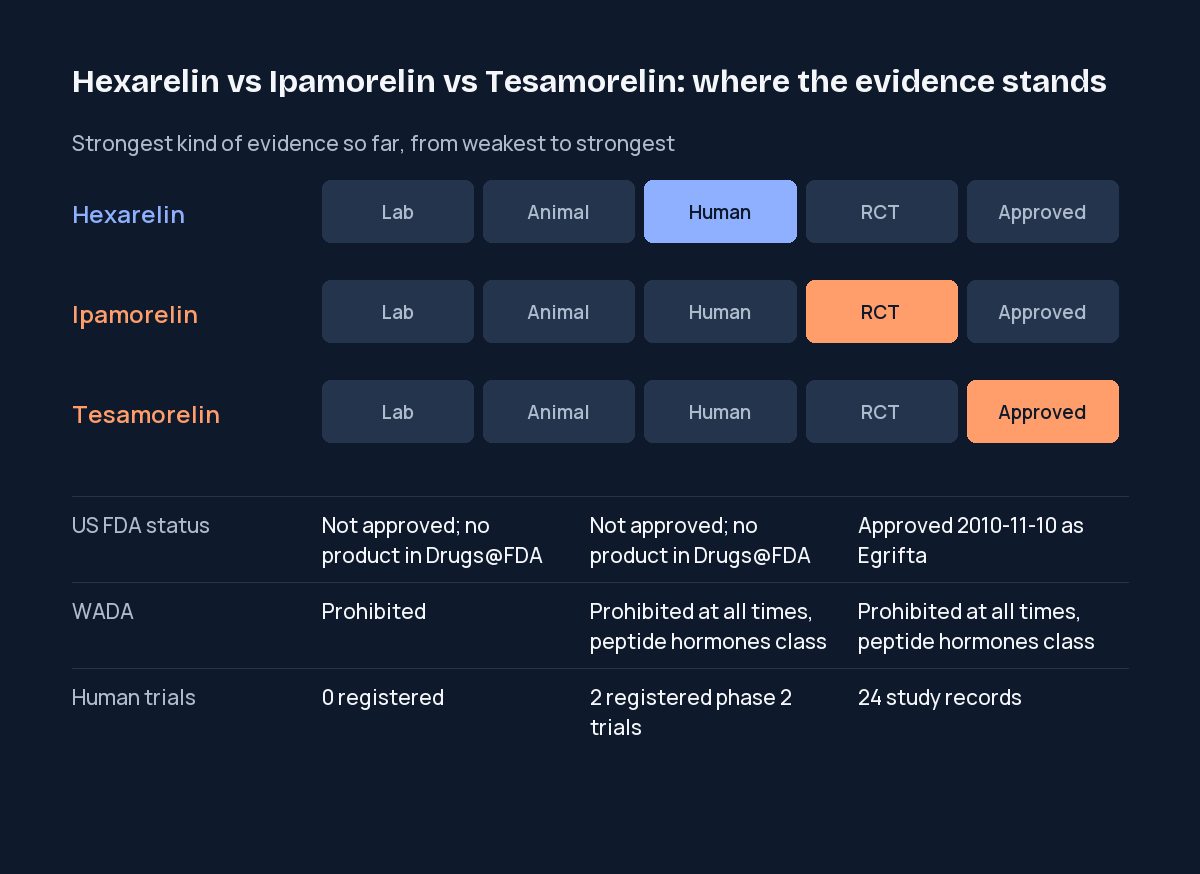
Hexarelin, ipamorelin and tesamorelin all make the pituitary release more growth hormone (GH), but their evidence differs sharply. Tesamorelin has the strongest record: it cut visceral belly fat by 15.2% against a 5.0% gain on placebo in a 412-patient trial (Falutz 2007) and is FDA approved as Egrifta for HIV-associated abdominal fat. Hexarelin produced strong GH pulses and short-lived heart-pumping gains in small 1990s human studies, and ipamorelin released GH without raising stress hormones in swine; neither is FDA approved, and both have only small or negative human trials.
| Item | Hexarelin | Ipamorelin | Tesamorelin |
|---|---|---|---|
| US FDA status | Not approved; no product in Drugs@FDA (openFDA, searched 2026-11-02) | Not approved; no product in Drugs@FDA (searched 2026-11-02) | Approved 2010-11-10 as Egrifta (BLA 022505) for excess abdominal fat in adults with HIV lipodystrophy |
| Compounding | Not named on FDA’s 503A or 503B nomination lists or its Category 2 page (searched 2026-11-02) | 503B Category 2 (significant safety risks) since 2023-09-29; 503A nomination withdrawn (FDA) | Licensed as a biologic; transitioned biologics are not eligible for the 503A/503B compounding exemptions (FDA) |
| WADA | Prohibited: named among WADA-listed peptides (Thomas 2016); GH-releasing peptides stay prohibited under S2 on the 2027 List (USADA) | Prohibited at all times, peptide hormones class (USADA); still named under S2 for 2027 (USADA) | Prohibited at all times, peptide hormones class (USADA); USADA’s 2027 advisory describes no change |
| Strongest evidence | Small human studies (n=7 to 24) | Human RCT, phase 2 (n=114 analysed): no benefit | Approved label; phase 3 RCTs |
| Human trials | 0 registered (ClinicalTrials.gov, 2026-11-02); 58 PubMed records tagged clinical trial, 1994 to 2004 | 2 registered phase 2 trials: NCT00672074 (published) and NCT01280344 (no results posted) | 24 study records (ClinicalTrials.gov, 2026-11-02), including phase 3 NCT00123253 |
| Next regulatory step | None announced | None announced | None announced |
| Last checked | 2026-11-02 | 2026-11-02 | 2026-11-02 |
Key points:
- Hexarelin and ipamorelin act on the ghrelin (GH secretagogue) receptor; tesamorelin copies GHRH, the hypothalamus’s own GH-releasing hormone.
- In 16 weeks of twice-daily use, hexarelin’s GH response faded by about half and IGF-1, body fat and lean mass did not change.
- Ipamorelin’s only published human efficacy trial, in 114 patients after bowel surgery, found no significant benefit over placebo.
- Tesamorelin’s gains in visceral fat were lost quickly once people switched to placebo.
- No controlled human study of any two of the three together was found on PubMed or ClinicalTrials.gov (searched 2026-11-02).
Hexarelin vs ipamorelin vs tesamorelin at a glance
| Feature | Hexarelin | Ipamorelin | Tesamorelin |
|---|---|---|---|
| What it is | Synthetic hexapeptide (6 amino acids) | Synthetic pentapeptide (5 amino acids) | Stabilized analog of human GHRH |
| Class | GH-releasing peptide (GHRP) | GH-releasing peptide (GHRP) | GH-releasing factor analog |
| Receptor | Ghrelin (GHS) receptor; heart receptors | Ghrelin (GHS) receptor | GHRH receptor |
| Research focus | GH testing, short stature, heart function | Gut recovery after surgery | Visceral fat, fatty liver in HIV |
| Human evidence | Small studies, mostly single doses | 2 phase 2 trials, 1 published | Phase 3 RCTs, n=412 and 404 |
| Approval | Not FDA approved | Not FDA approved | FDA approved (Egrifta) |
| WADA | Prohibited (S2) | Prohibited (S2) | Prohibited (S2 class) |
| Routes studied | IV, under the skin, nasal | IV infusion | Under the skin |
| Timelines in studies | GH peak at about 30 min | GH peak at 0.67 h | Fat change measured at 26 weeks |
| Hormone side effects | Raises prolactin and cortisol | No ACTH/cortisol rise in swine | Raises IGF-1; glucose intolerance |
| Main safety concerns | Unknown long term; unregulated products | FDA cites a death with IV use; impurities | Fluid retention, glucose, neoplasm warnings |
What is hexarelin?
Hexarelin is a synthetic six-amino-acid peptide, His-D-2-methyl-Trp-Ala-Trp-D-Phe-Lys-NH2, from the GH-releasing peptide family. In a placebo-controlled study of 12 healthy men, GH peaked about 30 minutes after an IV dose and returned to baseline within 240 minutes [Human, n=12] (Imbimbo 1994). Its most intriguing finding is on the heart: an IV dose raised left ventricular ejection fraction in GH-deficient men, which points to an effect that does not depend on GH [Human, n=16] (Bisi 1999). PubMed’s clinical-trial records for hexarelin end in 2004, and no hexarelin trial is registered on ClinicalTrials.gov (searched 2026-11-02).
What is ipamorelin?
Ipamorelin is a five-amino-acid GH-releasing peptide developed in the 1990s. Its developers called it “the first selective growth hormone secretagogue”: in swine it released GH without raising ACTH or cortisol, even at more than 200 times the dose needed for GH release [Animal] (Raun 1998). In healthy men, eight at each of five infusion rates, it had a half-life of about 2 hours and caused a single GH pulse [Human] (Gobburu 1999). It was then tested for gut recovery after surgery, not for muscle or fat. More on how it compares with other GH peptides is on our ipamorelin vs sermorelin vs tesamorelin page.
What is tesamorelin?
Tesamorelin is a stabilized analog of growth hormone-releasing hormone (GHRH). The FDA first approved it in 2010, and its current label, Egrifta WR, is indicated “for the reduction of excess abdominal fat in HIV-infected adult patients with lipodystrophy” (Egrifta WR label). The same label says it is not indicated for weight loss because it “has a weight neutral effect”, and that long-term cardiovascular safety has not been established. Its week-by-week trial results are on our tesamorelin results timeline.
How they work differently
- Hexarelin: raised GH, prolactin and cortisol in a dose-dependent way in healthy men [Human] (Massoud 1996). During bypass surgery it raised ejection fraction and cardiac output within 10 minutes, while GH and GHRH did not [Human, n=24] (Broglio 2002).
- Ipamorelin: acts on the same GHRP-like receptor, but in swine, unlike GHRP-6 and GHRP-2, it did not raise ACTH or cortisol beyond what GHRH does [Animal] (Raun 1998).
- Tesamorelin: mimics GHRH, so the pituitary releases GH in response, and IGF-1 rose by 81.0% over 26 weeks in its phase 3 trial [Human RCT, n=412] (Falutz 2007).
The two GHRPs are compared with their older relatives on our GHRP-2 vs GHRP-6 page.
Evidence head-to-head: hexarelin vs ipamorelin vs tesamorelin
No study has compared any two of these peptides directly in people (PubMed, searched 2026-11-02). Every figure below comes from a separate study, so any comparison across columns is cross-trial.
| Outcome | Hexarelin | Ipamorelin | Tesamorelin |
|---|---|---|---|
| GH release | Human, n=12: peak GH 52.3 to 55.0 ng/mL at the two top doses (Imbimbo 1994) | Human, 8 men per dose level: one GH pulse, peak at 0.67 h (Gobburu 1999) | Human RCT, n=412: IGF-1 +81.0% (Falutz 2007) |
| Visceral fat | Human, 16 weeks: no change in body fat (Rahim 1998) | No human data found | Human RCT, n=404: -10.9% vs -0.6% at 6 months (Falutz 2010) |
| Liver fat | No human data found | No human data found | Human RCT, n=61: liver fat -37% relative (Stanley 2019) |
| Heart function | Human, n=24: ejection fraction up for up to 90 min (Broglio 2002) | No human data found | Label: long-term cardiovascular safety not established |
| Growth in children | Human, uncontrolled, n=8: 5.3 to 8.3 cm/year (Laron 1995) | No human data found | Not studied for this |
| Gut recovery after surgery | Not studied | Human RCT, n=114: 25.3 vs 32.6 h to first meal, not significant (Beck 2014) | Not studied |
Tesamorelin’s benefits rest on two phase 3 trials. In the second, visceral fat fell by about 18% in people who stayed on it for 12 months, but the gains of the first 6 months “were rapidly lost” in those switched to placebo [Human RCT, n=404] (Falutz 2010). Hexarelin’s longest adult study is less encouraging for body composition: over 16 weeks, the GH response shrank from 19.1 to 10.5 µg/L.h, and IGF-1, body fat and lean mass did not change significantly [Human] (Rahim 1998). Its children’s growth result came from 8 children followed for up to 8 months with no control group [Human, uncontrolled] (Laron 1995).
Which fits which goal?
- Visceral (belly) fat: tesamorelin has far more evidence, two phase 3 RCTs and an FDA approval, though only in adults with HIV lipodystrophy (Falutz 2007). Hexarelin showed no fat change over 16 weeks, and ipamorelin has no fat study.
- Fatty liver: tesamorelin has more evidence: after 12 months, 35% on tesamorelin vs 4% on placebo had liver fat below 5% [Human RCT, n=61] (Stanley 2019).
- Heart function: hexarelin has human data, all short-term and acute; in severe heart failure it raised ejection fraction in ischemic but not dilated cardiomyopathy [Human, n=13] (Imazio 2002). In rats after a heart attack it improved cardiac output about as much as GH [Animal] (Tivesten 2000).
- A GH pulse with fewer stress-hormone effects: ipamorelin has the cleaner profile, but that evidence is in swine [Animal] (Raun 1998), while hexarelin raised cortisol and prolactin in people.
- Muscle or strength: no completed controlled human trial of any of the three for muscle or strength was found (PubMed, searched 2026-11-02); a tesamorelin trial of physical function in people with HIV is recruiting (NCT06554717). Related GH peptides are compared on our MK-677 vs ipamorelin page.
These are statements about evidence, not recommendations. A clinician is the person to decide whether any GH-axis treatment fits a given person.
Can they be combined?
A 2026 review lists tesamorelin, hexarelin and ipamorelin among agents used in “online self-administration protocols” (Dominikowski 2026). The idea draws on old physiology: in healthy men, GHRH given with a low dose of hexarelin produced a large GH release with a smaller prolactin rise and no cortisol rise [Human] (Massoud 1996). That study used GHRH itself, not tesamorelin. No controlled human study of hexarelin, ipamorelin or tesamorelin combined with each other was found on PubMed or ClinicalTrials.gov (searched 2026-11-02). The same review warns of “uncertainty surrounding product composition, dose, and stacking practices in unregulated supply chains”. How common stacks are built is covered on our peptide stacks explained page.
Safety and regulatory status
Hexarelin. Even single doses changed other hormones: IV hexarelin raised prolactin by up to 180% and cortisol by about 40% from baseline [Human] (Massoud 1996), and night-time doses cut deep (stage 4) sleep in seven volunteers [Human, n=7] (Frieboes 2004). With 16 weeks of use, these effects did not build up: prolactin was unchanged and urinary cortisol did not change [Human] (Rahim 1999). It is not FDA approved, and no long-term safety study was found (PubMed, searched 2026-11-02).
Ipamorelin. In its phase 2 trial, adverse events were 87.5% on ipamorelin and 94.8% on placebo, and it was “well tolerated” [Human RCT, n=114] (Beck 2014). FDA nonetheless placed ipamorelin acetate in 503B Category 2, citing immunogenicity risk, unnatural amino acids and a published report of “serious adverse events including death” with IV use for gastric motility (FDA Category 2 page).
Tesamorelin. The label lists fluid retention (swelling, joint pain, carpal tunnel syndrome), glucose intolerance, hypersensitivity, raised IGF-1 whose long-term effects “are unknown”, and a neoplasm warning; it is contraindicated in pregnancy and active cancer (Egrifta WR label). By week 26, 5% on Egrifta vs 1% on placebo had an HbA1c of 6.5% or more. Unapproved “research” tesamorelin is a separate matter: an FDA warning letter dated 2026-08-24 called a website’s “Tesamorelin” an unapproved new drug (FDA warning letter).
Athletes. All three are prohibited in sport. USADA lists ipamorelin and tesamorelin in the peptide hormones class (USADA), hexarelin is named among WADA-listed peptides that anti-doping labs screen urine for (Thomas 2016), and the 2027 List, in force from 2027-01-01, keeps GH-releasing peptides and ipamorelin under S2 (USADA). The wider picture is on our are peptides safe? page.
Anyone who suspects a side effect from hexarelin, ipamorelin, tesamorelin or any other drug or product can report it to the FDA through MedWatch.
How long do effects take in studies?
- Hexarelin: GH peaked about 30 minutes after an IV dose (Imbimbo 1994); the heart effect appeared within 10 minutes and lasted up to 90 minutes (Broglio 2002). The GH response was already blunted by week 4 of daily use (Rahim 1998).
- Ipamorelin: GH peaked at 0.67 hours after an infusion (Gobburu 1999).
- Tesamorelin: visceral fat was measured at 26 weeks (Falutz 2007), and liver fat at 6 and 12 months (Stanley 2014; Stanley 2019).
What users report
These are unverified self-reports, usually from people who bought unregulated products, and they are not evidence. People who post about these peptides on forums and social media most often describe better sleep, faster recovery and a leaner waist, and tesamorelin posts focus on belly fat in particular. Hexarelin is commonly described as the “strongest” of the group, and a recurring complaint is that its effect seems to fade after some weeks of use. Ipamorelin is often described as mild, with fewer side effects but also less noticeable results. Common complaints across all three include water retention, tingling or numb hands, joint aches, increased hunger, redness at the injection site and, for tesamorelin, the high cost of the prescription drug. Many posters doubt whether their “research” vials contained what the label said. Arguments center on whether combining a GHRP with a GHRH analog does anything beyond either alone, and whether any of it changes body composition in healthy people.
Frequently asked questions
Is hexarelin stronger than ipamorelin?
No study comparing them directly was found (PubMed, searched 2026-11-02). Hexarelin raised peak GH to about 52 to 55 ng/mL in 12 healthy men (Imbimbo 1994); ipamorelin’s human study reports a single GH pulse but no comparable peak figure. Any comparison is cross-trial. Hexarelin also raised prolactin and cortisol, while ipamorelin did not raise cortisol in swine.
Is tesamorelin better than ipamorelin?
Tesamorelin has much stronger evidence: in a phase 3 RCT of 412 adults with HIV, visceral fat fell 15.2% against a 5.0% rise on placebo (Falutz 2007). Ipamorelin’s phase 2 RCT in 114 surgery patients found no significant benefit. These are separate trials in different patients, so the comparison is cross-trial.
Is hexarelin better than tesamorelin?
On evidence, no. Tesamorelin is FDA approved and cut visceral fat by about 18% over 12 months in a 404-patient RCT (Falutz 2010). Hexarelin’s best human data are small, short studies; its 16-week study found no change in body fat. The figures come from different studies, so the comparison is cross-trial.
Is tesamorelin and ipamorelin a good blend?
There is no trial evidence either way. No controlled human study of tesamorelin and ipamorelin together was found on PubMed or ClinicalTrials.gov (searched 2026-11-02). A 2026 review notes that such stacks circulate in online self-administration protocols with uncertain product composition (Dominikowski 2026), and ipamorelin itself is not FDA approved.
Are hexarelin, ipamorelin and tesamorelin banned in sport?
Yes. USADA states that ipamorelin and tesamorelin are prohibited at all times in the peptide hormones class (USADA). Hexarelin is a GH-releasing peptide, a group that stays prohibited under S2 on the 2027 List, and anti-doping laboratories have developed urine tests that cover it.
References
- Falutz J, et al. (2007). Metabolic effects of a growth hormone-releasing factor in patients with HIV. N Engl J Med. PubMed 18057338
- Falutz J, et al. (2010). Effects of tesamorelin in HIV-infected patients with abdominal fat accumulation: a randomized placebo-controlled trial with a safety extension. J Acquir Immune Defic Syndr. PubMed 20101189
- Stanley TL, et al. (2014). Effect of tesamorelin on visceral fat and liver fat in HIV-infected patients with abdominal fat accumulation. JAMA. PubMed 25038357
- Stanley TL, et al. (2019). Effects of tesamorelin on non-alcoholic fatty liver disease in HIV. Lancet HIV. PubMed 31611038
- Imbimbo BP, et al. (1994). Growth hormone-releasing activity of hexarelin in humans. A dose-response study. Eur J Clin Pharmacol. PubMed 7957536
- Massoud AF, et al. (1996). Hexarelin-induced growth hormone, cortisol, and prolactin release: a dose-response study. J Clin Endocrinol Metab. PubMed 8954038
- Rahim A, et al. (1998). Growth hormone status during long-term hexarelin therapy. J Clin Endocrinol Metab. PubMed 9589671
- Rahim A, et al. (1999). The effect of chronic hexarelin administration on the pituitary-adrenal axis and prolactin. Clin Endocrinol. PubMed 10341859
- Laron Z, et al. (1995). Intranasal administration of the GHRP hexarelin accelerates growth in short children. Clin Endocrinol. PubMed 8548949
- Bisi G, et al. (1999). Cardiac effects of hexarelin in hypopituitary adults. Eur J Pharmacol. PubMed 10528131
- Broglio F, et al. (2002). Effects of acute hexarelin administration on cardiac performance in patients with coronary artery disease during by-pass surgery. Eur J Pharmacol. PubMed 12144941
- Imazio M, et al. (2002). GH-independent cardiotropic activities of hexarelin in patients with severe left ventricular dysfunction. Eur J Heart Fail. PubMed 11959048
- Frieboes RM, et al. (2004). Hexarelin decreases slow-wave sleep and stimulates the secretion of GH, ACTH, cortisol and prolactin during sleep in healthy volunteers. Psychoneuroendocrinology. PubMed 15177700
- Tivesten A, et al. (2000). The growth hormone secretagogue hexarelin improves cardiac function in rats after experimental myocardial infarction. Endocrinology. PubMed 10614623
- Raun K, et al. (1998). Ipamorelin, the first selective growth hormone secretagogue. Eur J Endocrinol. PubMed 9849822
- Gobburu JV, et al. (1999). Pharmacokinetic-pharmacodynamic modeling of ipamorelin in human volunteers. Pharm Res. PubMed 10496658
- Beck DE, et al. (2014). Prospective, randomized, controlled, proof-of-concept study of the ghrelin mimetic ipamorelin for the management of postoperative ileus. Int J Colorectal Dis. PubMed 25331030
- Thomas A, et al. (2016). Simplifying and expanding the screening for peptides <2 kDa by direct urine injection, liquid chromatography, and ion mobility mass spectrometry. J Sep Sci. PubMed 26578461
- Dominikowski A, et al. (2026). The emerging landscape of performance-enhancing peptides modulating GH-IGF1 axis. Front Endocrinol. PubMed 42395176
- US FDA. EGRIFTA WR (tesamorelin) prescribing information, DailyMed (2026). DailyMed
- US FDA. Drugs@FDA: Egrifta, BLA 022505. Drugs@FDA
- US FDA. Drugs@FDA database. Drugs@FDA
- US FDA. Certain bulk drug substances for use in compounding that may present significant safety risks (Category 2). FDA
- US FDA. Notice to compounders: changes that affect compounding on March 23, 2020. FDA
- US FDA. Warning letter 735127, 2026-08-24. FDA
- ClinicalTrials.gov. NCT00123253, NCT00672074 and NCT01280344; searches for hexarelin, ipamorelin and tesamorelin (2026-11-02). NCT00123253, NCT00672074, NCT01280344, hexarelin, tesamorelin
- USADA (2025). Sanction announcement listing ipamorelin and tesamorelin as prohibited at all times. USADA
- USADA (2026). Athlete advisory: 2027 Prohibited List. USADA
Change log
2026-11-02: first published after review by the editorial team.