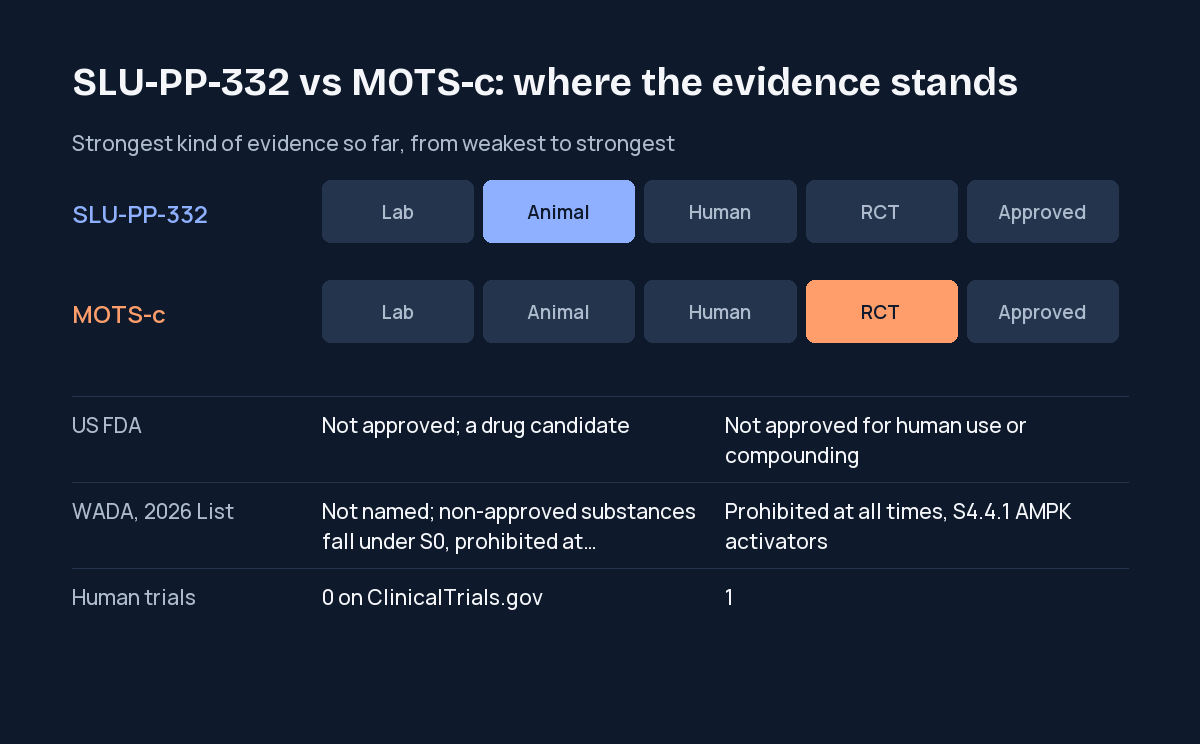
SLU-PP-332 is a lab-made “exercise mimetic” that made mice run about 70% longer (Billon 2023); MOTS-c is a natural mitochondrial peptide that improved running in young and old mice (Reynolds 2021). Neither is FDA-approved. MOTS-c has one registered human trial, of an analog, and none of MOTS-c itself; SLU-PP-332 has none, so its evidence is mouse-only.
| Item | SLU-PP-332 | MOTS-c |
|---|---|---|
| US FDA | Not approved; a drug candidate (Möller 2026) | Not approved for human use or compounding (USADA) |
| Compounding | Not on FDA’s Category 2 page; not reviewed by the advisory committee (FDA) | Withdrawn from Category 2; PCAC reviewed it on 2026-07-23 for 503A listing (obesity, osteoporosis); FDA has posted no vote record, any vote is advisory, no FDA rule yet (FDA) |
| WADA, 2026 List | Not named; non-approved substances fall under S0, prohibited at all times (USADA) | Prohibited at all times, S4.4.1 AMPK activators |
| WADA, 2027 List (from 2027-01-01) | Named under S4 metabolic modulators (USADA) | No change reported by USADA |
| Strongest evidence | Animal (mice) | Human RCT of an analog, CB4211 (n=20), company-reported |
| Human trials | 0 on ClinicalTrials.gov (searched 2026-10-18) | 1: NCT03998514 (the analog CB4211, completed, no results posted); no registered trial of MOTS-c itself |
| Last checked | 2026-10-18 | 2026-10-18 |
Key points:
- SLU-PP-332 is not a peptide: it is a synthetic compound designed to switch on estrogen-related receptors (ERRs), a family of gene switches for energy metabolism (Billon 2023).
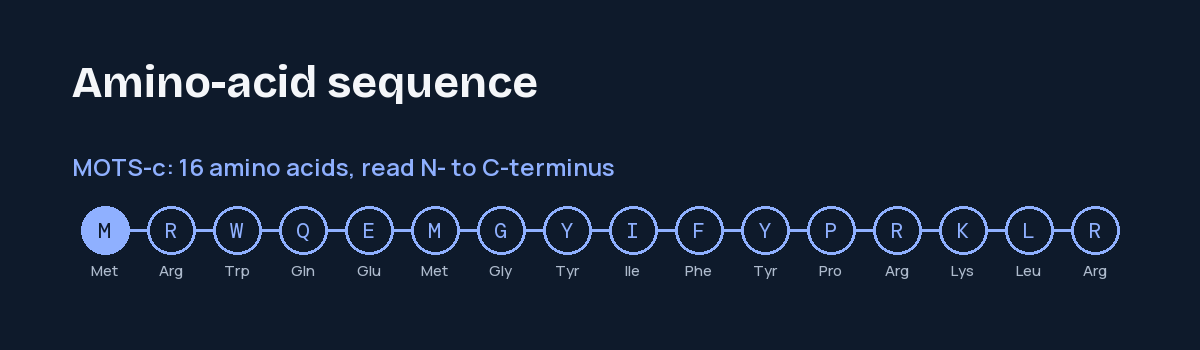
- MOTS-c is a 16-amino-acid peptide encoded in mitochondrial DNA (Lee 2015).
- The only human efficacy figures come from a MOTS-c analog: 20 people, four weeks, reported by the sponsor and not peer-reviewed (CohBar 2021).
- Anti-doping labs have already published detection work for SLU-PP-332 (Avliyakulov 2026).
- No study of the two together was found on PubMed or ClinicalTrials.gov (searched 2026-10-18).
MOTS-c vs SLU-PP-332 at a glance
| Feature | SLU-PP-332 | MOTS-c |
|---|---|---|
| What it is | Synthetic small molecule | Natural 16-amino-acid peptide |
| Class | Pan-ERR agonist (“exercise mimetic”) | Mitochondrial-derived peptide |
| Main target | ERRα, β and γ; strongest at ERRα | AMPK activation via folate and purine metabolism |
| Research focus | Endurance, obesity, heart failure, kidney ageing | Insulin resistance, obesity, age-related physical decline |
| Human evidence | None registered | 1 trial, of an analog |
| FDA | Not approved | Not approved |
| WADA | S0 now; named in S4 from 2027 | S4.4.1, prohibited at all times |
| Routes studied | Injection into the abdomen (mice); not orally available | Injection (mice); under-the-skin injection (analog trial) |
| Timelines in studies | 7 days (mouse endurance); 28 days (mouse fat mass) | 2 weeks (mouse running); 4 weeks (analog, humans) |
| Main safety concern | No human safety data at all | Injection-site reactions (analog); long-term data absent |
What is SLU-PP-332?
SLU-PP-332 is a synthetic compound that activates all three estrogen-related receptors, with the highest potency at ERRα (EC50 98 nM, versus 230 nM at ERRβ and 430 nM at ERRγ) (Billon 2023). Despite the name, ERRs are “orphan” receptors rather than estrogen receptors (Billon 2024); switching them on activates genes for fatty acid metabolism and mitochondrial function. It was built by structure-based drug design (Xu 2024). Its developers report that it lacks oral bioavailability and have moved to an oral successor, SLU-PP-915 (Billon 2026). It remains a drug candidate with no human trial registered.
What is MOTS-c?
MOTS-c (mitochondrial open reading frame of the 12S rRNA-c) is a 16-amino-acid peptide encoded inside mitochondrial DNA. Its main target appears to be skeletal muscle, where it activates AMPK, the cell’s energy sensor (Lee 2015). The body makes it naturally: in 10 sedentary young men, a bout of exercise raised muscle MOTS-c 11.9-fold [Human observational, n=10] (Reynolds 2021). It is set against another metabolic compound in our MOTS-c vs 5-Amino-1MQ comparison, and against other mitochondrial options in MOTS-c vs SS-31 vs NAD+.
How they work differently
- SLU-PP-332: binds nuclear receptors and turns on an “acute aerobic exercise” gene program; ERRα activation was needed for the endurance effect in mice [Animal] (Billon 2023).
- MOTS-c: acts on the cell’s metabolism rather than on a receptor: it inhibits the folate pathway and purine synthesis, which leads to AMPK activation [Lab and Animal] (Lee 2015).
- SLU-PP-332: in the heart, ERRγ was the main mediator of its protective effect [Animal] (Xu 2024).
- MOTS-c: regulates nuclear genes related to metabolism and protein maintenance and helps muscle cells adapt to metabolic stress [Lab and Animal] (Reynolds 2021).
Both are called exercise mimetics, but they pull different levers: one is a receptor switch for oxidative genes, the other an energy-sensing signal that exercise itself raises.
Evidence head-to-head: SLU-PP-332 vs MOTS-c benefits
Each cell gives the best result found for that outcome and its evidence level. Figures come from different studies, species and designs, so every comparison across columns is cross-trial and indicative only.
| Outcome | SLU-PP-332 best evidence | MOTS-c best evidence |
|---|---|---|
| Endurance | Animal: mice ran ~70% longer and ~45% further (n=6/group) (Billon 2023) | Animal: old mice ran 2-fold longer, 2.16-fold farther (Reynolds 2021) |
| Body weight / fat | Animal: obese mice ~12% lighter at 28 days, lean mass kept (n=7/group) (Billon 2024) | Animal: prevented diet-induced obesity (Lee 2015); Human RCT, analog (n=20): only a trend (CohBar) |
| Blood sugar / insulin | Animal: better glucose tolerance in obese mice (Billon 2024) | Human RCT, analog (n=20): fasting glucose −6% vs 0% placebo, p<0.05 (CohBar) |
| Liver | Animal: less fatty liver (Billon 2024) | Human RCT, analog (n=20): ALT −21% vs +4% placebo, p<0.05 (CohBar) |
| Heart | Animal: better ejection fraction and survival in heart failure (Xu 2024) | No trial found |
| Ageing | Animal: reversed kidney ageing markers in 21-month-old mice (Wang 2023) | Animal: late-life treatment raised physical capacity and healthspan (Reynolds 2021) |
The SLU-PP-332 results are encouraging for an early compound. In diet-induced obese mice it raised energy expenditure and fat burning while lean mass stayed the same, and in leptin-deficient obese mice it cut fat mass with food intake unaltered (Billon 2024).
MOTS-c’s most notable result is its age range: it improved physical performance in young, middle-aged and old mice (Reynolds 2021). The human numbers for MOTS-c come from CB4211, which its sponsor describes as “a novel and improved analog of MOTS-c”, not from MOTS-c itself; 88 people enrolled in that phase 1a/1b trial, and ClinicalTrials.gov shows no posted results (NCT03998514).
Which is better for which goal?
Neither has been shown to be better; they have evidence in different places.
- SLU-PP-332 has more evidence for endurance and heart function in mice. Its endurance study measured running directly, and it is the only one of the two with a heart-failure study (Xu 2024). All of it is Animal evidence.
- MOTS-c has more evidence for blood sugar and liver markers, because its family is the only one with human trial data: the analog lowered ALT and fasting glucose versus placebo in a 20-person study (CohBar).
- For weight loss, both rest on mouse data or a body-weight trend. Approved and late-stage incretin drugs have phase 3 human results, set out in our weight-loss peptides ranked by evidence and our retatrutide vs CagriSema trial and FDA timeline.
Whether either suits a particular person is a question for a clinician to decide.
Can SLU-PP-332 and MOTS-c be taken together?
The two are often discussed online as a pair of exercise mimetics, but the combination has not been tested. No controlled human study of the combination was found on PubMed or ClinicalTrials.gov (searched 2026-10-18); a Europe PMC search for both names returned two review articles and no experimental study. Because SLU-PP-332 has no human safety data on its own, there is no basis for judging how the two would interact.
Safety and regulatory status
Side effects and unknowns
- SLU-PP-332: no human study was found on ClinicalTrials.gov or PubMed (searched 2026-10-18), so there are no human safety data. In mice, its developers saw “no overt toxicity” over 10 days, with normal blood counts (Billon 2023). In a second mouse study, one experiment was cut from 28 to 12 days because of injection tolerance (Billon 2024). Doping-control chemists describe the available data on its metabolism as “limited” (Möller 2026).
- MOTS-c analog CB4211: no serious adverse events in the sponsor’s report; injection-site reactions in 79% of CB4211 recipients versus 33% on placebo [Human RCT, n=20] (CohBar). No published human safety data for MOTS-c itself were found on Europe PMC, which indexes PubMed (searched 2026-10-18).
United States
Neither compound is FDA-approved. USADA states MOTS-c “is not approved by the Food and Drug Administration (FDA) for use in humans or in compounded medications” (USADA). MOTS-c was withdrawn from FDA’s Category 2 list of compounding substances that may present significant safety risks, and SLU-PP-332 does not appear on that page (content current 2026-04-22) (FDA). FDA’s Pharmacy Compounding Advisory Committee reviewed MOTS-c for obesity and osteoporosis on 2026-07-23; any vote it took is advisory, and FDA has posted no vote record, minutes or rule (FDA). What that vote does and does not change is explained in our guide to the FDA peptide compounding vote.
Sport (WADA)
MOTS-c is explicitly listed under S4.4.1, AMPK activators, per USADA, and USADA’s 2025 List advisory named it as an example of an AMPK activator (USADA 2025). SLU-PP-332 is not named on the 2026 List, but USADA describes substances “not approved for human use” as prohibited under S0 (USADA). From 2027-01-01, the 2027 List names SLU-PP-332 and SLU-PP-915 as “metabolic modulators acting on oxidative metabolism” (USADA 2027). Two 2026 papers already map its metabolites for doping-control testing (Avliyakulov 2026).
Anyone who suspects a side effect from SLU-PP-332, MOTS-c or any other drug or product can report it to the FDA through MedWatch.
How long do effects take in studies?
- SLU-PP-332: in leptin-deficient obese mice, fat burning rose within 2 hours of an injection, and diet-induced obese mice weighed about 12% less after 28 days (Billon 2024); endurance gains were measured after 7 days (Billon 2023) [Animal].
- MOTS-c: old mice ran farther after 2 weeks [Animal] (Reynolds 2021); the analog’s liver and glucose changes were measured at week 4 [Human RCT, n=20] (CohBar).
What users report
What follows are unverified self-reports from people who usually bought unregulated products, not evidence. People who post about SLU-PP-332 on Reddit, YouTube and biohacking boards most often describe more stamina during cardio and, less often, a small drop in body fat over several weeks; a common counterpoint is that they noticed nothing at all. Threads frequently argue over whether capsule products sold under the name can work at all, and product quality and authenticity are recurring worries. People who post about MOTS-c commonly describe better energy and exercise tolerance, sometimes while also using weight-loss drugs; complaints center on injection-site redness, fatigue or flushing, high cost and no noticeable effect. On both, debates often turn on whether the effects are real or a mix of placebo, diet and harder training, and athletes in these threads are frequently reminded that both are banned in sport.
Frequently asked questions
Which is better, SLU-PP-332 or MOTS-c?
Neither has been shown to be better in people: they have never been compared, and SLU-PP-332 has no human data. In mice, SLU-PP-332 extended running time by about 70% [Animal] (Billon 2023). MOTS-c’s family has the only human trial figures: its analog CB4211 lowered ALT 21% [Human RCT, n=20] (CohBar). These are cross-trial figures.
Can SLU-PP-332 and MOTS-c be used together?
No study answers this. No controlled human study of the combination was found on PubMed or ClinicalTrials.gov (searched 2026-10-18), and SLU-PP-332 has no registered human trial on its own (ClinicalTrials.gov). Both are also prohibited in sport: MOTS-c under WADA class S4.4.1, SLU-PP-332 as a non-approved substance.
How long does MOTS-c take to work?
In studies, effects appeared within weeks. Old mice ran about twice as long after two weeks of treatment [Animal] (Reynolds 2021), and the analog CB4211 changed liver enzymes and fasting glucose by week 4 in a 20-person trial. No trial of MOTS-c itself is registered on ClinicalTrials.gov, so there is no human timeline for it.
How long does SLU-PP-332 take to work?
Only mouse timelines exist. In obese mice, changes in fat burning and body weight appeared within hours to weeks [Animal] (Billon 2024). Endurance was tested after 7 days. No human timeline exists because no human trial is registered (searched 2026-10-18).
What are the potential benefits of SLU-PP-332?
In mice, SLU-PP-332 has shown several promising results: longer running, lower fat mass with lean mass kept, better glucose tolerance, improved heart function in heart failure (Xu 2024) and reversal of kidney-ageing markers. All are Animal findings; none has been tested in people, so they are not established human benefits.
References
- Billon C, Sitaula S, Banerjee S, et al. (2023). Synthetic ERRα/β/γ agonist induces an ERRα-dependent acute aerobic exercise response and enhances exercise capacity. ACS Chemical Biology. PubMed 36988910
- Billon C, Schoepke E, Avdagic A, et al. (2024). A synthetic ERR agonist alleviates metabolic syndrome. Journal of Pharmacology and Experimental Therapeutics. PubMed 37739806
- Xu W, Billon C, Li H, et al. (2024). Novel pan-ERR agonists ameliorate heart failure through enhancing cardiac fatty acid metabolism and mitochondrial function. Circulation. PubMed 37961903
- Wang XX, Myakala K, Libby AE, et al. (2023). Estrogen-related receptor agonism reverses mitochondrial dysfunction and inflammation in the aging kidney. American Journal of Pathology. PubMed 37717940
- Billon C, Appourchaux K, Côté I, Burris TP (2026). An orally active estrogen receptor-related receptor agonist, SLU-PP-915, enhances aerobic exercise capacity. Journal of Pharmacology and Experimental Therapeutics. PubMed 41421047
- Möller T, Krug O, Thevis M (2026). In vitro metabolism and analytical characterization of SLU-PP-332 and SLU-PP-915: novel pan-ERR agonists with doping potential. Rapid Communications in Mass Spectrometry. PubMed 41588687
- Avliyakulov NK, Sobolevsky T, Ahrens E (2026). Analysis and identification of in vitro metabolites of exercise mimetic SLU-PP-332 ERRα/β/γ agonist for doping-control purposes. Drug Testing and Analysis. PubMed 41688415
- Lee C, Zeng J, Drew BG, et al. (2015). The mitochondrial-derived peptide MOTS-c promotes metabolic homeostasis and reduces obesity and insulin resistance. Cell Metabolism. PubMed 25738459
- Reynolds JC, Lai RW, Woodhead JST, et al. (2021). MOTS-c is an exercise-induced mitochondrial-encoded regulator of age-dependent physical decline and muscle homeostasis. Nature Communications. PubMed 33473109
- CohBar, Inc. (2021-08-10). Press release: CB4211 phase 1a/1b topline results. Form 8-K, Exhibit 99.2. SEC
- CohBar, Inc. (2021-08-10). CB4211 phase 1b results presentation. Form 8-K, Exhibit 99.3. SEC
- ClinicalTrials.gov. NCT03998514: A phase 1a/1b study of CB4211 in healthy non-obese subjects and subjects with nonalcoholic fatty liver disease. ClinicalTrials.gov
- ClinicalTrials.gov. Search: SLU-PP-332 (searched 2026-10-18). ClinicalTrials.gov
- USADA. What is MOTS-c peptide? USADA
- USADA. Athlete advisory: what’s new on the 2025 WADA Prohibited List. USADA
- USADA. Athlete advisory: what’s new on the 2027 WADA Prohibited List. USADA
- USADA. #AskUSADA: What is a non-approved substance and why are they prohibited? USADA
- FDA. Certain bulk drug substances for use in compounding that may present significant safety risks (Category 2), content current 2026-04-22. FDA
- FDA. July 23–24, 2026 meeting of the Pharmacy Compounding Advisory Committee. FDA
Change log
2026-10-18: removed ClinicalTrials.gov record NCT07505745, whose sponsor posts example records; MOTS-c now has one registered trial, of the analog CB4211, and no registered trial of its own; reviewed by the editorial team.
2026-10-18: first published after review by the editorial team.