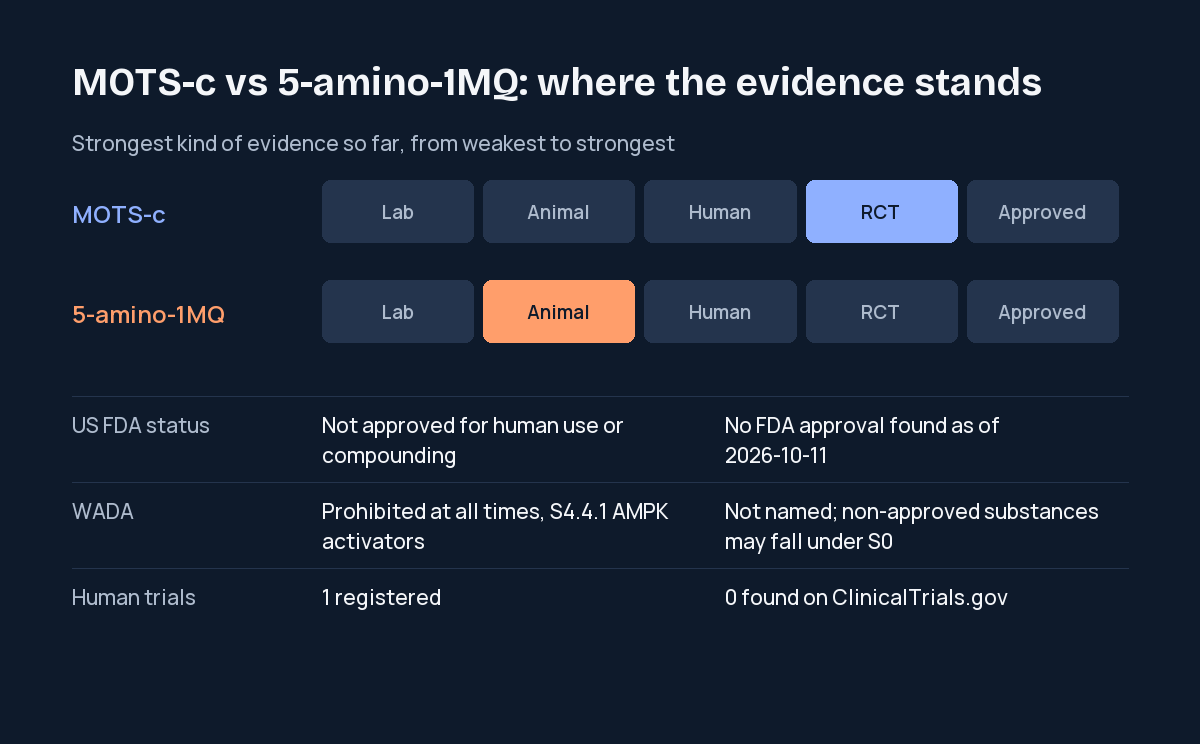
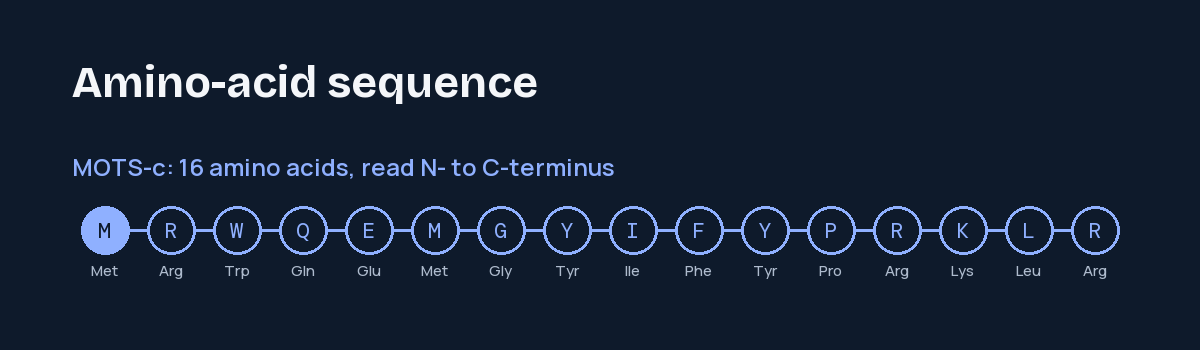
MOTS-c is a 16-amino-acid peptide encoded in mitochondrial DNA (Lee 2015); 5-amino-1MQ is a small-molecule NNMT inhibitor, not a peptide (Neelakantan 2018). Neither is FDA approved: USADA states MOTS-c is not (USADA), and no approval of 5-amino-1MQ was found (checked 2026-10-11). MOTS-c has more human evidence: a completed trial of its analog CB4211 (NCT03998514); no trial of MOTS-c itself is registered. 5-amino-1MQ has mouse and cell data only.
Both are promoted for fat loss, and both have encouraging results in obese mice. The difference is how far each has moved toward people: an analog of MOTS-c has been tested in a small placebo-controlled human trial, while no human study of 5-amino-1MQ was found on ClinicalTrials.gov or PubMed (searched 2026-10-11). MOTS-c is banned in sport by name, 5-amino-1MQ may fall under WADA’s catch-all for unapproved substances, and neither has published human safety data for the compound itself.
| Item | MOTS-c | 5-amino-1MQ |
|---|---|---|
| US FDA status | Not approved for human use or compounding (USADA) | No FDA approval found as of 2026-10-11 |
| Compounding (503A/503B) | Withdrawn from Category 2 (FDA); PCAC reviewed it for obesity and osteoporosis on 2026-07-23; FDA has posted no vote result (FDA meeting); advisory, no FDA rule yet | Not named on FDA’s Category 2 page (checked 2026-10-11); no PCAC review |
| WADA 2026 | Prohibited at all times, S4.4.1 AMPK activators (USADA) | Not named; non-approved substances may fall under S0 (USADA) |
| Strongest evidence | Human RCT of analog CB4211 (n=23, 4 weeks) | Animal (mice) |
| Human trials | 1 registered: NCT03998514 (the analog CB4211, completed, no results posted); no registered trial of MOTS-c itself | 0 found on ClinicalTrials.gov (searched 2026-10-11) |
| Last checked | 2026-10-18 | 2026-10-11 |
What changed (October 2026): FDA’s own pre-meeting review of MOTS-c is now summarized, a 2026 review of injury and performance peptides is added, and the sport section covers the 2027 WADA List.
Key points:
- In its sponsor’s phase 1b trial, the MOTS-c analog CB4211 lowered the liver enzyme ALT by 21% over 4 weeks, versus a 4% change on placebo (CohBar 10-K) [Human RCT, n=23].
- Injection-site reactions were the main side effect of CB4211: 79% versus 33% on placebo (CohBar 2021).
- In obese mice, the higher of two 5-amino-1MQ doses cut 28-day weight gain from 5.4 g to 0.9 g, while the lower dose barely changed it (5.2 g) (Babula 2024) [Animal].
- They act on cell energy from different ends: MOTS-c activates the fuel sensor AMPK (Lee 2015), while 5-amino-1MQ blocks NNMT, an enzyme that methylates nicotinamide, a precursor of NAD+ (Kraus 2014) [Lab/Animal].
- No study of the two together was found on PubMed or ClinicalTrials.gov (searched 2026-10-11).
MOTS-c vs 5-amino-1MQ at a glance
| Feature | MOTS-c | 5-amino-1MQ |
|---|---|---|
| What it is | 16-amino-acid peptide made from mitochondrial DNA | Synthetic methylquinolinium small molecule |
| Class | Mitochondrial-derived peptide | NNMT inhibitor (not a peptide) |
| Mechanism | Inhibits the folate cycle, which activates AMPK (Lee 2015) | Blocks NNMT; raises NAD+ and SAM in fat cells (Neelakantan 2018) |
| Main research focus | Insulin resistance, obesity, physical decline with age | Diet-induced obesity, fatty liver, aged muscle |
| Human evidence | 1 completed analog trial; none of MOTS-c itself | None found (searched 2026-10-11) |
| Approval status | Not FDA approved | No FDA approval found |
| WADA | Prohibited, S4.4.1 | Not named; may fall under S0 |
| Routes studied | Injection in mice; injection in the analog trial (CB4211) | Injection in mice |
| Study lengths | 4 weeks (CB4211) | 28 days to 8 weeks (mice) |
| Main safety concerns | Injection-site reactions (analog); no published human safety data for native MOTS-c | No human safety data found |
What is MOTS-c?
MOTS-c (mitochondrial open reading frame of the 12S rRNA-c) is a 16-amino-acid peptide coded by the DNA inside mitochondria, the cell’s energy-producing structures. Its discoverers reported that its main target appears to be skeletal muscle and that treating mice with it prevented diet-induced obesity and insulin resistance (Lee 2015) [Animal]. The body makes it naturally: in 10 young men, one cycling session raised muscle MOTS-c 11.9-fold and blood levels 1.6-fold (Reynolds 2021) [Human observational, n=10]. That shows exercise raises the body’s own MOTS-c. It does not show that injected MOTS-c does anything in people. For how it compares with other mitochondrial compounds, see MOTS-c vs SS-31 vs NAD+.
What is 5-amino-1MQ?
5-amino-1MQ (5-amino-1-methylquinolinium) is a lab-made small molecule from a series of methylquinolinium compounds designed to block nicotinamide N-methyltransferase (NNMT) (Neelakantan 2018). NNMT adds a methyl group to nicotinamide, a form of vitamin B3 and a building block of NAD+. Although it is often sold alongside peptides, it is not a peptide. Interest in it comes from mouse studies: knocking down NNMT in fat and liver protected mice from diet-induced obesity by raising energy expenditure (Kraus 2014) [Animal]. Every published result for the compound found on PubMed (searched 2026-10-11) comes from cells or mice, most of it from one research group led by Neelakantan and Watowich.
How they work differently
- MOTS-c: blocks the folate cycle and the purine production tied to it, which switches on AMPK, the cell’s fuel sensor (Lee 2015) [Lab/Animal]. WADA lists it as an AMPK activator (USADA).
5-amino-1MQ: blocks NNMT. In fat cells, NNMT inhibitors lowered the enzyme’s product 1-MNA, raised NAD+ and SAM (the body’s main methyl donor) and suppressed fat building (Neelakantan 2018) [Lab]. - MOTS-c: acts mainly on skeletal muscle in mice (Lee 2015).
5-amino-1MQ: studied mainly in fat tissue and liver, and later in aged muscle (Dimet-Wiley 2024) [Animal]. - MOTS-c: a peptide the body makes itself, with levels that rise during exercise (Reynolds 2021).
5-amino-1MQ: a synthetic compound; the series was selective in lab tests, not blocking related methyltransferases or NAD+ salvage enzymes (Neelakantan 2018) [Lab].
The NAD+ link is why the two are often mentioned together with NAD+ supplements. That link is a lab and mouse finding for 5-amino-1MQ, and NAD+ is not part of the mechanism Lee 2015 describes for MOTS-c.
Evidence head-to-head
Each cell gives the best study found for that outcome. The figures come from different studies, species and designs, so they are cross-study numbers and cannot be compared directly.
| Outcome | MOTS-c best evidence | 5-amino-1MQ best evidence |
|---|---|---|
| Body weight and fat | Analog CB4211: “trend” to lower weight over 4 weeks, no figure given (CohBar 8-K) [Human RCT, n=23] | High dose: fat-mass gain 1.3 g vs 4.7 g on vehicle over 28 days; low dose no different from vehicle (Babula 2024) [Animal, n=8/group] |
| Blood sugar and insulin | Analog CB4211: fasting glucose −6% vs 0% on placebo (CohBar 10-K) [Human RCT, n=20 completers] | Better oral glucose tolerance and insulin sensitivity (Babula 2024) [Animal] |
| Liver | Analog CB4211: ALT −21% vs 4%; AST −28% vs −11% (CohBar 10-K) [Human RCT] | Less fatty liver; liver weight 1.4 g vs 2.1 g (Babula 2024) [Animal] |
| Muscle and physical function | Late-life treatment raised physical capacity in old mice (Reynolds 2021) [Animal] | ~40% greater grip strength in aged sedentary mice (Dimet-Wiley 2024) [Animal, n=35] |
| Fat loss with diet change | No study found | Fat mass −29.3% vs −2.9% with lean diet alone (Sampson 2021) [Animal, n=6–8/group] |
| Human safety | Analog: no serious adverse events; injection-site reactions 79% vs 33% (CohBar 2021) | No human data found (searched 2026-10-11) |
Two cautions apply to the MOTS-c column. CB4211 is described by its developer as “a novel and improved analog of MOTS-c”, not MOTS-c itself (CohBar 10-K), and its phase 1b results come from company filings; no results are posted on ClinicalTrials.gov and no journal paper was found. No trial of MOTS-c itself is registered on ClinicalTrials.gov.
Which fits which goal?
MOTS-c’s analog CB4211 has the only human data here, on liver markers and fasting glucose. Its analog lowered ALT, AST and fasting glucose over 4 weeks in obese adults with fatty liver disease (CohBar 10-K) [Human RCT, n=23]. The reason is that it is the only one of the two that has reached human testing.
5-amino-1MQ has more measured evidence for fat-mass change and aged-muscle strength, but only in mice. Its studies report concrete fat-mass and grip-strength figures (Babula 2024; Dimet-Wiley 2024) [Animal], while the human CB4211 data showed only a weight “trend”. Until a human study is run, these are research leads, not demonstrated effects in people.
Peptide-based weight-loss drugs that have been tested in large human trials are compared in retatrutide vs tirzepatide vs semaglutide. Whether any of these options is appropriate for a given person is a decision for a clinician.
Can MOTS-c and 5-amino-1MQ be stacked?
The pairing, often with NAD+ added, is widely promoted as a “metabolic stack” on the reasoning that the two act on different pathways. That reasoning has not been tested. No controlled human study of the combination was found on PubMed or ClinicalTrials.gov (searched 2026-10-11), and no animal study combining them was found on PubMed either. The only tested combinations are 5-amino-1MQ with a diet change (Sampson 2021) and with exercise (Dimet-Wiley 2024), both in mice. Combining two compounds without human safety data adds unknowns rather than removing them. The broader safety picture is in Are peptides safe?
Safety and regulatory status
Side effects. For MOTS-c, the only human safety data come from the analog CB4211: no serious adverse events, but injection-site reactions in 79% of treated subjects versus 33% on placebo (CohBar 2021), described in phase 1a as “painless bumps at the injection site” (CohBar 10-K). USADA states there are no completed human clinical trials of MOTS-c (USADA). A 2026 narrative review of peptides used for injuries and athletic performance, MOTS-c among them, found favorable results in animals but scarce human safety data and a potential for serious harm [Narrative review] (Mendias and Awan 2026). For the methylquinolinium NNMT inhibitors that include 5-amino-1MQ, a mouse study reported no observable adverse effects and no change in food intake (Neelakantan 2018) [Animal], but no human study of 5-amino-1MQ was found, so its side effects, drug interactions and long-term effects in people are unknown.
Marketing. USADA notes MOTS-c is marketed by clinics and on social media as a weight-loss peptide “even though it is an experimental peptide not approved for human therapeutic use” (USADA 2025). Neither compound has an FDA-approved product, so there is no approved standard to compare what is sold against.
| Jurisdiction | MOTS-c | 5-amino-1MQ |
|---|---|---|
| FDA approval | None | None found (2026-10-11) |
| US compounding | Withdrawn from Category 2; PCAC reviewed 2026-07-23, no vote result posted by FDA, advisory, no rule (FDA) | Not named on Category 2 page (FDA) |
| Sport (WADA) | Prohibited at all times, S4.4.1 | Not named; S0 may apply (USADA) |
On compounding: FDA’s committee reviewed MOTS-c on 2026-07-23 for obesity and osteoporosis. Before the meeting, FDA’s own staff review proposed not adding MOTS-c to the 503A list: its reviewers found no clinical study in which MOTS-c had been given to people, and they raised concerns about immune reactions and impurities (FDA briefing document, review memo dated 2026-05-11). Trade reports of the committee’s vote give different counts. FDA has posted no minutes or vote result, and any committee vote is advisory until FDA completes rulemaking. What the vote does and does not change is covered in FDA peptide compounding vote. For athletes, S0 covers substances “not approved by any government regulatory authority” for human use, which is how a compound not named on the list, such as 5-amino-1MQ, can still be prohibited; USADA can confirm the status of a specific substance. On the 2027 List, in force from 2027-01-01, S0 also names “peptides” in general (USADA athlete advisory). 5-amino-1MQ is not a peptide, so that new wording does not change its position.
How long do effects take in studies?
- MOTS-c analog (CB4211): liver-enzyme and glucose changes were reported at week 4 (CohBar 2021) [Human RCT].
- 5-amino-1MQ: weight and fat-mass differences in obese mice over 28 days (Babula 2024); grip-strength gains in aged mice over 8 weeks (Dimet-Wiley 2024) [Animal]. No human timeline has been reported.
What users report
What follows are unverified self-reports from people who usually bought unregulated products, not evidence. People who post about MOTS-c commonly describe more energy during workouts, better endurance and, less often, easier fat loss, usually saying it took several weeks to notice anything. People posting about 5-amino-1MQ mostly describe reduced appetite or modest fat loss alongside diet changes; a large share say they noticed nothing at all. Many posts describe using the two together, often with NAD+, which makes it impossible to tell which compound, if any, caused a change. Recurring complaints include injection-site redness or bumps with MOTS-c, headaches, poor sleep and stomach upset with 5-amino-1MQ, and high cost for both. Product quality is a frequent worry, with arguments about purity and whether products contain what the label says. Another common debate is whether either compound adds anything beyond the diet and training changes people usually make at the same time.
Frequently asked questions
Is 5-amino-1MQ a peptide?
No. 5-amino-1MQ is a small synthetic molecule from the methylquinolinium family, designed to block the enzyme NNMT, whereas MOTS-c is a chain of 16 amino acids. It is often sold and discussed alongside peptides, but chemically it belongs with small-molecule drug candidates (Neelakantan 2018).
Is 5-amino-1MQ good for you?
That is unknown, because no human study has been found (PubMed and ClinicalTrials.gov, searched 2026-10-11). In obese mice it limited weight and fat gain and improved glucose tolerance over 28 days (Babula 2024) [Animal]. Its safety, side effects and interactions in people have not been measured.
How long before MOTS-c starts working?
No human study of MOTS-c itself has reported a timeline yet. Its analog CB4211 lowered liver enzymes and fasting glucose by week 4 in obese adults with fatty liver (CohBar 2021) [Human RCT, n=23]. No trial of MOTS-c itself is registered on ClinicalTrials.gov.
Is it safe to take MOTS-c every day?
As of 2026-10-27, there is no published human safety data for daily MOTS-c, and no trial of MOTS-c itself is registered on ClinicalTrials.gov. FDA’s own 2026 review found no clinical study in which MOTS-c was given to people and raised concerns about immune reactions and impurities (FDA briefing document). The closest data are from the analog CB4211, where injection-site reactions were common.
Can MOTS-c, 5-amino-1MQ and NAD+ be combined?
The three are often promoted as a stack, but no study of MOTS-c with 5-amino-1MQ, with or without NAD+, was found on PubMed or ClinicalTrials.gov (searched 2026-10-11). The NAD+ link comes from lab work in which NNMT inhibitors raised NAD+ in fat cells (Neelakantan 2018) [Lab]. Any benefit or risk of the combination is untested.
References
- Lee C, Zeng J, Drew BG, et al. 2015. The mitochondrial-derived peptide MOTS-c promotes metabolic homeostasis and reduces obesity and insulin resistance. Cell Metabolism 21(3):443-454. PubMed 25738459
- Reynolds JC, Lai RW, Woodhead JST, et al. 2021. MOTS-c is an exercise-induced mitochondrial-encoded regulator of age-dependent physical decline and muscle homeostasis. Nature Communications. PubMed 33473109
- Neelakantan H, Vance V, Wetzel MD, et al. 2018. Selective and membrane-permeable small molecule inhibitors of nicotinamide N-methyltransferase reverse high fat diet-induced obesity in mice. Biochemical Pharmacology 147:141-152. PubMed 29155147
- Babula JJ, Bui D, Stevenson HL, Watowich SJ, Neelakantan H. 2024. Nicotinamide N-methyltransferase inhibition mitigates obesity-related metabolic dysfunction. Diabetes, Obesity and Metabolism 26(11):5272-5282. PubMed 39161060
- Sampson CM, Dimet AL, Neelakantan H, et al. 2021. Combined nicotinamide N-methyltransferase inhibition and reduced-calorie diet normalizes body composition and enhances metabolic benefits in obese mice. Scientific Reports 11:5637. PubMed 33707534
- Dimet-Wiley AL, Latham CM, Brightwell CR, et al. 2024. Nicotinamide N-methyltransferase inhibition mimics and boosts exercise-mediated improvements in muscle function in aged mice. Scientific Reports 14:15554. PubMed 38969654
- Kraus D, Yang Q, Kong D, et al. 2014. Nicotinamide N-methyltransferase knockdown protects against diet-induced obesity. Nature. PubMed 24717514
- CohBar, Inc. 2022. Form 10-K for fiscal year 2021. US Securities and Exchange Commission. sec.gov
- CohBar, Inc. 2021. Form 8-K, Exhibit 99.1 (press release, 2021-08-10). US Securities and Exchange Commission. sec.gov
- CohBar, Inc. 2021. Form 8-K, Exhibit 99.3 (CB4211 phase 1a/1b presentation, 2021-08-10). US Securities and Exchange Commission. sec.gov
- CohBar, Inc. A Phase 1a/1b Study of Safety, Tolerability, and Pharmacokinetics of CB4211. ClinicalTrials.gov NCT03998514. ClinicalTrials.gov
- ClinicalTrials.gov. Search: intervention “5-amino-1MQ” (0 studies, searched 2026-10-11). ClinicalTrials.gov
- USADA. What is MOTS-c peptide? usada.org
- USADA. Athlete advisory: what’s new on the 2025 WADA Prohibited List. usada.org
- USADA. #AskUSADA: What is a non-approved substance and why are they prohibited? usada.org
- US FDA. Certain bulk drug substances for use in compounding that may present significant safety risks (content current as of 2026-04-22). fda.gov
- US FDA. July 23–24, 2026 meeting of the Pharmacy Compounding Advisory Committee. fda.gov
- US FDA. FDA briefing document: MOTS-c, Pharmacy Compounding Advisory Committee, July 23–24, 2026 (review memo 2026-05-11). fda.gov
- Mendias CL, Awan TM (2026). Safety and efficacy of approved and unapproved peptide therapies for musculoskeletal injuries and athletic performance. Sports Med. doi:10.1007/s40279-026-02437-0
- USADA. Athlete advisory: 2027 Prohibited List (2026-10-06). usada.org
Change log
2026-10-27: FDA’s pre-meeting review of MOTS-c summarized; 2026 narrative review added; 2027 WADA List added; reviewed by the editorial team.
2026-10-19: links to related entries added; no change to the facts.
2026-10-18: removed ClinicalTrials.gov record NCT07505745 (MOTS-MET), whose sponsor posts example records; MOTS-c now has no registered trial of its own, only the completed trial of its analog CB4211; reviewed by the editorial team.
2026-10-13: links corrected (a link inside a citation or on a generic word removed); no change to the facts.
2026-10-12: links to related entries added; no change to the facts.
2026-10-11: first published after review by the editorial team.