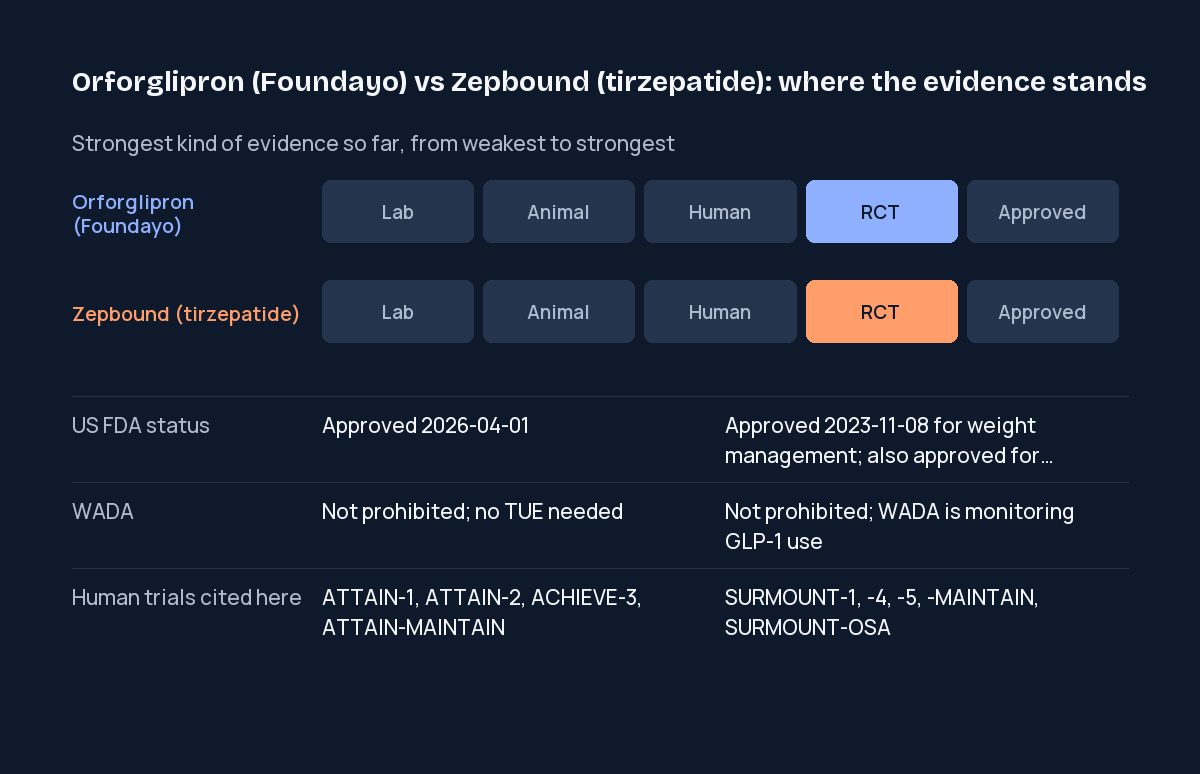
Orforglipron (Foundayo) is a once-daily GLP-1 pill, FDA-approved for weight management on April 1, 2026. Zepbound (tirzepatide) is a once-weekly GIP/GLP-1 injection approved in 2023. Both rest on phase 3 RCTs, and no head-to-head trial was found on ClinicalTrials.gov (searched 2026-10-07). In separate 72-week trials, Zepbound’s top dose produced about 21% weight loss and orforglipron’s about 11%.
The pill’s strengths are convenience and a role after injections. In a 52-week randomized trial, people who switched from Zepbound to orforglipron kept about three-quarters of the weight they had lost. Zepbound has the larger weight-loss effect and a second approved use, obstructive sleep apnea. Both labels carry a boxed warning for thyroid C-cell tumors, and both drugs mainly cause stomach and gut side effects.
| Item | Orforglipron (Foundayo) | Zepbound (tirzepatide) |
|---|---|---|
| US FDA status | Approved 2026-04-01: weight reduction and long-term maintenance in adults with obesity, or overweight plus a weight-related condition (label) | Approved 2023-11-08 for weight management; also approved for moderate to severe sleep apnea with obesity (label) |
| Compounding | Not named on FDA’s unapproved GLP-1 page (checked 2026-10-06) | FDA declared the shortage resolved on 2024-12-19, and the compounding grace periods ended in 2025 (FDA). FDA proposed excluding it from the 503B list on 2026-04-30; no final decision found as of 2026-10-06 |
| WADA 2026 | Not prohibited; no TUE needed (USADA) | Not prohibited; WADA is monitoring GLP-1 use (USADA) |
| Strongest evidence | Human RCT, phase 3 (n=3,127, 72 weeks) | Human RCT, phase 3 (n=2,539, 72 weeks), plus a head-to-head win over semaglutide |
| Human trials cited here | ATTAIN-1, ATTAIN-2, ACHIEVE-2 (NCT06192108), ACHIEVE-3, ATTAIN-MAINTAIN (NCT06584916) | SURMOUNT-1, -4, -5, -MAINTAIN, SURMOUNT-OSA (NCT05412004) |
| Next regulatory step | US type 2 diabetes application submitted; no decision date announced (Lilly, 2026-08-05) | None announced in Lilly’s Q2 2026 results |
| Head-to-head trial | None found on ClinicalTrials.gov (searched 2026-10-06) | Same search: none found |
| Last checked | 2026-10-24 | 2026-10-06 |
Key points:
- Orforglipron is a small molecule, not a peptide, and is taken as a tablet. Tirzepatide is a peptide injected under the skin once a week (ATTAIN-1).
- In the obesity trials, more people stopped because of side effects on orforglipron (5.3–10.3% vs 2.7% on placebo) than on tirzepatide (4.3–7.1% vs 2.6%). These are cross-trial figures (SURMOUNT-1).
- When people switched from Zepbound to orforglipron, they regained 5.0 kg on average over a year. In a separate trial (SURMOUNT-MAINTAIN, Human RCT, n=441), people who stayed on their full Zepbound dose kept all of their prior loss (Lilly, 2026).
- The two labels give different contraceptive advice. Foundayo’s label says to use a non-oral or backup method for 30 days after starting and after each dose increase; Zepbound’s says 4 weeks.
- Price and insurance coverage change often, and this page does not compare them. Our peptide therapy cost explainer covers why approved and compounded products are priced differently.
Orforglipron vs Zepbound at a glance
| Feature | Orforglipron | Zepbound |
|---|---|---|
| Brand | Foundayo | Zepbound (also sold as Mounjaro for diabetes) |
| Class | Small-molecule (non-peptide) GLP-1 receptor agonist | Peptide that acts on two receptors, GIP and GLP-1 |
| Receptors | GLP-1 only | GIP + GLP-1 |
| Route | Tablet, once daily | Injection under the skin, once weekly |
| Weight loss, 72 wk, no diabetes | −11.2% top dose vs −2.1% placebo (Human RCT, n=3,127) | −20.9% top dose vs −3.1% placebo (Human RCT, n=2,539) |
| Weight loss with type 2 diabetes | −9.6% vs −2.5% (Human RCT, n=1,613) | Not covered on this page |
| Maintenance data | Switch trial after injections (Human RCT, n=376) | Withdrawal trial (n=670) and dose-reduction trial (n=441) |
| Approved uses (US) | Weight management | Weight management; sleep apnea with obesity |
| Head-to-head trial vs semaglutide | Yes, oral semaglutide in type 2 diabetes (ACHIEVE-3) | Yes, injected semaglutide in obesity (SURMOUNT-5) |
| WADA | Not prohibited | Not prohibited; monitored |
| Boxed warning | Thyroid C-cell tumors (class warning) | Thyroid C-cell tumors (rat finding) |
| Main side effects | Nausea, constipation, diarrhea, vomiting | Nausea, diarrhea, vomiting, constipation, injection-site reactions |
What is orforglipron?
Orforglipron is a once-daily tablet that activates the GLP-1 receptor, the target of the gut hormone that reduces appetite. Unlike semaglutide and tirzepatide, it is a small molecule rather than a peptide (Wharton 2025). The FDA approved it as Foundayo on April 1, 2026, 50 days after filing. It was the first new molecular entity approved under the agency’s National Priority Voucher program. The approved use is weight reduction and long-term maintenance in adults with obesity, or with overweight plus at least one weight-related condition. The label does not recommend taking it together with another GLP-1 drug (Approved label).
What is Zepbound?
Zepbound is tirzepatide, a peptide injected under the skin once a week. It activates two gut-hormone receptors, GIP and GLP-1, and the FDA approved it for chronic weight management on November 8, 2023. The same molecule is sold as Mounjaro for type 2 diabetes (FDA). Its label now also covers moderate to severe obstructive sleep apnea in adults with obesity (Approved label). Our CagriSema vs Zepbound comparison sets Zepbound against an investigational injectable rival.
How they work differently
- Orforglipron: acts on the GLP-1 receptor alone (ATTAIN-1). Zepbound: acts on both the GIP and GLP-1 receptors (SURMOUNT-1).
- Orforglipron: taken by mouth as a once-daily tablet (Approved label). Zepbound: injected under the skin once a week (FDA).
- Orforglipron: it does not act on the rat or mouse GLP-1 receptor and produced no tumors in rodents [Animal]. Its label still carries the class thyroid warning because the human relevance is undetermined (Approved label). Zepbound: caused thyroid C-cell tumors in rats [Animal]; whether it does so in humans is unknown (Approved label).
For how a third receptor target changes the picture, see our retatrutide vs tirzepatide vs semaglutide comparison.
Orforglipron vs Zepbound weight loss: evidence head-to-head
All figures below come from separate trials, so they are cross-trial comparisons. Differences in the people enrolled and in the analysis methods limit how directly the numbers can be set side by side. We found no orforglipron-versus-tirzepatide trial registered on ClinicalTrials.gov (searched 2026-10-06).
| Outcome | Orforglipron best evidence | Zepbound best evidence |
|---|---|---|
| Weight, obesity without diabetes | Human RCT (n=3,127): −11.2% vs −2.1% at 72 wk (ATTAIN-1) | Human RCT (n=2,539): −20.9% vs −3.1% at 72 wk (SURMOUNT-1) |
| Lost 20% or more | 18.4% of top-dose group vs 2.8% placebo (ATTAIN-1) | 57% of top-dose group vs 3% placebo (SURMOUNT-1) |
| Weight with type 2 diabetes | Human RCT (n=1,613): −9.6% vs −2.5% (ATTAIN-2) | Not covered here |
| Against semaglutide | Human RCT (n=1,698): better HbA1c than oral semaglutide (ACHIEVE-3) | Human RCT (n=751): −20.2% vs −13.7% with injected semaglutide (SURMOUNT-5) |
| Keeping weight off | Human RCT (n=205, Zepbound cohort): among those who had reached a weight plateau, kept 74.7% of prior loss vs 49.2% placebo (ATTAIN-MAINTAIN) | Human RCT (n=670): −5.5% on tirzepatide vs +14.0% after stopping (SURMOUNT-4) |
| Sleep apnea | No approved use (label, July 2026) | Two phase 3 RCTs: AHI −25.3 and −29.3 events/hour vs −5.3 and −5.5 (SURMOUNT-OSA) |
| Stopped for side effects | 5.3–10.3% vs 2.7% placebo (ATTAIN-1) | 4.3–7.1% vs 2.6% placebo (SURMOUNT-1) |
The orforglipron results are encouraging for a pill. In ATTAIN-1, 54.6% of the top-dose group lost at least 10% of their body weight, compared with 12.9% on placebo. Waist size, blood pressure, triglycerides and non-HDL cholesterol also improved more than with placebo (Human RCT, n=3,127). Tirzepatide still holds the larger effect. In SURMOUNT-1, more than half of the top-dose group lost 20% or more (Human RCT, n=2,539). No single randomized trial has measured that gap directly.
Orforglipron for maintenance after Zepbound
This is the one question where the two drugs have been studied in sequence. ATTAIN-MAINTAIN enrolled people who had finished 72 weeks of Zepbound or Wegovy in SURMOUNT-5. It randomly assigned them to orforglipron or placebo for 52 weeks (Human RCT, n=376; Zepbound cohort n=205). In the Zepbound cohort, among people who had reached a weight plateau, those switched to orforglipron kept an estimated 74.7% of their earlier weight loss, compared with 49.2% of those switched to placebo. The difference was 25.5 percentage points (95% CI 14.5 to 36.5).
In weight terms, the Zepbound switchers averaged 90.9 kg when they switched and 95.9 kg a year later, a regain of 5.0 kg (Lilly, 2025). The authors note an important limit: the trial had no arm that stayed on the injection. Other trials fill part of that gap. In SURMOUNT-4, people who stayed on tirzepatide lost a further 5.5% while those switched to placebo regained 14.0% (Human RCT, n=670). In SURMOUNT-MAINTAIN, people who stayed on their maximum tolerated Zepbound dose kept all of their prior loss. A lower Zepbound dose kept all but 5.6 kg (Human RCT, n=441, Lilly, 2026). Taken together, switching to the pill kept more weight off than stopping, but less than staying on the injection. Those are cross-trial comparisons again.
Which fits which goal?
- Zepbound has more evidence for the largest weight loss. Its top dose produced −20.9% at 72 weeks (SURMOUNT-1). It also beat injected semaglutide head to head (SURMOUNT-5).
- Zepbound has more evidence for sleep apnea. It has two phase 3 trials and an approved indication (SURMOUNT-OSA). Foundayo’s label has no sleep apnea indication.
- Orforglipron has the evidence for a needle-free option. It is the one of the two taken by mouth, with −11.2% at 72 weeks in a phase 3 RCT (ATTAIN-1).
- Orforglipron has randomized data on switching from Zepbound to a pill to hold weight off (ATTAIN-MAINTAIN). Zepbound has the evidence that staying on the injection preserves the most weight.
These are statements about what has been studied, not a recommendation for either drug. Which one suits a particular person depends on their health history, other medicines and coverage. A clinician is the person to make that decision.
Can they be combined?
Foundayo’s label says that using it at the same time as another GLP-1 receptor agonist “is not recommended” (Approved label), and tirzepatide acts on the GLP-1 receptor. In the trials, the two drugs were given one after the other, never together. No controlled human study has tested taking them together; we found none registered on ClinicalTrials.gov (searched 2026-10-06).
Safety and regulatory status
Both drugs carry a boxed warning for thyroid C-cell tumors. Both are contraindicated in people with a personal or family history of medullary thyroid carcinoma or MEN 2. Their warning lists are almost the same: pancreatitis, severe gastrointestinal reactions, kidney injury from dehydration, gallbladder disease, low blood sugar, allergic reactions, diabetic eye complications, and aspiration during anesthesia (Foundayo label; Zepbound label).
| Issue | Orforglipron | Zepbound |
|---|---|---|
| Common (≥5%) per label | Nausea, constipation, diarrhea, vomiting, indigestion, abdominal pain, headache, bloating, fatigue, burping, reflux, gas, hair loss | Nausea, diarrhea, vomiting, constipation, abdominal pain, indigestion, injection-site reactions, fatigue, allergic reactions, burping, hair loss, reflux |
| Oral contraceptives | Non-oral or backup method for 30 days after start and each dose increase | Same advice, for 4 weeks |
| Other signals | Larger pulse rise than oral semaglutide (3.7–4.7 vs 1.0–1.5 bpm, Human RCT, n=1,698) | GI events mostly during dose escalation (Human RCT, n=2,539) |
| US | Prescription only; approved 2026 | Prescription only; approved 2023 |
| Sport | Not prohibited | Not prohibited; monitored |
In the head-to-head diabetes trial, gastrointestinal side effects were more common with orforglipron (58–59%) than with oral semaglutide (37–45%), and so was stopping because of side effects (9–10% vs 4–5%) (ACHIEVE-3). In ATTAIN-MAINTAIN, nausea was reported by 18.8% on orforglipron versus 4.1% on placebo (Lilly, 2026).
On the regulatory side, FDA says compounded GLP-1 products “do not undergo FDA’s review for safety, effectiveness and quality.” It also warns about products labeled “for research purposes” that are sold to consumers (FDA). USADA likewise warns that GLP-1 “pills, tablets” offered online may be unapproved products. A compounded or “research” product is not Foundayo or Zepbound. Our peptide safety overview explains why that difference matters.
How long do effects take in studies?
In both pivotal obesity trials, the main weight result was measured at 72 weeks. SURMOUNT-1 included a 20-week dose-escalation period, and its gastrointestinal side effects occurred mainly during that phase (SURMOUNT-1). In ATTAIN-2, orforglipron’s gastrointestinal events likewise occurred mostly during dose escalation (ATTAIN-2). The maintenance trials ran for 52 weeks after the switch. In SURMOUNT-4, stopping tirzepatide led to a 14.0% regain over that span (SURMOUNT-4).
What users report
These are unverified self-reports from public forums and social media, not evidence. Some posters describe compounded or unregulated products rather than the approved brands. People who post about switching from Zepbound to orforglipron often describe it as a way to stay on treatment without weekly injections. A recurring theme is some weight regain or returning appetite after the switch, which matches the direction of the ATTAIN-MAINTAIN results. Common complaints with both drugs are nausea, constipation, reflux and tiredness. With the pill, some posters say the side effects return at each dose step. With the injection, the extra complaints are injection-site reactions and the weekly routine. Many threads are about insurance coverage and out-of-pocket cost rather than results. Debates center on whether a daily pill is easier to keep up than a weekly shot, and on whether the smaller average weight loss on orforglipron is an acceptable trade for not injecting. Posters also argue about whether it makes sense to start on the pill at all or to use it only after reaching a goal on an injection.
Frequently asked questions
Is orforglipron the same as Zepbound?
No. Orforglipron (Foundayo) is a different molecule: a non-peptide tablet taken once a day that acts only on the GLP-1 receptor. Zepbound is tirzepatide, a peptide injected weekly that acts on both the GIP and GLP-1 receptors. Both are made by Lilly and both are FDA-approved for weight management. Only Zepbound is also approved for sleep apnea (Zepbound label).
Is orforglipron the same as tirzepatide?
No. Tirzepatide is the active ingredient in Zepbound and Mounjaro. Orforglipron is a separate small-molecule drug with one receptor target instead of two. Tirzepatide produced the larger weight loss in separate 72-week trials. That is a cross-trial comparison, not a head-to-head result (ATTAIN-1).
Can you switch from Zepbound to orforglipron?
That switch has been tested in a randomized trial. In ATTAIN-MAINTAIN, among people who had reached a weight plateau on Zepbound, those moved to orforglipron kept an estimated 74.7% of their prior weight loss over 52 weeks, compared with 49.2% of those moved to placebo (Human RCT, n=205). The trial had no arm that stayed on the injection. Whether and how to switch is a decision for a prescribing clinician.
Is orforglipron available now?
Yes, as a prescription medicine. The FDA approved orforglipron as Foundayo on April 1, 2026 for adults with obesity, or with overweight plus at least one weight-related condition (FDA). In the US it is not approved for type 2 diabetes yet. Lilly’s second-quarter 2026 results reported that application as submitted but announced no decision date.
Which causes more weight loss, orforglipron or Zepbound?
Zepbound did in the separate pivotal trials: −20.9% at its top dose versus −11.2% for orforglipron’s top dose, both at 72 weeks in people without diabetes (SURMOUNT-1). No head-to-head trial was found on ClinicalTrials.gov (searched 2026-10-06), so the size of the difference in one population is not known.
References
- Wharton S, Aronne LJ, Stefanski A, et al. Orforglipron, an oral small-molecule GLP-1 receptor agonist for obesity treatment (ATTAIN-1). N Engl J Med. 2025;393(18):1796-1806. PubMed 40960239
- Jastreboff AM, Aronne LJ, Ahmad NN, et al. Tirzepatide once weekly for the treatment of obesity (SURMOUNT-1). N Engl J Med. 2022;387(3):205-216. PubMed 35658024
- Horn DB, Ryan DH, Kis SG, et al. Orforglipron for the treatment of obesity in people with type 2 diabetes (ATTAIN-2). Lancet. 406(10522):2927-2944. PubMed 41275875
- Aronne LJ, Horn DB, le Roux CW, et al. Orforglipron for maintenance of body weight reduction: the ATTAIN-MAINTAIN trial. Nat Med. 2026;32(7):2679-2687. PubMed 42120723
- Aronne LJ, Sattar N, Horn DB, et al. Continued treatment with tirzepatide for maintenance of weight reduction (SURMOUNT-4). JAMA. 2024;331(1):38-48. PubMed 38078870
- Aronne LJ, Horn DB, le Roux CW, et al. Tirzepatide as compared with semaglutide for the treatment of obesity (SURMOUNT-5). N Engl J Med. 2025;393(1):26-36. PubMed 40353578
- Malhotra A, Grunstein RR, Fietze I, et al. Tirzepatide for the treatment of obstructive sleep apnea and obesity (SURMOUNT-OSA). N Engl J Med. 2024;391(13):1193-1205. PubMed 38912654
- Rosenstock J, Yabe D, Cox D, et al. Once-daily oral orforglipron compared with oral semaglutide in adults with type 2 diabetes (ACHIEVE-3). Lancet. 2026. PubMed 41765029
- ClinicalTrials.gov. NCT06584916: A study of orforglipron for the maintenance of body weight reduction (ATTAIN-MAINTAIN). ClinicalTrials.gov
- US FDA. FDA approves first new molecular entity under National Priority Voucher program. 2026-04-01. fda.gov
- US FDA. FDA approves new medication for chronic weight management. 2023-11-08. fda.gov
- Foundayo (orforglipron) tablets, prescribing information, revised July 2026. DailyMed
- Zepbound (tirzepatide) injection, prescribing information, revised August 2026. DailyMed
- US FDA. FDA clarifies policies for compounders as national GLP-1 supply begins to stabilize. fda.gov
- US FDA. FDA proposes to exclude semaglutide, tirzepatide and liraglutide from 503B bulks list. 2026-04-30. fda.gov
- US FDA. FDA’s concerns with unapproved GLP-1 drugs used for weight loss. fda.gov
- USADA. Weight loss drugs: what athletes need to know about GLP-1s. usada.org
- Eli Lilly and Company. Lilly’s orforglipron helped people maintain weight loss after switching from injectable incretins (press release). 2025-12-18. Press release
- Eli Lilly and Company. Lilly’s Foundayo and lower-dose Zepbound helped people maintain weight loss after switching from higher doses of injectable incretin therapy (press release). 2026-05-12. Press release
- Eli Lilly and Company. Second-quarter 2026 results, Form 8-K exhibit. 2026-08-05. sec.gov
Change log
2026-10-24: ATTAIN-MAINTAIN maintenance result now says that both the 74.7% orforglipron and 49.2% placebo figures are for people who had reached a weight plateau (Nat Med 2026); reviewed by the editorial team.
2026-10-24: added ACHIEVE-2 (orforglipron vs dapagliflozin, phase 3, T2D) — first results posted 2026-10-16; reviewed by the editorial team.
2026-10-19: links to related entries added; no change to the facts.
2026-10-18: ATTAIN-MAINTAIN figures limited to participants who had reached a weight plateau, the trial’s primary-endpoint group; reviewed by the editorial team.
2026-10-14: links to related entries added; no change to the facts.
2026-10-13: links corrected (a link inside a citation or on a generic word removed); no change to the facts.
2026-10-12: links to related entries added; no change to the facts.
2026-10-07: source links restored; a trial label and a search date added; reviewed by the editorial team.
2026-10-06: first published after review by the editorial team.