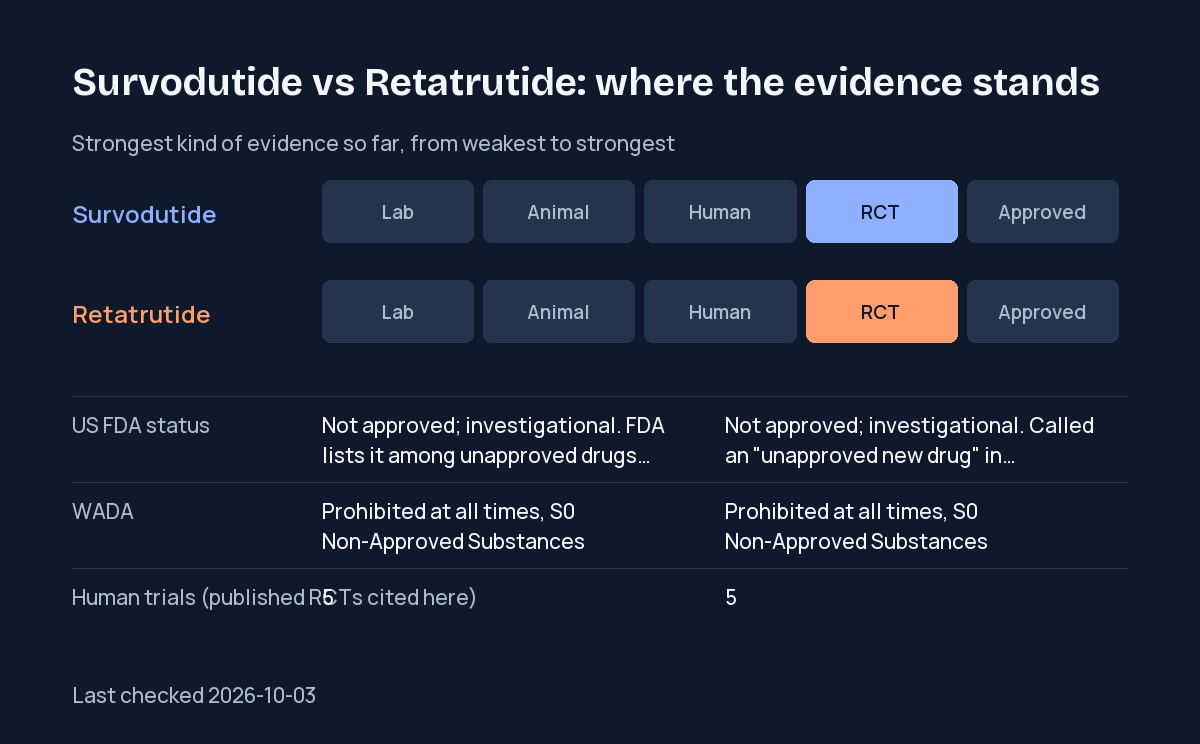
Survodutide is a glucagon/GLP-1 dual agonist from Boehringer Ingelheim; retatrutide is a GIP/GLP-1/glucagon triple agonist from Eli Lilly. Neither is FDA approved. Both now have published phase 3 trials (Human RCT). Retatrutide’s show the larger weight loss, but no trial has compared the two directly.
In adults with obesity and no diabetes, the 12 mg retatrutide arm lost 25.0% of body weight at 80 weeks versus 3.9% on placebo in TRIUMPH-1 (Human RCT, n=2,339). In SYNCHRONIZE-1 (Human RCT, n=725), the 6.0 mg survodutide arm lost 13.0% at 76 weeks versus 5.4% on placebo. Gastrointestinal side effects were the most common problem with both, and both are still investigational drugs that cannot be obtained legally outside clinical trials.
| Item | Survodutide | Retatrutide |
|---|---|---|
| US FDA status | Not approved; investigational. FDA lists it among unapproved drugs illegally sold as “research” products (FDA) | Not approved; investigational. Called an “unapproved new drug” in a 2026-08-24 FDA warning letter |
| Compounding (503A/503B) | No FDA statement specific to survodutide; it is not an approved drug (FDA) | “Cannot be used in compounding under federal law” (FDA) |
| WADA 2026 | Prohibited at all times, S0 Non-Approved Substances (WADA) | Prohibited at all times, S0 Non-Approved Substances (WADA) |
| Strongest evidence | Human RCT, phase 3 | Human RCT, phase 3 |
| Human trials (published RCTs cited here) | 5: NCT06066515, NCT06066528, NCT06309992, NCT04667377, NCT04771273 | 5: NCT05929066, NCT05929079, NCT06354660, NCT04881760, NCT04867785 |
| Next regulatory step | No filing date announced; sponsor expects cardiovascular-outcomes results “later this year” (2026-10-01 release) | US Biologics License Application planned for Q1 2027 (Lilly 8-K); no FDA decision date |
| Last checked | 2026-10-03 | 2026-10-03 |
Key points:
- In people with type 2 diabetes, survodutide 6.0 mg cut weight 9.8% at 76 weeks (SYNCHRONIZE-2); retatrutide 12 mg cut it 18.8% at 80 weeks (TRIUMPH-2). These are separate trials, not a head-to-head result.
- Survodutide’s distinctive data are in the liver: FDA granted it Breakthrough Therapy designation for MASH (an inflammatory form of fatty-liver disease) with moderate or advanced fibrosis in September 2024 (sponsor release).
- Retatrutide’s phase 3 data also cover knee osteoarthritis pain and sleep apnea, in subgroups of TRIUMPH-1.
- Stopping treatment because of side effects was common: 18% of survodutide-treated participants in SYNCHRONIZE-2 stopped for gastrointestinal events; up to 12% stopped retatrutide for adverse events in TRIUMPH-2.
- A 2026 network meta-analysis of mostly phase 2 trials rated the indirect comparison as low-certainty evidence.
Survodutide vs retatrutide at a glance
| Feature | Survodutide | Retatrutide |
|---|---|---|
| What it is | Investigational weekly peptide drug (Boehringer Ingelheim, licensed from Zealand Pharma) | Investigational weekly peptide drug (Eli Lilly) |
| Class | Dual agonist | Triple agonist |
| Receptors | Glucagon + GLP-1 | GIP + GLP-1 + glucagon |
| Main research focus | Obesity, type 2 diabetes, fatty liver (MASH/MASLD) | Obesity, type 2 diabetes, knee osteoarthritis pain, sleep apnea |
| Published phase 3 RCTs | 3 (SYNCHRONIZE-1, -2, -MASLD) | 3 (TRIUMPH-1, TRIUMPH-2, TRANSCEND-T2D-1) |
| Top weight result, no diabetes | −13.0% at 76 weeks (placebo −5.4%) | −25.0% at 80 weeks (placebo −3.9%) |
| Top weight result, type 2 diabetes | −9.8% at 76 weeks (placebo −3.9%) | −18.8% at 80 weeks (placebo −5.1%) |
| FDA status | Not approved; no filing date announced | Not approved; filing planned Q1 2027 |
| WADA | S0, prohibited at all times | S0, prohibited at all times |
| Route studied | Once weekly, under the skin | Once weekly, under the skin |
| Main safety concerns | Gastrointestinal events; dropouts during dose escalation | Gastrointestinal events, dysesthesia (abnormal skin sensation), low blood pressure |
What is survodutide?
Survodutide (BI 456906) is a once-weekly peptide that activates two hormone receptors, glucagon and GLP-1 (phase 2, Human RCT n=386). Zealand Pharma licensed it to Boehringer Ingelheim, which is solely responsible for its development (sponsor release). Its phase 3 program, called SYNCHRONIZE, has published results in obesity, obesity with type 2 diabetes and obesity with fatty liver. Liver disease is a second main track: the release states that FDA granted Fast Track designation in May 2021 and Breakthrough Therapy designation in September 2024 for non-cirrhotic MASH with stage 2–3 fibrosis.
What is retatrutide?
Retatrutide (LY3437943) is a once-weekly peptide that activates three receptors: GIP, GLP-1 and glucagon (phase 2, Human RCT n=281). Eli Lilly’s phase 3 program, called TRIUMPH, has published results in obesity with and without type 2 diabetes. Lilly says its data package now supports filings for obesity, obstructive sleep apnea and knee osteoarthritis pain (Lilly 8-K, 2026-08-05). A phase 3 trial comparing it directly with tirzepatide is under way (NCT06662383). For how it compares with the approved drugs, see retatrutide vs tirzepatide vs semaglutide.
How do they work differently?
- Receptors. Survodutide: glucagon and GLP-1 (le Roux 2024). Retatrutide: the same two plus GIP, a second gut hormone (Rosenstock 2023).
- Shared glucagon arm. Both belong to the glucagon-receptor agonist group, which a 2026 network meta-analysis (14 RCTs, 3,102 participants) analyzed together with cotadutide and mazdutide.
- Liver fat. Survodutide: 62% of the 4.8 mg arm had MASH improvement without fibrosis worsening versus 14% on placebo (Human RCT, n=293). Retatrutide: liver fat fell 82.4% in the 12 mg arm at 24 weeks versus a 0.3% rise on placebo (Human RCT substudy, n=98). The two measured different things, a biopsy outcome versus an MRI fat measure.
- Schedule studied. Survodutide: once weekly under the skin (SYNCHRONIZE-1). Retatrutide: once weekly under the skin (TRIUMPH-1).
Evidence head-to-head
Each cell gives the evidence level and the best published result. The trials differ in length (76 vs 80 weeks), populations and statistical methods, so the rows show what each drug did against its own placebo, not which one wins. Our grading method is explained in how we compare peptides.
| Outcome | Survodutide best evidence | Retatrutide best evidence |
|---|---|---|
| Weight, obesity without diabetes | Human RCT (n=725): −12.2% / −13.0% vs −5.4% at 76 weeks (SYNCHRONIZE-1) | Human RCT (n=2,339): −17.6% / −23.7% / −25.0% vs −3.9% at 80 weeks (TRIUMPH-1) |
| Weight, with type 2 diabetes | Human RCT (n=752): −8.2% / −9.8% vs −3.9% at 76 weeks (SYNCHRONIZE-2) | Human RCT (n=1,152): −11.9% / −16.8% / −18.8% vs −5.1% at 80 weeks (TRIUMPH-2) |
| Blood sugar (HbA1c) | Human RCT (n=752): −0.9 / −0.8 vs −0.2 points from 7.4% (SYNCHRONIZE-2) | Human RCT (n=537): −1.69 / −1.86 / −1.94 vs −0.81 points at 40 weeks (TRANSCEND-T2D-1) |
| Fatty liver | Human RCT (n=216): ≥30% liver-fat drop in 68.5% vs 28.6% (SYNCHRONIZE-MASLD); MASH biopsy data, Human RCT n=293 (phase 2) | Human RCT substudy (n=98): normal liver fat in up to 86% vs 0% (phase 2a) |
| Knee osteoarthritis pain | No published trial | Human RCT subgroup (n=574): WOMAC pain 1.4–1.6 points better than placebo (TRIUMPH-1) |
| Sleep apnea | No published trial | Human RCT subgroup (n=243): up to −34.3 vs −9.9 events/hour (TRIUMPH-1) |
| Cardiovascular outcomes | Trial completed, n=5,531; results not yet published (NCT06077864) | No published outcomes trial |
| Direct comparison | None. Network meta-analysis of mostly phase 2 trials, certainty “low” (Abulehia 2026) | |
The sponsors also report a second way of measuring results, the “efficacy estimand”, which assumes everyone stayed on treatment. On that basis, Boehringer Ingelheim reports up to 13.1% weight loss versus 3.1% on placebo in SYNCHRONIZE-2 (Zealand Pharma release). News headlines often use this higher figure, so it is worth checking which one a source quotes.
Which fits which goal?
These are evidence statements, not recommendations; neither drug is available outside trials.
- Weight loss: retatrutide has more evidence for larger average weight loss. Its phase 3 arms lost up to 25.0% without diabetes and 18.8% with diabetes, versus up to 13.0% and 9.8% for survodutide (TRIUMPH-1; SYNCHRONIZE-1), with the cross-trial caveat above.
- Type 2 diabetes: retatrutide has more evidence for lowering HbA1c, including a dedicated 40-week phase 3 trial (Human RCT, n=537). In the meta-analysis, survodutide’s HbA1c effect did not reach statistical significance (Abulehia 2026).
- Fatty liver and MASH: survodutide has more evidence, with biopsy outcomes in a phase 2 trial (Human RCT, n=293), a phase 3 liver-fat trial (Human RCT, n=216) and a Breakthrough Therapy designation (sponsor release).
- Joint pain and sleep apnea: only retatrutide has published phase 3 data.
- Gastrointestinal tolerability: the meta-analysis found survodutide “showed the best tolerability across all gastrointestinal outcomes” of the four drugs studied, but that rests on low-certainty, mostly phase 2 data.
Whether either would suit a particular person once approved is a decision for a clinician who knows that person’s history.
Can they be combined?
No controlled human study has tested the combination. Both drugs already act on the GLP-1 and glucagon receptors (le Roux 2024; Rosenstock 2023), and every trial cited on this page tested one drug on its own against placebo.
Safety and regulatory status
Side effects in trials
- Survodutide: gastrointestinal events affected 80.9–89.7% of treated participants versus 47.9% on placebo in SYNCHRONIZE-1, and 72.8–77.7% versus 38.6% in SYNCHRONIZE-2, mostly mild to moderate. In SYNCHRONIZE-2, 18% stopped treatment for gastrointestinal events versus 1.2% on placebo, usually during dose escalation (sponsor release). In the phase 2 MASH trial, vomiting affected 41% versus 4% on placebo (Human RCT, n=293).
- Retatrutide: in TRIUMPH-2, the 12 mg arm reported diarrhea in 34% versus 13% and nausea in 28% versus 8%. Dysesthesia occurred in up to 7% versus 1%, and low blood pressure in up to 6% versus under 1%. Treatment was stopped for adverse events or death in 12% (9 mg) and 8% (12 mg) versus 5% on placebo.
The two dropout figures measure different things (gastrointestinal events only versus any adverse event), so they are not directly comparable. The phase 3 trials cited here ran 76 to 80 weeks; safety over longer use has not been published in them, and survodutide’s cardiovascular-outcomes results are still pending. For the wider picture, see are peptides safe?
United States
Neither drug is FDA approved. FDA states that “retatrutide and cagrilintide cannot be used in compounding under federal law”, and it names both retatrutide and survodutide among unapproved drugs that companies have illegally sold “falsely labeled ‘for research purposes’ or ‘not for human consumption’” (FDA, current as of 2026-10-01). Lilly plans to submit retatrutide to FDA in the first quarter of 2027 (Lilly 8-K); the timeline is covered in more depth in retatrutide vs CagriSema. Zealand Pharma’s 2026-10-01 release gives no filing date for survodutide.
United Kingdom
In May 2026 the MHRA reported its largest-ever seizure of unlicensed weight-loss medicines, about 12,000 doses, “including retatrutide and tirzepatide, as well as peptide products” (MHRA).
Sport
Because neither drug is approved by any health regulator, both fall under WADA’s S0 Non-Approved Substances class, prohibited in and out of competition (WADA Prohibited List). How this differs from other drug classes is set out in peptides vs steroids vs SARMs.
How long do effects take in studies?
- Retatrutide: in phase 2, the 12 mg arm had lost 17.5% by 24 weeks and 24.2% by 48 weeks, versus 1.6% and 2.1% on placebo (Human RCT, n=338). Liver fat had fallen 82.4% by 24 weeks in the substudy (Human RCT, n=98). Phase 3 weight results were measured at 80 weeks in TRIUMPH-1 and TRIUMPH-2, and at 40 weeks in TRANSCEND-T2D-1.
- Survodutide: in phase 2, weight loss reached 14.9% at 46 weeks in the 4.8 mg arm versus 2.8% on placebo, after a 20-week dose-escalation period (Human RCT, n=386). Phase 3 weight results were measured at 76 weeks, and the liver-fat trial at 48 weeks (Human RCT, n=216).
What users report
What follows are unverified self-reports from people who usually bought unregulated products, not evidence. Retatrutide gets far more discussion on Reddit, X and YouTube than survodutide, which appears mostly in threads comparing “next-generation” GLP-1 options. People who post about retatrutide commonly describe strong appetite suppression and fast early weight loss, often saying they noticed less hunger within the first weeks. Recurring complaints are nausea, constipation or diarrhea, fatigue, a faster resting heart rate, and tingling or sensitive skin. Survodutide posts more often mention nausea and vomiting that led people to stop. Much of the argument is about product quality: whether “research” vials contain what the label says, whether they are sterile, and what happens when a product is mislabeled. Others debate whether the risk is worth taking before approval and long-term safety data exist, and many say they would rather wait for an approved version. Cost and the legal risk of buying unapproved drugs also come up often.
Frequently asked questions
Is retatrutide stronger than survodutide for weight loss?
On published averages, yes, but they have never been tested against each other. Retatrutide’s top phase 3 arm lost 25.0% of body weight at 80 weeks in TRIUMPH-1, while survodutide’s top arm lost 13.0% at 76 weeks in SYNCHRONIZE-1. Different trials, placebo responses and populations make the gap an estimate, not a measured difference.
Is survodutide FDA approved?
No. Survodutide is an investigational drug, and Boehringer Ingelheim has announced no filing date. FDA names it among unapproved drugs that companies have illegally sold as “research” products (FDA). It cannot be obtained legally outside a clinical trial. Its first phase 3 obesity results, SYNCHRONIZE-1 and SYNCHRONIZE-2, were published in 2026 (le Roux 2026; Wharton 2026).
When could retatrutide be approved?
Not before 2027. Eli Lilly plans to submit a Biologics License Application to FDA in the first quarter of 2027 (Lilly 8-K). FDA review follows submission, and no decision date has been announced. Until approval, retatrutide remains an investigational drug available only in trials.
Does survodutide help fatty liver disease?
The trial data are encouraging. In a phase 2 trial of people with MASH and fibrosis, 62% of the 4.8 mg arm improved without fibrosis worsening, versus 14% on placebo (Human RCT, n=293). It is still investigational, though, and not an approved treatment for any liver disease.
Are survodutide and retatrutide banned in sport?
Yes. Neither is approved by any health regulator, so both fall under WADA’s S0 Non-Approved Substances class and are prohibited at all times, in and out of competition (WADA). Athletes bound by the World Anti-Doping Code can face an anti-doping rule violation for using either.
References
- le Roux CW, Wharton S, Startseva E, et al. (2026). Survodutide Once Weekly for the Treatment of Adults with Obesity (SYNCHRONIZE-1). N Engl J Med 395(8):776-787. PubMed 42253238
- Wharton S, le Roux CW, Startseva E, et al. (2026). Survodutide Once Weekly in Adults with Obesity and Type 2 Diabetes (SYNCHRONIZE-2). N Engl J Med. PubMed 42820639
- Kaplan LM, et al. (2026). Survodutide in adults with obesity and MASLD: SYNCHRONIZE-MASLD. Nat Med 32(8):2948-2958. PubMed 42252333
- le Roux CW, et al. (2024). Glucagon and GLP-1 receptor dual agonist survodutide for obesity: a phase 2 trial. Lancet Diabetes Endocrinol 12(3):162-173. PubMed 38330987
- Sanyal AJ, et al. (2024). A Phase 2 Randomized Trial of Survodutide in MASH and Fibrosis. N Engl J Med 391(4):311-319. PubMed 38847460
- TRIUMPH-1 investigators (2026). Retatrutide, a Triple Hormone Receptor Agonist, for Treatment of Obesity. N Engl J Med. PubMed 42814954
- TRIUMPH-2 investigators (2026). Retatrutide in adults with obesity and type 2 diabetes (TRIUMPH-2). Lancet. PubMed 42810372
- Bajaj HS, et al. (2026). Efficacy and safety of retatrutide in type 2 diabetes (TRANSCEND-T2D-1). Lancet 407(10546):2402-2413. PubMed 42250575
- Jastreboff AM, et al. (2023). Triple-Hormone-Receptor Agonist Retatrutide for Obesity: A Phase 2 Trial. N Engl J Med 389(6):514-526. PubMed 37366315
- Rosenstock J, et al. (2023). Retatrutide, a GIP, GLP-1 and glucagon receptor agonist, for people with type 2 diabetes: a phase 2 trial. Lancet 402(10401):529-544. PubMed 37385280
- Sanyal AJ, et al. (2024). Triple hormone receptor agonist retatrutide for MASLD: a randomized phase 2a trial. Nat Med 30(7):2037-2048. PubMed 38858523
- Abulehia A, et al. (2026). Comparative Efficacy and Safety of Glucagon Receptor Agonists on Metabolic Outcomes: A Network Meta-Analysis. Endocrinol Diabetes Metab 9(2):e70187. PMC12963462
- ClinicalTrials.gov. SYNCHRONIZE-CVOT, NCT06077864. Trial record
- ClinicalTrials.gov. Retatrutide compared to tirzepatide in adults who have obesity, NCT06662383. Trial record
- Zealand Pharma / Boehringer Ingelheim (2026-10-01). Survodutide SYNCHRONIZE-2 results, press release. Zealand Pharma release
- Eli Lilly and Company (2026-08-05). Second-quarter 2026 results, Form 8-K. SEC
- US FDA. FDA’s concerns with unapproved GLP-1 drugs used for weight loss (current as of 2026-10-01). FDA
- US FDA. Warning letter, Peak Performance Peptides (2026-08-24). FDA
- World Anti-Doping Agency. The Prohibited List (2026). WADA
- MHRA (2026-05-29). Two arrested during the MHRA’s largest-ever seizure of unlicensed weight loss medicines. GOV.UK
Change log
2026-10-19: links to related entries added; no change to the facts.
2026-10-12: links to related entries added; no change to the facts.
2026-10-04: sponsor sources linked (Zealand Pharma release, Lilly 8-K); the release attributed to Zealand Pharma; FAQ expanded with the two published phase 3 trials; reviewed by the editorial team.
2026-10-03: first published after review by the editorial team.