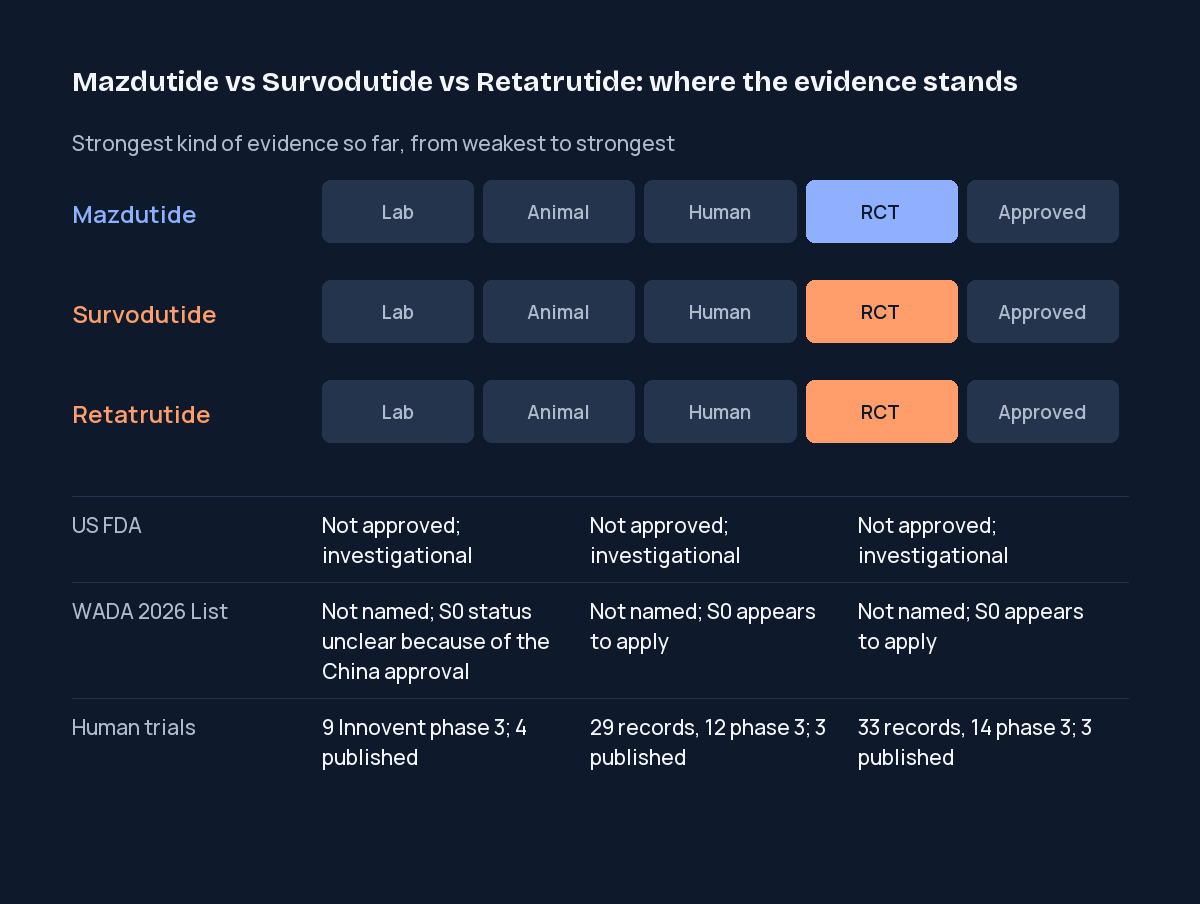
Mazdutide is already approved in China for weight management and type 2 diabetes; survodutide has the strongest liver-disease data, including biopsy-confirmed MASH improvement; retatrutide has the largest weight loss, 25.0% at 80 weeks in TRIUMPH-1 [Human RCT, n=2,339]. None is FDA-approved, and no trial has compared them directly.
All three are once-weekly injectable peptides that activate the GLP-1 and glucagon receptors; retatrutide adds a third, GIP. Mazdutide’s 9 mg dose cut body weight by 16.65% at 60 weeks in GLORY-2 [Human RCT, n=461, Chinese adults]. Survodutide’s 6.0 mg dose cut it by 13.0% at 76 weeks, against 5.4% on placebo, in SYNCHRONIZE-1 [Human RCT, n=725]. These figures come from separate trials with different populations and lengths, so they are cross-trial numbers, not a ranking. Outside China, all three remain investigational and are legally available only through clinical trials or, for retatrutide, Lilly’s pre-approval expanded access program.
| Item | Mazdutide | Survodutide | Retatrutide |
|---|---|---|---|
| US FDA | Not approved; investigational (Lilly, phase 2 in US) | Not approved; investigational (NEJM 2026) | Not approved; investigational |
| Other approval | China NMPA: weight management (2025-06-27), type 2 diabetes (2025-09-19) | None found | None found |
| Compounding | Not on FDA’s 503A bulks pages; FDA has warned sellers | Not on FDA’s 503A bulks pages; FDA has warned sellers | “Cannot be used in compounding under federal law” (FDA) |
| WADA 2026 List | Not named; S0 status unclear because of the China approval (our reading) | Not named; S0 appears to apply (our reading) | Not named; S0 appears to apply (our reading) |
| WADA 2027 List (from 2027-01-01) | “Peptides” in general named in S0 (USADA); none of the three named; no status change found | ||
| Strongest evidence | Human RCT, phase 3 (GLORY-1, n=610) | Human RCT, phase 3 (SYNCHRONIZE-2, n=752) | Human RCT, phase 3 (TRIUMPH-1, n=2,339) |
| Human trials | 9 Innovent phase 3; 4 published | 29 records, 12 phase 3; 3 published | 33 records, 14 phase 3; 3 published |
| Next regulatory step | US: none announced | US: none announced | FDA BLA planned Q1 2027 (Lilly 8-K) |
| Last checked | 2026-11-04 | ||
Key points:
- Mazdutide beat an approved diabetes drug, dulaglutide, on blood sugar in the phase 3 DREAMS-2 trial [Human RCT, n=731].
- In a phase 2 MASH trial, 62% on survodutide 4.8 mg improved on liver biopsy versus 14% on placebo [Human RCT, n=293].
- Retatrutide also reduced knee-osteoarthritis pain and sleep-apnea events in TRIUMPH-1 subgroups [Human RCT, n=574 and n=243].
- Stomach and gut side effects are the main problem for all three; in GLORY-2, 53.1% on mazdutide 9 mg vomited versus 1.3% on placebo.
- A 2026 BMJ network meta-analysis rated the evidence for emerging agents, mazdutide and retatrutide among them, as very low to low certainty.
Mazdutide vs survodutide vs retatrutide at a glance
| Feature | Mazdutide | Survodutide | Retatrutide |
|---|---|---|---|
| Class | Dual agonist | Dual agonist | Triple agonist |
| Receptors | GLP-1 + glucagon | Glucagon + GLP-1 | GIP + GLP-1 + glucagon |
| Developer | Lilly; Innovent in China | Boehringer Ingelheim | Lilly |
| Main research focus | Obesity, type 2 diabetes | Obesity, liver disease (MASH) | Obesity, diabetes, knee OA, sleep apnea |
| Largest phase 3 | DREAMS-2, n=731 | SYNCHRONIZE-2, n=752 | TRIUMPH-1, n=2,339 |
| Best phase 3 weight result | −16.65% at 60 weeks | −13.0% at 76 weeks | −25.0% at 80 weeks |
| Tested against an approved drug | Dulaglutide (published); semaglutide (topline only) | No phase 3 result found | Tirzepatide and semaglutide trials ongoing |
| Approval | China (2025); not FDA | None | None; BLA planned Q1 2027 |
| Route studied | Weekly injection | Weekly injection | Weekly injection |
| Trial lengths reported | 24–60 weeks | 46–76 weeks | 40–80 weeks |
| Main safety concern | Nausea, vomiting, diarrhea | Nausea, vomiting, diarrhea | Gut effects; AE stops up to 12% |
What is mazdutide?
Mazdutide (LY3305677, IBI362) is a weekly injectable peptide that activates both the GLP-1 and glucagon receptors; Innovent says the glucagon action helps limit fat build-up in the liver. Lilly developed it and licensed the China rights to Innovent, which won Chinese approval for chronic weight management in June 2025 and for type 2 diabetes in September 2025. Its phase 3 trials enrolled Chinese adults. In a US phase 2 trial, the 16 mg arm lost 18.1% at 32 weeks versus 0.9% on placebo [Human RCT, n=179].
What is survodutide?
Survodutide (BI 456906) is Boehringer Ingelheim’s weekly injectable dual agonist of the glucagon and GLP-1 receptors. Its program leans toward the liver: besides obesity, it has been tested in MASH, the inflammatory form of fatty liver disease, and has phase 3 liver trials recruiting (LIVERAGE). In SYNCHRONIZE-MASLD, 84.2% on survodutide had at least a 30% drop in liver fat at 48 weeks versus 24.3% on placebo [Human RCT, n=216]. The NEJM report of SYNCHRONIZE-1 describes it as investigational. Our survodutide vs tirzepatide comparison sets it against an approved drug.
What is retatrutide?
Retatrutide (LY3437943) is Lilly’s weekly injectable triple agonist: it adds the GIP receptor, one of tirzepatide’s two targets, to GLP-1 and glucagon. It has the largest trial program of the three, with 14 phase 3 trials registered and three published in 2026. In the phase 2 trial, the 12 mg arm lost 24.2% at 48 weeks versus 2.1% on placebo [Human RCT, n=338]. Lilly plans to file for FDA approval in the first quarter of 2027. Our retatrutide vs tirzepatide vs semaglutide comparison sets it against the approved drugs.
How they work differently
- Mazdutide: GLP-1 plus glucagon. In GLORY-1, the authors reported “beneficial effects on all prespecified cardiometabolic measures” [Human RCT, n=610].
- Survodutide: the same two receptors as mazdutide. Its biopsy trial is the only one of the three to report fibrosis improvement by at least one stage (34–36% versus 22% on placebo) [Human RCT, n=293].
- Retatrutide: GIP, GLP-1 and glucagon. The TRIUMPH-1 abstract calls it a triple hormone receptor agonist; in a liver-fat substudy, 86% on 12 mg reached normal liver fat by 24 weeks versus 0% on placebo [Human RCT, n=98].
A 2026 meta-analysis of glucagon/GLP-1 dual agonists (19 RCTs) found mazdutide and survodutide showed the largest effects in that class, with no rise in serious adverse events versus controls (risk ratio 0.90, high certainty). The two-way matchup is covered in more depth in our survodutide vs retatrutide comparison.
Evidence head-to-head
Every row below is cross-trial: each drug’s best published result against its own placebo or comparator. Populations differ (all published mazdutide phase 3 trials enrolled Chinese adults), and so do doses and durations.
| Outcome | Mazdutide | Survodutide | Retatrutide |
|---|---|---|---|
| Weight, no diabetes | Human RCT (n=461): −16.65% vs −1.50% at 60 wk (GLORY-2) | Human RCT (n=725): −13.0% vs −5.4% at 76 wk (SYNCHRONIZE-1) | Human RCT (n=2,339): −25.0% vs −3.9% at 80 wk (TRIUMPH-1) |
| Weight, type 2 diabetes | Human RCT, open-label (n=349): −10.29% vs −6.00% on semaglutide at 32 wk (topline release) | Human RCT (n=752): −9.8% vs −3.9% at 76 wk (SYNCHRONIZE-2) | Human RCT (n=1,152): −18.8% vs −5.1% at 80 wk (TRIUMPH-2) |
| Blood sugar (HbA1c) | Human RCT (n=320): −2.15 vs −0.14 points at 24 wk (DREAMS-1) | Human RCT (n=752): −0.8 vs −0.2 points at 76 wk | Human RCT (n=537): −1.94 vs −0.81 points at 40 wk (TRANSCEND-T2D-1) |
| Liver disease | No liver trial published; phase 2 MASH trial registered | Human RCT (n=293): MASH improved in 62% vs 14% on biopsy (phase 2) | Human RCT (n=98): liver fat −82.4% at 24 wk (phase 2a) |
| Knee pain, sleep apnea | No published result found | No published result found | Human RCT subgroups: WOMAC pain −1.8, apnea events −21.9/h vs placebo |
| Versus an approved drug | Human RCT (n=731): better HbA1c than dulaglutide (DREAMS-2) | No phase 3 result found | Trials vs tirzepatide and semaglutide ongoing |
| Heart outcomes | No outcome trial found | SYNCHRONIZE-CVOT completed; not yet published | Outcome trial active |
Which fits which goal?
Retatrutide has more evidence for maximum weight loss. Its 25.0% at 80 weeks in TRIUMPH-1 [Human RCT, n=2,339] is the largest figure in any of the three programs, and the same trial reported benefits for knee-osteoarthritis pain and sleep apnea. It also has the most trial participants behind it.
Survodutide has more evidence for fatty liver disease. It is the only one of the three with a published biopsy trial showing MASH and fibrosis improvement [Human RCT, n=293], plus a phase 3 liver-fat result. Its weight-loss figures are the smallest of the three, and the placebo arm in SYNCHRONIZE-1 lost 5.4%, which narrows the gap between arms.
Mazdutide has more evidence for type 2 diabetes against established drugs. It is the only one with a published phase 3 win over an approved comparator, dulaglutide, in DREAMS-2 [Human RCT, n=731], and the only one approved anywhere we checked. Its limit is reach: its phase 3 data come from Chinese adults, and no Lilly-sponsored phase 3 was found on ClinicalTrials.gov (searched 2026-11-04).
These are statements about where the evidence is deepest, not advice. A clinician is the person to decide whether any of these drugs, or an approved alternative, suits an individual. Our weight-loss peptides ranked by evidence page places all three alongside the approved GLP-1 drugs.
Can they be combined?
All three act on the GLP-1 and glucagon receptors, and retatrutide also acts on the GIP receptor, so any combination would overlap heavily in mechanism. No controlled human study of any combination of mazdutide, survodutide and retatrutide was found on PubMed or ClinicalTrials.gov (searched 2026-11-04). The gut side effects each causes on its own, described below, are the main known risk any combination would carry.
Safety and regulatory status
Side effects. Nausea, vomiting and diarrhea dominate all three programs. In SYNCHRONIZE-1, gut symptoms occurred in 80.9–89.7% on survodutide versus 47.9% on placebo [Human RCT, n=725]. In GLORY-2, 53.1% on mazdutide 9 mg vomited and 46.9% had nausea, versus 1.3% and 3.2% on placebo [Human RCT, n=461]. In TRIUMPH-2, 4–12% stopped retatrutide because of adverse events versus 5% on placebo [Human RCT, n=1,152]. Discontinuation was lower in GLORY-1: 0.5–1.5% versus 1.0% [Human RCT, n=610]. No published heart-outcome result and no safety data beyond 80 weeks were found for any of the three on PubMed (searched 2026-11-04).
United States. None of the three is FDA-approved. FDA states that retatrutide “cannot be used in compounding under federal law” and that it has warned companies that illegally sold unapproved drugs containing retatrutide, survodutide or mazdutide, including products “falsely labeled ‘for research purposes’”. Survodutide and mazdutide do not appear on FDA’s 503A bulk-substance pages (checked 2026-11-04). Lilly lists a pre-approval expanded access program for retatrutide; otherwise, trials are the only lawful route. Lilly plans its retatrutide BLA for the first quarter of 2027 (Form 8-K).
China. Mazdutide is approved for chronic weight management and for blood-sugar control in type 2 diabetes (Innovent, 2025-09-19). No approval of survodutide or retatrutide was found in sponsor releases or trial reports (checked 2026-11-04).
Sport (WADA). WADA’s S0 class covers substances “not approved by any government regulatory authority” (USADA). On our reading of the 2026 List, that makes survodutide and retatrutide prohibited. Mazdutide is the open question: it has a Chinese approval, and approved GLP-1 drugs “are not prohibited in sport” (USADA), but we found no anti-doping ruling on it. The 2027 List, in force from 2027-01-01, names “peptides” in general in S0 and names none of the three. USADA notes that a peptide not named on the List “may still be prohibited”.
Anyone who suspects a side effect from mazdutide, survodutide, retatrutide or any other drug or product can report it to the FDA through MedWatch.
How long do effects take in studies?
- Mazdutide: in GLORY-1, the 6 mg arm had lost 12.55% at 32 weeks and 14.01% at 48 weeks, so weight was still falling between the two readouts [Human RCT, n=610]. In the US phase 2 trial, the 16 mg arm reached 18.1% by week 32 [Human RCT, n=179].
- Survodutide: the phase 2 trial measured 14.9% at 46 weeks on 4.8 mg [Human RCT, n=386]; phase 3 measured 13.0% at 76 weeks.
- Retatrutide: liver fat fell 82.4% by week 24 on 12 mg in the MASLD substudy [Human RCT, n=98]; weight loss was 24.2% at 48 weeks in phase 2 and 25.0% at 80 weeks in TRIUMPH-1.
What users report
What follows are unverified self-reports from people who usually bought unregulated “research” products, not evidence. People who post about these three drugs on forums and social media most often describe strong appetite suppression and steady weight loss, with retatrutide the most discussed of the three and usually described as the strongest. Survodutide and mazdutide come up more often in comparisons than in personal accounts. A recurring complaint is nausea, reflux, constipation or vomiting, especially in the first weeks, and some posters describe a faster heartbeat. Others report little effect and suspect the product was weaker than labeled or not what the label said, a worry that runs through these threads because the products are unregulated. Cost and supply interruptions are frequent topics. The main arguments are whether glucagon activity preserves muscle or burns more fat, whether trial-size results are reachable outside a trial, and whether it is worth waiting for approval instead of taking an untested product of unknown purity.
Frequently asked questions
Is mazdutide or survodutide better for weight loss?
No trial has compared them. Mazdutide 9 mg lowered weight by 16.65% at 60 weeks in GLORY-2 [Human RCT, n=461, Chinese adults]. Survodutide 6.0 mg lowered it by 13.0% at 76 weeks in SYNCHRONIZE-1 [Human RCT, n=725]. These are cross-trial numbers from different populations and trial lengths, so they cannot rank the two drugs.
Is retatrutide stronger than mazdutide?
Retatrutide has the larger published figure, but no direct comparison exists. Retatrutide 12 mg produced 25.0% weight loss at 80 weeks in TRIUMPH-1 [Human RCT, n=2,339]; mazdutide 9 mg produced 16.65% at 60 weeks in GLORY-2 [Human RCT, n=461]. The trials differed in length, population and design, so this is a cross-trial gap, not a measured difference.
Is survodutide or retatrutide more effective?
For weight, retatrutide’s published result is larger: 25.0% at 80 weeks in TRIUMPH-1 [Human RCT, n=2,339] versus survodutide’s 13.0% at 76 weeks in SYNCHRONIZE-1 [Human RCT, n=725]. These are cross-trial figures, and survodutide has the stronger liver evidence, including biopsy-confirmed MASH improvement [Human RCT, n=293]. No head-to-head trial was found on ClinicalTrials.gov (searched 2026-11-04).
What is mazdutide?
Mazdutide is a once-weekly injectable peptide that activates the GLP-1 and glucagon receptors. Lilly developed it, and its partner Innovent won Chinese approval for weight management in June 2025 (Innovent). It is not FDA-approved. Its pivotal trial, GLORY-1, reported 14.01% weight loss at 48 weeks on 6 mg [Human RCT, n=610].
Can these drugs be obtained legally in the US?
Only through clinical trials or, for retatrutide, Lilly’s pre-approval expanded access program listed on ClinicalTrials.gov. None of the three is FDA-approved, and FDA says retatrutide cannot be used in compounding. FDA has warned companies illegally selling all three, including products labeled “for research purposes”.
References
- Ji L, Jiang H, Bi Y, et al. Once-weekly mazdutide in Chinese adults with obesity or overweight (GLORY-1). N Engl J Med. 2025;392(22):2215-2225. PubMed 40421736
- Gao L, et al. Treatment with 9-mg mazdutide for weight reduction in Chinese adults with obesity: the GLORY-2 randomized clinical trial. JAMA. 2026. PubMed 42251595
- Hsia SH, et al. Efficacy and safety of mazdutide in adults with obesity or overweight (phase 2). Lancet Diabetes Endocrinol. 2026. PubMed 42628555
- Zhu D, et al. Mazdutide versus placebo in Chinese adults with type 2 diabetes (DREAMS-1). Nature. 2026. PubMed 41407859
- Guo L, et al. Mazdutide versus dulaglutide in Chinese adults with type 2 diabetes (DREAMS-2). Nature. 2026. PubMed 41407860
- Innovent Biologics. Mazdutide shows superiority in glycemic control with weight loss over semaglutide in a head-to-head phase 3 clinical trial (DREAMS-3). Press release, 2025-10-26. Press release
- Innovent Biologics. Mazdutide received approval from China’s NMPA for chronic weight management. Press release, 2025-06-27. Press release
- Innovent Biologics. Mazdutide received approval from China’s NMPA for glycemic control in adults with type 2 diabetes. Press release, 2025-09-19. Press release
- le Roux CW, Wharton S, Startseva E, et al. Survodutide once weekly for the treatment of adults with obesity (SYNCHRONIZE-1). N Engl J Med. 2026;395(8):776-787. PubMed 42253238
- Wharton S, et al. Survodutide once weekly in adults with obesity and type 2 diabetes (SYNCHRONIZE-2). N Engl J Med. 2026. PubMed 42820639
- Kaplan LM, et al. Survodutide in adults with obesity and metabolic dysfunction-associated steatotic liver disease (SYNCHRONIZE-MASLD). Nat Med. 2026. PubMed 42252333
- Sanyal AJ, et al. A phase 2 randomized trial of survodutide in MASH and fibrosis. N Engl J Med. 2024. PubMed 38847460
- le Roux CW, et al. Glucagon and GLP-1 receptor dual agonist survodutide for obesity: a phase 2 trial. Lancet Diabetes Endocrinol. 2024. PubMed 38330987
- Jastreboff AM, Kaplan LM, Davies MJ, et al. Retatrutide, a triple hormone receptor agonist, for treatment of obesity (TRIUMPH-1). N Engl J Med. 2026. PubMed 42814954
- Bellido V, et al. Retatrutide in adults with obesity and type 2 diabetes (TRIUMPH-2). Lancet. 2026. PubMed 42810372
- Bajaj HS, et al. Efficacy and safety of retatrutide in type 2 diabetes (TRANSCEND-T2D-1). Lancet. 2026. PubMed 42250575
- Jastreboff AM, et al. Triple-hormone-receptor agonist retatrutide for obesity: a phase 2 trial. N Engl J Med. 2023. PubMed 37366315
- Sanyal AJ, et al. Triple hormone receptor agonist retatrutide for metabolic dysfunction-associated steatotic liver disease. Nat Med. 2024. PubMed 38858523
- Nong K, et al. Comparative effects of drugs for adults with overweight or obesity: systematic review and network meta-analysis. BMJ. 2026. PubMed 42419792
- Amjad MM, et al. Efficacy and safety of dual GLP-1/glucagon receptor agonism in overweight and obesity. Diabetes Obes Metab. 2026. PubMed 42811393
- Eli Lilly and Company. Form 8-K, Q2 2026 results, filed 2026-08-05. US SEC. SEC filing
- US FDA. FDA’s concerns with unapproved GLP-1 drugs used for weight loss. Updated 2026-10-01. FDA
- US FDA. Bulk drug substances used in compounding under section 503A of the FD&C Act. Content current 2026-05-14. FDA
- World Anti-Doping Agency. 2026 Prohibited List. WADA
- USADA. #AskUSADA: What is a non-approved substance and why are they prohibited? USADA
- USADA. Athlete advisory: what’s new on the 2027 WADA Prohibited List. USADA
- USADA. Weight loss drugs: what athletes need to know about GLP-1s. USADA
- ClinicalTrials.gov. Searches for mazdutide, survodutide and retatrutide, 2026-11-04, and records NCT06124807, NCT06937749, NCT06632444, NCT06077864, NCT06383390, NCT06662383, NCT06260722, NCT07629401. ClinicalTrials.gov
Change log
2026-11-04: first published after review by the editorial team.