No peptide is FDA-approved to treat anxiety. Among the peptides promoted for anxiety and stress, the best-researched are intranasal oxytocin (several small human RCTs with mixed results), Selank (Russian comparative trials in anxiety disorders, no placebo arm in the English abstracts) and neuropeptide Y (one phase 1 trial in PTSD). Semax, DSIP and BPC-157 have animal or indirect evidence only for anxiety. Approved, evidence-based care for anxiety disorders exists and is listed by the National Institute of Mental Health.
| Item | Status |
|---|---|
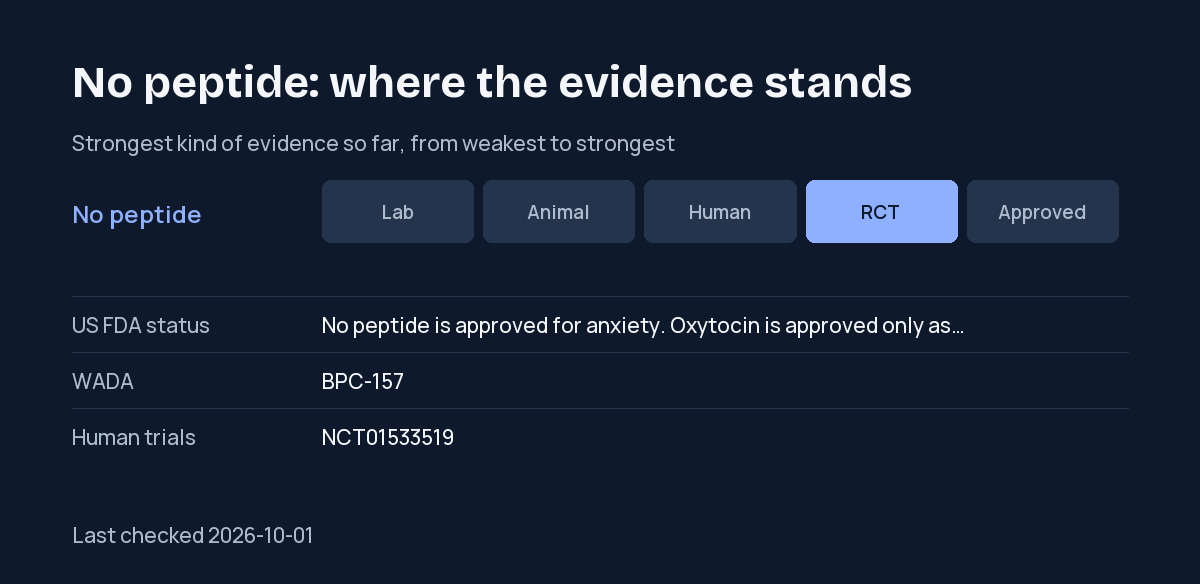
| US FDA status | No peptide is approved for anxiety. Oxytocin is approved only as Pitocin injection for labor and postpartum bleeding (label). Selank, Semax, DSIP, neuropeptide Y and BPC-157 are not approved for any use. |
| Compounding (503A/503B) | Selank, Semax, emideltide (DSIP) and BPC-157 are listed as withdrawn by nominators from FDA’s Category 2 list (FDA), not moved to another category. The July 2026 advisory committee reviewed Semax and DSIP; its reported votes (Semax 8–5 for, DSIP 6–7 against) are advisory only. No final FDA decision. |
| WADA 2026 | BPC-157: prohibited at all times under S0 (USADA). Selank, Semax, DSIP and oxytocin are not named on the List; S0 covers any substance with no government approval for human use. |
| Strongest evidence | Human RCT, small and mixed (oxytocin); human comparative trials without placebo (Selank); human phase 1 (neuropeptide Y) |
| Human trials | NCT01533519 (NPY, PTSD, n=26) · NCT01856530 (oxytocin, social anxiety, n=60) · NCT00989937 (oxytocin, anxiety disorders, terminated at n=17). No ClinicalTrials.gov record found for Selank or Semax. |
| Last checked | 2026-10-01 |
Key points:
- In a 2026 oxytocin brain-imaging meta-analysis (55 studies, 3,337 participants), oxytocin reduced amygdala activity in men but increased it in women (Guo 2026).
- FDA’s own reviewers found no human pharmacokinetic studies of Semax by any route and recommended against adding it to the compounding list (FDA briefing).
- A 2021 pharmacology review called Selank a “poorly studied” Russian drug sold to US consumers as a dietary supplement (Doyno and White 2021).
- The only anxiety finding for BPC-157 comes from one 2001 rodent study (Sikiric 2001).
- A 2020 review of emerging anxiety drugs reported that recent RCTs of novel agents, neuropeptides included, had “largely been negative” (Garakani 2020).
Best peptides for anxiety: the evidence ranking at a glance
The ranking below follows the evidence tiers this site uses for every roundup: approved drugs first, then investigational substances with human trials, then animal or lab findings only. It ranks the strength of the research, not how well any peptide works for a given person.
| Peptide | Best anxiety evidence | US status |
|---|---|---|
| Oxytocin (intranasal) | Human controlled trials, small, mixed (n=25, n=79) | Injection approved for labor only |
| Selank | Human comparative trials vs benzodiazepines (n=62, n=60) | Not approved |
| Neuropeptide Y | Human phase 1, PTSD (n=26) | Not approved |
| DSIP (emideltide) | Human double-blind trial for insomnia, not anxiety (n=16) | Not approved |
| Semax | Animal (rats) only for anxiety (2010) | Not approved |
| BPC-157 | Animal (rats, mice) only (2001) | Not approved |
Tier 1: approved options, and why no peptide is among them
For generalized anxiety disorder, the NIMH lists cognitive behavioral therapy (CBT), acceptance and commitment therapy, SSRI and SNRI antidepressants, buspirone and benzodiazepines as treatments. These are established, approved treatments; no peptide on this page has comparable trial support. The same NIMH material lists the 988 Suicide & Crisis Lifeline (call or text 988) for anyone in crisis.
Oxytocin is the only peptide here with an FDA-approved product, and that approval is narrow: the Pitocin label covers starting or strengthening uterine contractions and controlling postpartum bleeding [Approved label]. It names no psychiatric use. Anxiety research on oxytocin uses nasal sprays given in trials, which is an investigational use.
Tier 2: peptides with human anxiety or stress studies
Oxytocin (intranasal)
Oxytocin is a nine-amino-acid hormone made in the brain’s hypothalamus. It has the most controlled human research of any peptide on this list, and the results are encouraging in places but inconsistent. In 18 people with generalized social anxiety disorder, one dose of oxytocin spray brought exaggerated amygdala responses to fearful faces back to the level of healthy controls in a double-blind crossover fMRI study [Human placebo-controlled crossover (n=36)] (Labuschagne 2010). In a placebo-controlled trial of 40 people with social anxiety disorder and 39 controls, observers rated patients’ social behavior as better after oxytocin in one of two live tasks, but patients did not feel the difference and their mood ratings did not change [Human placebo-controlled trial (n=79)] (Voncken 2021).
When oxytocin was added to exposure therapy for social anxiety disorder, participants rated their own speech and appearance more positively over the sessions, yet overall symptom improvement was the same as with placebo [Human RCT (n=25)] (Guastella 2009). A US pilot trial in anxiety disorders stopped at 17 participants because of a break in funding (NCT00989937). The 2026 imaging meta-analysis adds a twist: oxytocin damped amygdala activity in men but increased it in women [Human, meta-analysis of 55 studies] (Guo 2026).
Selank
Selank is a seven-amino-acid synthetic analog of tuftsin, an immune peptide, developed in Russia. In brain tissue it acted as a positive allosteric modulator of GABA binding, a mechanism it partly shares with benzodiazepines [Lab (in vitro)] (Vyunova 2018). Its human data come from Russian clinical studies. In 62 patients with generalized anxiety disorder or neurasthenia, Selank (30 patients) and the benzodiazepine medazepam (32 patients) had similar anxiety-lowering effects on the Hamilton and Zung scales [Human comparative trial (n=62)] (Zozulya 2008). A second study compared Selank with phenazepam in 60 patients with anxiety and somatoform disorders and reported a “pronounced” anxiolytic effect [Human comparative trial (n=60)] (Medvedev 2014).
These results are promising on paper but hard to weigh. The English abstracts do not describe randomization or blinding, neither study had a placebo group and both are published in Russian. No Selank trial appears on ClinicalTrials.gov.
Neuropeptide Y
Neuropeptide Y (NPY) is a 36-amino-acid brain peptide; in male rats, a single intranasal dose prevented and reversed many stress-induced behavioral changes in a PTSD model [Animal] (Sabban and Tanelian 2026, review). In a randomized, double-blind, placebo-controlled crossover study at Mount Sinai, 26 people with PTSD received single intranasal doses at five ascending levels before a trauma-script challenge [Human RCT, phase 1 (n=26)] (Sayed 2018). NPY was well tolerated at every level, and higher doses were linked to lower Beck Anxiety Inventory scores than placebo, but there was no significant effect on the State-Trait Anxiety Inventory. It remains an early-stage research compound (NCT01533519).
DSIP (emideltide)
Delta sleep-inducing peptide is a nine-amino-acid peptide studied for sleep, not for anxiety disorders. In a double-blind trial in 16 people with chronic insomnia, DSIP produced weak improvements in sleep efficiency and sleep onset that may partly reflect a change in the placebo group, with no change in subjective sleep quality; the authors concluded it was “not likely to be of major therapeutic benefit” [Human double-blind controlled trial (n=16)] (Bes 1992). FDA reviewers judged the insomnia studies “inconclusive and at best preliminary” (FDA briefing).
Tier 3: animal-only evidence for anxiety
Semax
Semax is a seven-amino-acid analog of a fragment of ACTH (adrenocorticotropic hormone), registered as nasal drops in Russia (FDA briefing). Its anxiety data are from rodents. In rats, Semax had no effect on normal behavior but normalized the anxiety and depression-like behavior caused by the anxiety-inducing peptide CCK-4 [Animal] (Levitskaya 2010). In young rats separated from their mothers, Semax brought raised anxiety back to normal levels [Animal] (Volodina 2012). The human studies FDA found involved healthy adults, adults with chronic ischemic brain disease, migraine, trigeminal neuralgia or peptic ulcer, and children with depression or tics, not anxiety disorders.
BPC-157
BPC-157 is a 15-amino-acid peptide best known for tissue-healing research (compared in BPC-157 vs TB-500). In one study, rats given BPC-157 buried a shock probe far less, as diazepam-treated rats did, while in a light/dark test in mice its pattern differed from diazepam’s; the authors called its activity “particular, and different from diazepam” [Animal] (Sikiric 2001). No human anxiety study exists.
How the human studies compare
The table lists every human study cited above that measured anxiety or a closely related outcome, with its design and its actual result.
| Study | Design and size | Result |
|---|---|---|
| Oxytocin + exposure therapy (2009) | RCT, double-blind, social anxiety, n=25 | Better self-ratings; no gain in symptom outcome |
| Oxytocin fMRI (2010) | Placebo-controlled crossover, 18 patients + 18 controls | Amygdala fear response normalized |
| Oxytocin social tasks (2021) | Placebo-controlled, 40 patients + 39 controls | Observer-rated gain in one task; no felt change |
| Selank vs medazepam (2008) | Comparative, no placebo, n=62 | Similar anxiety reduction |
| Selank vs phenazepam (2014) | Comparative, no placebo, n=60 | Anxiolytic effect reported |
| NPY in PTSD (2018) | Phase 1 crossover RCT, n=26 | Dose-related drop on one of two anxiety scales |
Can these peptides be combined?
One Russian study tested Selank alongside a standard drug: 40 patients received Selank plus phenazepam and 30 received phenazepam alone. The combination group reached the treatment effect sooner and reported fewer phenazepam side effects such as sedation and memory problems [Human comparative trial (n=70)] (Medvedev 2015). In rats under chronic stress, Selank combined with diazepam lowered anxiety measures most [Animal] (Kasian 2017). Selank also blocked diazepam’s effect on GABA binding in lab tests [Lab (in vitro)] (Vyunova 2018). How Selank interacts with prescribed sedatives in people has not been studied beyond the phenazepam trial. No controlled human study has tested any of these peptides combined with each other.
Safety and regulatory status
United States. None of these peptides is approved for anxiety. Selank, Semax, emideltide and BPC-157 sit in the “withdrawn by nominators” section of FDA’s Category 2 page, and that listing is not an approval. FDA staff recommended against adding Semax to the 503A bulks list, citing poor chemical characterization, possible immune reactions to injected or sprayed peptide, a possible bleeding risk from Semax’s anti-clotting activity, and rodent data showing it boosted amphetamine-driven dopamine release (FDA Semax briefing). FDA also recorded one consumer report of eye pain and hospitalization after Semax nasal drops bought online. For DSIP, reviewers raised the same quality concerns and flagged untested addiction potential, because the peptide stimulates the body’s opioid system (FDA DSIP briefing). The committee’s votes are advice; FDA states it makes no final determination until that input and all reviews are considered.
Supplements and quality. A clinical pharmacology review noted that Selank is sold in the US as a dietary supplement despite thin evidence, and called for GABA-acting agents to be evaluated for abuse potential before public access (Doyno and White 2021).
Oxytocin. Across 38 RCTs (1,529 participants, 79% male), short-term research use of intranasal oxytocin produced side effects no different from placebo; three case reports described adverse reactions with misuse or longer use [Human, systematic review] (MacDonald 2011). Long-term safety outside trials, and safety in women and young people, are not well studied.
Sport. BPC-157 is prohibited at all times under the S0 class (USADA). The other peptides are not named on the WADA Prohibited List, but S0 applies to any substance lacking government approval for human use, so athletes under the WADA Code rely on their anti-doping agency’s ruling.
How long do effects take in studies?
Most oxytocin and NPY findings are acute: in the 2021 oxytocin trial, social tasks began 40 minutes after a single spray (Voncken 2021), and the NPY study tested anxiety within the same session as a single dose (Sayed 2018). For Selank, one study reported that the anti-anxiety effect lasted for a week after the last administration (Medvedev 2014), and a related study tracked blood cytokine changes over a 14-day course in anxiety patients (Uchakina 2008). None of the studies cited here reports long-term anxiety outcomes.
What users report
What follows is a summary of unverified self-reports from people who usually bought unregulated products; it is not evidence and has not been checked. People who post about Selank on forums and social media commonly describe a quieter, less “wired” feeling and say it is milder than prescription anti-anxiety drugs; a sizable share say they noticed nothing at all. Semax posts focus more on focus and energy than calm, and some users describe feeling more on edge rather than less. Posts about oxytocin spray are mixed, with some describing a brief sense of warmth in social settings and others no change. DSIP reports split between better sleep and no effect, with some mentioning vivid dreams or next-day grogginess. Recurring complaints across all of them include nasal irritation or headaches, effects that fade with continued use, doubts about whether the product contained what the label said, and cost. A frequent argument is whether any effect is more than placebo, which is the question the small trials above have not settled.
Frequently asked questions
What is the best-researched peptide for anxiety?
Oxytocin has the most placebo-controlled human research, but its results are mixed and no product is approved for anxiety. Selank has more direct anxiety-disorder studies, but the published ones are Russian and lack placebo groups. In a randomized trial, adding oxytocin to exposure therapy did not improve overall symptom outcomes in 25 people with social anxiety disorder (Guastella 2009).
Is Selank FDA approved?
No. Selank is not approved by FDA for any use, and no Selank trial is registered on ClinicalTrials.gov. FDA lists selank acetate among substances withdrawn by nominators from its Category 2 compounding list, and that withdrawal is not an approval (FDA). Its human data come from small Russian comparative studies.
Does oxytocin nasal spray reduce anxiety?
The evidence is inconsistent. Single doses normalized fear-related amygdala activity in people with social anxiety in a small imaging study, but trials have not shown a lasting drop in symptoms. A 2026 meta-analysis of 55 imaging studies found oxytocin reduced amygdala activity in men and increased it in women (Guo 2026).
Are anxiety peptides banned in sport?
BPC-157 is prohibited at all times under WADA’s S0 class for non-approved substances (USADA). Selank, Semax, DSIP and oxytocin are not named on the 2026 List, but S0 covers any substance without government approval for human use, so athletes depend on a ruling from their anti-doping agency.
Can peptides replace anxiety medication or therapy?
No peptide has been tested as a replacement for standard anxiety care, and none has the trial record of approved treatments. The National Institute of Mental Health lists cognitive behavioral therapy, SSRIs, SNRIs, buspirone and benzodiazepines for generalized anxiety disorder (NIMH). Decisions about treatment belong with a licensed clinician.
References
- National Institute of Mental Health. Generalized Anxiety Disorder: When Worry Gets Out of Control. nimh.nih.gov
- Pitocin (oxytocin) injection, prescribing information. DailyMed, US National Library of Medicine. dailymed.nlm.nih.gov
- US FDA. Certain bulk drug substances for use in compounding that may present significant safety risks (content current as of 2026-04-22). fda.gov
- US FDA. July 23–24, 2026 meeting of the Pharmacy Compounding Advisory Committee. fda.gov
- US FDA. Briefing document: Semax-related bulk drug substances. PCAC, July 2026. fda.gov
- US FDA. Briefing document: Emideltide-related bulk drug substances. PCAC, July 2026. fda.gov
- USADA. BPC-157: experimental peptide creates risk for athletes. usada.org
- World Anti-Doping Agency. The Prohibited List (2026). wada-ama.org
- Guo X, Zhang L, Zhang Q, Kendrick KM, Yao S. A systematic review and meta-analysis of oxytocin modulation of amygdala responses to emotional stimuli and implications for anxiolytic effects. Neurosci Biobehav Rev. 2026;186:106679. PubMed
- Guastella AJ, Howard AL, Dadds MR, Mitchell P, Carson DS. A randomized controlled trial of intranasal oxytocin as an adjunct to exposure therapy for social anxiety disorder. Psychoneuroendocrinology. 2009;34(6):917-23. PubMed
- Labuschagne I, Phan KL, Wood A, et al. Oxytocin attenuates amygdala reactivity to fear in generalized social anxiety disorder. Neuropsychopharmacology. 2010;35(12):2403-13. PubMed
- Voncken MJ, Dijk C, Stöhr F, et al. The effect of intranasally administered oxytocin on observed social behavior in social anxiety disorder. Eur Neuropsychopharmacol. 2021;53:25-33. PubMed
- MacDonald E, Dadds MR, Brennan JL, et al. A review of safety, side-effects and subjective reactions to intranasal oxytocin in human research. Psychoneuroendocrinology. 2011;36(8):1114-26. PubMed
- Zozulya AA, Neznamov GG, Syunyakov TS, et al. Efficacy and possible mechanisms of action of a new peptide anxiolytic selank in the therapy of generalized anxiety disorders and neurasthenia. Zh Nevrol Psikhiatr Im S S Korsakova. 2008;108(4):38-48. PubMed
- Medvedev VE, Tereshchenko ON, Israelian AY, et al. A comparison of the anxiolytic effect and tolerability of selank and phenazepam in the treatment of anxiety disorders. Zh Nevrol Psikhiatr Im S S Korsakova. 2014;114(7):17-22. PubMed
- Medvedev VE, Tereshchenko ON, Kost NV, et al. Optimization of the treatment of anxiety disorders with selank. Zh Nevrol Psikhiatr Im S S Korsakova. 2015;115(6):33-40. PubMed
- Uchakina ON, Uchakin PN, Myasoedov NF, et al. Immunomodulatory effects of selank in patients with anxiety-asthenic disorders. Zh Nevrol Psikhiatr Im S S Korsakova. 2008;108(5):71-5. PubMed
- Vyunova TV, Andreeva L, Shevchenko K, Myasoedov N. Peptide-based anxiolytics: the molecular aspects of heptapeptide Selank biological activity. Protein Pept Lett. 2018;25(10):914-923. PubMed
- Kasian A, Kolomin T, Andreeva L, et al. Peptide Selank enhances the effect of diazepam in reducing anxiety in unpredictable chronic mild stress conditions in rats. Behav Neurol. 2017;2017:5091027. PubMed
- Doyno CR, White CM. Sedative-hypnotic agents that impact gamma-aminobutyric acid receptors: focus on flunitrazepam, gamma-hydroxybutyric acid, phenibut, and selank. J Clin Pharmacol. 2021;61 Suppl 2:S114-S128. PubMed
- Sayed S, Van Dam NT, Horn SR, et al. A randomized dose-ranging study of neuropeptide Y in patients with posttraumatic stress disorder. Int J Neuropsychopharmacol. 2018;21(1):3-11. PubMed
- Bes F, Hofman W, Schuur J, Van Boxtel C. Effects of delta sleep-inducing peptide on sleep of chronic insomniac patients. A double-blind study. Neuropsychobiology. 1992;26(4):193-7. PubMed
- Levitskaya NG, Vilensky DA, Sebentsova EA, et al. Influence of Semax on the emotional state of white rats in the norm and against the background of cholecystokinin-tetrapeptide action. Izv Akad Nauk Ser Biol. 2010;(2):231-7. PubMed
- Volodina MA, Sebentsova EA, Glazova NY, et al. Semax attenuates the influence of neonatal maternal deprivation on the behavior of adolescent white rats. Bull Exp Biol Med. 2012;152(5):560-3. PubMed
- Sikiric P, Jelovac N, Jelovac-Gjeldum A, et al. Anxiolytic effect of BPC-157, a gastric pentadecapeptide: shock probe/burying test and light/dark test. Acta Pharmacol Sin. 2001;22(3):225-30. PubMed
- Sabban EL, Tanelian A. Revisited case for intranasal neuropeptide Y based therapeutics: from preclinical to clinical. Neuropeptides. 2026;117:102605. PubMed
- Garakani A, Murrough JW, Freire RC, et al. Pharmacotherapy of anxiety disorders: current and emerging treatment options. Front Psychiatry. 2020;11:595584. PubMed
- ClinicalTrials.gov. NCT01533519: A dose escalation study of intranasal neuropeptide Y in PTSD. clinicaltrials.gov
- ClinicalTrials.gov. NCT01856530: Effect of oxytocin on pro-social behavior in social anxiety disorder. clinicaltrials.gov
- ClinicalTrials.gov. NCT00989937: Pilot study of intranasal oxytocin in patients with anxiety disorder (terminated). clinicaltrials.gov
Change log
2026-10-26: links to related entries added; no change to the facts.
2026-10-18: oxytocin brain-imaging meta-analysis no longer called the largest (Guo 2026); reviewed by the editorial team.
2026-10-13: links corrected (a link inside a citation or on a generic word removed); no change to the facts.
2026-10-06: links to related entries were added on 2026-10-05; no change to the facts.
2026-10-01: first published after review by the editorial team.