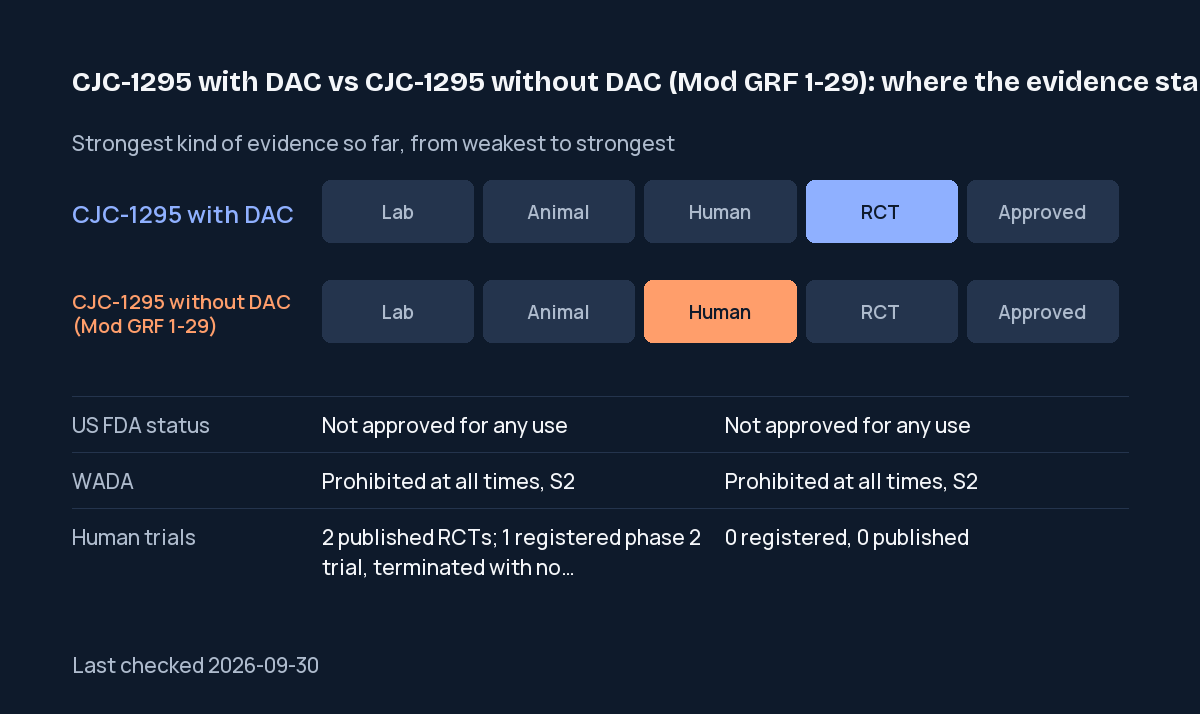
Verdict: CJC-1295 with DAC is a long-acting growth hormone–releasing hormone (GHRH) analog with a few small human trials measuring hormone levels. CJC-1295 without DAC (Mod GRF 1-29) is the same peptide minus the albumin-binding linker and has no published human trials. Neither is FDA approved; both are banned in sport.
Across both forms, the strongest evidence is two placebo-controlled trials in healthy adults. One injection of the DAC form raised growth hormone (GH) and IGF-1 for days [Human RCT]. No study of either form has measured muscle, fat loss, recovery or long-term safety. FDA lists serious adverse events, including increased heart rate and a systemic vasodilatory reaction.
| Item | CJC-1295 with DAC | CJC-1295 without DAC (Mod GRF 1-29) |
|---|---|---|
| US FDA status | Not approved for any use | Not approved for any use |
| Compounding (503A/503B) | “CJC-1295”: nominated, then withdrawn from Category 2 (FDA, 2026-04-22); not on the 503A bulks list | FDA’s page names “CJC-1295” and does not separate the forms |
| WADA 2026 | Prohibited at all times, S2 (GHRH analogs) (WADA) | Prohibited at all times, S2 (a GHRH analog) |
| Strongest evidence | Human RCT, hormone levels only | No published human study; rat detection data only |
| Human trials | 2 published RCTs; 1 registered phase 2 trial, terminated with no results (NCT00267527) | 0 registered, 0 published |
| Last checked | 2026-09-30 | 2026-09-30 |
Key points:
- “DAC” (Drug Affinity Complex) is a lysine carrying a maleimide group. It binds the peptide to albumin in the blood, which is what makes the DAC form long-acting (Jetté 2005) [Animal].
- The only human study of GH pulse patterns used the DAC form. Pulses were kept, and baseline (trough) GH rose 7.5-fold (Ionescu 2006) [Human].
- A product seized by Norwegian police and sold as “CJC-1295” contained a 29-amino-acid peptide, which matches the no-DAC form (Henninge 2010).
- The “about 30 minutes” half-life widely quoted for the no-DAC form has no primary source that we could find.
- The one company-sponsored phase 2 trial, in HIV-associated abdominal fat, was terminated in 2006 and never posted results.
CJC-1295 with DAC vs without DAC at a glance
| Feature | With DAC | Without DAC |
|---|---|---|
| What it is | Modified GRF(1-29) plus a lysine–maleimide linker (Jetté 2005) | The 29-amino-acid modified GRF(1-29) alone (Knoop 2016) |
| Class | GHRH analog | GHRH analog |
| Receptor | GHRH receptor on the pituitary | GHRH receptor on the pituitary |
| Key design feature | Binds albumin; half-life 5.8–8.1 days in humans (Teichman 2006) | Four amino-acid swaps resist enzyme breakdown; no published human half-life |
| Main research focus | GH deficiency, HIV-associated abdominal fat | Anti-doping detection only |
| Human evidence | 2 RCTs in healthy adults, plus 2 small studies in healthy men | None |
| Registered trials | 1, terminated (NCT00267527) | 0 |
| Approval status | Not approved anywhere we could find | Not approved anywhere we could find |
| WADA | S2, banned at all times | S2, banned at all times |
| Routes studied | Subcutaneous (humans, rats) | Intravenous (rats, detection study) |
| Timelines reported | GH raised for 6+ days, IGF-1 for 9–11 days after one dose | Detectable in rat plasma up to 8 hours |
| Main safety concerns | FDA-listed serious events; no long-term data | No human safety data at all |
What is CJC-1295 with DAC?
CJC-1295 with DAC is the compound first described under the name CJC-1295. It starts from the first 29 amino acids of human GHRH, changes four of them, and adds a lysine carrying a maleimidopropionamide group at the end. In rats, that group attached the peptide to serum albumin within 15 minutes, and the peptide was still in plasma after 72 hours (Jetté 2005) [Animal]. In healthy adults, its half-life was 5.8–8.1 days (Teichman 2006) [Human RCT]. Its only registered patient trial ended early, and it was never approved.
What is CJC-1295 without DAC?
CJC-1295 without DAC, often sold as “Mod GRF 1-29,” is the modified 29-amino-acid chain without the albumin-binding linker. Anti-doping chemists describe it as (D-Ala2, Gln8, Ala15, Leu27)-GRF amide, meaning four amino acids are swapped to slow its breakdown in blood (Knoop 2016). Its published literature is almost entirely about finding it in seized products and athletes’ samples, not about its effects. A preparation sold as “CJC-1295” has been found to contain this form, so the name alone does not say which peptide a product contains (Henninge 2010).
How do they work differently?
Both forms act on the same receptor, the GHRH receptor on pituitary cells that make growth hormone. The difference is how long they stay in the body.
- With DAC: binds albumin after injection, which extends its half-life and duration of action (Alba 2006) [Animal]. In humans, one dose kept GH above baseline for 6 days or more (Teichman 2006) [Human RCT].
- Without DAC: has no albumin anchor. After an intravenous dose in rats, the four-substitution peptide was detected at 4 and 8 hours, while sermorelin (native GRF 1-29) was detected only at 2 hours (Knoop 2016) [Animal, n=3 rats].
- With DAC, pulse pattern: online sources often claim the DAC form gives a flat, constant “GH bleed” and the no-DAC form a “natural pulse.” The one human study that sampled GH every 20 minutes found that the DAC form kept normal pulse frequency and size and raised trough levels 7.5-fold (Ionescu 2006) [Human, healthy men].
- Without DAC, pulse pattern: no human study has measured it. Claims that it “mimics natural pulses” are reasoning from its short action, not measurements.
Evidence head-to-head
| Outcome | With DAC: best evidence | Without DAC: best evidence |
|---|---|---|
| Raises GH | Human RCT: 2- to 10-fold for 6+ days (Teichman 2006) | No published study |
| Raises IGF-1 | Human RCT: 1.5- to 3-fold for 9–11 days (Teichman 2006) | No published study |
| Keeps GH pulses | Human, healthy men: pulses preserved (Ionescu 2006) | No published study |
| Growth | Animal: normal growth in GHRH-knockout mice with daily dosing (Alba 2006) | No published study |
| Blood protein changes | Human, healthy men: apolipoprotein A1 and transthyretin fell (Sackmann-Sala 2009) | No published study |
| Abdominal fat (HIV) | Phase 2 terminated, no results (NCT00267527) | Never tested |
| Muscle, fat loss, recovery | No study | No study |
| How long it lasts | Human: half-life 5.8–8.1 days (Teichman 2006) | Animal: detected up to 8 h in rats (Knoop 2016) |
Raising GH and IGF-1 on a blood test is a surrogate marker. It does not show benefits for muscle, fat loss or recovery, and neither form has been tested for those outcomes.
Which fits which goal?
CJC-1295 with DAC has more evidence for raising GH and IGF-1 levels for several days after one dose in healthy adults (Teichman 2006) [Human RCT]. The trial authors saw a cumulative effect: with repeated doses, IGF-1 stayed above baseline for up to 28 days. CJC-1295 without DAC has no human evidence for any outcome. The claim that it is “gentler” or “more natural” has not been tested in people.
For body composition, strength, sleep, recovery or anti-aging, neither form has any human outcome data. The GHRH analog with FDA-approved outcome data is tesamorelin (Egrifta). It is approved to reduce excess abdominal fat in people with HIV and lipodystrophy (FDA label) [Approved label]. We compare it with two other GH-related peptides in ipamorelin vs sermorelin vs tesamorelin. Whether any GH-axis treatment is appropriate is for a clinician to decide, after testing.
Can they be combined?
People rarely combine the two CJC-1295 forms with each other. The common pairing online is either form with ipamorelin, a GH secretagogue that acts on a different receptor. Ipamorelin remains in FDA’s Category 2 for 503B outsourcing facilities because of safety concerns (FDA). No controlled human study has tested CJC-1295 (either form) combined with ipamorelin, or the two CJC-1295 forms together. Our review of the peptides discussed on Joe Rogan’s podcast covers what is known about each one separately.
Safety and regulatory status
United States. Neither form is an approved drug. FDA’s compounding page says compounded CJC-1295 “may pose risk for immunogenicity” (a risk of triggering an immune response), notes impurity and characterization problems, and states that “FDA has identified serious adverse events associated with CJC-1295 including increased heart rate and systemic vasodilatory reaction. Available clinical data are limited” (FDA, page dated 2026-04-22). A systemic vasodilatory reaction is a sudden, body-wide widening of blood vessels. The nomination was withdrawn from Category 2. That withdrawal is not an approval and not a Category 1 listing. FDA’s text does not say which form the reports involved.
Human safety record. In the two trials in healthy adults, no serious adverse reactions were reported, and the authors called doses of 30 or 60 µg/kg “relatively well tolerated” (Teichman 2006) [Human RCT]. Those trials lasted 28 and 49 days. The only patient trial was terminated without posted results (NCT00267527). The no-DAC form has no human safety data. A 2026 review of GH-axis peptides used without supervision describes endocrine and metabolic disturbances among its adverse effects (Dominikowski 2026) [Review].
A risk specific to the DAC form. With a half-life of about a week, any unwanted effect would not stop quickly when dosing stops. This follows from the measured half-life. No study has examined how long side effects last.
Product identity. Because both forms are sold under one name, the label may not say which peptide is in a product. Forensic analysis has found the 29-amino-acid form in a preparation sold as CJC-1295 (Henninge 2010). Our overview Are peptides safe? covers the wider quality problem with unregulated peptides.
Sport. WADA’s 2026 list bans GHRH and its analogs, naming CJC-1295, under S2 at all times (WADA 2026 Prohibited List). USADA states that growth hormone–releasing factors “are prohibited at all times” (USADA). Anti-doping labs have published methods that detect CJC-1295 in plasma (Knoop 2016).
How long do effects take in studies?
With DAC: after a single injection, mean GH rose 2- to 10-fold for 6 days or more and IGF-1 rose 1.5- to 3-fold for 9–11 days. After multiple doses, IGF-1 stayed above baseline for up to 28 days (Teichman 2006) [Human RCT]. One week after a single dose, overall GH was up 46% and IGF-1 up 45%, with no difference between the two doses tested (Ionescu 2006) [Human]. In mice lacking growth hormone-releasing hormone, growth normalized over a 5-week course only on the most frequent of the three injection schedules tested (Alba 2006) [Animal]. Without DAC, no human timeline has been published.
What users report
What follows are unverified self-reports from people who usually bought unregulated products, not evidence. People who post about CJC-1295 on Reddit, bodybuilding boards and YouTube most often describe deeper sleep, more vivid dreams, water retention and a flushed or warm feeling soon after use. A recurring complaint about the DAC form is lasting water retention, numb or tingling hands, and lethargy that did not fade quickly. People describe the no-DAC form as milder, with shorter-lived flushing and head rush. Many say they noticed no change in body composition, and some question whether their product contained what the label said. Much of the discussion is an argument over whether the DAC form causes a harmful “GH bleed” or whether the no-DAC form is “more natural.” As the sections above show, the only human measurement of pulse patterns does not settle this. Cost, injection-site redness and confusing product names are other common complaints.