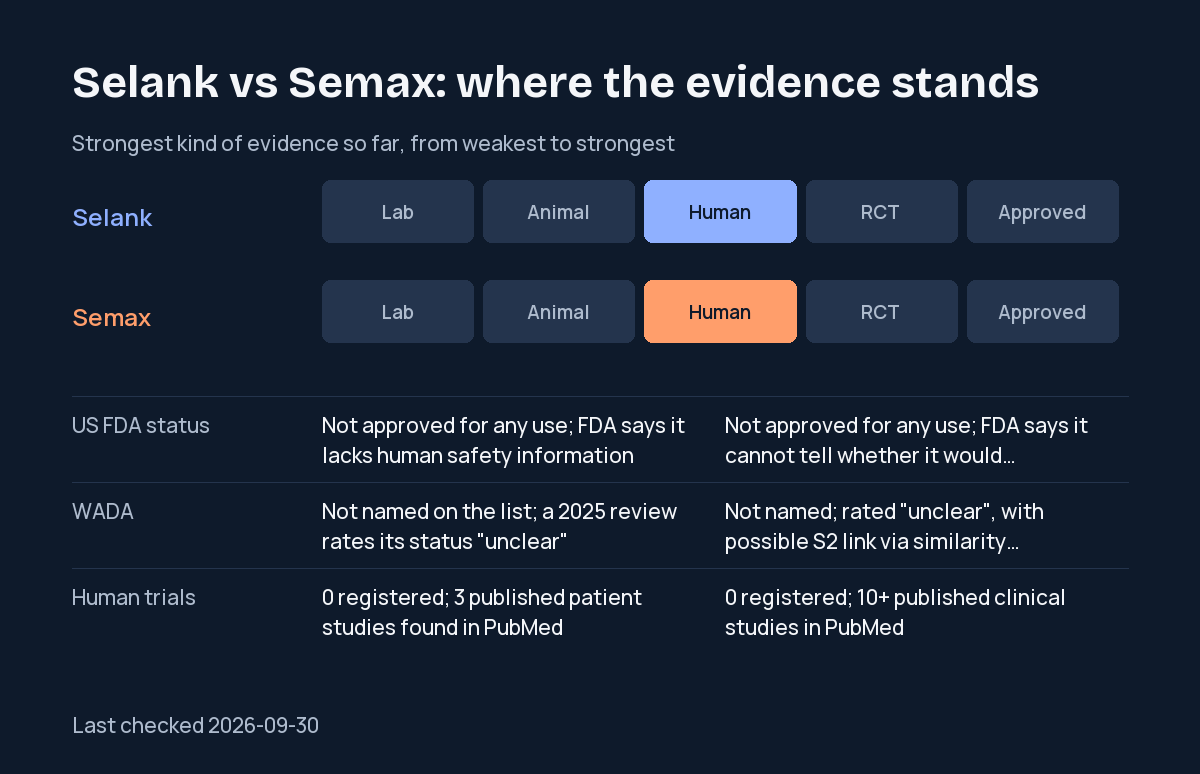
Selank vs Semax: Selank is a tuftsin-based peptide studied mainly for anxiety. Semax is an ACTH-based peptide studied mainly for stroke recovery and brain function. Neither is FDA-approved. Semax has more human studies, but for both the best evidence is small Russian comparative studies, and none is registered on ClinicalTrials.gov.
Both have encouraging early results. In a 62-patient study, Selank’s anti-anxiety effect was similar to that of the benzodiazepine medazepam [Human, comparative study, n=62]. In 110 stroke patients, adding Semax was linked to faster functional recovery [Human, comparative study, n=110]. Neither peptide has long-term safety data or a registered randomized trial.
| Item | Selank | Semax |
|---|---|---|
| US FDA status | Not approved for any use; FDA says it lacks human safety information | Not approved for any use; FDA says it cannot tell whether it would cause harm |
| Compounding (503A/503B) | Category 2 nomination withdrawn (FDA page updated 2026-04-22); in no category now; not on the July 2026 PCAC agenda; no review date posted | Category 2 nomination withdrawn; PCAC voted 8–5 on 2026-07-24 to recommend 503A listing (as reported); advisory, no FDA rule yet; rulemaking date not announced |
| WADA 2026 | Not named on the list; a 2025 review rates its status “unclear” (not the same as permitted) | Not named; rated “unclear”, with possible S2 link via similarity to tetracosactide |
| Outside the US | Described as a Russian drug | On Russia’s Vital and Essential Drugs list |
| Strongest evidence | Human comparative studies vs benzodiazepines (n=60–70) | Human comparative studies in stroke and cerebrovascular disease (n=110–187) |
| Human trials | 0 registered; 3 published patient studies found in PubMed | 0 registered; 10+ published clinical studies in PubMed |
| Last checked | 2026-09-30 | 2026-09-30 |
What changed (October 2026): FDA’s own pre-meeting review of Semax is now summarized, the 2027 WADA List is added, and a short section covers the nasal-drop forms both were studied in.
Key points:
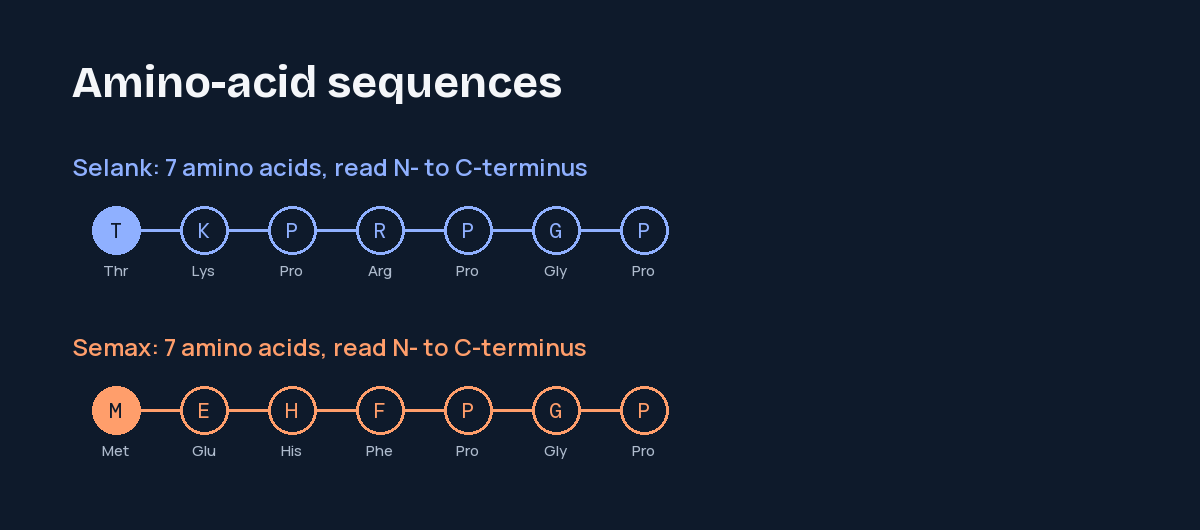
- Both peptides end in the same Pro-Gly-Pro tail, which was added to help them resist breakdown by enzymes.
- FDA flagged both for possible immunogenicity (unwanted immune reactions) from aggregation and impurities in compounded forms.
- Selank has been tested as an add-on: with phenazepam it reduced that drug’s side effects in 70 patients [Human, comparative study, n=70].
- A 2020 laboratory analysis found both in seized preparations marketed online as freeze-dried powders and nasal sprays.
- No controlled human study has tested Selank and Semax together (PubMed, searched 2026-10-27).
Selank vs Semax at a glance
| Feature | Selank | Semax |
|---|---|---|
| What it is | Synthetic 7-amino-acid peptide (Thr-Lys-Pro-Arg-Pro-Gly-Pro) | Synthetic 7-amino-acid peptide (Met-Glu-His-Phe-Pro-Gly-Pro) |
| Parent molecule | Tuftsin, a fragment of immunoglobulin G (Volkova 2016) | ACTH(4-7), a fragment of the stress hormone ACTH (Filippenkov 2020) |
| Proposed mechanism | Slows enkephalin breakdown [Lab]; shifts GABA-related gene activity [Animal] | Raises BDNF and trkB in rat hippocampus [Animal] |
| Main research focus | Anxiety, neurasthenia | Stroke, cerebrovascular disease, optic nerve disease |
| Human evidence | 3 comparative patient studies, n=60–70 | Comparative studies up to n=187 |
| Registered trials | 0 (ClinicalTrials.gov) | 0 (ClinicalTrials.gov) |
| US approval | None | None |
| Russia | Described as a Russian drug | Vital and Essential Drugs list |
| WADA 2026 | Not named; status unclear | Not named; unclear, possibly S2 |
| Routes studied | Intranasal (animal studies) | Intranasal (most clinical studies) |
| Timelines reported | Effect lasted about a week after the last dose | Ulcer healing assessed at day 14 |
| Main safety concerns | No long-term data; FDA immunogenicity concern | EEG paroxysmal activity in some patients; FDA immunogenicity concern |
What is Selank?
Selank is a seven-amino-acid peptide made by extending tuftsin, a short fragment of human immunoglobulin G, with a Pro-Gly-Pro tail. It was designed at the Institute of Molecular Genetics of the Russian Academy of Sciences together with the Zakusov Institute of Pharmacology. According to a 2016 summary of the clinical work, its effect resembles low-dose tranquilizers without the amnesia, withdrawal and dependence seen with benzodiazepines. A 2021 US pharmacology review called it a poorly studied Russian drug “inexplicably sold to US consumers as dietary supplements”. No FDA-approved Selank product exists.
What is Semax?
Semax is a seven-amino-acid peptide that joins ACTH(4-7), a fragment of the stress hormone adrenocorticotropin, to the same Pro-Gly-Pro tail, which makes it more resistant to peptidases. It is described as having no hormonal activity and is on Russia’s List of Vital and Essential Drugs for neurological conditions and stress states. Its clinical literature centers on ischemic stroke, chronic cerebrovascular insufficiency and optic nerve disease. It is the only one of the two that FDA’s compounding advisory committee has reviewed.
How they work differently
- Enkephalins (the body’s own pain- and stress-dampening peptides). Selank: in patients’ plasma it dose-dependently slowed enkephalin breakdown, with an IC50 of 15 µM [Lab] (Zozulya 2001). Semax: showed the same kind of enzyme inhibition in human serum [Lab] (Kost 2001), so this is an overlap rather than a difference.
- GABA system. Selank: changed the expression of GABA-related genes in the rat frontal cortex after intranasal administration [Animal, n=30] (Volkova 2016). Semax: we found no comparable GABA finding.
- BDNF (brain-derived neurotrophic factor, a nerve-growth signal). Selank: regulated BDNF expression in the rat hippocampus [Animal] (Inozemtseva 2008). Semax: one application raised hippocampal BDNF protein up to 1.4-fold and trkB receptor activation 1.6-fold in rats [Animal] (Dolotov 2006), and plasma BDNF rose and stayed high in stroke patients [Human, n=110] (Gusev 2018).
- Injury and immune genes. Selank: induced interferon-alpha gene expression in mice with influenza [Animal] (Ershov 2009). Semax: after a stroke-like injury in rats it changed 394 genes, suppressing inflammation genes and activating neurotransmission genes [Animal] (Filippenkov 2020).
- Brain networks in people. Selank and Semax each changed connectivity between the right amygdala and temporal regions compared with placebo [Human fMRI, n=52] (Panikratova 2020). Semax also enlarged the frontal part of the brain’s default mode network compared with placebo [Human fMRI, n=24] (Lebedeva 2018).
Evidence head-to-head
Each cell gives the highest evidence level we found and the study behind it (our grading method is explained on how we compare peptides). None of the human studies below is described as randomized and blinded in its abstract, and all come from Russian research groups.
| Outcome | Selank best evidence | Semax best evidence |
|---|---|---|
| Anxiety | Human, comparative (n=62): effect similar to medazepam (Zozulia 2008); n=60 vs phenazepam (Medvedev 2014) | Animal: less anxiety-like behavior in rats (Glazova 2021) |
| Benzodiazepine side effects | Human, comparative (n=70): fewer phenazepam side effects (Medvedev 2015) | No data found |
| Acute stroke recovery | No human data found | Human, vs controls (n=110): faster Barthel-score recovery (Gusev 2018); 30 vs 80 controls (Gusev 1997) |
| Chronic cerebrovascular disease | No data found | Human (n=187) (Gusev 2005) |
| Memory and focus | Human fMRI only, no cognitive test (n=52) (Panikratova 2020) | Human (n=73): helped memory problems after hypoxic brain injury (Alekseeva 1999); animal learning gains (Dolotov 2006) |
| Motor neuron disease (ALS) | No data found | Human (n=27): better quality of life, no effect on disease course (Serdiuk 2007) |
| Peptic ulcer | No data found | Human, vs controls: 89.5% vs 30.8% healed by day 14 (Ivanikov 2002) |
| Antiviral/immune | Animal and lab: suppressed influenza virus reproduction (Ershov 2009) | No data found |
| Registered trials | 0 (ClinicalTrials.gov) | 0 (ClinicalTrials.gov) |
The pattern is clear: Selank’s human record is narrow but on-target for anxiety, while Semax’s is broader and larger, spread across stroke, eye, gut and neurological conditions. A 2020 analysis of seized products noted that, to the authors’ knowledge, neither peptide had “completed any clinical trials”.
Which fits which goal?
Selank has more evidence for anxiety. Three Russian patient studies (n=60–70) compared it with benzodiazepines or used it alongside one, and its effect on anxiety was described as similar to medazepam [Human, comparative study, n=62].
Semax has more evidence for recovery after ischemic stroke and for chronic cerebrovascular insufficiency, where studies enrolled up to 187 patients [Human, n=187]. It also has small human studies in optic nerve disease, ALS and peptic ulcer.
For focus or memory in healthy people, neither has outcome data: the healthy-volunteer studies measured brain scans, not test scores (Panikratova 2020). These are statements about evidence, not a reason to use either peptide. A clinician is the person to decide whether any treatment fits a given situation.
Can they be combined?
Selank and Semax are often discussed as a pair online, but no controlled human study has tested the combination (PubMed, searched 2026-10-27). The closest work is a 2001 lab study showing both inhibit the same enkephalin-degrading enzymes in human serum [Lab], and a 2020 brain-imaging study that reported each peptide’s effects in healthy volunteers without describing a combined arm [Human fMRI, n=52]. Selank has been studied alongside a benzodiazepine, phenazepam, where the pairing lowered phenazepam’s side effects [Human, comparative study, n=70]. That result says nothing about pairing it with Semax.
Safety and regulatory status
United States
Neither peptide is FDA-approved. Both were nominated for compounding and placed on FDA’s Category 2 list, then the nominations were withdrawn (page updated 2026-04-22). Withdrawal did not move either into Category 1. On that page FDA says compounded forms of both “may pose risk for immunogenicity for certain routes of administration due to the potential for aggregation and peptide-related impurities”. For Selank, FDA says it lacks important safety information for use in humans. For Semax, it says it lacks enough information to know whether the drug would cause harm in humans.
Semax was reviewed by FDA’s Pharmacy Compounding Advisory Committee on 2026-07-24 for cerebral ischemia, migraine and trigeminal neuralgia. Trade and medical press reported an 8–5 vote to recommend adding it to the 503A bulks list; FDA has posted no minutes. The vote is advisory: FDA has published no rule, and no rulemaking date is announced. Selank was not on the agenda.
FDA’s own staff review, written for that meeting (FDA briefing document, review memo dated 2026-05-11), found “insufficient evidence to support the effectiveness” of Semax for any of the three uses. The migraine data were one uncontrolled study of 12 adults, in which 4 reported that the headache stopped; in an uncontrolled trigeminal neuralgia study of 25 adults, patients with typical trigeminal neuralgia showed no change. The review also raised three safety signals: anticoagulant and antithrombotic effects in rats, which “raises concern about the risk of bleeding” [Animal]; a stronger amphetamine-induced dopamine release in mice [Animal]; and one consumer report to FDA of eye pain and burning after nasal drops bought online. The committee voted after reading this review. For how these categories work across peptides, see are peptides safe? what the evidence and the FDA say.
Russia and elsewhere
FDA’s review states that “Semax is a registered drug in Russia and is available as 0.1% and 1% nasal drops” (FDA briefing document). Most Semax clinical studies, and the Selank animal work, used the intranasal route. Sprays and drops sold online in the US are not those registered products: no US product of either peptide is approved, and their contents are not checked by any regulator.
Semax is on Russia’s List of Vital and Essential Drugs, and Selank is described in the literature as a Russian drug. A 2020 analysis of seized preparations found both in two suspicious products, noted that such peptides are sold freely online, and developed a test method so control agencies could detect them [Lab].
Sport
Neither is named on the WADA Prohibited List. A 2025 Biology of Sport review classed both as “unclear” status and noted Semax’s similar biological effects to tetracosactide, a prohibited S2 peptide hormone. “Unclear” is not the same as permitted; a national anti-doping agency is the body that answers that question for an athlete.
The 2027 List, in force from 2027-01-01, now names “peptides” in general in the S0 class (USADA athlete advisory). S0 covers substances with no current approval by any government health authority for human use. Semax is “a registered drug in Russia” (FDA briefing document), so the List’s wording does not settle whether S0 reaches it, and neither peptide is named. Selank’s position is no clearer. The advice above stands: ask the agency first.
Side effects and unknowns
Selank’s clinical reports describe no benzodiazepine-type side effects such as amnesia, withdrawal or dependence, but the studies are small and short. For Semax, one study of 73 patients noted that “in some cases EEG showed episodes of paroxysmal activity”, meaning sudden bursts of abnormal brain-wave activity, after administration [Human, n=73]. No study reports long-term use of either, and products sold online are unregulated, so their contents and purity are unknown.
How long do effects take in studies?
- Selank: in 60 patients with anxiety disorders, the anti-anxiety effect lasted about a week after the last dose [Human, comparative study, n=60].
- Semax: in refractory peptic ulcer, healing was assessed on day 14 (89.5% vs 30.8% of controls) [Human, comparative study].
- Semax: in stroke patients, plasma BDNF rose and stayed high for the whole study period [Human, n=110].
What users report
These are unverified self-reports from people who usually bought unregulated products; they are not evidence. People who post about Selank commonly describe feeling calmer or less socially anxious without the drowsiness they associate with benzodiazepines, often saying they noticed it within the first few days. People who post about Semax more often describe sharper focus, motivation or easier word-finding, sometimes soon after use. A recurring complaint for both is that nothing noticeable happened at all, and many threads argue about placebo. Other frequent complaints are nasal irritation, headaches and, for Semax, irritability, restlessness or worse sleep. Some posters say the effect faded over a few weeks. Product quality is a constant worry: many doubt that sprays or powders contain the labeled peptide, and cost comes up often. Users also argue about whether the two should be combined and whether the Russian clinical studies say anything about products sold online.
Frequently asked questions
Is Selank or Semax FDA approved?
No. Neither Selank nor Semax is approved by the FDA for any use. Both had their compounding nominations withdrawn from FDA’s Category 2 list, which is not the same as approval. FDA states that compounded forms of both may pose an immunogenicity risk and that it lacks human safety information.
Which is better for anxiety, Selank or Semax?
Selank has the stronger anxiety evidence, though it is still limited. In a Russian study of 62 patients with generalized anxiety disorder or neurasthenia, its effect was similar to medazepam, a benzodiazepine. Semax’s anxiety data come from rats. Neither has a registered randomized trial, and a clinician should judge any treatment choice.
Can Selank and Semax be used together?
No controlled human study has tested Selank and Semax together (PubMed, searched 2026-10-27), so there is no evidence on the benefits or risks of the pair. A 2020 brain-imaging study in 52 healthy volunteers reported each peptide’s effects against placebo but did not describe a combined group. Claims about the combination are anecdotal.
Are Selank and Semax banned in sports?
Neither is named on WADA’s 2026 or 2027 list, but that does not make them permitted. From 2027-01-01, S0 names “peptides” in general for substances without government approval (USADA), and Semax is registered in Russia, so the wording does not settle it. A 2025 anti-doping review rated both “unclear”. Athletes need a ruling from their anti-doping agency.
Do Selank and Semax have side effects?
The small Russian studies report few side effects, but no long-term data exist for either. One Semax study of 73 patients recorded paroxysmal EEG activity in some cases. FDA also says compounded forms of both may pose a risk of immune reactions from aggregation and impurities.
Is Selank or Semax better for ADHD?
Neither can be called better, because no published study has tested Selank or Semax in people with ADHD. Semax has been proposed for it on the basis of animal findings, such as a rise of up to 1.4-fold in hippocampal BDNF after one application in rats (Dolotov 2006) [Animal]. Rat findings do not show benefit in people, and ADHD treatment decisions belong with a clinician.
References
- US Food and Drug Administration. Certain bulk drug substances for use in compounding that may present significant safety risks (updated 2026-04-22). fda.gov
- US Food and Drug Administration. July 23–24, 2026 meeting of the Pharmacy Compounding Advisory Committee. fda.gov
- World Anti-Doping Agency. The Prohibited List (2026). wada-ama.org
- Pokrywka A, et al. (2025). “Brain doping” substances: prohibited or not in sports? Biology of Sport. PMC12492343
- ClinicalTrials.gov search: selank. clinicaltrials.gov
- ClinicalTrials.gov search: semax. clinicaltrials.gov
- Zozulia AA, Neznamov GG, Siuniakov TS, et al. (2008). Efficacy and possible mechanisms of action of a new peptide anxiolytic selank in the therapy of generalized anxiety disorders and neurasthenia. Zh Nevrol Psikhiatr Im S S Korsakova. PMID 18454096
- Medvedev VE, Tereshchenko ON, Israelian AIu, et al. (2014). A comparison of the anxiolytic effect and tolerability of selank and phenazepam in the treatment of anxiety disorders. Zh Nevrol Psikhiatr Im S S Korsakova. PMID 25176261
- Medvedev VE, Tereshchenko ON, Kost NV, et al. (2015). Optimization of the treatment of anxiety disorders with selank. Zh Nevrol Psikhiatr Im S S Korsakova. PMID 26356395
- Gusev EI, Skvortsova VI, Miasoedov NF, et al. (1997). Effectiveness of semax in acute period of hemispheric ischemic stroke. Zh Nevrol Psikhiatr Im S S Korsakova. PMID 11517472
- Gusev EI, Martynov MY, Kostenko EV, et al. (2018). The efficacy of semax in the treatment of patients at different stages of ischemic stroke. Zh Nevrol Psikhiatr Im S S Korsakova. PMID 29798983
- Gusev EI, Skvortsova VI, Chukanova EI, et al. (2005). Semax in prevention of disease progress and development of exacerbations in patients with cerebrovascular insufficiency. Zh Nevrol Psikhiatr Im S S Korsakova. PMID 15792140
- Ivanikov IO, Brekhova ME, Samonina GE, et al. (2002). Therapy of peptic ulcer with semax peptide. Bull Exp Biol Med. PMID 12459874
- Serdiuk AV, Levitskiĭ GN, Miasoedov NF, et al. (2007). The study of chronic partial denervation and quality of life in patients with motor neuron disease treated with semax. Zh Nevrol Psikhiatr Im S S Korsakova. PMID 18379501
- Alekseeva GV, Bottaev NA, Goroshkova VV, et al. (1999). Use of semax at a follow-up of patients with posthypoxic encephalopathy. Anesteziol Reanimatol. PMID 10199046
- Lebedeva IS, Panikratova YR, Sokolov OY, et al. (2018). Effects of Semax on the default mode network of the brain. Bull Exp Biol Med. PMID 30225715
- Panikratova YR, Lebedeva IS, Sokolov OY, et al. (2020). Functional connectomic approach to studying Selank and Semax effects. Dokl Biol Sci. PMID 32342318
- Kost NV, Sokolov OIu, Gabaeva MV, et al. (2001). Semax and selank inhibit the enkephalin-degrading enzymes from human serum. Bioorg Khim. PMID 11443939
- Zozulya AA, Kost NV, Sokolov OYu, et al. (2001). The inhibitory effect of Selank on enkephalin-degrading enzymes as a possible mechanism of its anxiolytic activity. Bull Exp Biol Med. PMID 11550013
- Dolotov OV, Karpenko EA, Inozemtseva LS, et al. (2006). Semax, an analog of ACTH(4-10) with cognitive effects, regulates BDNF and trkB expression in the rat hippocampus. Brain Res. PMID 16996037
- Inozemtseva LS, Karpenko EA, Dolotov OV, et al. (2008). Intranasal administration of the peptide Selank regulates BDNF expression in the rat hippocampus in vivo. Dokl Biol Sci. PMID 18841804
- Volkova A, Shadrina M, Kolomin T, et al. (2016). Selank administration affects the expression of some genes involved in GABAergic neurotransmission. Front Pharmacol. PMC4757669
- Filippenkov IB, Stavchansky VV, Denisova AE, et al. (2020). Novel insights into the protective properties of ACTH(4-7)PGP (Semax) peptide at the transcriptome level following cerebral ischaemia–reperfusion in rats. Genes. PMC7350263
- Radchenko AI, Kuzubova EV, Apostol AA, et al. (2025). The potential of the peptide drug Semax and its derivative for correcting pathological impairments in the animal model of Alzheimer’s disease. Acta Naturae. PMC12755871
- Glazova NY, Manchenko DM, Volodina MA, et al. (2021). Semax, synthetic ACTH(4-10) analogue, attenuates behavioural and neurochemical alterations following early-life fluvoxamine exposure. Neuropeptides. PMID 33418449
- Ershov FI, Uchakin PN, Uchakina ON, et al. (2009). Antiviral activity of immunomodulator Selank in experimental influenza infection. Vopr Virusol. PMID 19882898
- Vanhee C, Francotte A, Janvier S, Deconinck E (2020). The occurrence of putative cognitive enhancing research peptides in seized pharmaceutical preparations. Drug Test Anal. PMID 31667971
- Doyno CR, White CM (2021). Sedative-hypnotic agents that impact gamma-aminobutyric acid receptors. J Clin Pharmacol. PMID 34396551
- US Food and Drug Administration. FDA briefing document: semax (free base) and semax acetate, Pharmacy Compounding Advisory Committee, July 23–24, 2026 (review memo 2026-05-11). fda.gov
- USADA. Athlete advisory: 2027 Prohibited List (2026-10-06). usada.org
Change log
2026-10-27: FDA’s pre-meeting review of Semax summarized (effectiveness and safety findings); 2027 WADA List added; nasal-drop forms described; PubMed re-searched for combined studies; reviewed by the editorial team.
2026-10-26: links to related entries added; no change to the facts.
2026-10-24: evidence level added to the 2020 seized-product analysis (Vanhee 2020); reviewed by the editorial team.
2026-10-18: 2020 seized-product study described as in its abstract (Vanhee 2020); reviewed by the editorial team.
2026-10-04: FAQ expanded with one question readers search for (ADHD); reviewed by the editorial team.
2026-09-30: first published after review by the editorial team.