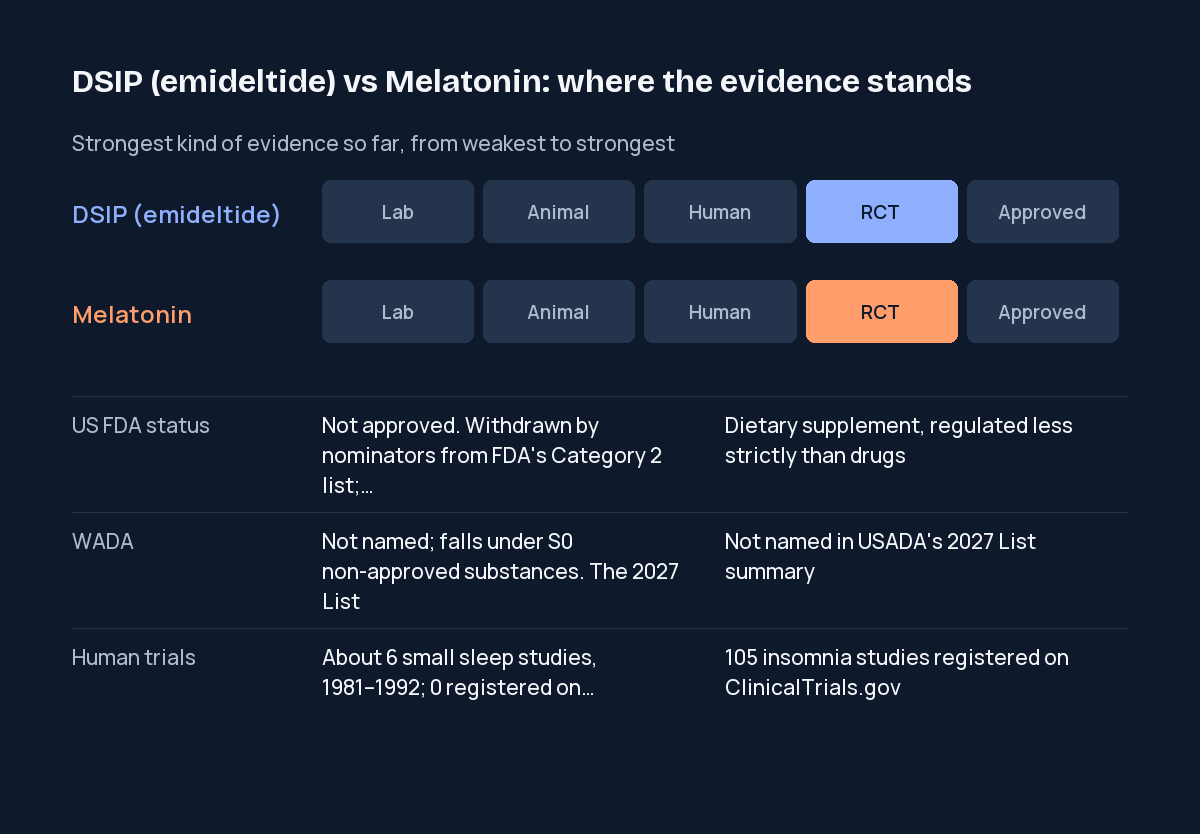
DSIP vs melatonin: DSIP (delta sleep-inducing peptide) is an unapproved research peptide whose most promising result is a small 1987 placebo-controlled trial in which seven nights of injections brought sleep efficiency in 14 chronic insomniacs up to the level of normal sleepers (Schneider-Helmert, 1987). Melatonin is a pineal hormone with far more evidence: a meta-analysis of 19 trials (n=1,683) found it shortened time to fall asleep by about 7 minutes (Ferracioli-Oda, 2013). DSIP has no FDA approval; melatonin is a US dietary supplement and an EU-authorized medicine for insomnia at 55 and over.
| Item | DSIP (emideltide) | Melatonin |
|---|---|---|
| US FDA status | Not approved. Withdrawn by nominators from FDA’s Category 2 list; page current as of 2026-04-22 (FDA) | Dietary supplement, regulated less strictly than drugs (NIH NCCIH) |
| Compounding (503A) | PCAC reviewed it on 2026-07-24; no vote is posted on the FDA meeting page (checked 2026-11-09), any vote is advisory, and FDA has issued no rule (FDA meeting page) | Not on FDA’s Category 2 page (checked 2026-11-09) |
| Approved elsewhere | None identified in the sources reviewed (2026-11-09) | EU: Circadin, authorized 2007-06-29, insomnia aged 55+ (EMA) |
| WADA | Not named; falls under S0 non-approved substances. The 2027 List (in force 2027-01-01) names “peptides” in S0 (USADA) | Not named in USADA’s 2027 List summary (checked 2026-11-09) |
| Strongest evidence | Human RCT (n=16, 1992), weak effect | Meta-analysis of 19 RCTs (n=1,683) |
| Human trials | About 6 small sleep studies, 1981–1992; 0 registered on ClinicalTrials.gov (searched 2026-11-09) | 105 insomnia studies registered on ClinicalTrials.gov (searched 2026-11-09) |
| Last checked | 2026-11-09 | 2026-11-09 |
Key points:
- The best-designed DSIP trial, a 1992 double-blind study of 16 insomniacs, found weak effects and judged DSIP “not likely to be of major therapeutic benefit” (Bes, 1992).
- No DSIP gene, precursor protein or receptor has been isolated, so how it would act on sleep is unknown (Kovalzon, 2006).
- In 354 people aged 55–80, prolonged-release melatonin produced 26% responders vs 15% on placebo (Wade, 2007).
- Melatonin supplements tested in a 2017 study held between 83% less and 478% more melatonin than their labels stated (Erland, 2017).
- No human study of DSIP and melatonin together was found.
DSIP vs melatonin at a glance
| Feature | DSIP | Melatonin |
|---|---|---|
| What it is | Nine-amino-acid peptide first isolated from rabbit blood in 1977 | Hormone the pineal gland releases at night |
| Class | Neuropeptide, unlike any known peptide family | Pineal hormone (5-methoxy-N-acetyltryptamine) |
| Target | No receptor identified | MT1 and MT2 receptors |
| Main research focus | Chronic insomnia, opioid withdrawal | Insomnia, jet lag |
| Human evidence | About 6 small sleep studies (n=6 to 16 where reported) | 19 RCTs in one meta-analysis; 10 jet-lag trials in a Cochrane review |
| Approval | None identified | EU medicine (Circadin); US supplement |
| WADA | S0 (non-approved) | Not named |
| Routes studied | Intravenous | Oral tablets |
| Timelines in studies | Hours to 7 nights | Near bedtime (jet lag); short-term use (EU label) |
| Main safety concerns | No long-term data; unregulated products; immunogenicity risk flagged by FDA | Drowsiness; mislabeled supplements; child poisonings |
What is DSIP?
Delta sleep-inducing peptide, also called emideltide, is a peptide that a Basel research group isolated from rabbit cerebral venous blood in 1977 and first considered a natural sleep factor (Kovalzon and Strekalova, 2006). It is a nonapeptide, nine amino acids long (Ouichou, 1992), and its structure differs from every other known peptide family. The Kovalzon review calls the case for DSIP as a sleep factor “extremely poorly documented and still weak.” Human sleep testing ran from 1981 to 1992, by intravenous injection in the studies cited here. Our DSIP vs epitalon vs pinealon comparison ranks it against other sleep peptides.
What is melatonin?
Melatonin is a hormone the pineal gland releases on a circadian rhythm: low during the day, high at night (Liu, 2016). It is not a peptide. In the US it is sold as a dietary supplement, which the FDA regulates less strictly than drugs (NCCIH). In the EU, a 2 mg prolonged-release tablet, Circadin, has been an authorized medicine since 2007 for the short-term treatment of primary insomnia “characterised by poor quality of sleep” in people aged 55 or over (EMA). That makes melatonin the only one of the two with a regulator-reviewed sleep indication in the sources checked.
How they work differently
- DSIP: no gene, precursor protein or receptor has been isolated, and in rabbits and rats some synthetic DSIP analogues promoted slow-wave sleep “but not DSIP itself” [Animal] (Kovalzon, 2006).
Melatonin: binds two well-characterized G protein-coupled receptors, MT1 and MT2, which synthetic drugs such as ramelteon and tasimelteon also target (Liu, 2016). - DSIP: in healthy volunteers it produced a feeling of sleep pressure without “sedation in the classic pharmacologic way” [Human, n=6] (Schneider-Helmert, 1981).
Melatonin: its clearest trial results are in jet lag, a circadian timing problem [systematic review of 10 trials] (Herxheimer, 2002). - The link between them: in perifused rat pineal glands, DSIP stimulated the synthesis and release of melatonin and serotonin, apparently outside the noradrenergic and opioid pathways [Lab] (Ouichou, 1992). No human study testing this was found (PubMed, searched 2026-11-09).
Evidence head-to-head
| Outcome | DSIP best evidence | Melatonin best evidence |
|---|---|---|
| Time to fall asleep | Human RCT (n=16): shorter, but weak and possibly a placebo-group artifact (Bes, 1992) | Meta-analysis, 19 RCTs (n=1,683): 7.06 min shorter (Ferracioli-Oda, 2013) |
| Total sleep time | Human crossover RCT: increase in stage 2 only; no difference from baseline nights (Monti, 1987) | Meta-analysis: 8.25 min longer (Ferracioli-Oda, 2013) |
| Sleep efficiency / quality | Human RCT (n=14): reached normal-control levels after 7 nights (Schneider-Helmert, 1987) | Human RCT (n=354, ages 55–80): 26% vs 15% responders (Wade, 2007) |
| Jet lag | No study found | Systematic review, 10 trials: 9 positive, NNT 2 (Herxheimer, 2002) |
| Opioid withdrawal | Open trial, uncontrolled (Backmund, 1998) | No study cited here |
| Lasting effect | Open study (n=7): sleep normal in 6 of 7 at 3–7 months (Kaeser, 1984) | Long-term data lacking (NCCIH) |
All figures are cross-trial: no study has compared DSIP with melatonin directly, and the DSIP sleep studies are more than 30 years old, small, and half of them come from one lead author. The most encouraging DSIP benefits, better sleep efficiency and a significant rise in daytime alertness and performance, came from Schneider-Helmert’s 1987 trial (Schneider-Helmert, 1987). Other groups did not reproduce them: Monti’s team concluded the improvement was “of little clinical significance” (Monti, 1987), and Bes’s team found only weak effects (Bes, 1992). Melatonin’s average effect is modest too, but it rests on many more trials and people.
Which fits which goal?
Melatonin has more evidence for falling asleep sooner, insomnia after 55 and jet lag. Those are the outcomes with pooled trial data (Ferracioli-Oda, 2013), an EU authorization (EMA) and a Cochrane review (Herxheimer, 2002). The limit is the size of the effect: the American Academy of Sleep Medicine’s 2017 guideline suggests clinicians not use melatonin for sleep-onset or sleep-maintenance insomnia in adults, a weak recommendation (Sateia, 2017), and NIH’s complementary-health center says the evidence is not strong enough to recommend it for chronic insomnia (NCCIH).
DSIP has more evidence only where melatonin has none in the sources cited here: opioid withdrawal, and that rests on one uncontrolled trial (Backmund, 1998). For sleep, its promising results on sleep efficiency and daytime alertness (Schneider-Helmert, 1987) were not matched by later double-blind trials. A clinician is the person to decide what fits an individual sleep problem.
Can DSIP and melatonin be taken together?
People search for DSIP and melatonin together, and for blends that add GABA. The only evidence linking the two is a lab finding: DSIP raised melatonin release from rat pineal glands [Lab] (Ouichou, 1992). None of the human DSIP trials cited on this page gave melatonin or GABA alongside it. No controlled human study of the combination was found on PubMed or ClinicalTrials.gov (searched 2026-11-09), so nothing is known about whether the effects add up, cancel out or raise side-effect risk.
Safety and regulatory status
DSIP, United States. DSIP is not an approved drug. FDA once placed it in Category 2, the list of compounding substances that may present significant safety risks, noting that compounded emideltide “may pose risk for immunogenicity for certain routes of administration”; the nominators later withdrew it (FDA). Immunogenicity means the body may form antibodies against the product. On 2026-07-24 FDA’s Pharmacy Compounding Advisory Committee reviewed DSIP for opioid withdrawal, chronic insomnia and narcolepsy (FDA). FDA has not posted the committee’s vote or minutes on the meeting page (checked 2026-11-09). The vote is advisory; FDA has issued no rule. More on what the vote means is in our explainer on the FDA peptide compounding vote.
DSIP, side effects. The small 1981 studies reported no side effects (Schneider-Helmert, 1981), but they followed six people each over days. No long-term human safety data were found (PubMed, searched 2026-11-09), and with no approved product, purity and content depend on unregulated sellers. Our overview Are peptides safe? covers those risks in general.
Melatonin, United States. As a dietary supplement it is regulated less strictly than drugs. Short-term use “appears to be safe for most people,” long-term safety information is lacking, and mild side effects include headache, dizziness, nausea and sleepiness (NCCIH). Label accuracy is a real problem: in a 2017 analysis of 31 supplements, 71% missed their label claim by more than 10%, lot-to-lot content varied by up to 465%, and 26% contained serotonin (Erland, 2017). US poison centers recorded 260,435 pediatric melatonin ingestions from 2012 to 2021, with the annual number up 530%; five children needed mechanical ventilation and two died (Lelak, 2022).
Melatonin, European Union. The Circadin information lists irritability, restlessness, abnormal dreams, dizziness, migraine and somnolence among reactions seen in 1 to 10 of every 1,000 patients, warns that it can cause drowsiness and advises avoiding alcohol (EMA).
Sport. WADA’s S0 class bans substances “not approved by any government regulatory authority” for human use (USADA). DSIP fits that description, and from 2027-01-01 the List names unapproved “peptides” in S0 explicitly (USADA). Melatonin is not named in USADA’s summary of the 2027 List (USADA), and because it is an EU-authorized medicine, the non-approved S0 class does not describe it.
Anyone who suspects a side effect from DSIP, melatonin or any other drug or product can report it to the FDA through MedWatch.
How long do effects take in studies?
- DSIP: in insomniacs, sleep promotion appeared in the second hour after injection, after a slight arousing effect in the first hour [Human, n=6] (Schneider-Helmert, 1981). Repeated injections showed a buildup, with sleep structure normalizing after four administrations (Schneider-Helmert, 1984). In the 7-night trial, effects held for one placebo night after treatment stopped [Human RCT, n=14] (Schneider-Helmert, 1987).
- Melatonin: in jet-lag trials it worked when taken close to the target bedtime at the destination (Herxheimer, 2002); Circadin is authorized for short-term treatment (EMA).
What users report
These are unverified self-reports from people who usually bought unregulated products, not evidence. People who post about DSIP commonly describe deeper or more vivid sleep and waking more refreshed, while a large share say they noticed nothing at all; many say any effect faded after the first few nights. Recurring complaints are grogginess the next morning, headaches, doubt about whether a product contained any peptide, and cost compared with melatonin. Posts about melatonin are more mixed than its reputation suggests: many describe falling asleep faster or adjusting better to time-zone changes, while frequent complaints include vivid dreams or nightmares, a “hangover” feeling, and products that seem to work one month and not the next. Threads often argue about whether DSIP’s effects are placebo, whether it does anything when not given intravenously as in the old trials, and whether adding it to melatonin or GABA does anything beyond what melatonin does alone.
Frequently asked questions
Is DSIP stronger than melatonin for sleep?
There is no evidence that it is, and no trial has compared them. DSIP’s best-controlled study, 16 insomniacs in 1992 [Human RCT], found weak effects judged not of “major therapeutic benefit” (Bes, 1992). Melatonin cut time to fall asleep by 7.06 minutes across 19 trials and 1,683 people [meta-analysis]. These are cross-trial figures from different populations and eras.
Does DSIP raise melatonin levels?
Only in a lab setting so far. In perifused rat pineal glands, DSIP stimulated melatonin and serotonin release in a dose-dependent way [Lab] (Ouichou, 1992). No human study measuring melatonin after DSIP was found (PubMed, searched 2026-11-09), so it is unknown whether this happens in people or explains any sleep effect.
Is DSIP FDA approved?
No. DSIP has no FDA approval as of 2026-11-09. FDA’s compounding advisory committee reviewed it on 2026-07-24 for insomnia, narcolepsy and opioid withdrawal; FDA has not posted the vote on its meeting page as of 2026-11-09 (FDA). The vote is advisory, and FDA has issued no rule.
Is melatonin safe to use long term?
That is not established. NIH’s complementary-health center says short-term use appears safe for most people but long-term safety information is lacking (NCCIH). Supplements also vary widely in content, from 83% below to 478% above the label in one 2017 analysis, which makes the actual amount in a product uncertain.
Is DSIP banned in sport?
Yes, for athletes under the WADA Code. No government approval of DSIP for human use was found, which places it in S0, non-approved substances (USADA). The 2027 List, in force from 2027-01-01, also names unapproved peptides in S0 explicitly. Melatonin is not named in USADA’s summary of the 2027 List.
References
- Schneider-Helmert D. (1987). Effects of delta-sleep-inducing peptide on 24-hour sleep-wake behaviour in severe chronic insomnia. European Neurology. PubMed 3622582
- Bes F, Hofman W, Schuur J, Van Boxtel C. (1992). Effects of delta sleep-inducing peptide on sleep of chronic insomniac patients. A double-blind study. Neuropsychobiology. PubMed 1299794
- Monti JM, Debellis J, Alterwain P, Pellejero T, Monti D. (1987). Study of delta sleep-inducing peptide efficacy in improving sleep on short-term administration to chronic insomniacs. International Journal of Clinical Pharmacology Research. PubMed 3583493
- Schneider-Helmert D, Gnirss F, Monnier M, Schenker J, Schoenenberger GA. (1981). Acute and delayed effects of DSIP on human sleep behavior. Int J Clin Pharmacol Ther Toxicol. PubMed 6895513
- Schneider-Helmert D, Schoenenberger GA. (1981). The influence of synthetic DSIP on disturbed human sleep. Experientia. PubMed 7028502
- Schneider-Helmert D. (1984). DSIP in insomnia. European Neurology. PubMed 6391925
- Kaeser HE. (1984). A clinical trial with DSIP. European Neurology. PubMed 6391926
- Backmund M, Meyer K, Rothenhaeusler HB, Soyka M. (1998). Opioid detoxification with delta sleep-inducing peptide: results of an open clinical trial. Journal of Clinical Psychopharmacology. PubMed 9617990
- Kovalzon VM, Strekalova TV. (2006). Delta sleep-inducing peptide (DSIP): a still unresolved riddle. Journal of Neurochemistry. PubMed 16539679
- Ouichou A, Zitouni M, Raynaud F, Simonneaux V, Gharib A, Pévet P. (1992). Delta-sleep-inducing peptide stimulates melatonin, 5-methoxytryptophol and serotonin secretion from perifused rat pineal glands. Biological Signals. PubMed 1339175
- Ferracioli-Oda E, Qawasmi A, Bloch MH. (2013). Meta-analysis: melatonin for the treatment of primary sleep disorders. PLoS One. PubMed 23691095
- Wade AG, Ford I, Crawford G, et al. (2007). Efficacy of prolonged release melatonin in insomnia patients aged 55–80 years: quality of sleep and next-day alertness outcomes. Current Medical Research and Opinion. PubMed 17875243
- Herxheimer A, Petrie KJ. (2002). Melatonin for the prevention and treatment of jet lag. Cochrane Database of Systematic Reviews. PubMed 12076414
- Sateia MJ, Buysse DJ, Krystal AD, Neubauer DN, Heald JL. (2017). Clinical practice guideline for the pharmacologic treatment of chronic insomnia in adults. Journal of Clinical Sleep Medicine. PubMed 27998379
- Liu J, Clough SJ, Hutchinson AJ, et al. (2016). MT1 and MT2 melatonin receptors: a therapeutic perspective. Annual Review of Pharmacology and Toxicology. PubMed 26514204
- Erland LA, Saxena PK. (2017). Melatonin natural health products and supplements: presence of serotonin and significant variability of melatonin content. Journal of Clinical Sleep Medicine. PubMed 27855744
- Lelak K, Vohra V, Neuman MI, Toce MS, Sethuraman U. (2022). Pediatric melatonin ingestions — United States, 2012–2021. MMWR. PubMed 35653284
- European Medicines Agency. Circadin (melatonin): EPAR. ema.europa.eu
- NIH National Center for Complementary and Integrative Health. Melatonin: what you need to know (updated May 2024). nccih.nih.gov
- US FDA. Certain bulk drug substances for use in compounding that may present significant safety risks (content current as of 2026-04-22). fda.gov
- US FDA. July 23–24, 2026 meeting of the Pharmacy Compounding Advisory Committee. fda.gov
- ClinicalTrials.gov. Search: melatonin, insomnia (searched 2026-11-09). clinicaltrials.gov
- USADA. #AskUSADA: What is a non-approved substance and why are they prohibited? usada.org
- USADA. Athlete advisory: what’s new on the 2027 WADA Prohibited List. usada.org
Change log
2026-11-09: first published after review by the editorial team.