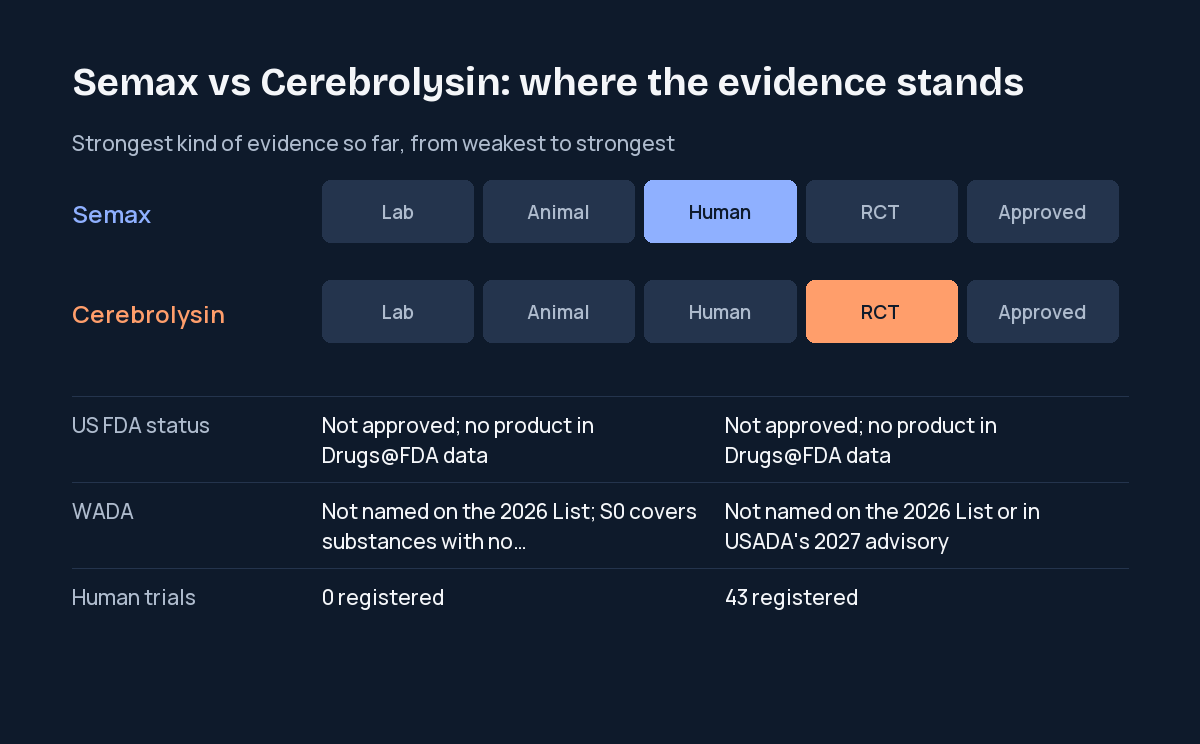
Semax is a Russian nasal peptide linked to faster functional recovery in a 110-patient stroke study (Gusev 2018). Cerebrolysin is a pig-brain peptide mixture with placebo-controlled stroke trials (Cochrane 2023). Neither is FDA approved. Cerebrolysin has far more human evidence, but a Cochrane review found little to no effect on survival after stroke.
| Item | Semax | Cerebrolysin |
|---|---|---|
| US FDA status | Not approved; no product in Drugs@FDA data (openFDA, searched 2026-11-08). A registered drug in Russia (FDA briefing) | Not approved; no product in Drugs@FDA data (openFDA, searched 2026-11-08). Used for stroke in Russia, Eastern Europe and China (Cochrane 2023) |
| Compounding (503A/503B) | Category 2 nomination withdrawn (FDA, updated 2026-04-22). PCAC voted 8–5 on 2026-07-24 to recommend 503A listing, as reported by trade press (FDA PCAC), after FDA staff proposed not listing it (FDA briefing); advisory, no FDA rule yet | Not on FDA’s Category 2 page (checked 2026-11-08); no PCAC review posted |
| WADA | Not named on the 2026 List; S0 covers substances with no government approval anywhere (WADA 2026). From 2027-01-01, S0 names “peptides” in general (USADA); status unclear | Not named on the 2026 List or in USADA’s 2027 advisory (checked 2026-11-08); status unclear, because it is approved in some countries |
| Strongest evidence | Human studies published in Russian (n=110 to 187) | Human RCTs and Cochrane reviews (up to n=1,070) |
| Human trials | 0 registered (ClinicalTrials.gov, 2026-11-08) | 43 registered (ClinicalTrials.gov, 2026-11-08) |
| Next regulatory step | None announced by FDA (checked 2026-11-08) | None announced |
| Last checked | 2026-11-08 | 2026-11-08 |
Key points:
- Semax is one defined seven-amino-acid peptide; Cerebrolysin is a mixture of many small peptides and amino acids.
- Semax is studied as nasal drops, while Cerebrolysin is given as a series of daily intravenous infusions.
- FDA’s own staff reviewed Semax in 2026 and proposed keeping it off the 503A list, citing insufficient evidence of effectiveness.
- A Cochrane review found a rise in non-fatal serious adverse events with Cerebrolysin after stroke (RR 2.39).
- No controlled human study of the two together was found on PubMed or ClinicalTrials.gov (searched 2026-11-08).
Semax vs Cerebrolysin at a glance
| Feature | Semax | Cerebrolysin |
|---|---|---|
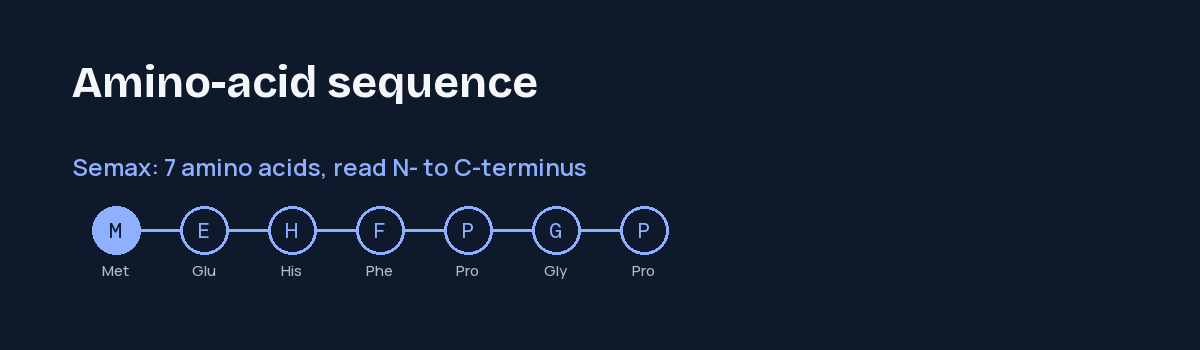
| What it is | Synthetic heptapeptide, Met-Glu-His-Phe-Pro-Gly-Pro | Mixture of low-molecular-weight peptides and amino acids from pig brain |
| Class | ACTH(4-10) analog | Neuropeptide preparation |
| Main mechanism studied | Raises BDNF and trkB in rat hippocampus | Trophic, nerve-growth-like activity in cell culture |
| Main research focus | Stroke and cerebrovascular disease | Stroke recovery, brain injury, dementia |
| Human evidence | Russian studies, n=110 to 187 | Placebo-controlled RCTs; 2 Cochrane reviews |
| Registered trials | 0 (ClinicalTrials.gov) | 43 (ClinicalTrials.gov) |
| US approval | None | None |
| Elsewhere | Registered drug in Russia | Approved for stroke in some countries |
| WADA | Not named; unclear | Not named; unclear |
| Routes studied | Intranasal | Intravenous infusion |
| Timelines in studies | BDNF stayed high over 5 months | Motor gains measured at day 90 |
| Main safety concerns | No human pharmacokinetic data; FDA immunogenicity and bleeding concerns | More non-fatal serious adverse events after stroke |
What is Semax?
Semax is a synthetic seven-amino-acid peptide, Met-Glu-His-Phe-Pro-Gly-Pro, built on a fragment of the hormone ACTH (adrenocorticotropic hormone) (Dolotov 2006). It is a registered drug in Russia, sold there as 0.1% and 1% nasal drops (FDA briefing document), and it is on Russia’s list of Vital and Essential Drugs (Radchenko 2025). FDA’s 2026 review found that its stroke studies are written in Russian (FDA briefing document). We compare it with its sister peptide on our Selank vs Semax comparison.
What is Cerebrolysin?
Cerebrolysin is a mixture of low-molecular-weight peptides and amino acids derived from pig brain, and it is widely used for acute ischemic stroke in Russia, Eastern Europe, China and other Asian countries (Cochrane 2023). A manufacturer-supported meta-analysis describes it as a neuropeptide preparation approved for the treatment of stroke (Guekht 2017). It is given as a series of daily intravenous infusions (Cochrane 2019). Unlike Semax, it has been tested in multinational placebo-controlled trials, several of them supported by its manufacturer.
How they work differently
- Semax: a single dose raised BDNF (brain-derived neurotrophic factor, a protein that supports nerve cells) 1.4-fold and its receptor trkB activation 1.6-fold in rat hippocampus, and treated rats learned an avoidance task better [Animal] (Dolotov 2006).
- Cerebrolysin: in rat PC12 cells, a lab model of nerve cells, it cut the share of dying cells from 32% to 10% and triggered growth of cell processes within 24 hours [Lab] (Safarova 2002).
- Semax: in the same cell test it had no such trophic effect, so the authors concluded its protective effects run through other mechanisms [Lab] (Safarova 2002).
- Cerebrolysin: because it is a mixture, no single receptor explains it; the Cochrane authors describe only “potential neuroprotective properties” (Cochrane 2023).
Evidence head-to-head: Semax vs Cerebrolysin
No study has compared Semax with Cerebrolysin in people (PubMed, searched 2026-11-08). The figures below come from separate studies, so any comparison between the columns is cross-trial.
| Outcome | Semax best evidence | Cerebrolysin best evidence |
|---|---|---|
| Recovery after stroke | Human controlled, n=110: faster Barthel-index recovery and higher BDNF (Gusev 2018) | Human RCT meta-analysis, n=442: better arm function at day 90 (Guekht 2017) |
| Acute stroke outcome | Human controlled, 30 vs 80 patients: “some influence” on motor recovery speed (Gusev 1997) | Human RCT, n=1,070: no difference on the primary end point (Heiss 2012) |
| Death after stroke | No study found (PubMed, 2026-11-08) | Cochrane, 6 RCTs incl. one of Cortexin, n=1,689: RR 0.96, no difference (Cochrane 2023) |
| Cerebrovascular disease | Human, n=187: fewer strokes and transient attacks reported (Gusev 2005) | Cochrane, vascular dementia, n=420: SMD 0.36, very low quality (Cochrane 2019) |
| Brain injury | No study found (PubMed, 2026-11-08) | Human RCT meta-analysis, n=185: small-to-medium benefit at day 90 (Vester 2021) |
| Alzheimer’s disease | Animal: better memory tests, fewer amyloid deposits in mice (Radchenko 2025) | Human RCT meta-analysis, 6 trials: cognitive gain at 4 weeks, not at 6 months (Gauthier 2015) |
| Healthy people | Human reports, 33 to 47 healthy adults in total, mostly without safety data (FDA briefing) | Human RCT, n=48 healthy men: placebo’s early dip in word recall not seen (Funke 1998) |
The most encouraging Cerebrolysin result is the CARS trial, where 21 days of infusions plus rehabilitation gave what its authors called a “large superiority” over placebo in arm function at day 90 [Human RCT] (Muresanu 2016). The authors called that trial exploratory and asked for a larger one. A 2021 European neurology guideline recommends Cerebrolysin for early rehabilitation after ischemic stroke (Beghi 2021). Semax’s strongest result is the 110-patient study, where treated patients recovered daily-living function faster [Human, controlled, n=110] (Gusev 2018). FDA reviewers set the Russian-language stroke papers aside because no English translations were available (FDA briefing document).
Which fits which goal?
- Stroke rehabilitation: Cerebrolysin has more evidence, from double-blind trials pooled across 442 patients (Guekht 2017). Semax has smaller Russian studies whose design is not fully described.
- Survival after stroke: neither has shown a benefit; Cochrane found Cerebrolysin made little to no difference to death (Cochrane 2023).
- Brain injury and dementia: Cerebrolysin has more evidence, though Cochrane rates the dementia data very low quality (Cochrane 2019). For Semax, the Alzheimer’s evidence found here comes from mice.
- Focus and memory in healthy people: neither has strong data. Cerebrolysin has one small 1998 trial in healthy men, and FDA counted only 33 to 47 healthy adults given Semax across published reports (FDA briefing document).
- ADHD: a 2026 Russian expert council put both in its “limited evidence base” group (Lapochkin 2026).
These are statements about evidence, not advice. A clinician is the person to decide whether either fits a given case.
Can Semax and Cerebrolysin be combined?
The two appear together in a 2002 cell-culture study, which tested each separately and found that only Cerebrolysin had a trophic effect [Lab] (Safarova 2002). A 2026 Russian expert council listed both as separate add-on options for ADHD but did not assess them together (Lapochkin 2026). No controlled human study of the combination was found on PubMed or ClinicalTrials.gov (searched 2026-11-08), so the safety of using both is unknown.
Safety and regulatory status
United States
Neither product is FDA approved; neither appears in Drugs@FDA data (openFDA, searched 2026-11-08). For Semax, FDA lists a possible immunogenicity risk, meaning unwanted immune reactions from aggregates and impurities (FDA Category 2 page). FDA staff found no human pharmacokinetic studies and one FAERS report, from a consumer hospitalized with eye pain after nasal drops bought online (FDA briefing document). The same review flags possible bleeding risk and, in mice, a boost to amphetamine-driven dopamine release. Staff proposed keeping Semax off the 503A list; the advisory committee then voted 8–5 for listing, as reported by trade press (FDA PCAC). Our guide to the FDA compounding vote explains what that does and does not change.
Side effects in studies
For Cerebrolysin after stroke, Cochrane found more people with non-fatal serious adverse events (RR 2.39, 95% CI 1.10 to 5.23; 3 trials, 1,335 people), with no difference in total serious events (Cochrane 2023). In healthy men, the highest dose caused mild overdose signs and a small fall in blood pressure (Funke 1998). For Semax, a Russian study of 73 patients recorded episodes of paroxysmal (sudden-burst) EEG activity in some cases after Semax injection (Alekseeva 1999).
Sport
Neither is named on the WADA 2026 List. Its S0 class covers substances with no approval by any government health authority (WADA 2026). Both have approval somewhere, so the wording does not settle their status. A 2025 anti-doping review rated Semax “unclear”, noting its likeness to tetracosactide, a prohibited S2 hormone (Biology of Sport 2025). From 2027-01-01, S0 names “peptides” in general, and USADA warns that an unnamed peptide “may still be prohibited” (USADA). USADA explains the non-approved class in its #AskUSADA guide.
Anyone who suspects a side effect from Semax, Cerebrolysin or any other drug or product can report it to the FDA through MedWatch.
How long do effects take in studies?
- Semax: after stroke, plasma BDNF rose quickly and stayed high across the 5-month observation (Gusev 2018).
- Cerebrolysin, stroke: early neurological gains were measurable at days 14 and 21, and arm-function gains at day 90 (Guekht 2017).
- Cerebrolysin, healthy men: brain-wave changes began 15 minutes after an infusion, peaked at 2 hours and lasted to 8 hours (Funke 1998).
- Cerebrolysin, Alzheimer’s: the cognitive gain seen at 4 weeks was no longer statistically significant at 6 months (p = 0.1710) (Gauthier 2015).
What users report
What follows are unverified self-reports from people who usually bought unregulated products; they are not evidence. People who post about Semax commonly describe sharper focus, more mental energy and better mood, often within the first days, and many pair it with Selank. People who post about Cerebrolysin more often write about recovery after a head injury or stroke, or about long-term memory complaints, and many say it was given to them by a doctor outside the US. Recurring complaints for Semax are headaches, irritability, anxiety, restless sleep and a nasal sting; some say they noticed nothing at all. For Cerebrolysin, people mention dizziness, headaches, feeling agitated, the burden of repeated injections and doubts about whether imported products are genuine. Threads often argue over whether the effects are placebo, whether Semax’s and Cerebrolysin’s effects overlap, and whether either is worth the risk without medical supervision.
Frequently asked questions
Is Semax or Cerebrolysin better for the brain?
Cerebrolysin has more evidence, though not proof of benefit. Its double-blind stroke trials, pooled across 442 patients, showed better arm function at day 90, while a 1,070-patient trial missed its main goal (Heiss 2012). Semax’s best data are smaller Russian studies. The figures come from separate trials, so the comparison is cross-trial.
Can Semax and Cerebrolysin be used together?
No controlled human study of the combination was found on PubMed or ClinicalTrials.gov (searched 2026-11-08). The only paper testing both is a 2002 cell-culture study that examined each one separately and found a trophic effect for Cerebrolysin alone (Safarova 2002). How the two interact in people is unknown.
Does Cerebrolysin increase IQ?
No study measuring IQ was found on PubMed (searched 2026-11-08). In a 48-man placebo-controlled trial, healthy volunteers on Cerebrolysin did not show the dip in word recall that the placebo group had over the first 4 hours (Funke 1998). That is a short-term memory test, not intelligence, and it has not been repeated in a larger trial.
What is the main difference between Semax and Selank?
Semax is built on a fragment of the hormone ACTH and studied mainly in stroke, while Selank was tested for anxiety, matching the benzodiazepine medazepam in a 62-patient study (Zozulia 2008). FDA flagged both for possible immunogenicity when their nominators withdrew them from Category 2 (FDA). Our anxiety peptides roundup ranks Selank’s evidence.
Are Semax and Cerebrolysin banned in sports?
Neither is named on WADA’s 2026 List, but that does not mean they are permitted. Both are approved in some countries, which makes the S0 wording unclear, and from 2027-01-01 S0 names “peptides” in general (USADA). Athletes need an answer from their anti-doping agency before using either.
References
- Gusev EI, et al. 2018. The efficacy of semax in the treatment of patients at different stages of ischemic stroke. Zh Nevrol Psikhiatr Im S S Korsakova. PMID 29798983
- Ziganshina LE, et al. 2023. Cerebrolysin for acute ischaemic stroke. Cochrane Database Syst Rev. PMID 37818733
- US FDA. 2026. Briefing document: Semax-related bulk drug substances, Pharmacy Compounding Advisory Committee, July 23–24, 2026. fda.gov
- US FDA. Certain bulk drug substances for use in compounding that may present significant safety risks (content current as of 2026-04-22). fda.gov
- US FDA. July 23–24, 2026: Meeting of the Pharmacy Compounding Advisory Committee. fda.gov
- World Anti-Doping Agency. 2026 Prohibited List. wada-ama.org
- USADA. Athlete advisory: 2027 Prohibited List. usada.org
- USADA. #AskUSADA: What is a non-approved substance and why are they prohibited? usada.org
- ClinicalTrials.gov. Search: semax (searched 2026-11-08). clinicaltrials.gov
- ClinicalTrials.gov. Search: cerebrolysin (searched 2026-11-08). clinicaltrials.gov
- Dolotov OV, et al. 2006. Semax, an analog of ACTH(4-10) with cognitive effects, regulates BDNF and trkB expression in the rat hippocampus. Brain Res. PMID 16996037
- Radchenko AI, et al. 2025. The potential of the peptide drug Semax and its derivative for correcting pathological impairments in the animal model of Alzheimer’s disease. Acta Naturae. PMC12755871
- Guekht A, et al. 2017. Safety and efficacy of Cerebrolysin in motor function recovery after stroke: a meta-analysis of the CARS trials. Neurol Sci. PMID 28707130
- Cui S, et al. 2019. Cerebrolysin for vascular dementia. Cochrane Database Syst Rev. PMID 31710397
- Safarova ER, et al. 2002. Trophic effects of nootropic peptide preparations cerebrolysin and semax on cultured rat pheochromocytoma. Bull Exp Biol Med. PMID 12124658
- Gusev EI, et al. 1997. Effectiveness of semax in acute period of hemispheric ischemic stroke. Zh Nevrol Psikhiatr Im S S Korsakova. PMID 11517472
- Heiss WD, et al. 2012. Cerebrolysin in patients with acute ischemic stroke in Asia: results of a double-blind, placebo-controlled randomized trial. Stroke. PMID 22282884
- Gusev EI, et al. 2005. Semax in prevention of disease progress and development of exacerbations in patients with cerebrovascular insufficiency. Zh Nevrol Psikhiatr Im S S Korsakova. PMID 15792140
- Vester JC, et al. 2021. Cerebrolysin after moderate to severe traumatic brain injury: prospective meta-analysis of the CAPTAIN trial series. Neurol Sci. PMID 33620612
- Gauthier S, et al. 2015. Cerebrolysin in mild-to-moderate Alzheimer’s disease: a meta-analysis of randomized controlled clinical trials. Dement Geriatr Cogn Disord. PMID 25832905
- Funke M, et al. 1998. Dose-dependent effects of Cerebrolysin on EEG and short-term memory of healthy volunteers. J Neural Transm Suppl. PMID 9700674
- Muresanu DF, et al. 2016. Cerebrolysin and Recovery After Stroke (CARS): a randomized, placebo-controlled, double-blind, multicenter trial. Stroke. PMID 26564102
- Beghi E, et al. 2021. EAN and EFNR guideline on pharmacological support in early motor rehabilitation after acute ischaemic stroke. Eur J Neurol. PMID 34152062
- Lapochkin OL, et al. 2026. Expert Council resolution: adjunctive pharmacotherapy for hyperkinetic disorders (ADHD) in children and adolescents. Zh Nevrol Psikhiatr Im S S Korsakova. PMID 42910684
- Alekseeva GV, et al. 1999. Use of semax at a follow-up of patients with posthypoxic encephalopathy. Anesteziol Reanimatol. PMID 10199046
- Zozulia AA, et al. 2008. Efficacy and possible mechanisms of action of a new peptide anxiolytic selank in the therapy of generalized anxiety disorders and neurasthenia. Zh Nevrol Psikhiatr Im S S Korsakova. PMID 18454096
- Pokrywka A, et al. 2025. “Brain doping” substances: prohibited or not in sports? Biol Sport. PMC12492343
Change log
2026-11-08: first published after review by the editorial team.