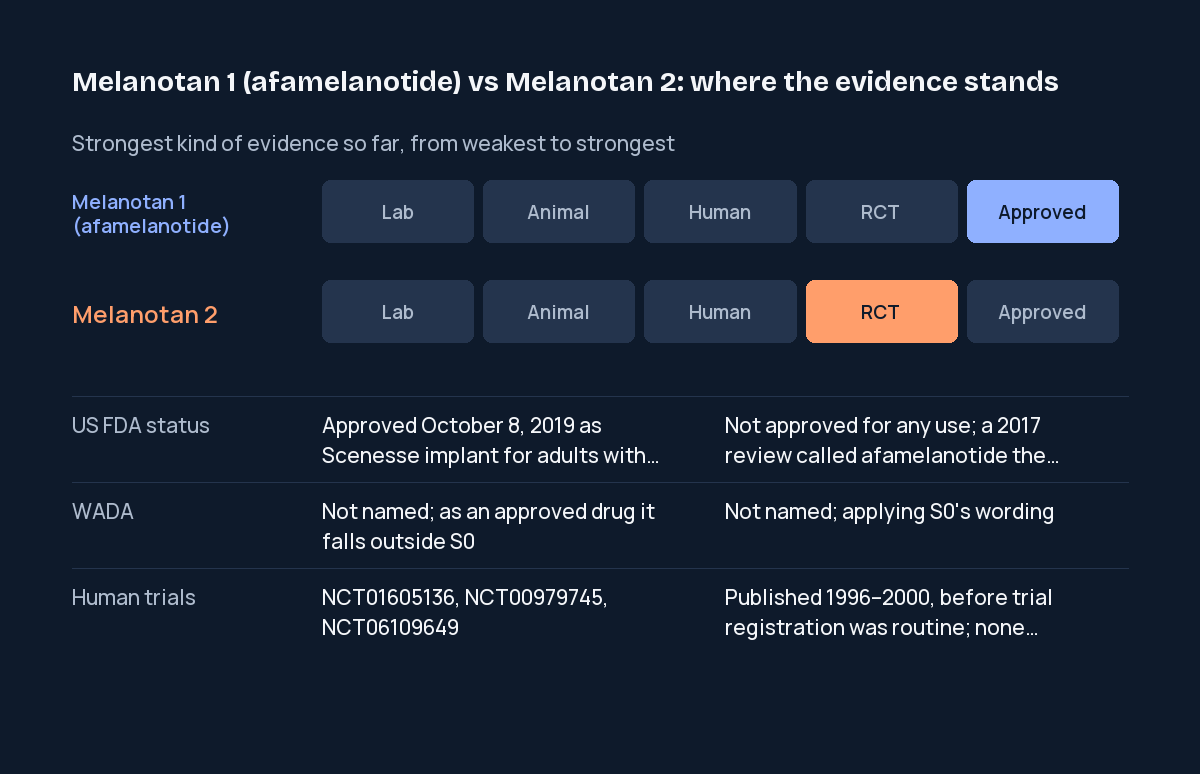
Verdict: Melanotan 1 is afamelanotide, an FDA- and EMA-approved implant (Scenesse) for the light-sensitivity disorder erythropoietic protoporphyria. Melanotan 2 is unapproved anywhere we checked; its human evidence is three small trials published 1996–2000 plus case reports of serious harm.
Melanotan 1 (MT-1) has the stronger record by a wide margin. Two randomized, placebo-controlled phase 3 trials showed that afamelanotide implants increased pain-free time in sunlight for people with erythropoietic protoporphyria (EPP) [Human RCT, n=74 and n=94] (Langendonk 2015), and the FDA approved it in October 2019 (FDA approval letter). Melanotan 2 (MT-II) triggered erections in small trials [Human RCT, n=10] (Wessells 1998), but it was never approved, and the FDA notes published case reports of melanoma, a brain-swelling syndrome and priapism (FDA). Neither is approved for cosmetic tanning.
| Item | Melanotan 1 (afamelanotide) | Melanotan 2 |
|---|---|---|
| US FDA status | Approved October 8, 2019 as Scenesse implant for adults with phototoxic reactions from EPP (FDA); not approved for tanning | Not approved for any use; a 2017 review called afamelanotide the only approved alpha-MSH analogue at the time (Habbema 2017) |
| Compounding (503A/503B) | Approved product; not on FDA’s Category 2 safety-risk list | Was in Category 2; now listed as “nominated but withdrawn”, with FDA’s safety concerns still posted (FDA); no next step announced |
| EU | Authorised December 22, 2014, under exceptional circumstances (EMA) | Not authorised |
| WADA 2026 | Not named; as an approved drug it falls outside S0 (WADA 2026 List) | Not named; applying S0’s wording (substances with no current regulatory approval are banned at all times), it would fall under S0, as we found no approval for it |
| Strongest evidence | Approved label; two phase 3 RCTs | Small crossover RCTs (n=10 each); case reports of harm |
| Human trials | NCT01605136, NCT00979745, NCT06109649 (vitiligo, running) | Published 1996–2000, before trial registration was routine; none completed on ClinicalTrials.gov |
| Next regulatory step | None announced in the sources checked; the vitiligo phase 3 trial (NCT06109649) passed its estimated primary completion (December 2025) with no results posted | None announced |
| Last checked | 2026-10-04 | 2026-10-04 |
What changed (October 2026): Clinuvel’s July 2026 update on afamelanotide’s vitiligo trials (210 patients enrolled, results expected in December 2026) is added, and the sport section covers the 2027 WADA List.
Key points:
- Afamelanotide and Melanotan 1 are the same molecule: a 13-amino-acid copy of the skin-darkening hormone alpha-MSH with two substitutions (Chawathe 2026).
- Melanotan 2 is a shorter, ring-shaped peptide that switches on several melanocortin receptors, not mainly the skin one (Wessells 2000 review).
- Even the approved drug can darken existing moles and freckles; its label recommends a full-body skin check twice a year (Scenesse label).
- Melanotan II vials bought online held less drug than labeled, and vials from two of three shops carried 4.1–5.9% unknown impurities (Breindahl 2015).
- No study has tested the two together.
Melanotan 1 vs Melanotan 2 at a glance
| Feature | Melanotan 1 | Melanotan 2 |
|---|---|---|
| What it is | Afamelanotide, a linear 13-amino-acid alpha-MSH analogue | A cyclic 7-amino-acid alpha-MSH analogue |
| Brand | Scenesse (Clinuvel) | None |
| Main receptor | Binds mainly MC1R, the pigment receptor on skin cells | Non-selective: several melanocortin receptors, including brain ones |
| Main research focus | Light-sensitivity disorders (EPP, vitiligo, polymorphic light eruption) | Tanning, then erectile dysfunction |
| Best human evidence | Two phase 3 RCTs in EPP (NEJM 2015) | Two crossover RCTs in erectile dysfunction, n=10 each (Urology 2000) |
| Approval | FDA (2019), EU (2014), for EPP only | None |
| WADA | Not named on the List | Not named; falls under S0 by that class’s wording (non-approved substances) |
| Route studied | Under the skin (injection, then a slow-release implant) | Under the skin (injection) |
| Tanning onset in studies | Peak 1–3 weeks after a course ended | Visible 1 week after dosing ended (n=3) |
| Main safety concerns | Nausea, implant-site reactions, darker moles, rare anaphylaxis | Nausea, spontaneous erections, priapism, mole changes, melanoma case reports |
| Product quality | Regulated, made to approved standards | Unregulated; dose and purity unreliable |
What is Melanotan 1?
Melanotan 1 was built at the University of Arizona as a longer-lasting copy of alpha-melanocyte-stimulating hormone (alpha-MSH), the hormone that tells skin cells to make the dark pigment eumelanin (Hadley and Dorr 2006). Under the name afamelanotide it became the first alpha-MSH analogue given to human volunteers (Minder 2017). Today it is sold as Scenesse, a small dissolving rod placed under the skin by a trained health professional. In the US it is approved to increase pain-free light exposure in adults with a history of phototoxic reactions from EPP, a rare inherited condition in which light on the skin causes severe pain (Scenesse label). It is not approved for cosmetic tanning.
What is Melanotan 2?
Melanotan 2 came from the same Arizona group: a truncated, ring-shaped (cyclic) peptide that was tested for tanning and then for erectile dysfunction (Hadley and Dorr 2006). Its sexual effects were found by accident during the tanning studies (Hadley 2005). A Melanotan 2 analogue, PT-141, was then being readied for phase 3 trials (Hadley and Dorr 2006); as bremelanotide, the FDA approved it in 2019 as Vyleesi for low sexual desire in premenopausal women (Vyleesi label). Melanotan 2 itself was never approved; what circulates under that name is sold online, in gyms and in tanning salons (Langan 2010).
How they work differently
- Melanotan 1: binds mainly the melanocortin-1 receptor (MC1R) on pigment cells and raises eumelanin production without sunlight [Approved label] (Scenesse label). Melanotan 2: a non-selective melanocortin agonist (Wessells 2000) whose sexual effects arise in the brain (Hadley 2005).
- Melanotan 1: in seven volunteers, forearm eumelanin rose 98% a week after injections ended, while the reddish pigment pheomelanin did not change [Human, n=7] (Dorr 2000). Melanotan 2: two of three volunteers developed darker skin on the face, upper body and buttock [Human, n=3] (Dorr 1996).
- Melanotan 1: side effects in an early volunteer study were limited to occasional stomach upset and facial flushing [Human, n=3] (Ugwu 1997). Melanotan 2: the brain effects show up as yawning, stretching, nausea and spontaneous erections lasting 1–5 hours after a dose (Dorr 1996).
Vyleesi, an approved relative of Melanotan 2, illustrates the broader receptor profile: its label lists MC1R and MC4R activity, nausea in 40% of users and patchy skin darkening (Vyleesi label).
Evidence head-to-head
| Outcome | Melanotan 1 best evidence | Melanotan 2 best evidence |
|---|---|---|
| Tanning in healthy people | Human RCT, n=28: darkening in both skin-type groups studied (I–II and III–IV), none on placebo (JAMA 1991) | Human pilot, n=3: darker skin in 2 of 3 (Life Sci 1996) |
| Sunburn protection | Human phase 1, n=8: 47% fewer sunburn cells (Arch Dermatol 2004) | No human data |
| Pain-free sun time in EPP | Human RCTs, n=74 and n=94; approved label (NEJM 2015) | No human data |
| Vitiligo repigmentation | Human RCT, n=55: 48.64% vs 33.26% with light therapy alone (JAMA Dermatol 2015) | No published human data |
| Erections | No human data | Human crossover RCT, n=10: erections in 8 of 10 (J Urol 1998) |
| Sexual desire | No human data | Human crossover RCTs, n=20: higher desire after 68% of doses vs 19% placebo (IJIR 2000) |
| Long-term safety | Label safety pool of 244 adults; up to 8 years of use reported in EPP (review) | No controlled data; case reports only |
The EPP trials are the most encouraging data for either peptide. In the US trial, people on afamelanotide had a median of 69.4 pain-free hours in direct sunlight over six months versus 40.8 hours on placebo; in the European trial, phototoxic reactions fell from 146 to 77 [Human RCT] (Langendonk 2015). The trials were funded by the manufacturer, and the EMA authorised the drug under exceptional circumstances because complete benefit data could not be collected in such a rare disease (EMA). The Melanotan 2 trials are small and short; the second crossover study, in men with organic-risk erectile dysfunction, found erections after 12 of 19 injections versus 1 of 21 placebo doses [Human RCT, n=10] (Wessells 2000). How we grade these levels is explained in how we compare peptides.
Vitiligo is afamelanotide’s next possible use. In a filing dated 2026-07-28, Clinuvel reported that its phase 3 trial CUV105 had enrolled 210 patients worldwide, comparing SCENESSE plus narrowband UVB light with the light alone over 20 weeks, with the share of patients reaching 50% repigmentation (T-VASI50) as the main end point; it expects topline results in December 2026. A second trial, CUV107, in 300 patients with darker skin (Fitzpatrick types IV to VI), is expected to start in November 2026 (Clinuvel, SEC Form 6-K). As of 2026-10-27, afamelanotide is not approved for vitiligo in the US or the EU, and these are company statements, not results.
Which fits which goal?
- Melanotan 1 has more evidence for protecting people with EPP from light-triggered pain [Approved label], for darkening skin without UV exposure [Human RCT, n=28] (Levine 1991), and for speeding repigmentation in vitiligo alongside light therapy [Human RCT, n=55] (Lim 2015).
- Melanotan 2 has more evidence for triggering erections in men with erectile dysfunction, from two crossover trials of 10 men each [Human RCT] (Wessells 2000). The analogue taken forward for commercial development was PT-141, not Melanotan 2 (Hadley and Dorr 2006).
- Cosmetic tanning: neither has an approval for it. Melanotan 1 has the cleaner tanning data, but only in supervised studies with pharmaceutical-grade product.
These are statements about evidence, not recommendations. A clinician who knows the person’s history and skin is the one to decide whether any treatment is appropriate; this page is general information, as set out in the medical disclaimer.
Can they be combined?
No controlled human study has tested the combination, so nothing is known about whether taking both changes either peptide’s effects or risks. Every published Melanotan 2 trial tested it alone (Wessells 2000), as did the afamelanotide trials behind its approval (Langendonk 2015). A review of unregulated use found that case reports of new and changing moles involve both melanotan I and II products (Habbema 2017).
Safety and regulatory status
Melanotan 1 (Scenesse)
In three placebo-controlled trials of 244 adults with EPP, the most common side effects were implant-site reactions (21% vs 10% on placebo) and nausea (19% vs 14%); skin darkening (4% vs 0%) and new moles (4% vs 2%) were also more frequent [Approved label] (Scenesse label). Serious allergic reactions, including anaphylaxis, have been reported since approval. Safety in children and in pregnancy has not been established, and no carcinogenicity studies were run. A review of afamelanotide reported no late effects in volunteers followed 25 years after first exposure (Minder 2017).
Melanotan 2
Melanotan 2 has no controlled long-term safety data. In one erectile dysfunction trial, severe nausea followed 4 of 19 injections [Human RCT, n=10] (Wessells 2000). Case reports describe:
- new moles and darkening of existing ones within 24 hours of a single injection (Schulze 2014);
- melanoma arising from existing moles during or shortly after melanotan use, in four reports, without proof of cause (Habbema 2017);
- muscle breakdown (rhabdomyolysis) and kidney dysfunction after an internet-bought injection, confirmed as Melanotan 2 by lab testing (Nelson 2012), and a kidney infarction most likely linked to it (Peters 2020);
- priapism, a painful erection that will not subside, needing surgery in one case (Mallory 2021) and leaving erectile function unrecovered at four weeks in another (Dreyer 2019).
A systematic review of sudden-onset moles grouped melanotan with immunosuppressants and chemotherapy as suspected causes in 41% of 179 cases; 16% of cases had at least one abnormal (dysplastic) mole (Burian 2019).
By jurisdiction
- United States: afamelanotide is approved only as Scenesse for EPP (FDA). Melanotan 2 has no approval; the FDA’s compounding page cites immunogenicity risk and case reports of melanoma, encephalopathy, sympathomimetic toxicity and priapism (FDA).
- European Union: Scenesse is authorised for preventing phototoxicity in adults with EPP and is prescribed only in specialist centres (EMA).
- United Kingdom: the MHRA has raised the risk of blood-borne infection from needle sharing and the potential impurity of unlicensed melanotan products (Langan 2010).
- Sport: the 2026 WADA List names neither peptide. Its S0 class bans at all times any substance with no current regulatory approval for human use; applying that wording, Melanotan 2, which has no approval we could find, would fall under S0 (WADA). The 2027 List, in force from 2027-01-01, also names “peptides” in general in S0 (USADA athlete advisory); Melanotan 2 is still not named.
For the wider picture on unapproved peptides, see are peptides safe?
How long do effects take in studies?
- Melanotan 1, tanning: darkening peaked 1 to 3 weeks after a 12-day course ended [Human RCT, n=28] (Levine 1991), and was still visible 3 weeks after the last dose in a small study [Human, n=3] (Ugwu 1997). Combined with sunlight, the tan lasted at least 3 weeks longer than sun alone [Human, n=8] (Dorr 2004).
- Melanotan 1, EPP: the benefits were measured over 6 and 9 months (Langendonk 2015).
- Melanotan 1, vitiligo: facial repigmentation was reached at 41 days versus 61 days with light therapy alone [Human RCT, n=55] (Lim 2015).
- Melanotan 2: erections came within hours of a dose; skin darkening was measured 1 week after dosing ended [Human, n=3] (Dorr 1996).
What users report
What follows are unverified self-reports from people who usually bought unregulated products, and they are not evidence. People who post about Melanotan 2 on forums and social media most often describe a fast, deep tan, especially when combined with sunbeds, and many mention nausea, facial flushing and unexpected erections or a raised libido early on. A recurring complaint is new or darker freckles and moles, and some posters describe worry about melanoma or dermatologist visits that followed. Others report appetite loss, yawning and a darkening of the lips or gums. Posts about Melanotan 1 are fewer; people describe a slower, milder tan with fewer side effects, and some argue it is “the safer one” because a drug version is approved, a point others dispute because online products are not that drug. Recurring arguments concern product quality, mislabeled vials, and whether tanning “without the sun” is real when most users still tan under UV.
Frequently asked questions
What is the difference between Melanotan 1 and Melanotan 2?
Melanotan 1 is afamelanotide, a linear peptide that mainly targets the skin’s pigment receptor and is approved as Scenesse for a rare light-sensitivity disorder. Melanotan 2 is a shorter, ring-shaped peptide that also acts on brain receptors, which is why it causes erections and nausea (Hadley and Dorr 2006). Melanotan 2 has never been approved.
Is Melanotan 1 FDA approved?
Yes, but only in one form and for one use. The FDA approved afamelanotide as the Scenesse implant on October 8, 2019, to increase pain-free light exposure in adults with a history of phototoxic reactions from erythropoietic protoporphyria (FDA). It is not approved for cosmetic tanning, and online products sold as Melanotan 1 are not Scenesse.
Is Melanotan 2 safe?
Its safety has never been shown. Only three small trials were published. The FDA notes case reports of melanoma, a brain-swelling syndrome, sympathomimetic toxicity and priapism, and warns of immune reactions from impurities (FDA). Lab tests of vials sold online found less drug than labeled.
Does Melanotan cause moles or melanoma?
Both melanotans can darken moles, and even the approved drug’s label recommends twice-yearly skin checks. With unregulated products, case reports describe sudden new moles and four melanomas arising from existing moles, although no study has proven that melanotan causes melanoma (Habbema 2017).
Is Melanotan banned in sport?
The WADA List does not name Melanotan 2, but its S0 class bans at all times any substance without current regulatory approval for human use, and from 2027-01-01 S0 also names “peptides” in general (USADA). We found no approval for Melanotan 2 anywhere, so that wording would make it prohibited (WADA 2026 List). Afamelanotide is approved, so S0 does not cover it.
References
- US Food and Drug Administration. 2019. NDA 210797 approval letter, Scenesse (afamelanotide) implant. accessdata.fda.gov
- Clinuvel Inc. Scenesse (afamelanotide) implant, US prescribing information (DailyMed, 2026). dailymed.nlm.nih.gov
- European Medicines Agency. Scenesse: EPAR. ema.europa.eu
- US Food and Drug Administration. Certain bulk drug substances for use in compounding that may present significant safety risks (content current as of April 22, 2026). fda.gov
- World Anti-Doping Agency. 2026 Prohibited List. wada-ama.org
- Cosette Pharmaceuticals. Vyleesi (bremelanotide) injection, US prescribing information (DailyMed). dailymed.nlm.nih.gov
- Langendonk JG, et al. 2015. Afamelanotide for erythropoietic protoporphyria. N Engl J Med. PMID 26132941
- Levine N, et al. 1991. Induction of skin tanning by subcutaneous administration of a potent synthetic melanotropin. JAMA. PMID 1658407
- Ugwu SO, et al. 1997. Skin pigmentation and pharmacokinetics of melanotan-I in humans. Biopharm Drug Dispos. PMID 9113347
- Dorr RT, et al. 2000. Increased eumelanin expression and tanning is induced by a superpotent melanotropin in humans. Photochem Photobiol. PMID 11045725
- Dorr RT, et al. 2004. Effects of a superpotent melanotropic peptide in combination with solar UV radiation on tanning of the skin. Arch Dermatol. PMID 15262693
- Lim HW, et al. 2015. Afamelanotide and narrowband UV-B phototherapy for the treatment of vitiligo. JAMA Dermatol. PMID 25230094
- Minder EI, et al. 2017. Pharmacokinetics and pharmacodynamics of afamelanotide and its clinical use in treating dermatologic disorders. Clin Pharmacokinet. PMID 28063031
- Chawathe A, Sharma N. 2026. Investigation of the stability profile of therapeutic α-MSH analogue afamelanotide. J Pharm Biomed Anal. PMID 41547183
- Hadley ME, Dorr RT. 2006. Melanocortin peptide therapeutics: historical milestones, clinical studies and commercialization. Peptides. PMID 16412534
- Hadley ME. 2005. Discovery that a melanocortin regulates sexual functions in male and female humans. Peptides. PMID 15996790
- Dorr RT, et al. 1996. Evaluation of melanotan-II, a superpotent cyclic melanotropic peptide in a pilot phase-I clinical study. Life Sci. PMID 8637402
- Wessells H, et al. 1998. Synthetic melanotropic peptide initiates erections in men with psychogenic erectile dysfunction. J Urol. PMID 9679884
- Wessells H, et al. 2000. Effect of an alpha-melanocyte stimulating hormone analog on penile erection and sexual desire in men with organic erectile dysfunction. Urology. PMID 11018622
- Wessells H, et al. 2000. Melanocortin receptor agonists, penile erection, and sexual motivation: human studies with Melanotan II. Int J Impot Res. PMID 11035391
- Habbema L, et al. 2017. Risks of unregulated use of alpha-melanocyte-stimulating hormone analogues: a review. Int J Dermatol. PMID 28266027
- Burian EA, Jemec GBE. 2019. Eruptive melanocytic nevi: a review. Am J Clin Dermatol. PMID 31119650
- Schulze F, et al. 2014. Eruptive naevi and darkening of pre-existing naevi 24 h after a single mono-dose injection of melanotan II. Eur J Dermatol. PMID 24334249
- Nelson ME, et al. 2012. Melanotan II injection resulting in systemic toxicity and rhabdomyolysis. Clin Toxicol. PMID 23121206
- Peters B, et al. 2020. Melanotan II: a possible cause of renal infarction. CEN Case Rep. PMID 31953620
- Mallory CW, et al. 2021. Melanotan tanning injection: a rare cause of priapism. Sex Med. PMID 33460908
- Dreyer BA, et al. 2019. Melanotan-induced priapism: a hard-earned tan. BMJ Case Rep. PMID 30796078
- Breindahl T, et al. 2015. Identification and characterization by LC-UV-MS/MS of melanotan II skin-tanning products sold illegally on the Internet. Drug Test Anal. PMID 24771717
- Langan EA, et al. 2010. Melanotropic peptides: more than just ‘Barbie drugs’ and ‘sun-tan jabs’? Br J Dermatol. PMID 20545686
- ClinicalTrials.gov. Phase III confirmatory study in EPP (CUV039). NCT01605136
- ClinicalTrials.gov. Phase III confirmatory study in EPP (CUV029). NCT00979745
- ClinicalTrials.gov. Scenesse plus NB-UVB vs NB-UVB alone in vitiligo (CUV105). NCT06109649
- CLINUVEL PHARMACEUTICALS LTD. Form 6-K, Exhibit 99.1: Update: SCENESSE in vitiligo (2026-07-28). SEC. sec.gov
- USADA. Athlete advisory: 2027 Prohibited List (2026-10-06). usada.org
Change log
2026-10-27: Clinuvel’s July 2026 vitiligo trial update added (CUV105 enrolment and timing, CUV107); 2027 WADA List added; reviewed by the editorial team.
2026-10-14: links to related entries added; no change to the facts.
2026-10-13: links corrected (a link inside a citation or on a generic word removed); no change to the facts.
2026-10-12: links to related entries added; no change to the facts.
2026-10-08: first published after review by the editorial team.